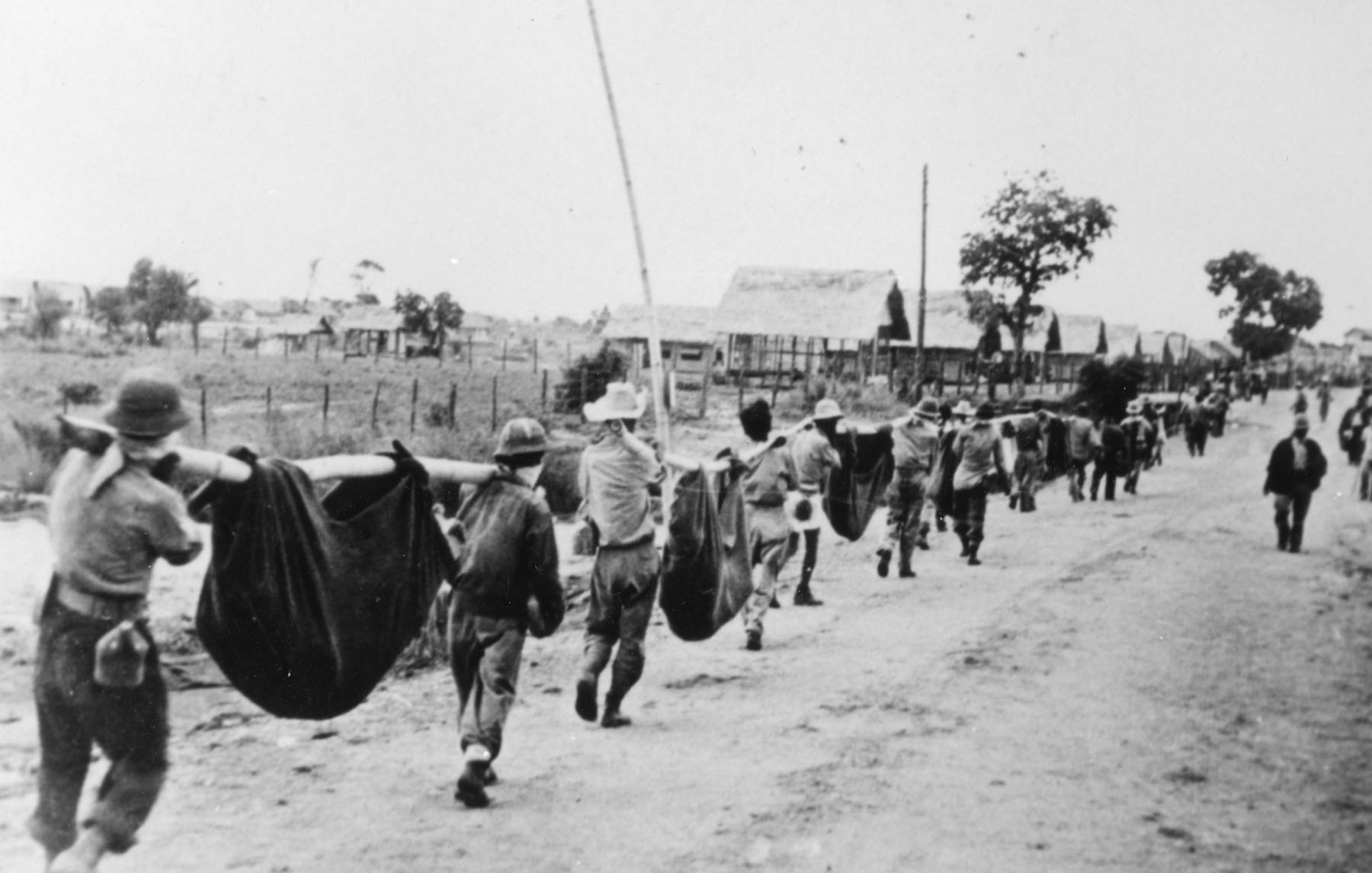
A burial detail carries the remains of POWs who survived the Death March, but who later succumbed to exhaustion, disease, or execution after reaching Camp O’Donnell. (U.S. Air Force photo).
The Bataan Death March began on April 9, 1942, following the three month battle of Bataan during World War II. It was the transfer of Filipino and American prisoners of war by the Imperial Japanese Army. This march was the worst atrocity on United States soldiers during the Second World War. This was because of its wide-ranging physical abuse and murder. During the march there was a very high fatality rate inflicted by the Japanese Army upon prisoners and civilians alike.
On December 7, 1941 the Japanese bombed Pearl Harbor, declaring war on the United States of America. On the 8th they launched a full scale assault on the American bases in the Philippian Islands. During the first day of the Japanese attack on the Philippian Islands, most of the American aircrafts got caught on the ground and were destroyed. Inside of a week, the Naval Yard at Manila was flattened by Japanese bombs, and many of the war ships left to find cover in the Dutch East Indies. Without sufficient air and sea support the Americans stationed in the Philippines were in a desperate situation, with little to no prospects of reinforcements. (1) After three months of fighting, the battered bloody and ill equipped American forces were forced to surrender to the well supplied and superior numbers of the Japanese forces. On April 9th Major General Edward P. King, commander of the last remaining American troops, rode off to meet Japanese General Homma and officially capitulate. The remaining American soldiers were now Japanese prisoners of war.
The uncertainty of how these American Soldiers would be treated was palpable amongst the American soldiers. As reported in the memoir of Army Captain Manny Lawton, entitled Some Survived, he wrote that some men expected to be shot on sight, as others were cautiously optimistic. The men found out quickly what they were in for when a truck of Japanese soldiers pulled up and motioned for the men to move forward. When they did not respond in time, the men got their first taste of Japanese brutality, “immediately they charged forward and began kicking and slapping us while indicating that we were to start marching….Our guard was assigned to heard us along while the others continued south to round up other prisoners. Threating with a bayonet, he kept us moving at a rapid pace almost a run.” (2) Thus began the treacherous journey known forever as the Bataan Death March.
More than seventy thousand Americans and Filipinos were sent on this forced march of sixty five miles. Approximately seven to ten thousand of them would die, from exhaustion, starvation and cruelties, before arriving at their destination, Camp O’Donnell, a Japanese prison camp.(3) The first of these fatalities would happen as early as the first day of the march, when the Japanese were searching the POWs for anything made in or from Japan. Their thinking being that these articles would have come from the corpse of a dead Japanese soldier. One unlucky prisoner, a Captain in the United States Army, was found with some Yen in his pocket. Lieutenant Colonel William Edwin “Ed” Dyess, a Bataan survivor, described what happened next, “The big Jap looked at the money. Without a word he grabbed the Captain by the shoulder and shoved him down to his knees. He pulled the sword out of the scabbard and raised it high above his head…Before we could grasp what was happening the black faced giant had swung his sword…. The Captains head seemed to jump off his shoulders … The body feel forward. I have seen wounds but never such a gush of blood as this.” (4) This was just one of the many unspeakable atrocities committed by the Japanese during the march.
Another shocking account is that of 3rd Lieutenant Corban K. Alabado. Lieutenant Alabado witnessed a fellow soldier break ranks to drink from a spring. He stated, “Just as he was about to drink, the Japanese sentry struck his bayonet into his back shouting “Kura Kura!” As our comrade struggled to get back into line, a Japanese truck ran him over like paper flat on the ground. A second truck whizzed by, its wheels running over the body and flattening it even more as if it were glued to the road.” (5) Lieutenant Alabado also observed the Japanese “fire volley after volley” at soldiers who broke rank to get sugar cane, since they were starving and thirsty. After they were wounded, the men lay bleeding on the ground as the Japanese fired into their defenseless bodies. Alabando was told to “Walk Faster” as he and the rest left those men suffering and bleeding in the middle of the road to die a horrible and slow death. (6)
In what can be argued as one of the most grotesque sites of the whole ordeal was what Sgt. Mario “Motts” Tonelli, a stand out football player for the University of Notre Dame, witnessed. He heard the hoof beats of a Japanese cavalry regiment approach and then suddenly stop. Tonelli looked up to see the Cavalry officer holding a Pike with a severed head on it. The morbid trophy was covered in flies and other insects. All Tonelli could say to a fellow soldier was, “We’re in trouble”. (7)
The brutality of the Japanese Guards was not the only problem facing the men during the march. Starvation was another pressing issue. Captain Manny Lawton recalls the rations being handed out only a few times during the entire march. These rations consisted of “one rice ball about the size of an orange.” (8) Captain Lawton also remembers that during their rare overnight stops more and more men would not awaken after they went to sleep, succumbing to both starvation and exhaustion. Lawton wrote, “Perhaps they were the fortunate ones, for more torment lay ahead for those who marched out.” (9)
The march culminated with the prisoners getting pushed and prodded at bayonet point into dark and dusty rail cars. “Temperatures in the poorly ventilated cars reached in excess of 100 degrees Fahrenheit, and a dreadful odor quickly filled the rolling kilns. The POWs had not bathed in weeks and their bodies stank. Floorboards were soon smeared with urine, feces, and vomit….In some cars, men died upright, unable to slump on the floor.” (10) When the train of horrors finally came to a stop, Lieutenant Colonel Dyess exited in a haze of hunger and exhaustion. The only thoughts swirling in his head were the horrors he had witnessed over the past few days. But he and the other prisoners had made it to Capas and Camp O’Donnell. The march was over. (11)
In both theaters of operation during the Second World War, the Bataan Death March was perhaps the most horrific war crime against the soldiers of the United States of America. One of the few other atrocities or World War II that stands out was the Malmedy massacre that took place during the Battle of the Bulge on December 17, 1944. This was when eighty six American soldiers were gunned down in cold blood after they surrendered by a German SS Division. (12) Although the Malmendy massacre was a dreadful atrocity, one can argue that Bataan was worse. First, one must look at the numbers. Over seventy thousand were involved in Bataan with several thousand dying from starvation, exhaustion, and being cut down by Japanese guards. Compare this to Malmandy, in which far less were affected. Second, we can look at the length of both occurrences. The Bataan Death March took place over days, with men suffering in agony over every hour and every mile dealing with starvation and overwhelming heat combined with exhaustion. Whereas by all accounts the Malmendy massacre lasted fifteen minutes with very little suffering, most of the men were killed instantly. (13) This is not to say that what happened in Malmendy was not a horrific and tragic event in the course of the Second World War, or to say that one life is worth more than another. However, the repeated atrocities and persistent agony that befell the men of Bataan make it the worst war crime committed against American soldiers during the Second World War.
Notes;
1) Lawton, Manny. Some Survived . Algonquin Books: Chapel Hill, 1984. 3
2) Ibid, 17
3) Reynoldson, Fiona. Key Battles of World War II. Chicago : Heinemann , 2001. 19
4) Alabado, Corban K. Bataan, Death March, Capas: A Tale of Japanese Cruelty and American Injustice. San Francisco: Sulu Books, 1995. 52-53
5) Ibid, 53
6) Lukacs, John D. Escape From Davao . New York: Simon & Schuster, 2010. 64
7) Lawton, 20
8) Ibid, 20
9) Ibid, 21
10) Lukacs, 72
11) Ibid, 73
12) Macdonald, Charles B. A Time for Trumpets: The Untold Story of the Battle of the Bulge. New York: William Morrow Paperbacks, 1997. 222
13) Ibid, 219
 The Military History Traveler
Bombing of hospital boats, Nanking massacre, unit 731, the japs were a cruel, sadistic sick people. As my grandma used to say they were worse than the nazis! She was a nurse in New Guinea
LikeLike