The Spanish American War was fought in 1898 between Spain, and The United States, it took place in both the Caribbean as well as the Pacific. The United States was forced to get involved in Cuba’s War for Independence following the mysterious explosion and sinking of the USS Maine in Havana harbor Cuba, on February 15, 1898. The war only lasted a few months, yet the United States lost 2,456 lives. Most of which were from disease; however 385 men were lost in battle. Perhaps, the most famous battle of the Spanish American War was the Battle of San Juan Hill on July 1 in Cuba. (1)
The Battle of San Juan Hill was fought between Americans and Cuban Gorillas. The Americans were led by Major General William R. Shafter and Major General Joseph Wheeler, also known as “Fighting Joe.” The Spanish forces were led by General Arsenio Linares.
The United States V Corps, consisting of 17,000 men, was under the command of Major General Shafter. (2) Shafter was born in 1835 in Michigan. Prior to the American Civil War he had no prior military experience and in fact was a school teacher when the war broke out. Shafter served with merit in the Union army and earned the Medal of Honor for heroism during the Battle of Fair Oaks. After the Civil War Shafter stayed in the army and eventually gained the rank of Brigadier General and by the time of the Spanish American War he was appointed Major General.
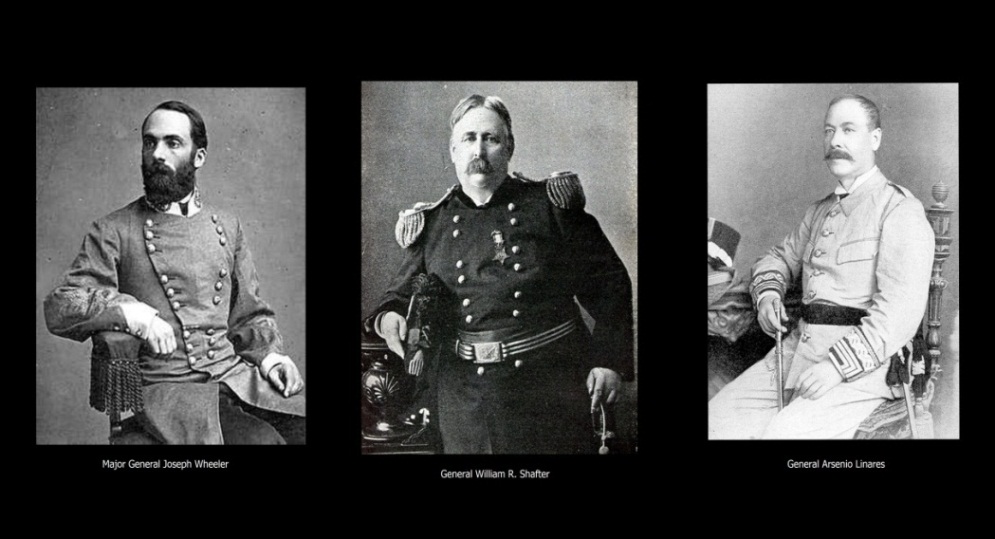
Left Gen. Wheeler, Middle Major Gen. Shafter Right Gen. Arsenio Linares
During the Spanish American War, Major General Shafter and his men faced a few obstacles. At the time of the war, Shafter was an obese man who suffered from gout. His lack of mobility made him very unfit to command an army. Also, his men lacked discipline. These two factors would hurt him in the war. (3) Major General Shafter was given his command due to politics, ironically because many felt he was not political. This shows that merit and fitness for command did not play into his appointment. Unfortunately, this cost many a young man his life during the Battle of San Juan Hill. Another problem facing Shafter was the fact that most of his men came from ill trained volunteer regiments. One of these units was the now famous “Rough Riders.” Their commanding officer was a well-seasoned military man, Colonel Leonard Wood. However the second in command was Colonel Theodore Roosevelt, a man with no military experience but high political ambitions seeking the glory of combat.
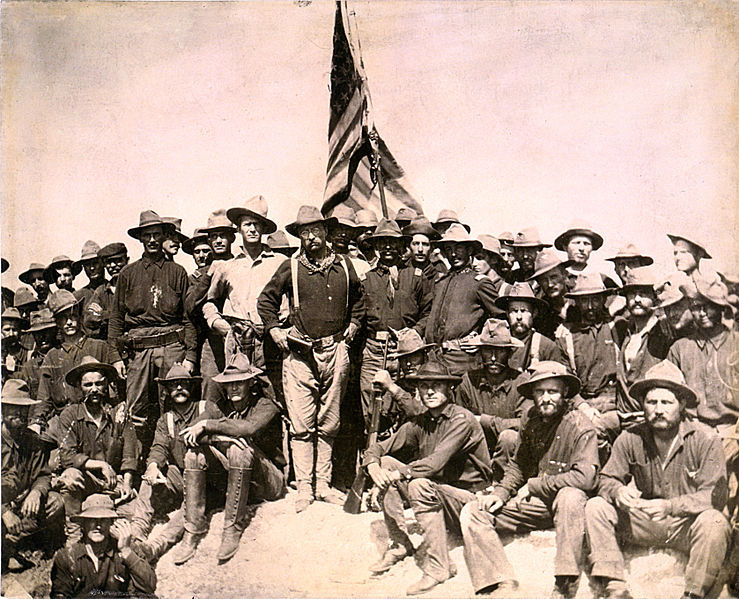
Colonel Theodore Roosevelt, and the “Rough Riders”
The most qualified men of Shafter’s V Corps were the African American men of the Twenty-forth and Twenty-fifth Infantry as well as the Ninth and Tenth Cavalry Regiments. (4) Conversely the African American soldiers may have had issues with one of their commanders, Major General Joseph Wheeler, since he commanded a brigade of Confederate soldiers during the Civil War.
Major General Wheeler graduated West Point in the class of 1859 and was appointed as a Lieutenant in the Dragoons, a Calvary unit of the United States Army. In 1861 Wheeler resigned from the army and joined the Confederate forces. In 1862, he commanded an infantry regiment at Shiloh and through the operations around Corinth, Mississippi. Then during the summer of 1862 he was assigned to be in charge of the Cavalry for General Braxton Bragg’s Army of the Mississippi. He directed a mounted brigade at Perryville and a division at Murfreesboro while fighting in Tennessee. Then Wheeler was put in command of a corps of mounted troopers which he led in the Tullahoma Campaign in 1863. Then at Chickamauga he was in charge of one of the two cavalry corps. Wheeler was later put in charge of all the mounted troops with the Army of Tennessee. Then in 1864, he fought at Chattanooga and led his men in the Atlanta Campaign. During these last two operations he was famous for his raids on the Union supply lines. After the Civil War Major General Wheeler became a businessman and a member of congress. When the Spanish American War came about he offered his generalship and was appointed by President William McKinley. (5)
The Americans faced a formidable opponent in the Spanish. They were led by General Arsenio Linares. He was a professional Spanish Army officer with a large amount of military understanding and battle experience. General Linares was made a Lieutenant in charge of artillery. Later he moved to the infantry where he clashed with rebels in Cuba during the Carlist Wars in Spain, as well as in the Philippians. (6) By 1897 Linares was chosen to be the commanding officer of the Spanish defense force at Santiago, Cuba in preparations for the the coming war. In May of 1898 he was appointed Lieutenant General and was in charge of 35,000 men. Instead of garrisoning them all in Santiago he spread them out all over Cuba to protect against insurgent attacks leaving only about 10,000 in Santiago. This would affect the Spanish forces greatly during the Battle of San Juan Hill. (7)
On June 22, 1898 the American assault force started coming ashore at Daiquiri and Siboney in Cuba. They began to head towards the city of Santiago where General Linares had deployed his Spanish troops along the peaks of San Juan and Kettle Hills, external to the city. The craggy topography and heavy vegetation combined with the lack of roads made anything other than a frontal attack impossible for the Americas. Furthermore outmoded rifles that used black powder exposed shooters positions and slowed their progress. In contrast the Spanish army had bolt action rifles that used new smokeless powder and a few German made machine-guns, but lacked the motivation to defend a Spanish colony as opposed to their homeland. (8) The American assault started early in the morning of July 1 as an attack on the city of El Caney. Major General Shafter grossly under estimated the Spanish and thought this battle would be a quick engagement, but the Spanish army was heavily entrenched and fought with ferocity hurting American progress. (9)
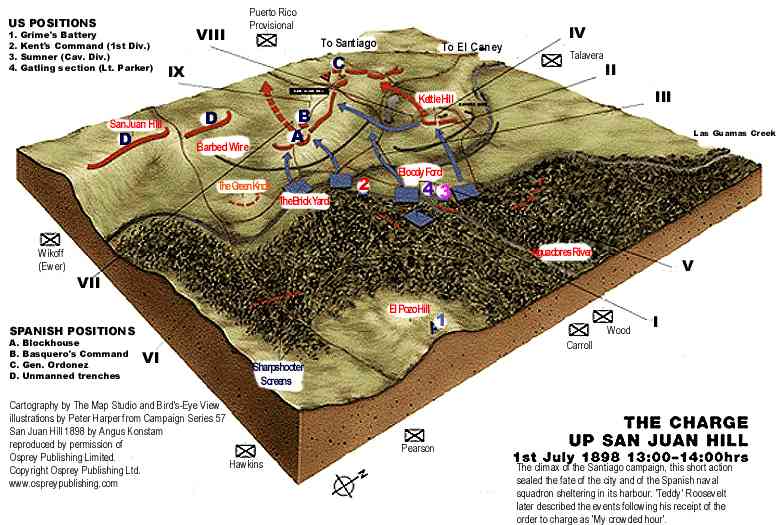
Battle of San Juan Hill Topographic Map
By eleven in the morning many of the American troops had reached the San Juan River, including the “Rough Riders.” They were ordered to the right of the line, so Roosevelt led his men in that direction. He recalled, “The fight was now on in good earnest and the Spaniards on the hills were engaged in heavy volley firing. The Mauser bullets drove through the trees and the tall jungle grass, making a peculiar whirring or rustling sound.” The Rough Riders stayed in a secure position and waited for orders. (10)
By one in the afternoon the American advance was all but halted by the Spanish resistance. A United States Captain at one point crawled into a ditch for cover and discovered over a hundred men lying there. He asked “Are those reserves?” and the reply he received was grave, “No sir by God They are casualties.” All of the men in that trench were dead. The situation was desperate; only a bold move could turn the tide in the Americans favor. (11) The American war correspondent Richard Harding Davis wrote of just how calamitous a predicament the United States Army was in, “Our troops could not retreat, as the trail for two miles behind them was wedged with men. They could not remain where they were for they were being shot to pieces. There was only one thing to do go forward and take San Juan Hills by force.” (12)
Colonel Roosevelt had the same thought and was about to move up Kettle Hill without orders when he was commanded to do so. Roosevelt first looked to the rear, the position he was supposed to be in as the commanding officer. Despite this, he decided that he could command better from the front. From this position Colonel Roosevelt rode between his men shouting orders and encouragement. The “Rough Riders” advanced so far and so fast that they reached the lines of the American infantry troops. Roosevelt later recalled this, “By the time I reached the lines of the regulars of the first brigade I had come to the conclusion that it would be silly to stay in the Valley firing at the hills, because that was really where we were
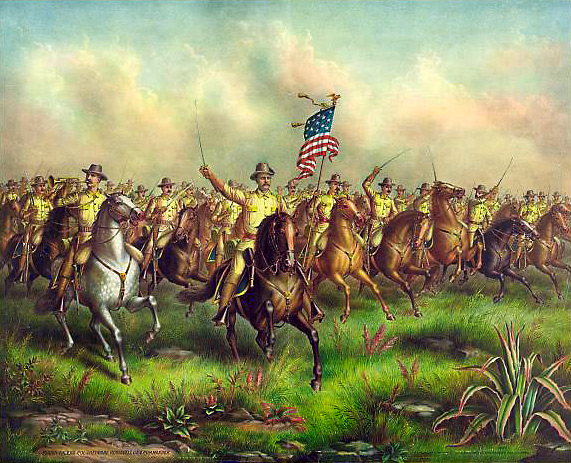
Teddy Roosevelt and his “Rough Riders” Charge Kettle Hill
most exposed, and the only thing to do was to try to rush the entrenchments….I waved my hat and we went up the hill in a rush.” Thus began the now famous charge up Kettle Hill, not San Juan Hill as many think. (13) Another misconception about the charge was that it was swift and had a large number of men in fact the opposite was true. War correspondent Davis wrote, “They had no glittering bayonets; they were not massed in a regular array. There were a few men in advance bunched together, and creeping up a steep, sunny hill the tops of which roared and flashed with flame.” (14)
The slow pace of the charge broke when the African American Troopers of the Ninth and Tenth Calvary broke free. This bolstered the spirit of the charge and the American forces rushed up the hill. When Colonel Roosevelt reached the top he came across a barbed wire fence and dismounted his horse; his uniform and elbow pierced by shot. The Spanish seeing the rush of men poured heavy fire onto the American troops, which took shelter in time to witness the American infantry trying charge up San Juan Hill. Colonel Roosevelt ordered his men to give fire support to those advancing men. Then out of nowhere the sound of heavy fire erupted. At first the men under Roosevelt’s command thought it to be the Spanish machine guns, but Roosevelt could discern the sound was coming from the American lines and promptly informed his men “It’s the Gatling’s, men our Gatling’s.” (15)
Using the cover fire from the dismounted cavalry and the Gatling guns Lieutenant Jules Garesche Ord ordered his men of the United States Sixth Infantry forward up San Juan Hill to take the Spanish blockhouse. This charge was a fierce and quick, unlike the one up Kettle Hill. The men of the Sixth gave a cheer as they went up the hill. When they got to the highest point, the Spanish fled in a hurry. Unfortunately, Lieutenant Ord, the first man a top San Juan, was slain.
Despite the tide of battle being turned in the American favorer the battle was not over yet. By two in the afternoon the Americans were spread thin atop the hills as the Spanish made an organized retreat. Furthermore, the battle at El Caney was still raging on and an American officer speaking about the situation in El Caney recalled, “Our situation was extremely serious; we were holding our own and no more, and were losing far more heavily than the enemy.” (16) After appraising the situation in El Caney, Major General Shafter realized he had made a mistake by sending his forces there. This mistake may have been caused by the fact that due to his health and weight. Major General Shafter could not survey the ground in person or lead in the field, so the men in El Caney had to fight it out against a tenacious Spanish army. During this fight the Spanish General Linares took personal command of his soldiers and was wounded. He was carried off the field and replaced.
After almost ten hours of fighting, at four fifteen in the afternoon El Caney was seized by the American forces. A British military observer describes the carnage after the siege, “The trench around the fort was a gruesome sight, floored with dead Spaniards in horribly contorted attitudes and with sightless staring eyes. Others were littered about the slope, and these were mostly terribly mutilated by shell fire. Those killed in the trenches were all shot through the forehead, and their brains oozed out like white paint from a colored tube.” (17) The battle was over with the American narrowly gaining a victory. In the end this action would total 420 lives, 205 Americans and 215 Spaniards. The Americans dug in waiting to make another advance in the upcoming days, but that was not essential due to the American naval victory at Santiago harbor that destroyed the Spanish fleets Caribbean Squadron. By July 17 the residual Spanish forces surrendered.
This battle was significant due to the fact that it bolstered American pride and nationalism as well as making the United States a power on the world stage due to the fact that this victory lead to the US obtaining the territories of Cuba, Puerto Rico and the Philippines. This triumph also gave the American military the experience it needed and exposed issues with the armed forces that needed improvement. For example, the fact that many men died of tropical diseases led to research in yellow fever that all but eradicated the disease, thus making the building of the Panama canal a possibility. Furthermore, many of the men who fought in Cuba would later use that experience to lead men in World War One.
Notes.
1) Lee, R. “The History Guy: Casualties From America’s Wars” retrieved from, http://www.historyguy.com/american_war_casualties.html (8-15-2012)
2) Lt. Col Lanning Michael, The Battle 100: The Stories Behind History’s Most Influential Battles Sourcebooks (April 1, 2005) 109
3) Maj. Gen. William Shafter (1835 – 1906) By Patrick McSherry; retrieved from http://www.spanamwar.com/shafter.htm (8-15-2012)
4) Lanning, 109
5) Joseph Wheeler, Retrieved from http://www.arlingtoncemetery.net/jwheeler.htm (8-15-12)
6) Tucker, Spencer, The Encyclopedia of the Spanish-American and Philippine-American Wars: A Political, Social, and Military History ABC-CLIO (January 2009) 338
7) Ibid
8) Lt. Col Lanning Michael, The Battle 100: The Stories Behind History’s Most Influential Battles Sourcebooks (April 1, 2005) 110
9) Ibid
10) O’Toole, G. J. A. The Spanish War: An American Epic 1898, W. W. Norton & Company (August 17, 1986) 310
11) Ibid 314
12) Ibid 315
13) Ibid 316
14) Ibid
15) Ibid 318
16) Ibid 320
17) Ibid
 The Military History Traveler
Good piece. I’m curious, though, as to your thoughts on the initial motivation for the U.S. entering the war, whether military action was forced or a deliberate decision, the role of Yellow Journalism, and the theories that the destruction of the USS Maine was a deliberate act by the U.S. designed to create a reason for involvement, similar (in concept) to Operation Northwoods? I’m increasingly interested in this period of U.S. military history and its conflicts in the Caribbean and Latin America prior to the First World War. Thoughts?
-jk
LikeLiked by 1 person
The press in the United States has a tremendous influence on our nation and has often impacted our nation’s policies politics. Late in the 19th Century was a time in our history when the press had a great deal of influence on important decisions made in this country. The press manipulated and exaggerated stories purely for the purpose of selling newspapers. This practice would be known as “Yellow Journalism.”
In the 1890’s the newspaper was king. Names like Joseph Pulitzer, and William Randolph Hearst, were highly respected journalists. Even today, these men’s names are synonymous with the concepts of the American press. In their time, they ruled the world of journalism. A tool they often used to accomplish their purposes was known as “Yellow Journalism.” A term which came from a prevalent comic strip titled “Hogan’s Alley,” which included a yellow-dressed character named the “The Yellow Kid.” This comic strip appeared in a newspaper owned by Pulitzer called The New York World. Resolute to contend with Pulitzer’s World in every way, rival New York Journal owner William Randolph Hearst copied Pulitzer’s shocking style and even hired “Hogan’s Alley” artist R.F. Outcault away from the World. In reply, Pulitzer ordered another cartoonist to create a second Yellow Kid. Soon, the scandalous press of the 1890s became a competition between the “yellow kids,” As a result of this journalistic style, the term “Yellow Journalism” was coined. (1) Rivalry between these two media moguls led to both men sensationalizing or even, to some extent, making up stories to sell newspapers. It was these larger-than-life stories that helped formulate the opinions of Americans. For example, there were many highly exaggerated “Yellow Journalism” stories bred to sell newspapers that lead to the Americans wanting to enter war with Spain. Two of these stories involved the explosion of the United States Battleship USS Maine and the harassment of women by the Spanish on an American ship.
Richard Harding Davis was one of the most well-known reporters of his day. It was his report about the events that were reported to him by Senorita Clemencia Arango concerning her return trip from Cuba that sparked outrage. (2) Davis heard the story of a young Cuban woman forced to submit to a strip search by male Cuban officials, on an American vessel, the OLLIVETTE. (3) This report and subsequent cartoon caused outrage in the United States.
An event that typifies the influence that “Yellow Journalism” influenced American politics and policies occurred in the war the United States fought with Spain. This event was the explosion of the USS Maine in Havana harbor. Newspaper headlines immediately after the explosion screamed, “Remember the Maine.” Accompanying articles accused the Spanish of using a torpedo or even a bomb planted by an agent of the Spanish government. (4) It was headlines like this that pushed the public to persuade the Government to go to war. A few months after the Maine, armies were mobilized and emergency funds were made available for war. The Spanish American War had begun. (5)
Overall these are examples of the dangers that a misguided press can have on a nation. It was solely for the purpose of selling newspapers that directly led to United States’ involvement in the Spanish American War. This involvement cost many young Americans their lives.
Citations
1) Newspaper Wars; retrieved from http://projects.vassar.edu/1896/nypress.html (7-26-2012)
2) Black, White and Yellow Journalism and Correspondents of the Spanish-American War By Jess Giessel; retrieved from http://www.spanamwar.com/press.htm
3) Ibid
4) Propaganda in the Spanish-American War; retrieved from http://library.thinkquest.org/C0111500/spanamer/app.htm
5) Ibid
LikeLiked by 1 person