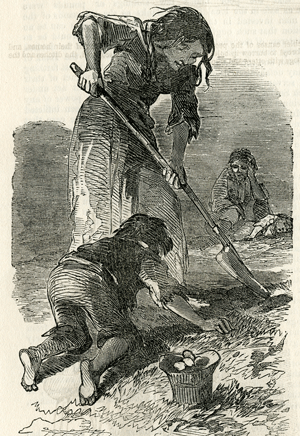
Searching for potatoes in a stubble field Illustrated London News, December 22, 1849
Ireland in the 1840s was a dreadful place. Many individuals lived on the edge of starvation and in subhuman conditions imposed by their British land lords. They relied on the potato as their main staple of life. Then, in 1845, the great famine occurred, or as the Irish called it “An Gorta Mór.” This blight was caused by the fungus Phytophthoera infestans and by 1852 this food shortage caused over one million people to die, and over two million to travel to North America. (1) Most of these immigrants traveled to America on what were known as “Coffin Ships,” called this due to their poor conditions and likelihood to sink. The passengers were provided with only one barrel of water and disease was rampant. (2) When the Irish immigrants landed in America they did not find the refuge they were seeking, in fact many of them found the opposite to be true.
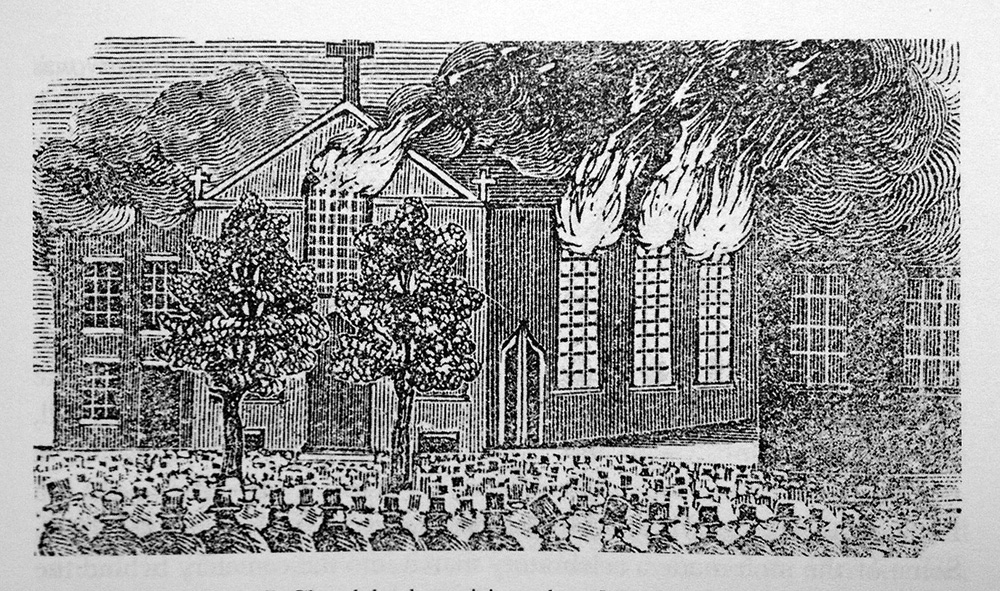
The burning of the original St. Michael’s Catholic Church | Engraving from A Full and Complete Account of the Late Awful Riots in Philadelphia, published in 1844 by nativist John B. Perry
The Irish Immigrants not only found poverty and overcrowding to be an issue, but they were also confronted by Americans who supported the nativist movement. A driving force in that movement was The Know Nothing party, founded in 1845, they led the political fight to purify America by removing its immigrants. As this group galvanized their movement the Irish were the prime target because of their high poverty rate, drinking, devotion to Ireland, and Catholic faith. The latter was due the fact that the Know Nothings felt the devotion of the Irish lay with the Pope in Rome and not with the United States. (3) The hatred the Know Nothings felt came to a boil in 1844 in Philadelphia when “Nativists battled Irish immigrants, and two Catholic churches and a Catholic school were burned by mobs. At least 20 people were killed in the mayhem.” (4) There were many more clashes with the Know Nothing party, including August 6, 1855 in Louisville, Kentucky. During an election the Know-nothings tried to take over the polls, resulting in a riot that culminated in the burning of an Irish tenement block and the shooting several Irishmen as they tried to escape the blaze. In all twenty two people lay dead after the night of anti-Irish violence. (5)
By the time the American Civil War came about the Irish felt the need to join the army of their new home, be it north or south. They wanted to gain a foothold in American society as well as to stand their ground and avoid being called cowards. A post war slogan stated, “Although the Celts be hyphenated Americans in name they were one hundred percent Americans in deed.” (6) All of the conflicts with the Know Nothings had the effect of galvanizing the Irish population in the south. This was increased by the idea of secession. The Irish population was more than happy to fight for the cause and prove themselves as true southerners. John McFarland, an Irish immigrant from county Tyrone Ireland that resided in Mississippi, wrote “My affections, my friends, my home are all here and whatever the fortunes of my adopted country mine rises and falls with it.” (7) This quote demonstrates how the typical southerner of Irish decent felt interconnected to their new homeland and wanted to be a worthy participant in its cause. This connection helped drive the Irish of the south to be fervent worriers in battle.
The Battle of Gettysburg was one of many battles that showed how hard the Irish of the south fought in the Civil War. The Battle for “Little Round Top” involved the now famous Union regiment the 20th Maine, commanded by Colonel Joshua Lawrence Chamberlin. One of their adversaries on this day would be Company K of the 15th Alabama, which was described by their commander Colonel William Calvin Oats in the following fashion: “It was an Irish company.” (8)

The 20th Maine & 15th Alabama at Gettysburg by Dale Gallon
The life blood of this unit was found in Sergeant Patrick O’Conner, a twenty three year old Irish born tinner, who was thought of as the “Hardest fighting and toughest non-commissioned officer of the 15th Alabama.” (9) The 15th Alabama made repeated attempts to take the hill, but were repulsed by the guns of the 20th Maine. Eventually intense hand to hand combat broke out with Sergeant O’Conner yelling for the men to advance into the hail of deadly shot. This advance was not only inspirational to his company but to the whole Confederate line. (10) At one point, a Union soldier attempted to take the colors of the 15th Alabama, when according to Colonel Oats, Sergeant O’Connor “stove his bayonet through the head of the Yankee who fell dead.” (11) This hard fighting and sacrifice for the Confederates, however, was to be for naught. The 15th Alabama could not take the position due to their lack of reinforcements and ammunition. Although this was not a victory for the Irish Alabamians is demonstrates the hard fighting spirit that the Irish Confederate had for their new home, their cause and to become full members of southern society.
There is not a more a fitting place in the Civil War than Fredericksburg to show how the Irish spilled their blood on the soil of their new home. During the battle Irishmen squared off against each other. The men of the Union’s Irish Brigade confronted the 24th Georgia, commanded by Irish born Colonel Robert McMillan. The Union’s Irish mounted a gallant charge against the 24th Georgia and were repelled. (12) When the Confederate Irish from Georgia noticed the green flag of the 28th Massachusetts part of the Union’s Irish Brigade, one member was said to have uttered, “Oh God, what a pity! Here come Meagher’s fellows.” McMillian replied, “Give it to them now, boys! Now’s the time! Give it to them!” (13) The charge of the Union and its Irish Brigade was described by Confederate Artillery Commander William M. Owen in the following manner, “Bearing aloft the green flag with the golden harp of Ireland, those brave fellows came within five-and-twenty paces of the stone-wall and encountered such a fire of shot, shell, canister, and musketry as no command was even known to live through.” (14) The Union’s Irish Brigade was soundly defeated that day on Marye’s Heights. Although the Brigade was not victorious, its gallantry was an inspiration to all that day and woven well into the fabric of American military history.

Clear The Way By Don Troini depicting the 28th Massachusetts at Fredricksburg
The Battle of Fredericksburg helped show the rest of the country that the Irish were proud American citizens. Color Sergeant Welsh of the 28th Massachusetts part of the Irish Brigade echoes this feeling in a letter home saying, “This is my country as much as the man who was born on the soil and so it is with every man who comes to this country and becomes a citizen this being the case I have as much interest in the maintenance of the government and the laws of the nation as any other man.” (15) This letter was written in February of 1863, a year after Fredericksburg. One can make the inference that Color Sergeant Welsh felt strongly about his citizenship due to the sacrifices he and his fellow Irishman made during the war, especially at Fredericksburg. Union General Thomas Francis Meagher wrote in a letter about the effect that a desire for acceptance had on the men at Fredericksburg.
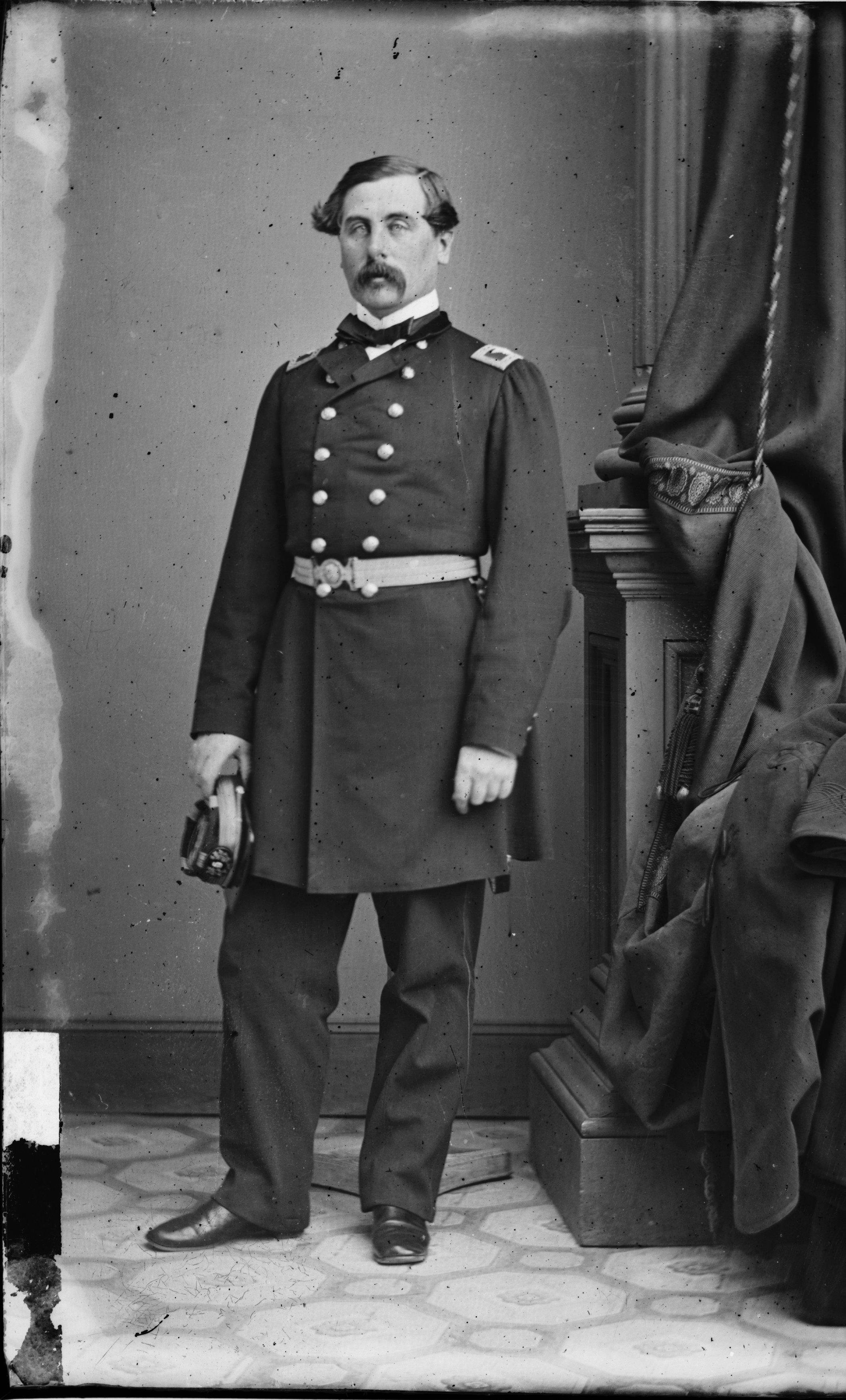
Brigadier general Thomas Francis Meagher
He felt this battle helped the Irish gain respect amongst natural born American citizens and stated, “In the very heart of the city of Fredericksburg under the fiercest play of shot and shell from the rifle pits and batteries of the enemy the General commanding the Brigade, displayed them (the colors) to the remnant of his command, as the splendid tribute which native-born Americans men of the highest private worth and widely acknowledged civic and social consequence had awarded to the Irish Brigade for the good service it had rendered in the great cause of the Constitution and the Chief-Magistracy of the American Union.” (16)
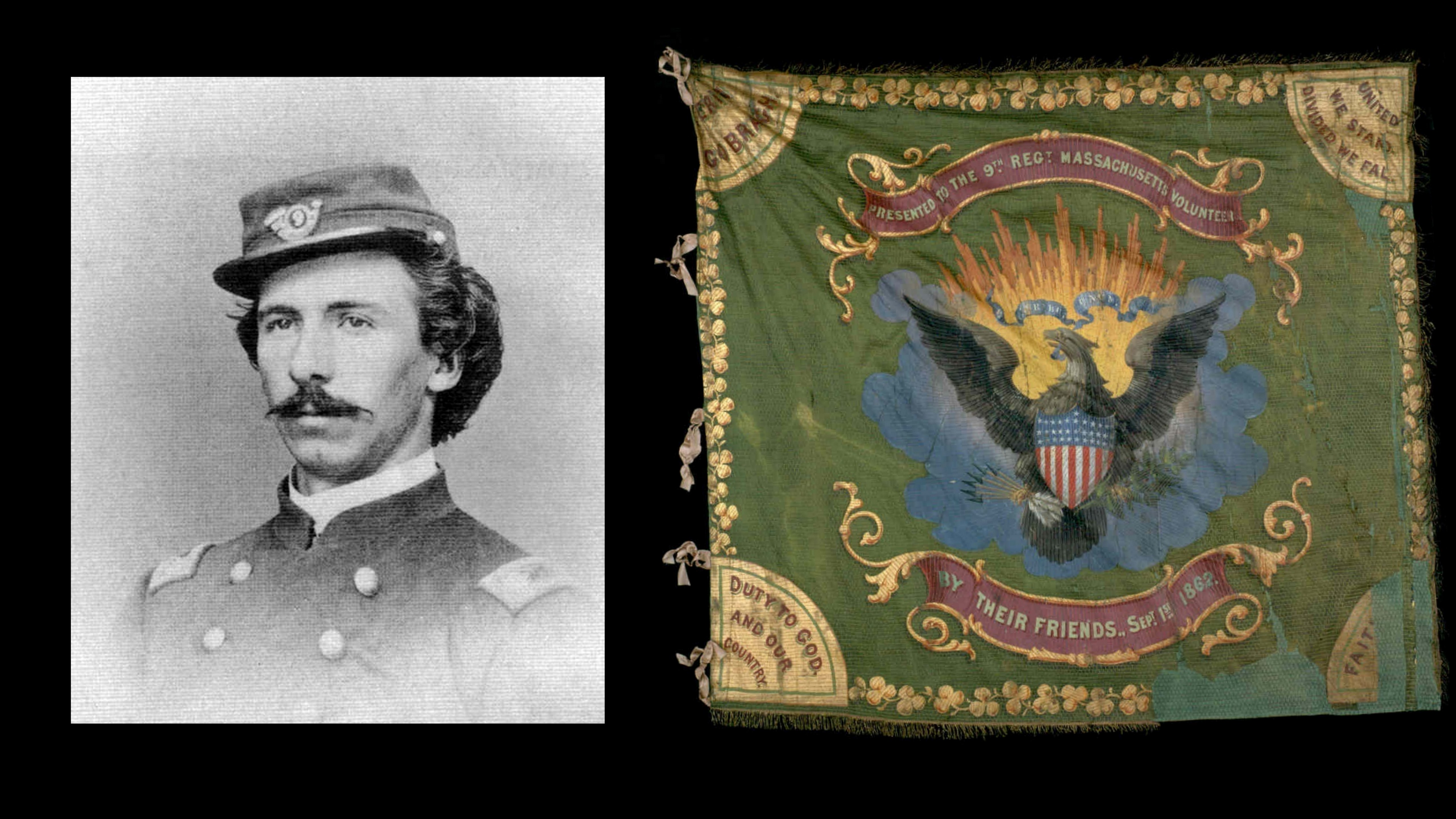
Left: Colonel Patrick Robert Guiney Right: The Colors Of The 9th Regiment Massachusetts Volunteer Infantry
One can see just how the idea of being American was high motivation for these men from the Emerald Isle, to fight and fight hard for their adopted land. After the war the idea of nativism was a thing of the past. Colonel Guiney of the Irish 9th said that the “accomplishments of the Irish regiments wiped away nativist prejudice against the Irish” and then challenged the audience to “go up to the State House and you will find the faded banners of the Ninth Regiment, and so long as they remain there no man will ever be heard to say that the Irish people living in Massachusetts are enemies of the republic.” (17) One can conclude that by being fierce fighters the Irish were able to accomplish their goal of being accepted in American society.
Notes;
1) Collins, J.J. Famine to Freedom The Irish in the American Civil War. (CreateSpace Independent Publishing Platform, 2011.) 28
2) Ibid, 28
3) Cal ,McCarthy. Green, Blue, and Grey : the Irish in the American Civil War. (Ireland: Collins Press, 2009.) 13
4) The Know-Nothing Party Opposed Immigration to America Secret Societies Emerged as Political Players in the 1850s By Robert McNamara; retrieved from http://history1800s.about.com/od/immigration/a/knownothing01.htm accessed on 09-11-2014
5) O’Brian. The Irish Americans In the Confederate Army. 18
6) Conyngham, The Irish Brigade and It’s Campaigns , XV.
7) Ibid, 19
8) Tucker, Phillip Thomas Irish Confederates The Civil Wars Forgotten Soldiers (Abilene Tx: McWhiney Foundation Press, 2006.) 78
9) Ibid, 80-81
10) Ibid, 85
11) Ibid
12) Undaunted Courage The Irish At Fredericksburg,” The Wildgeese.com, accessed January 01, 2012, http://www.thewildgeese.com/Pages/fredpt2.html.
13) Ibid
14) Tucker, Irish Confederates The Civil Wars Forgotten Soldiers. 62
15) Welsh, Irish Green and Union Blue, 65
16) Cavanagh, Michael. Memoirs of Gen, Thomas Francis Meagher, 533
17) Guiney, Patrick R. Commanding Boston’s Irish Ninth : the Civil War Letters of Colonel Patrick R. Guiney, Ninth Massachusetts Volunteer Infantry. (New York: Fordham University Press, 1998.) 252
 The Military History Traveler
Gary, very nicely done. Well written & quite informative. Thanks from your fellow enthusiasts.
LikeLike