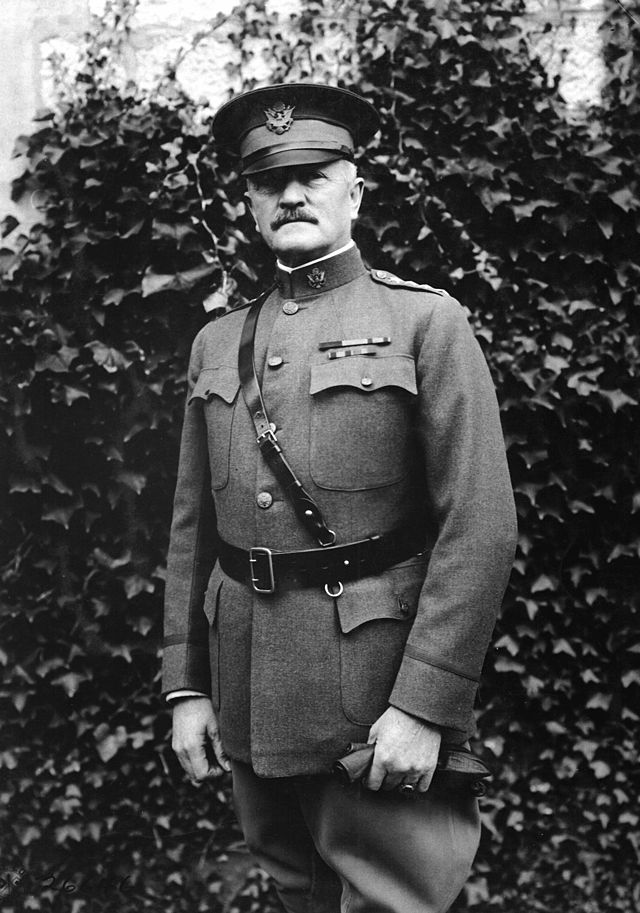
Pershing at General Headquarters in Chaumont, France, October 1918
On April 6, 1917 the United States entered into World War One; a war that had been raging on in Europe for three years already. America sent two million men overseas under the command of Major General John J. Pershing. Even though Pershing had some battle experience that made him a qualified commander, he was not the Army’s first choice. With the sudden death of General Frederick Funston, Pershing was chosen to lead the men into war. Pershing would soon show the world he was actually the right choice due to his skills as a leader, statesman and military tactical expert.
Pershing was born on September 13, 1860 in Laclede, Missouri and experienced war at an early age. By 1861 the Civil War had consumed the United States. The town of Laclede was constantly harassed by Southern Raiders who attacked local businesses. One of these businesses was owned by Perishing’s father. On June 18, 1863 a young Pershing accompanied his father to the store that morning and at four in the afternoon they were sacked by Raiders. Perishing’s father locked the safe and grabbed young John and his shotgun as they fled the store; this was the
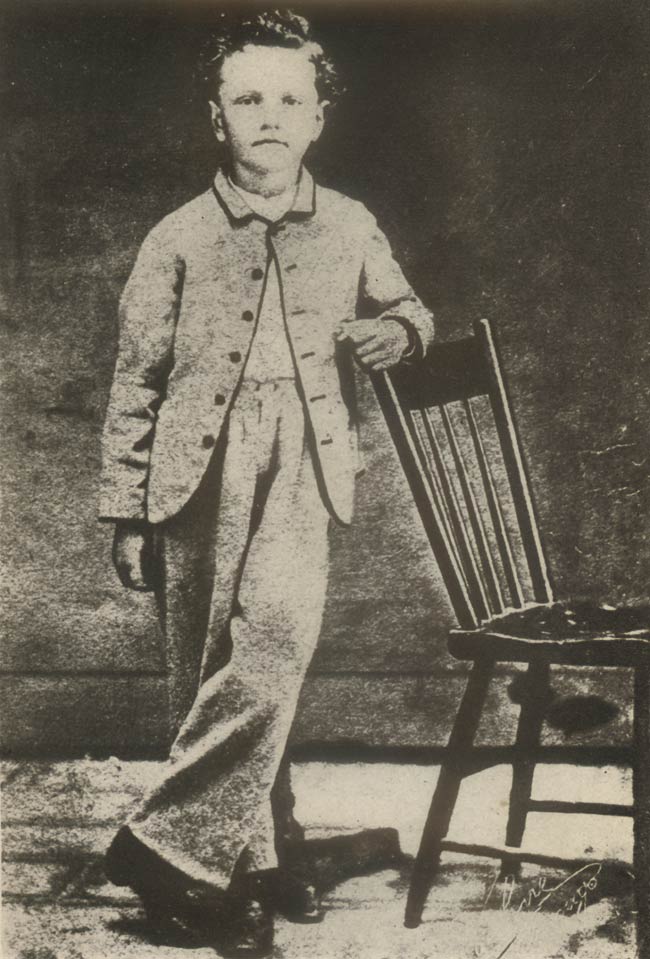
Young Pershing
General’s first taste of war.[1] Although no one in the family was hurt, the raiders took $3,000 and the lives of several of the towns citizens before a train full of Union Soldiers came to their rescue.[2]
After working a series of jobs with varied success Pershing saw an opportunity to better himself by attending West Point. After a rough testing process Pershing was admitted in 1882. [3] It was during his time at West Point that Pershing first established himself as a leader and was made Captain of the Corps of Cadets. It was during this role that he established his policy on discipline. Pershing stated “If the men of that class have a high regard for discipline and frown upon unbecoming behavior, the other classes follow the example; if there is a laxity in the First Class, or if they are complaining or carless in dress, such faults are reflected in the classes below.” [4] In 1886 Pershing graduated West Point, although not the top of his class academically. His actions as Captain set him apart from the rest of his class and made him a rising star in the United States Army. It was due to his class standing that Pershing was given the opportunity to select his assignment. Seeking glory and adventure, the twenty-six year old Pershing chose the cavalry.
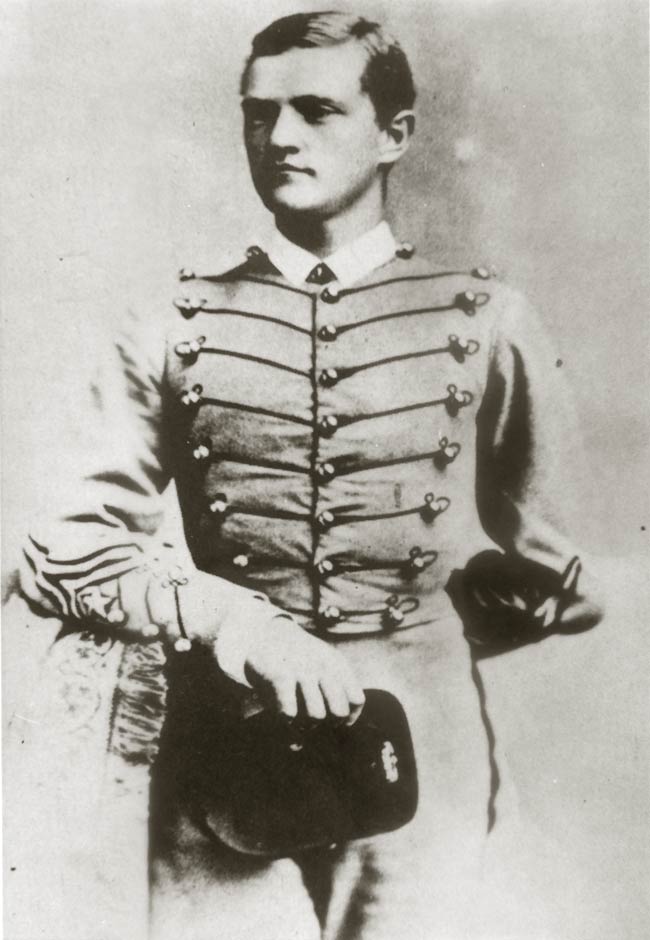
Cadet Pershing at West Point
The next few years were a time of growth and development for Pershing. Pershing first official assignment was at Fort Bayard in New Mexico as part of a unit that was trying to fight the last of the Apache Indian Tribe in the southwest. Pershing was out on many patrols but never had an opportunity to engage any members of the tribe. Over the next few years Pershing moved from post to post and learned how to lead men in harsh conditions, mostly climate related situations than actual combat. Pershing soon grew tired of roaming the plains and decided to apply for the position of Commander of Cadets at the University of Nebraska. This was a job Pershing excelled at. In just a few years he turned a floundering program into the winners of the National Drill Competition. After his term at the University of Nebraska Pershing was assigned to the Tenth Cavalry; an African American unit of the now famous Buffalo Soldiers.
It was with the Tenth Calvary that Pershing’s life and career would make a drastic shift. Pershing took his command of the Tenth Cavalry very earnestly and during this time of racial tension Pershing found his new job challenging. He soon discovered though that if he gave his men the respect they deserved, they would perform their tasks with extreme diligence. Lieutenant Perishing led the Tenth in rounding up Cree Indians. This was not an easy task as he had to forge through the mountains and his men were fighting outs of small pox. Due to his success Pershing caught the eye of the Commander of the Army, General Nelson Miles. This is when Perishing’s military career began to take off. He was assigned to General Miles staff and from there became an assistant instructor at West Point.
During his time as an instructor at West Point Pershing drove his cadets hard. Biographer Gene Smith state in his book on Pershing that “To his charges he seemed a heartless martinet, rigid, unforgiving, always ready to pounce on the slightest departure from perfect performance, someone seeming ever ready indeed anxious to mark down demerits.” [5] As a result of his hard driving attitude and Perishing’s association with the Tenth Cavalry the cadets nicknamed him “Nigger Jack.” [6] This name would later become Black Jack in public media. His now famous moniker was at first a term of derision and disrespect.
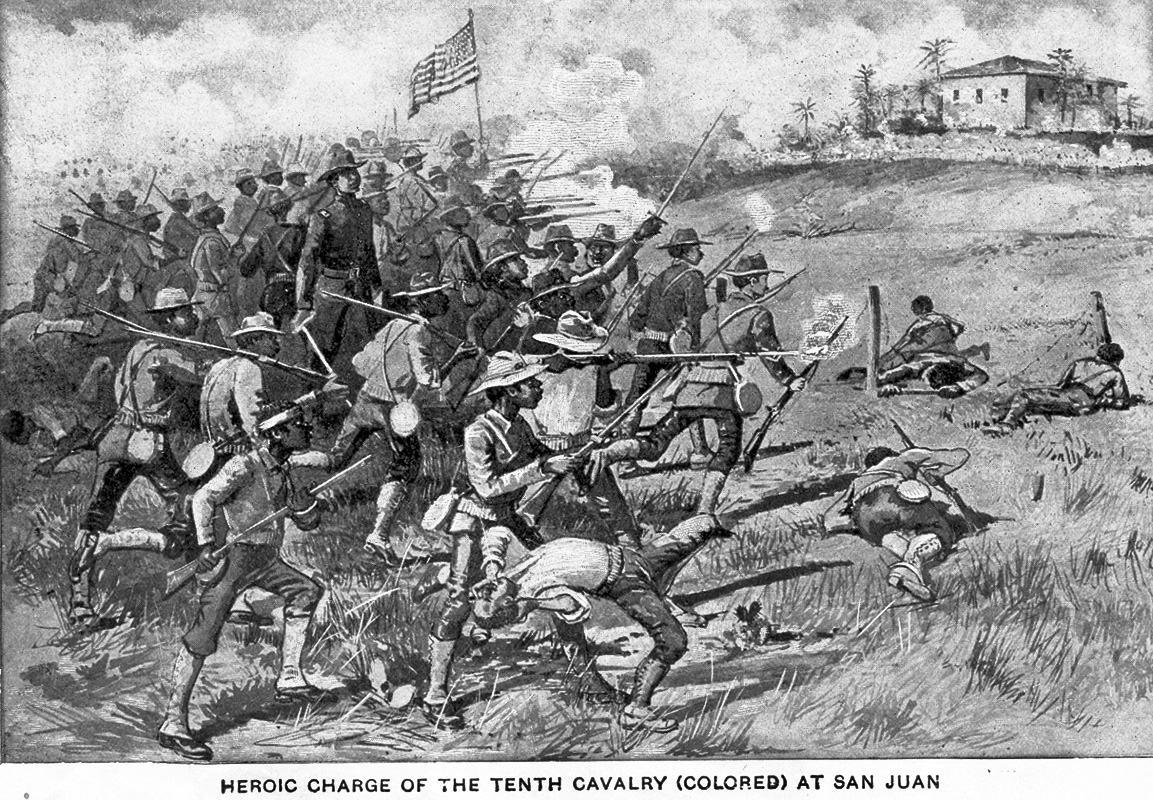 Pershing finally got to put his leadership skills into play during combat when the Spanish American War broke out in 1898. Pershing was not enjoying his teaching role and wanted to help on the front lines. The only problem was that he was not allowed to be called into the field due to a military decree that prevented instructors at West Point from doing so. Pershing had to call in every favor he had owed to him and stated he would take any post. Due to his connections, Pershing was finally allowed to leave West Point and was reassigned to the Tenth Cavalry as their captain. Pershing and the Tenth arrived in Cuba ready to fight. Unfortunately for Pershing he did not see any action when the war began. Instead, he was being assigned to various missions, such as picking up Cuban insurgents to help the American cause. Perishing’s first taste of hostile combat came during the Battle of San Juan Hill when the poorly equipped Tenth marched through the most harsh and unforgiving terrain only to be met by the heavily armed and entrenched Spanish. Pershing called it “A veritable hail of shot and shell”. [7] The Americans were out gunned since their weapons were no match for the Spanish. The Tenth took heavy fire and casualties. At one point one of the squadrons from the Tenth got separated from the rest of the unit, so Pershing set out to find them in the midst of the fight. Pershing ran across General Joseph Wheeler just as a shell exploded between the two of them. This incident made an impression on Pershing as he then decided that a fighting general should always be at the front. [8] Another thing that made a lasting impression on Pershing was the courage of the black troops. Pershing later wrote in a memo, “We officers of the Tenth Cavalry could have taken our black heroes in our arms.”[9]
The years following the Spanish American War contained a combination of combat, office work and personal tragedy. Pershing was assigned to a series of desk jobs in Washington DC before being sent to the Philippines in 1889. While there he used military tact and diplomacy to help settle a dispute between the United States and the local tribe. Pershing was again assigned back to Washington and held a desk job for several years. In 1914, he was sent to El Paso, Texas to lead troops for a possible excursion into Mexico. Pershing decided to leave his wife and children behind; a decision he would regret the rest of his life. In 1915 the Pershing house burned down killing his wife and three daughters, the only survivor was his son.[10] This forever changed Pershing. The once vibrant and sometimes even jovial man turned into a cold and withdrawn soul saddled with grief.
On March 14, 1916 Pershing got the orders to go into Mexico for the purpose of hunting down Poncho Villa. Villa had been raiding American
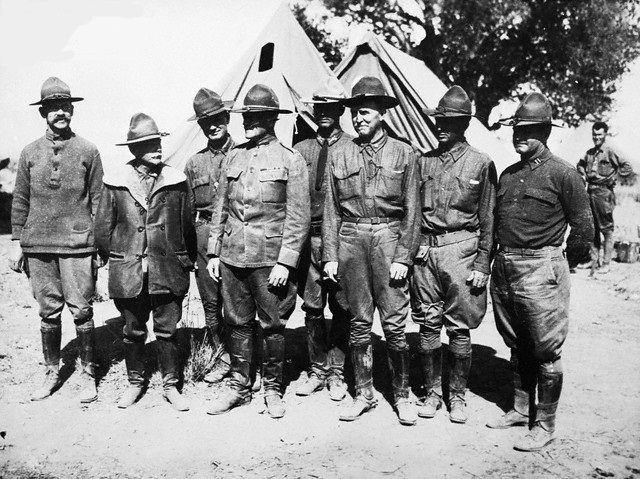
Pershing and staff in Mexico, Pershing 4th from left. Pershings aide, Capt George S. Patton 5th from left.
towns along the Mexican border and his men were murdering American citizens and stealing their positions. The Mexican expedition proved to be a failure overall as Villa was never captured. However, for Pershing it became a great proving ground as it tested his skills of leadership over such a force and its supply lines. This expedition also proved to be America’s first use of mechanized warfare. By exhibiting this force Pershing saw its potential for future wars. It was also on this expedition that Pershing met a young and eager lieutenant named George S. Patton. Pershing saw a lot of himself in the young officer and soon took him under his wing, which would later be beneficial during World War One.
In 1917 when the United States finally felt they had no choice but to enter the war that was happing in Europe, Pershing was station at Fort Sam Houston in Texas. In the preceding years the United States was desperately trying to stay out of the war that was embroiling Europe. However, after the sinking of the RMS Lusitania as sea, which killed one hundred and twenty eight Americans,[11] and the Publication of the Zimmerman Telegram, in which Germany promised American territory to Mexico, the U.S. entered the war. Pershing was fearful he would be passed over for a command to be a part of the action. He wrote the Secretary of War, Newton Baker, saying “My life has been spent as a soldier, much of it on campaign, so that I am now fully prepared for the duties of this hour.” [12] His plea worked as Pershing was assigned to command the first division in France. However, no decision was made on who would command the entire American Expeditionary Force (AEF). This decision was up to Baker; whom had eliminated candidates due to health reasons and age. Eventually he was left with two individuals: General Leonard Wood and Pershing. Pershing was finally selected due to the fact that he had led a large force before and Wood lacked discretion when speaking in public.
Major General Pershing now had the overwhelming task of putting together an army that was in shambles. Due to years of isolationism the United States Army was nothing but a paper tiger, full of outdated weapons and only a handful of soldiers. After Pershing selected his staff he set off to Europe with the AEF. They had only 550 guns, which was enough ammunition to last through a nine hour firefight, and 55 airplanes, most of which were outdated.[13] During the trip over to Europe Pershing had a staff meeting in which it was decided that 1,000,000 American soldiers were needed to win the war.[14] Pershing arrived in Great Britain to much fan fair and was the highlighted guest at many parties and political gatherings. However, this was not Perishing’s idea of war. He knew that there was work to be done and resented the public spectacle.
During the next few months Pershing was overworked and kept long hours trying to get his men ready for combat. Fourteen thousand young men mustered in front of Pershing on the June 26, 1917 the first of the American forces arrived. The General was unimpressed as he found them to be undisciplined and unkempt. Pershing was also disappointed in the commanders of the First Division, so in order to better fit his ideals he made some changes in the command structure. By October 1917 Perishing felt they were ready to be rotated into the fight.[15] Unfortunately, the Germans learned of the green American troops being transferred and launched an attack first. Although this attack was large in scale and a defeat for the Allies, the American casualties were light with only three Americans killed. When Pershing heard the news he openly wept. [16]
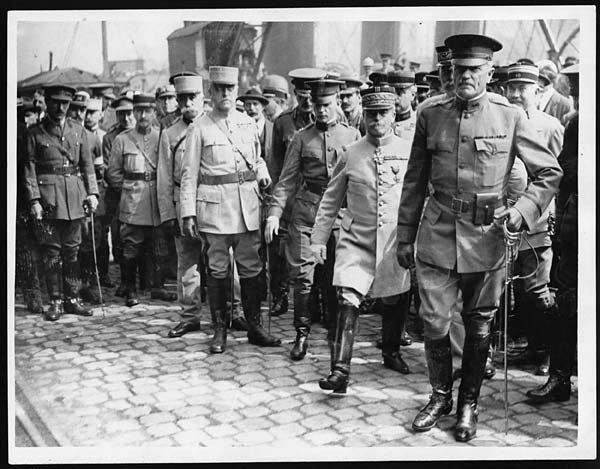
General Pershing In France Leading the American Expeditionary Force (AEF)
As the American entered the war it was a devastating time for the Allies. The Allies were losing men by the thousands and America had not yet raised the number of troops to be effective. During their early months of involvement, Pershing only had 175,000 men in Europe, mostly in non-combat related jobs.[17] With the losses suffered by the other Allied forces, France and Britain called for the amalgamation of all forces and to use the American forces as replacements in other units. Pershing was dead set against this idea because he felt it would demoralize the American troops. He also felt distrust for the foreign commanders and feeling did not want American blood spilled because of their incompetence. By the end of 1917 Pershing was still working on the logistics of gathering his force and was playing politics with the French, British and the United States War Department. The American forces still had not seen much action on the front.
It took till the summer of 1918 before Pershing felt comfortable enough with his numbers to issue an order creating the American First Army. This army was then sent into the fray at St. Mihiel, France and prepared for battle. At this time French Marshal Ferdinand Foch made one more push for the amalgamation of French and American forces. Perishing angrily replied, “Here on the very day that you turn over a sector the American army and almost on the eve of an offensive you ask me to reduce my operation so you can take away several of my divisions and assigning them to the French… This virtually destroys the American army that we have been trying for so long.” [18] Foch left the office angered and the issue was dropped for the last time.
During the fall of 1918 the United States army finally entered into the action. Their first major combat action was when they went into the battle
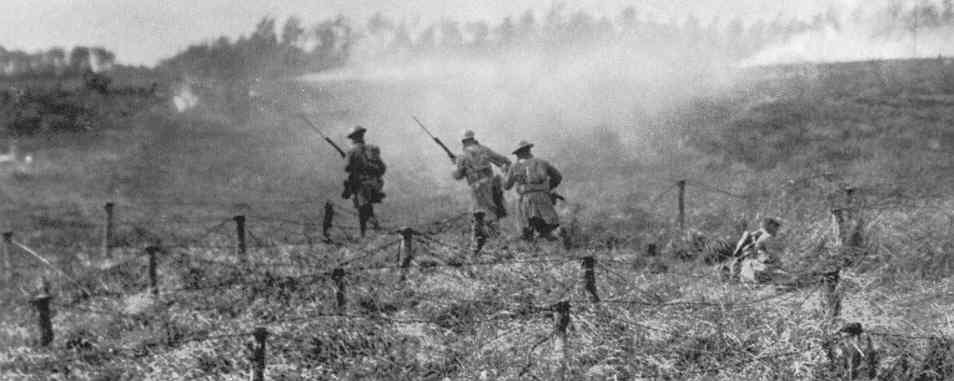
American charge against the St.-Mihiel salient
(one doughboy has just taken a hit from German fire)
of St. Mihiel. The American forces started off with an artillery barrage and then set forth with a push that went further than their objectives expected them too. The American force took 16,000 prisoners and 450 enemy guns.[19] This was the first major victory for the AEF. This success allowed Pershing to authorize what would be known as the Meuse-Argonne Offensive. Pershing wrote, “Our dogged offensive was wearing down the enemy, who continued desperately to throw his best troops against us, thus weakening his line in front of ours Allies and making their advance less difficult,” when discussing this American success.[20] This push eventually resulted in the depletion of German forces and by the 8th of November Pershing received word that the hostilities would be ending soon. Finally on the 11th of November, 1918 the war ended with the signing of the Treaty of Versailles. This Allied victory was set in motion due to the AEF and Perishing’s leadership.
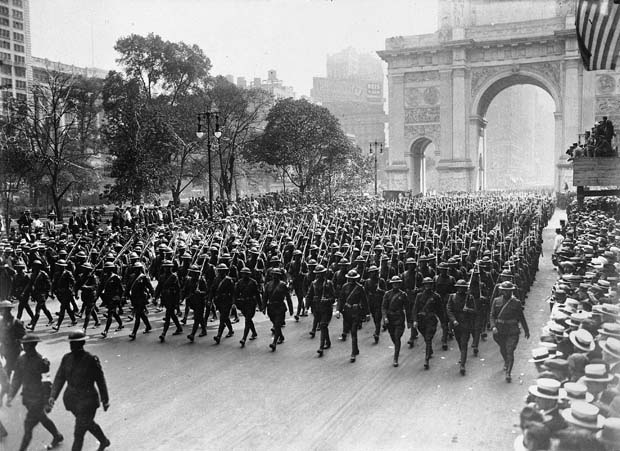
eterans of World War I parade down 5th Avenue in New York City on Sept. 10, 1919. The parade was held to honor General John J. Pershing and an estimated 25,000 soldiers from the American Expeditionary Force, almost one year after the official end to the war.
Pershing returned home to a hero’s welcome. Parades were held in Philadelphia and New York in which Pershing faced cheering crowds and adoring children. At one point a little girl handed him some flowers and Pershing broke down; one would only assume it was due to the loss of his own daughters. After that all visits with children had to be screened. Pershing was elevated to Army Chief of Staff before retiring in 1924 because of his age. The Cleveland Plain Dealer wrote about the loss of Pershing to the Army and said “His retirement is a loss to the country; and there is no doubt that when the public becomes acquainted with the circumstances of his retirement, especially the sharp reduction in his pay, it will demand tardy justice for him. Pershing has never stooped to the more obvious devices to obtain popularity; and this fact has strengthened his hold on the country.” [21] After retiring, Pershing gave speeches from time to time; but mostly kept to himself and what was left of his family. Over the years his appearances grew less and less as the General got weaker and finally passed quietly in his sleep in 1948. General Pershing
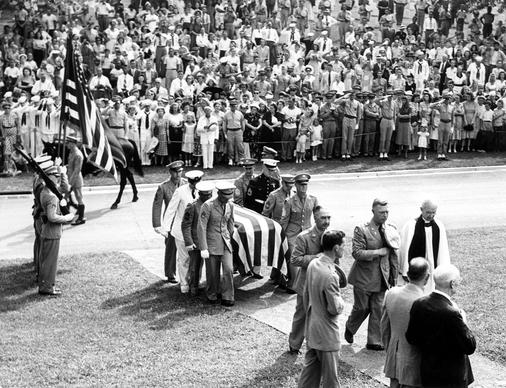
Carrying the casket of General John J. Pershing to the gravesite at Arlington National Cemetery
made a lasting impact on those he commanded and befriended over the years. Nothing compared though to the impact the death of his wife and children left on Pershing. Their deaths turned Perishing into the cold, calculated leader that crafted an army and won the First World War
Bibliography
Delgado, James P. Silent Killers: Submarines and Underwater Warfare. Osprey Publishing, 2011.
Lacey, Jim. Pershing. New York: Palgrave Macmillan, 2008.
Palmer, Frederick. John J. Pershing General of th Armies. Harrisburg: The Military Service Publishing Company, 1948.
Perry, John. Pershing Commander of The Great War. Nashville: Thomas Nelson , 2011.
Pershing, John J. My Experienced in the First World War. New York: Da Capo Press, 1931.
Smith, Gene. Until The Last Trumpet Sounds The Life of General of The Armies John J. Pershing. New York: John Wiley & Sons, Inc., 1998.
Times, The Army. The Yanks Are Coming. New York: G.P. Putnam’s Sons, 1960.
Vandiver, Frank E. Black Jack The Life and Times of John J. Pershing. College Station : Texas A&M University Press, 1977.
Weir, William. The Encyclopeda of African American Military History. Prometheus Books: Amherst, 2004.
[1] Lacey, Pg. 7
[2] Lacey, Pg. 8
[3] Lacey, Pg. 10
[4] Vandiver, Pg. 41
[5] Smith, Pg. 48
[6] Smith, Pg. 49
[7] Perry, Pg. 41
[8] Perry, Pg. 42
[9] Weir, Pg. 231
[10] Palmer, Pg. 67
[11] Delgado, Pg. 150
[12] Lacey, Pg. 88
[13] Times, Pg. 59
[14] Vandiver, Pg., 700
[15] Lacey, Pg. 127
[16] Lacey, Pg. 128
[17] Lacey, Pg. 130
[18] Lacey, Pg. 152
[19] Pershing, Pg. 270
[20] Times, Pg. 118
[21] Times, Pg.159

 The Military History Traveler