On my way back from Asheville I made a quick stop in Morganton. Here I paid respects to Lieut. John Caldwell. He was born in 1845 at Morganton, North Carolina to Tod & Minerva Caldwell. John grew up and worked on his family farm. In 1861 John who was known as “Jack”, was a Cadet at the Hillsboro Military Academy.[1] His father was a Unionist, but John went against his father’s wishes and chose to join his friends and defend his state. In July of 1861 John Was a member of the 6th North Carolina Volunteers stationed in Staunton Virginia.[2] By December of 1861, Caldwell was serving as a Drill Instructor for the state of North Carolina in a training camp at Asheville.[3] He continued in this capacity through 1862, until most of the volunteer regiments had organized and marched off. On May 5th, 1863, John Caldwell was mustered into “E” Co. 33rd North Carolina Infantry as a Private.[4]
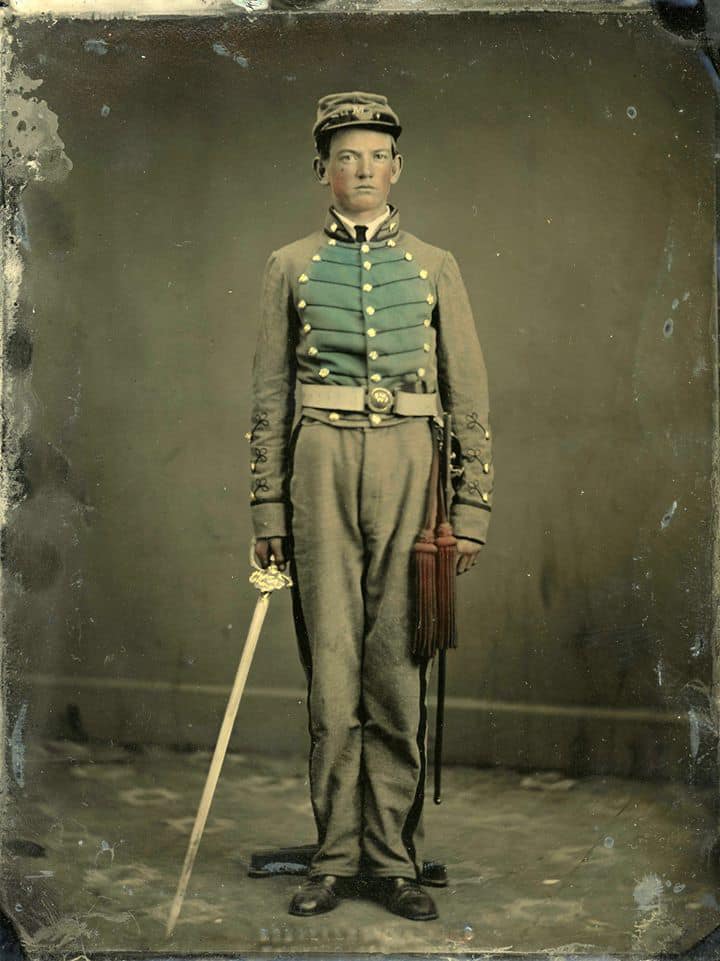
He would be immediately promoted to Lieut. in order to replace the 33rd’s loses from the Battle of Chancellorsville.[5] Upon hearing of Young Johns promotion his father sent him a letter containing some wise fatherly advice… “Don’t be tyrannical or overbearing toward your men. Be kind and obliging to everyone no matter how low or humble his position may be, and if you get into battle be like a man and a true soldier. Be kind and merciful to your enemies if any should be placed in your power. It is a badge of true courage and of a gentlemanly Christian spirit to show mercy and kindness to your enemies and it may in the fortunes of war happen that you may need the friendship of those you are fighting against. Observe vigorously the golden rule, “to do unto others as you would have them do unto you.” Oh what would I not give if this cruel and unnatural war was ended and you and your army and in honor return home to your friends.”[6]
Lieut. Caldwell led his men during the march into Pennsylvania, he and his men were shelled along the way, and performed picket duty. They would reach Gettysburg on July 1st at around 15:30 they “on the right of the Division in the final and successful movement against the Union forces on Seminary Ridge held back Union Cavalry which threatened the flank and had a sharp conflict at the stone wall on Seminary Ridge just south of Fairfield Road.”[7] On the second day the 33rd was involved in some heavy skirmishing. “our line of battle was not engaged but there was a very strong picket fighting in front of us and as it was the turn of his company to go out on skirmish he (John Caldwell) was skirmishing all day and was not relived until about sundown. He took his skirmishers out in gallant style and during the day lost two of his company killed and several wounded.”[8] On the third day Lieut. Caldwell and the 33rd took part in the Pickett–Pettigrew–Trimble Charge, as part of Longstreet’s assault. During the assault Lieut. Caldwell and Lieut. Wilson Lucas were ordered by General Pender to command 75 men and take a farm lane. Lieut. Wilson Lucas writes of this action saying….
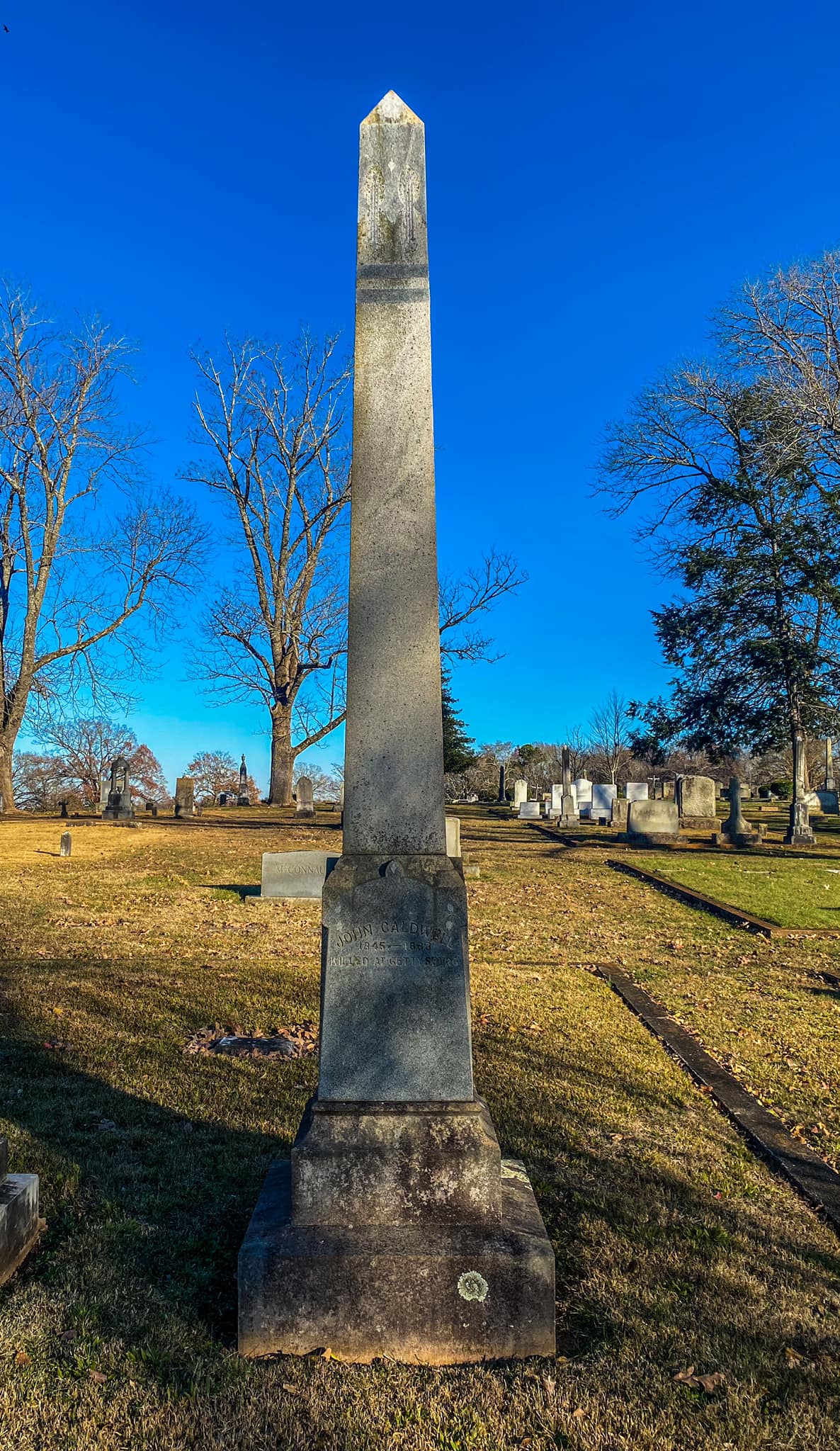
“We formed the men in line, I commanded the right and Lieut. Caldwell the left. We had to charge through an open field, with no protection whatever. … When we got within two hundred yards of the Federals, we charged with a yell, and they stood their ground until we were within ten steps of the road, then a part of them ran, but 26 surrendered. And the very last time they fired upon us, which was not more than twelve or fourteen feet from them, they shot Lieut. Caldwell in the left breast. I did not see him fall. As soon as we were in the road one of the men told me Lieut. Caldwell was killed. I went at once to the left and found him, lying partly on his back and side … I called two men, and we placed him on his back and spread his oil cloth over him. He was warm and bleeding very freely when I got to him. I could not send him out to the regiment, for it was such an exposed placed the Federal skirmishers would have killed a man before he could get a hundred yards, as we were lying close to each other.”[9]

Lieut. Caldwell’s commanding officer Col. Avery in letter to John’s father wrote “You may have the satisfaction to know that he fell where we would all wish to fall (if it be God will) with his face to the enemy.’[10] Lieut. John Caldwell’s body was buried on Seminary Ridge that night “near “two honey-pod trees … not far from an old two-story house.”[11] Even with the reports of Lieut. Caldwell falling before the enemy, his father refused to believe his son was killed.
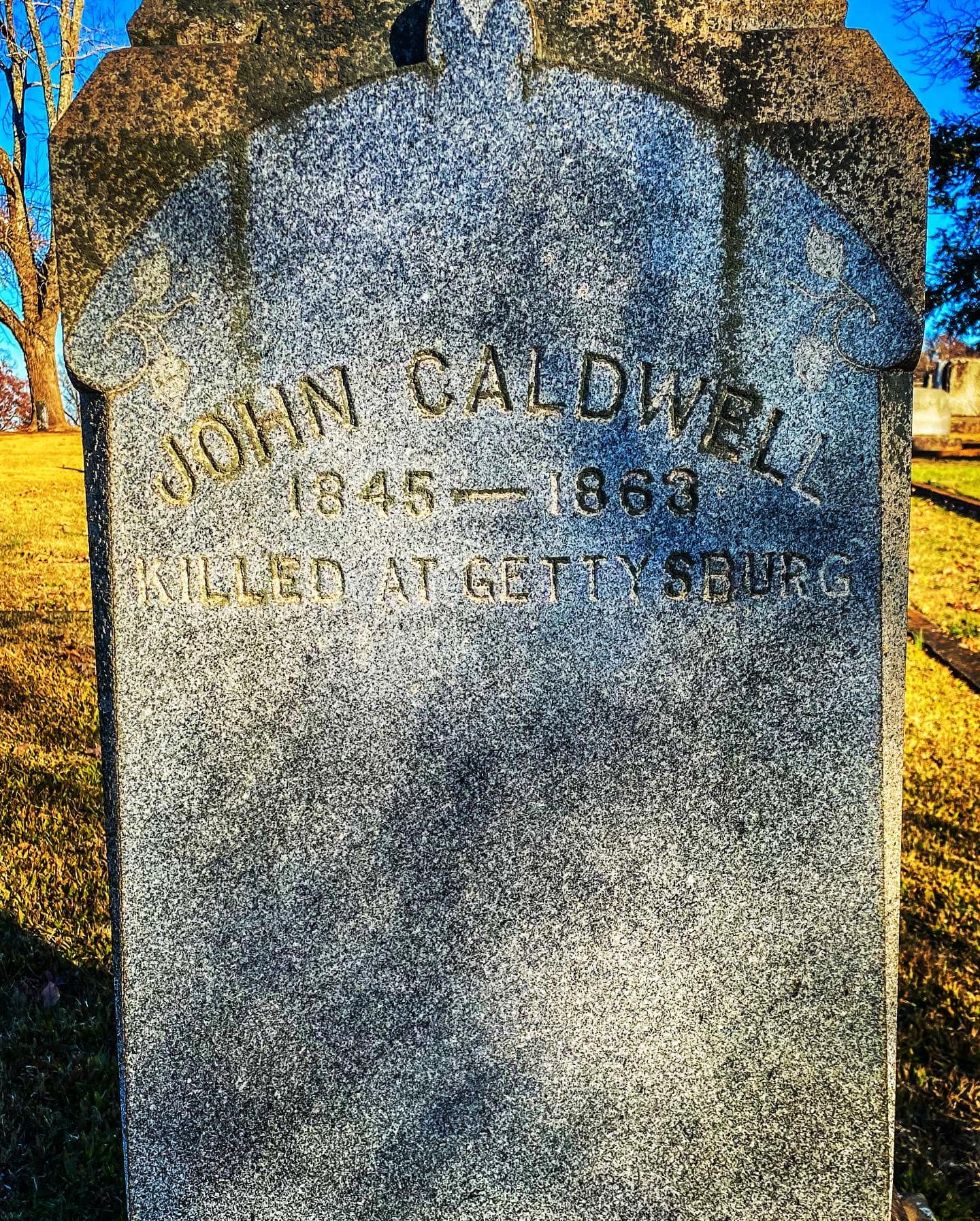
It was not until Tod R, Caldwell was governor of North Carolina, that he found out his son’s fate. It was told to him by Lieut. Wilson Lucas who was then a state legislature. It was said that the Governor “locked himself in his room and was all day in tears”.[12] Gov. Caldwell kept this secret from his wife for 14 years, she found out when Lieut. Caldwell’s bloodied commission to Lieut. Was sent home by a New Yorker who had found it on the Battlefield. Lieut. Caldwell’s body would be returned to North Carolina and reinterned at Forest Hill Cemetery in Morganton. Let us never forget this young man’s sacrifice for his state and his country.
[1] “Tod Robinson Caldwell Papers, 1801-1890.,” UNC University Libraries, accessed November 28, 2021, https://finding-aids.lib.unc.edu/00128/#folder_5#1. Scan 12
[2] Ibid, Scan 14
[3] Ibid, Scan 25
[4] “Page 2 Civil War Service Records (CMSR) – Confederate – North Carolina,” Fold3, accessed November 29, 2021, https://www.fold3.com/image/45066577.
[5] Ibid
[6] Christopher M. Watford, The Civil War in North Carolina: Soldiers’ and Civilians’ Letters and Diaries, 1861-1865 (Jefferson, North California: McFarland & Company, Inc., Publishers, 2009). Pg. 278
[7] “History of the 33rd North Carolina Infantry Regiment in the Civil War,” The Civil War in the East, May 17, 2021, https://civilwarintheeast.com/confederate-regiments/north-carolina/33rd-north-carolina-infantry-regiment/.
[8] Don Ernsberger, Also for Glory: The Pettigrew-Trimble Charge at Gettysburg July 3, 1863 (United States: Xlibris Corp, 2008). Pg. 57
[9] Michael C. Hardy, General Lee’s Immortals: The Battles and Campaigns of the Branch-Lane Brigade in the Army of Northern Virginia, 1861-1865 (El Dorado Hills, CA: Savas Beatie LLC, 2018). Pg. 330
[10] Biff Hollingsworth, “18 July 1863: ‘You May Have the Satisfaction to Know That He Fell Where We Would All Wish to Fall (If It Be God Will) with His Face to the Enemy.”: Civil War Day by Day,” 18 July 1863: “You may have the satisfaction to know that he fell where we would all wish to fall (if it be God will) with his face to the enemy.” | Civil War Day by Day, accessed November 29, 2021, https://web.lib.unc.edu/civilwar/index.php/2013/07/18/18-july-1863-you-may-have-the-satisfaction-to-know-that-he-fell-where-we-would-all-wish-to-fall-if-it-be-god-will-with-his-face-to-the-enemy/.
[11] Michael C. Hardy, General Lee’s Immortals: The Battles and Campaigns of the Branch-Lane Brigade in the Army of Northern Virginia, 1861-1865 (El Dorado Hills, CA: Savas Beatie LLC, 2018). Pg. 350
[12] John Hartwell, “Lt. John Caldwell, 33rd North Carolina, Pender’s Brigade,” Civil War Talk, n.d., https://civilwartalk.com/threads/lt-john-caldwell-33rd-north-carolina-penders-brigade.135030/?amp=1.
 The Military History Traveler