Every soldier has a story, and Private Robert Jones Jr. is no exception.

Jones was born to Robert and Mary Jones in Kent England[1] around 1832[2] The family immigrated to America prior to 1840[3], and settled in Westfield, Chautauqua, New York. Jones would work as a laborer, and would marry Betsy Ann Honeysett in 1860.[4] They would have their first child Rhoda in 1861.[5]At the outbreak of the American Civil War Robert’s brothers, Jacob[6]and Thomas[7] joined the Union as part of the 49th New York Infantry. Later when Chautauqua County was called on for a thousand men the state offered a $50 dollar bounty to any volunteer that enlisted. This $50 was in addition to a $100 dollar bounty offered by the Federal Government. The duty of recruiting a Regiment from Chautauqua County was met with enthusiasm[8]. On August 31st, 1862, Robert Jones filled with patriotism and some extra cash, joined the 112th New York. This regiment would be forever known as the “Chautauqua Regiment”. [9] At that time he was listed as being 5 Feet 7 and ¾ inches, with dark hair, chestnut eyes, and a fair complexion.[10] Jones would be mustered into “H” Co as a Private on September 11th, 1862.[11] Private Jones was in the following engagements; The Siege of Suffolk, Battle of Drewry’s Bluff, and the Battle of Cold Harbor. At Cold Harbor the 112th NY had to cross an open field of 600 yards to reach the Confederate advance skirmishers. This action is described by William Lyman Hyde, in his book History Of The One Hundred And Twelfth Regiment N.Y. Volunteers as follows.
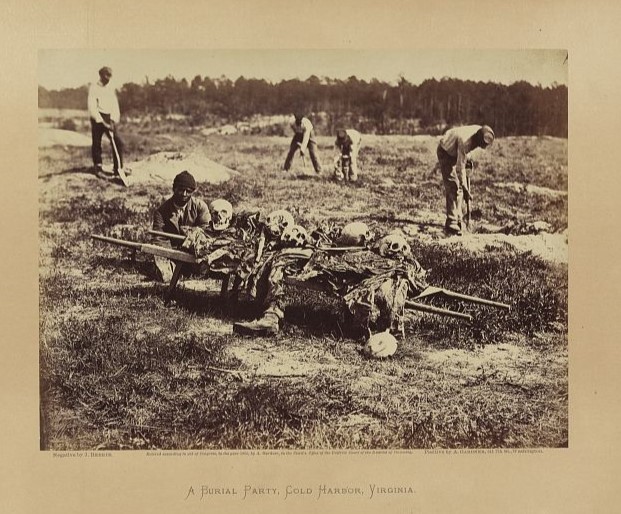
“This had been successfully accomplished and the enemy driven back to their rifle pits and the capture of 600 Confederate soldiers. Facing the Union Army were veteran soldiers….the right was occupied by General A.P. Hill’s Corp., in the center was General James Longstreet’s Corps., and on the left was General Richard Ewell’s Corps. As the attack progressed, Colonel Drake ordered the men to cease firing and fix bayonets. The attack pressed on, the Confederate works were irregular, and the men were exposed to a galling fire. Though the loss was severe the works were reached and mounting the parapet among the first of the men, Colonel Drake waved his sword, hurrahed and fairly danced with exultation as the rebels ran back to their rifle pits. This line of works had been carried with considerable loss and the ranks now quite broken, but the men were pressing on toward the second line. Unfortunately, a Regiment of the 6th Corps on the flank of the 112th New York was a raw regiment, enlisted only six weeks before and this was their first fight. The distance to the Confederate works in their front was less by a hundred rods than in front of Colonel Drake’s Brigade, but that Regiment quailed before the fire and could not be pushed up. This left the Brigade in a very unfortunate position and the Confederate rifle pits on the flank of the 112th were able to pour in a severe enfilading fire. In addition the men of the 112th were exposed to the frontal fire of the advance line of works….. at this point the carnage was terrible, the 112th New York from its position suffering the most severely, its casualties nearly equal to the sum of those in the rest of the Brigade.[12]”
Roberts survived this battle and continued to fight at, The Siege of Petersburg, Second Battle of Petersburg, and The Battle of the Crater. The Chaplin of the 112th New York, William L. Hyde describes the action at the Crater to his wife in a letter as such.

“Saturday morning about five o’clock our brigade with the ninth corps were drawn up in successive lines preparatory to a charge upon a redoubt which had been mined. The first operation was to blow up the fort. This was done in fine style, a complete success. The mine was lighted at precisely 5 o’clock and the huge mass of earth with men & guns were lifted up into the air. Some men were blown over into our advance pits. One man who came over unharmed said he thought it was rather unceremonious to send a man kiting through the air in that shape before he had eaten his breakfast. After the redoubt was blown up, we opened a terrible artillery fire along our whole line. then the troops made a charge the negro regiments first. We got possession of the redoubt without the loss of a man. With a very slight loss we got possession of the main works of the enemy. We held two lines and were preparing to make or position secure when the negros and some white troops in front were seized with panic and broke & ran and pressed the troops in the rear by sheer force of numbers. Some officers stood well & tried to stay the rush but it was in vain and in a few minutes the work of weeks was lost. Our Brigade was just getting into position when the stampede took place. They did what they could to arrest it but were too feeble. One man told me that a huge nigger came tumbling over him and almost broke his back! In our endeavoring to hold the position till the line could be reformed, our Regt suffered some casualties we had one man killed and eleven wounded. two men mortally wounded. I do not know of any with whom you are acquainted. We remained in the front of our works until about five o’clock PM when the regiment was marched back into the trenches where they had been so long.”[13]
Private Roberts would soldier on to, the Battle of Chaffin’s Farm, Battle of Fair Oaks & Darbytown Road, First Battle of Fort Fisher, Second Battle of Fort Fisher, and the Carolinas Campaign.[14] Robert would get through the war relatively unscathed. He would be mustered out with his regiment on June 13, 1865, at Raleigh, North Carolina.[15]
Sadly his brothers could not say the same. Jacob would be killed at Petersburg, Virginia, on April 2 1865[16], and Thomas would be severely wounded on May 5,1864 during The Battle of the Wilderness.
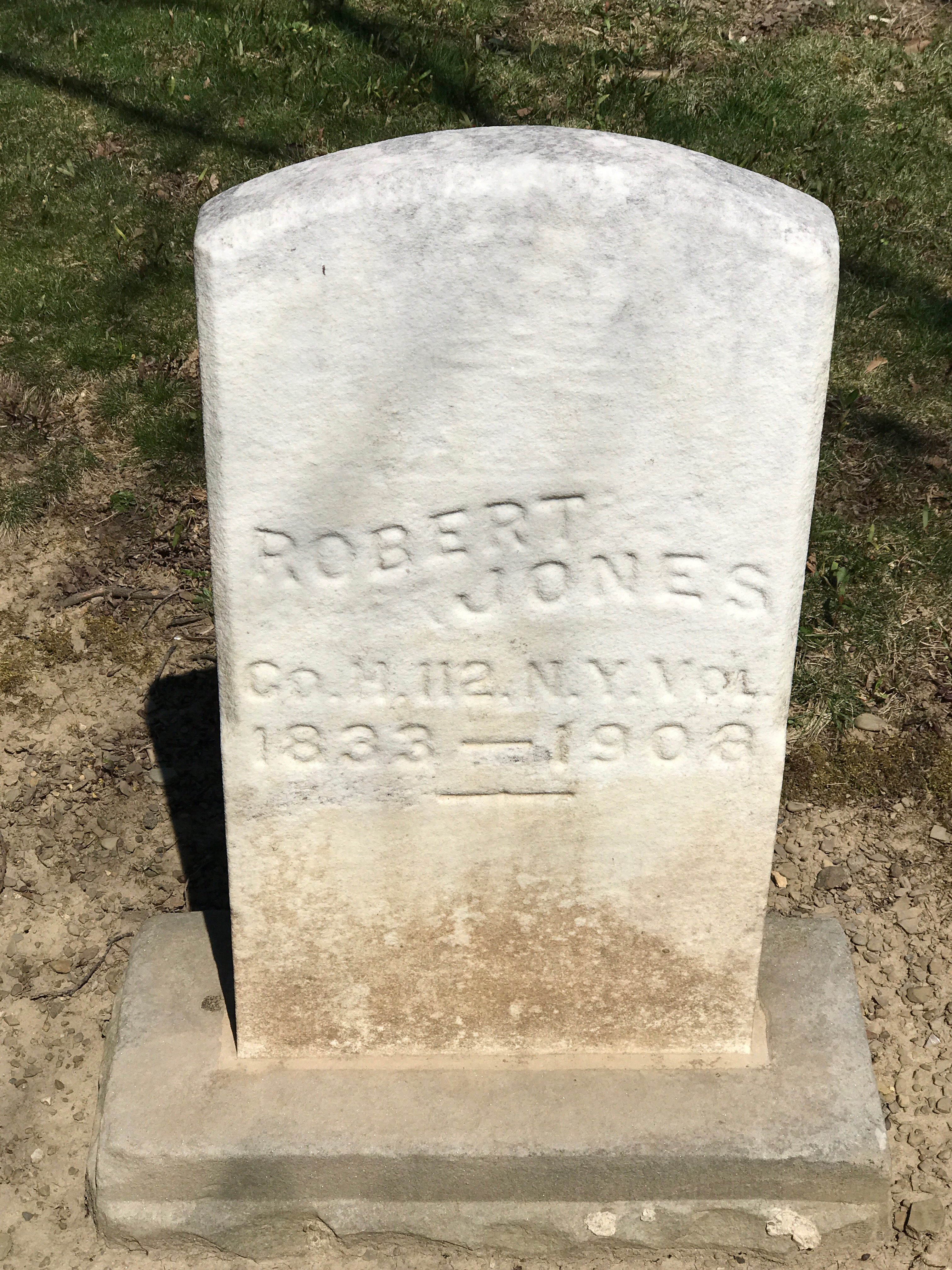
After the war Robert would become a farm laborer, and have three more children Matilda, Delbert, and Hattie.[17] His wife Betsy would die in 1878. Robert would pass on November 11th, 1908[18] at the approximate age of 76. He is interred at Quincy Rural Cemetery Ripley, Chautauqua County, New York, USA.[19]
[1] eburrelle. “Robert Jones.” Ancestry. Accessed February 1, 2021. https://www.ancestry.com/family-tree/person/tree/20830658/person/994697722/facts.
[2] “New York Civil War Muster Roll Abstracts 112th Infantry, Jones, Robert.” Fold3. Accessed February 1, 2021. https://www.fold3.com/image/315812072.
[3] “1840 United States Federal Census for Robert Jones.” Join Ancestry. Accessed February 1, 2021. https://www.ancestry.com/imageviewer/collections/8057/images/4409458_00336?pId=2348221.
[4] “1860 United States Federal Census for Robert Jones.” Ancestry. Accessed February 1, 2021. https://www.ancestry.com/imageviewer/collections/7667/images/4235216_00189?pId=49149036.
[5] eburrelle. “Robert Jones.” Ancestry. Accessed February 1, 2021. https://www.ancestry.com/family-tree/person/tree/20830658/person/994697722/facts.
[6] “New York, U.S., Civil War Muster Roll Abstracts, 49th New York Infantry, Jacob Jones.” Ancestry. Accessed February 1, 2021. https://www.ancestry.com/imageviewer/collections/1965/images/31514_219465-00495?pId=594673.
[7] “New York, U.S., Civil War Muster Roll Abstracts, 49th New York Infantry, Jones Thomas 1861-1900.” Ancestry. Accessed February 1, 2021. https://www.ancestry.com/imageviewer/collections/1965/images/31514_219465-00499?pId=594673
[8] Joel Babcock, The beginning – volunteers for the Army, accessed November 17, 2023, https://www.112thnyvi.com/index.html.
[9] “New York Civil War Muster Roll Abstracts 112th Infantry, Ones, Robert.” Fold3. Accessed February 1, 2021. https://www.fold3.com/image/315812072
[10] Ibid
[11] Ibid
[12] Joel Babcock, Cold Harbor, VA June 1, 1864, accessed November 17, 2023, https://www.112thnyvi.com/page29.html.
[13] William L. Hyde, The mine & ft. Gilmer, accessed November 17, 2023, https://www.112thnyvi.com/page4.html.
[14] “112th Infantry Regiment Civil War Chautauqua Regiment.” 112th NY Infantry Regiment during the Civil War – NY Military Museum and Veterans Research Center. Accessed February 1, 2021. https://dmna.ny.gov/historic/reghist/civil/infantry/112thInf/112thInfMain.htm.
[15] Ibid
[16] “New York, U.S., Civil War Muster Roll Abstracts, 49th New York Infantry, Jacob Jones.” Ancestry. Accessed February 1, 2021. https://www.ancestry.com/imageviewer/collections/1965/images/31514_219465-00495?pId=594673.
[17] “1880 United States Federal Census.” Ancestry. Accessed February 1, 2021. https://www.ancestry.com/imageviewer/collections/6742/images/4242062-00414?pId=1427991.
[18] “New York, U.S., Death Index, 1852-1956 for Robert Jones.” Ancestry. Accessed February 1, 2021. https://www.ancestry.com/imageviewer/collections/61535/images/47952_554183-00456?pId=1785815.
[19] “Robert Jones (1833-1908) – Find A Grave Memorial.” Find a Grave. Accessed February 1, 2021. https://www.findagrave.com/memorial/38795266/robert-jones.
 The Military History Traveler