Green Hill Cemetery in Greensboro North Carolina, is a beautiful place with many interesting stories. One such story is that of Sir Douglas F. Dickerson. He was born to Raymond and Blanche Dickerson in Greenville South Carolina on March 5th, 1920.[1] Douglas was described as 6’ tall, 165 pounds, with brown hair, brown eyes, and a light complexion. He would attend college at North Carolina State College of Agriculture and Engineering (now North Carolina State University) in Raleigh, N.C.. Here he would play quarterback for the football team and outfield in baseball. Dickerson registered for the draft on July 1st, 1941.[2]
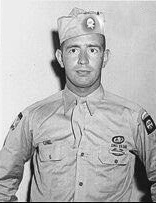
During his Junior year at State the Japanese bombed Pearl Harbor, and Douglas’s number was called. Dickerson was given a deferment to finish out the semester and would become part of the 302nd Ordnance Co. made up of local boys. He was with them at Fort Jackson, and Fort Lewis. While Douglass was at Fort Lewis his brother who was an officer in the 82nd Airborne, personally recommend Douglass for the outfit to then Col. James Gavin. Gavin would call Douglass personally to ask him to join the Paratroopers. Dickerson agreed and his orders would arrive in a week. As Douglass would say later in an interview “he (Gavin) didn’t mess around.”[3] Dickerson would take a train from DC to Fort Benning Georgia and reported for Airborne training. He would later be sent to Camp Claiborne, LA. for commando training. Dickerson would finish his Airborne training at Fort Bragg. Here he was made part of a thirty man “hit squad”, they would be split up in teams of three and placed in each company of the 505th Parachute Infantry Regiment 82nd Airborne. The men of the hit squad were sworn to secrecy and finished their training as “ordinary” paratroopers. Before being sent oversees Douglas would don his jumpsuit and marry Edna Lee Kearns.
His first oversees station was in Tunisia. Douglas’s hit squad would be the first men to jump into Sicily and he was the first man out the door. Their objective was to take an airfield. They killed 108 men, destroyed the barracks, and all German aircraft on the field.[4] Douglass and the hit squad would later meet up with the rest of the 82nd. They would become engaged at Biazza Ridge, where he was almost run down by a German tank. During Dickerson’s 14th day of combat in Sicily he was wounded when a sniper’s bullet hit a grenade in his pocket. The grenade exploded outward embedding the top half in his leg. Dickerson pulled it out by the pin with a pen taking a large chink of skin with it. He bandaged the wound and remained on the line for three more days before being evacuated. Fifty years later a Doctor would find that Dickerson still had that sniper’s bullet in his leg. Returning to action Dickerson and his commandos would jump into Italy again, this time he would land on a cow. Their mission was to destroy a group of German trucks, they would only find a single vehicle and promptly blew up its engine. On the way to extraction they encountered two German patrols of 25 men each and killed them all.[5]
His next combat jump was during the Normandy invasion where he was first out the door as well, this time he landed on an outhouse. Their objective was a major communications unit near Cherbourg. They would destroy it in forty minutes and head to Sainte-Mère-Église. He reached Sainte-Mère-Église in time to see the famous Paratrooper on the church steeple and the town ablaze.[6] Dickerson would be wounded again in the leg, he patched it up and spent 33 straight days on the line during the Normandy Campaign.
Dickerson would then jump into Holland as part of Operation Market Garden. Their objective was Groesbeek where they went house to house to root out the Germans. They then went to Nijmegen to support the other men of the 82nd in taking the bridge. He would spend two months on the line in Holland. Dickerson was then sent to France to a little R & R, however this would only last three days as the Bulge had begun. He and his commando unit were loaded into trucks and sent to St. Vith in order to help free surrounded allied troops. They would use bazookas to hold off German armor, and successfully rescued their beleaguered comrades.
Dickerson would be sent to the Siegfried Line. It was shortly after crossing that he had his most traumatic experience of the war. Dickerson was showing a young replacement where to position his gun when a mortar round exploded near them. The round blew off the young replacements legs, the young man was screaming, and Dickerson held him till the medics had to pry them apart. Douglass then went behind a tree and wept.[7] According to a 1999 interview he still had flashbacks to this incident.
After the fighting around the Siegfried Line Dickerson, and the four remaining original members of the “hit squad” met with General Gavin. Gavin would send them to the rear for a physical and mental checkup. During the exam the Doctors fund that Dickerson had a bleeding ulcer. He would receive a medical discharge in March of 1945.
Dickerson would spend 371 days in combat receiving two Bronze Stars, two Purple Hearts, the Expert Infantry Badge, Triple Combat Infantryman Badge, and the Presidential Unit Citation. He would also receive Croix de Guerre medals from both France and Belgium.
After the war Dickerson would return to Greensboro and resume his education at his education at Guilford College and then High Point College. He graduated in 1949 with a teaching certificate in Social Studies and Physical Education.[8] He was briefly employed as a teacher before working for the United States Postal Service. Dickerson would also coach High School football ant Little League Baseball. He would enjoy showing people his memorabilia gathered during his time overseas as well as items donated by other veterans and their families. The items were displayed in a “mini museum” in his pool house. In 1998 Dickerson published his wartime memoirs, “Doing My Duty”, in which he vividly described his wartime exploits.
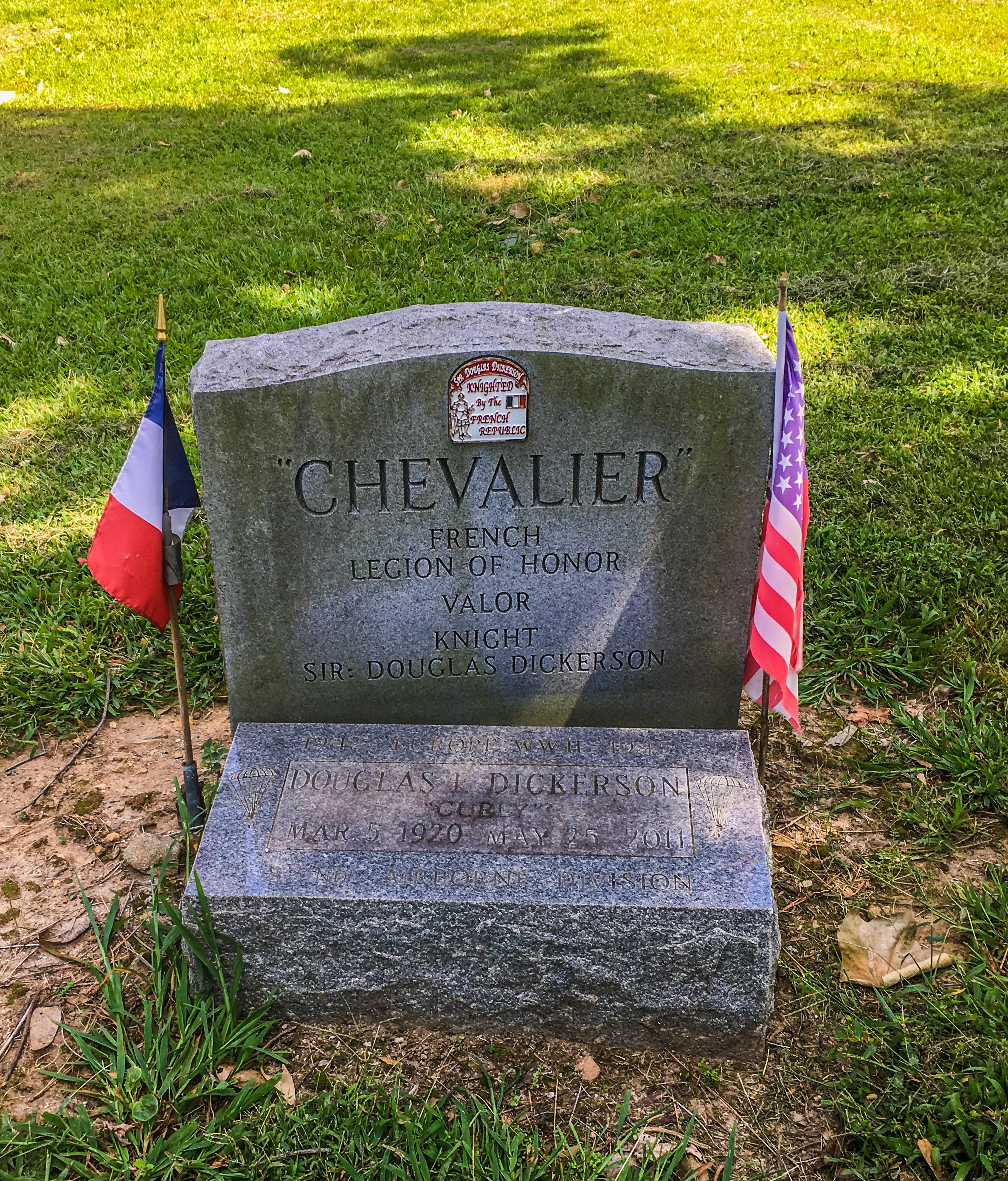
In 2006 The French Legion of Honor gave Dickerson the rank of “Chevalier” or “Knight”. Douglas F. Dickerson died

on May 25, 2011 in Greensboro, N.C., and was buried in Green Hill Cemetery in the same city.
[1] Froggatt, Errin. “Sir Douglas Farnum ‘Curly’ Dickerson.” Ancestry. Accessed November 6, 2019. https://www.ancestry.com/family-tree/person/tree/38740921/person/28890718647/facts.
[2] “U.S. WWII Draft Cards Young Men, 1940-1947 .” Ancestry. Accessed November 7, 2019. https://www.ancestry.com/family-tree/person/tree/38740921/person/28890718647/facts.
[3] Harrington, Sion, and John Durham. “Douglas F. Dickerson Interview, 1999-12-20 [MilColl OH 228] : Free Borrow & Streaming.” Internet Archive, December 20, 1999. https://archive.org/details/MilCollOH228Dickerson.
[4] Ibid
[5] Ibid
[6] Ibid
[7] Ibid
[8] “Doug Dickerson Papers, 1939-2006.” Greensboro History Museum. Accessed November 9, 2019. http://archives.greensborohistory.org/wp-content/uploads/sites/2/pdf/MssColl-204-Dickerson.pdf.
 The Military History Traveler
R.I.P. Trooper
No more ‘jumpin’ through the hole’.
LikeLike