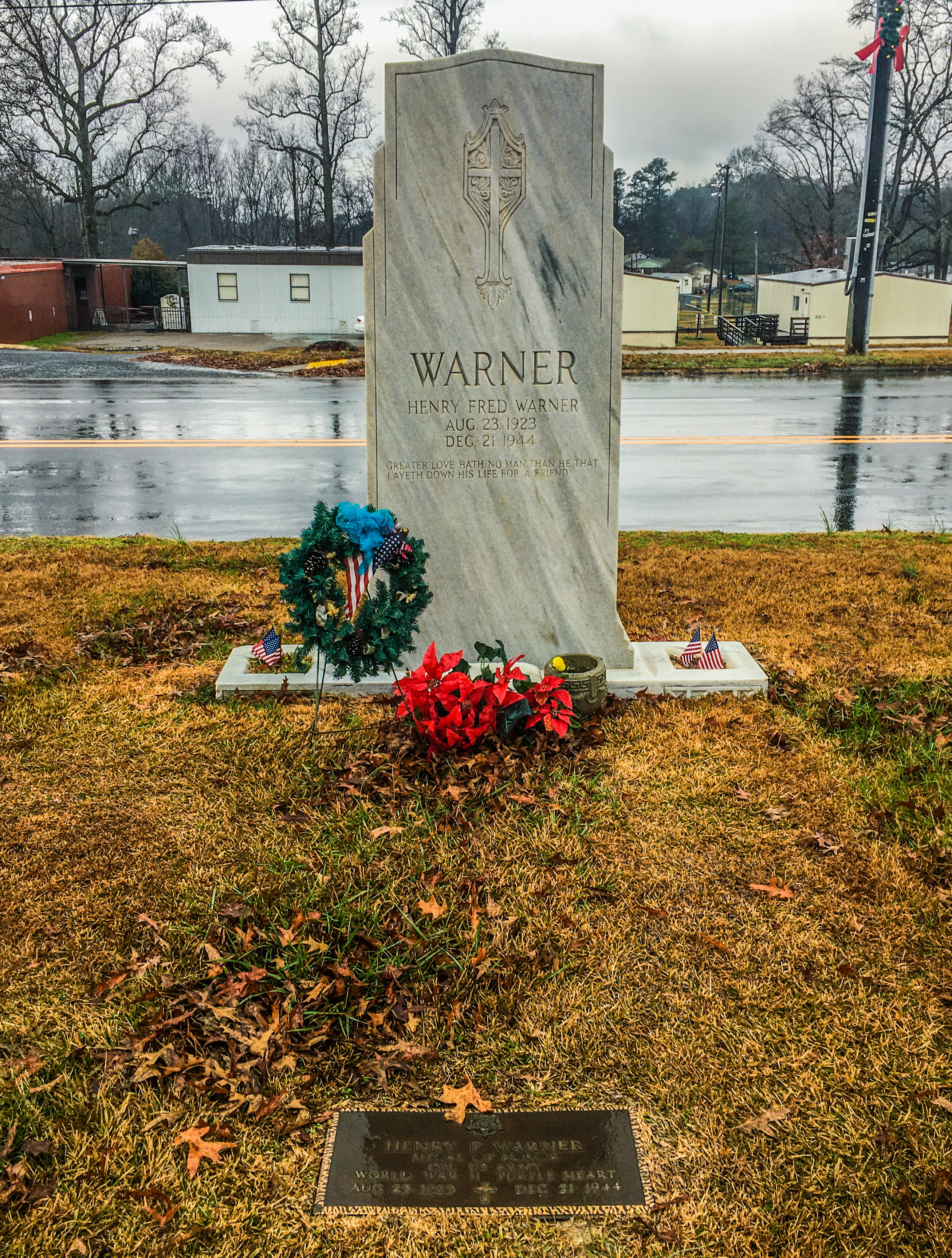
I took a trip to Troy North Carolina earlier in the week. Why Troy you ask? Answer; It is the final resting place of Corporal Henry F. Warner; this is his story.
Henry was born to Earnest and Minnie Warner on August 23rd, 1923 in Troy North Carolina.[1] Sadly, Henry’s father would be a homicide victim when Warner was only five.[2] Henry would attend the local schools, and took a job as a machine operator in the Troy Textile Mill after graduation. He entered the army on January 11th, 1943.[3]
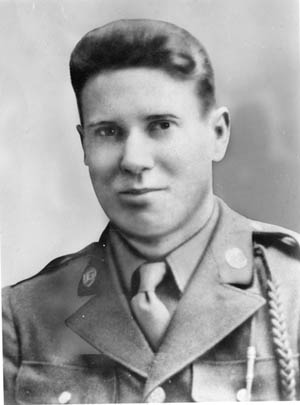
Corporal Warner was listed on his draft card as being six feet tall, 135 pounds, with red hair, and a light complexion. He would be assigned as a 57mm anti tank gunner with the 2nd battalion of 26th Infantry regiment, in the 1st Division (The Big Red One).[4] He would accompany them during the D-day landings, as well as fighting through France and Belgium.
On December 16th, 1944, the German army launched a large offensive into Belgium known as “Battle of the Bulge”. By the 20th of December the allies were practically surrounded and under constant attack, the 26th Infantry was no exception. Early that morning 20 German tanks broke through their line with almost complete surprise due to a dense fog.[5], this is when Corporal Henry Warner sprung into action. Staff Sergeant Stanley Oldenski, witnessed Warner’s actions and describes them as such,
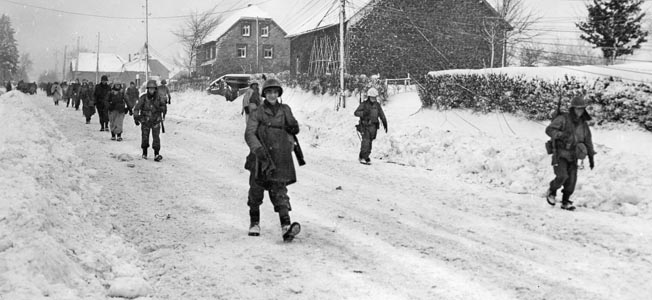
“Two (tanks) headed straight toward Corporal Warner’s position, firing tank cannon and machineguns, He answered the fire and his first round hit the lead tank and set it afire. Four more shots set it afire and destroyed it. “The second tank was firing and coming right at him, but he carefully placed four rounds into it and silenced its cannon and machineguns, “‘then he saw the third Mark V was bearing down on him he didn’t seem to pay any attention. He was working at the breach lock of his weapon and didn’t stop trying to make it work until the tank was within five yards of him. “Then, jumping to the side of the gun pit, he fired his pistol at the tank as it came on and the tank commander fired back with a pistol. Corporal Warner kept firing until the German tank commander threw up his hands and slumped over the side of the tank. The tank retreated. “On the following day, the Jerries threw in a very heavy barrage and again the tanks broke through the battalion line and started machinegunning our riflemen in an attempt to drive them out of their foxholes so the German riflemen could break through. A German Mark IV appeared in front of Corporal Warner’s position and he fired, setting the motor on fire. But its machineguns got off a burst that killed Corporal Warner.”[6]
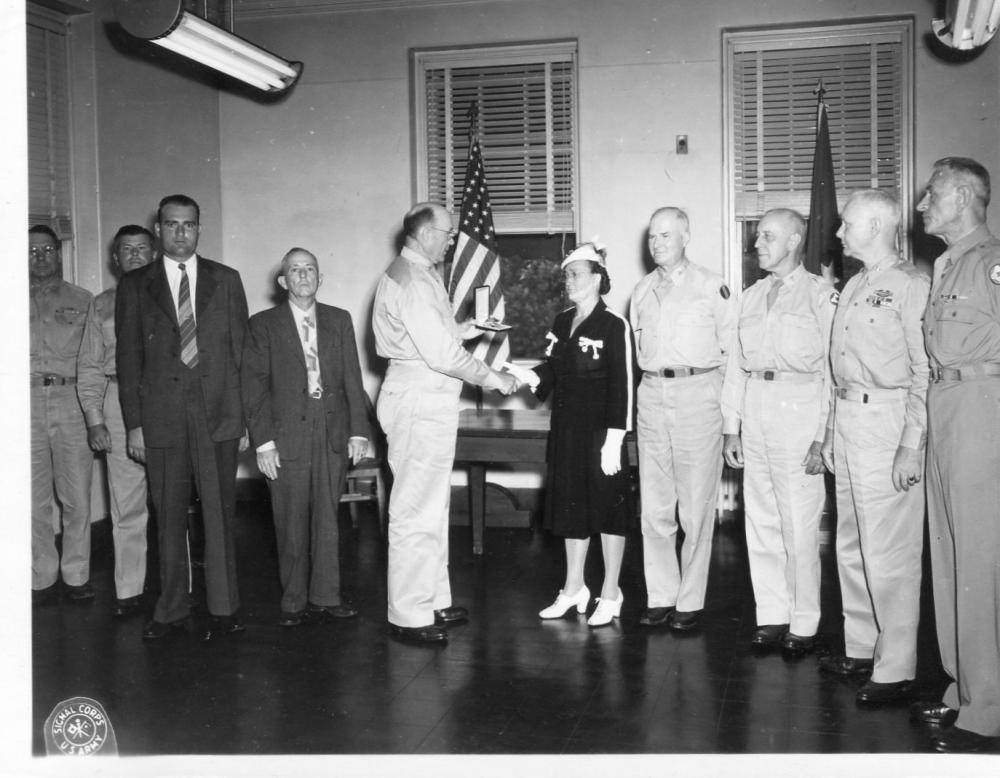
For his actions those two days Corporal Warner was posthumously awarded the Medal of Honor. The decoration was presented to his mother by General John T. Kennedy in a ceremony at Fort Bragg on July 6th, 1945.[7]
His official citation reads; “Serving as 57-mm. antitank gunner with the 2d Battalion, he was a major factor in stopping enemy tanks during heavy attacks against the battalion position near Dom Butgenbach, Belgium, on 20-21 December 1944. In the first attack, launched in the early morning of the 20th, enemy tanks succeeded in penetrating parts of the line. Cpl. Warner, disregarding the concentrated cannon and machine gun fire from 2 tanks bearing down on him, and ignoring the imminent danger of being overrun by the infantry moving under tank cover, destroyed the first tank and scored a direct and deadly hit upon the second. A third tank approached to within 5 yards of his position while he was attempting to clear a jammed breach lock. Jumping from his gun pit, he engaged in a pistol duel with the tank commander standing in the turret, killing him and forcing the tank to withdraw.
Following a day and night during which our forces were subjected to constant shelling, mortar barrages, and numerous unsuccessful infantry attacks, the enemy struck in great force on the early morning of the 21st. Seeing a Mark IV tank looming out of the mist and heading toward his position, Cpl. Warner scored a direct hit.
Disregarding his injuries, he endeavored to finish the loading and again fire at the tank whose motor was now aflame, when a second machine gun burst killed him. Cpl. Warner’s gallantry and intrepidity at the risk of life above and beyond the call of duty contributed materially to the successful defense against the enemy attacks.”[8]
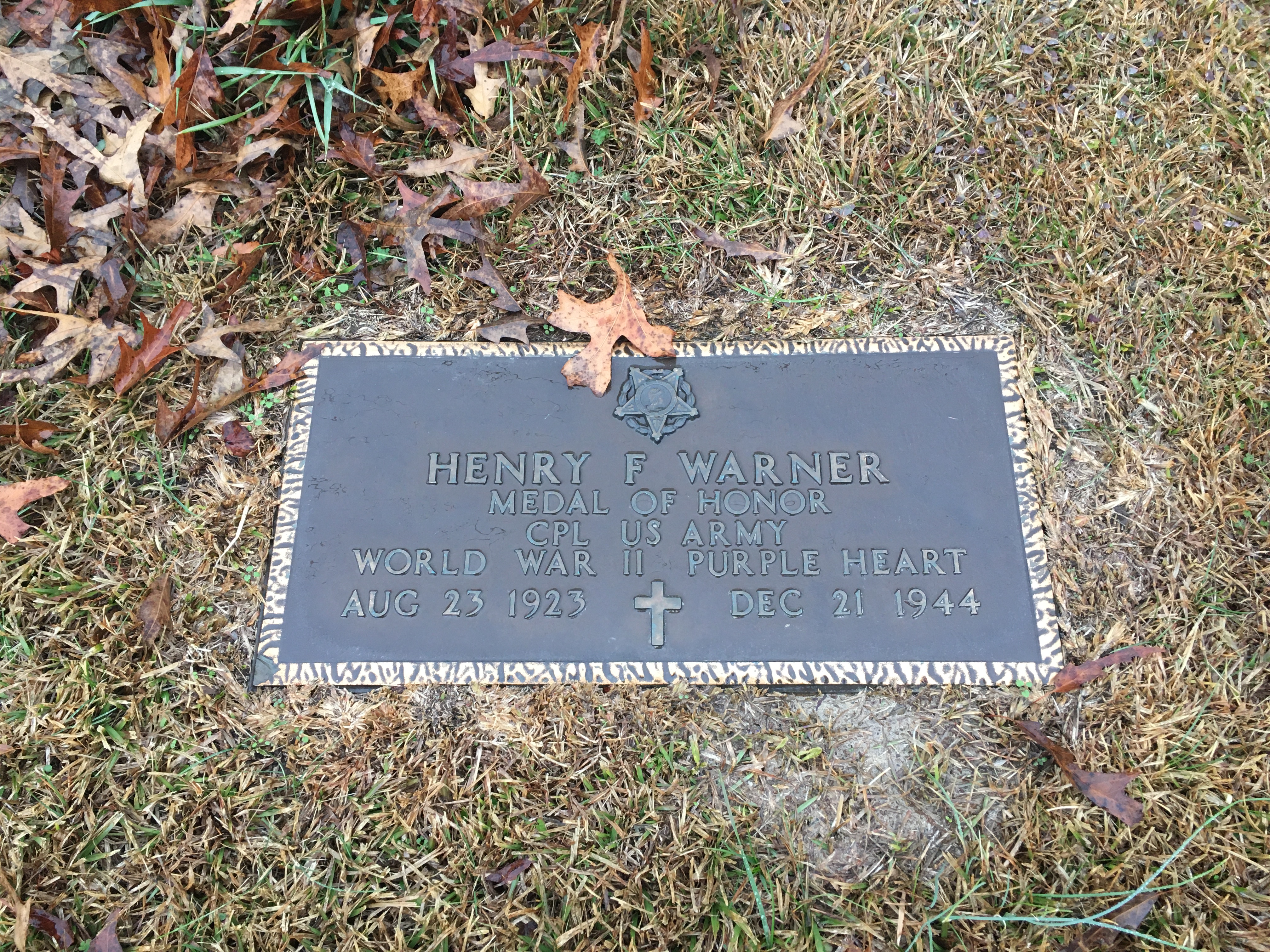
Corporal Warner’s body was repatriated in November of 1947,[9] and he was interred at Southside Cemetery in Troy North Carolina. He was survived by his mother, brother, and sister.[10]

Grave of Corporal Henry F. Warner at Southside Cemetery in Troy, North Carolina. Photo By @firefightinirish
[1] “Henry Fred Warner U.S. WWII Draft Cards Young Men, 1940-1947.” Search. Accessed December 29, 2019. https://tinyurl.com/rh8lrgq.
[2] “North Carolina, Deaths, 1906-1930 Earnest Coll Warner.” Search. Accessed December 29, 2019. https://tinyurl.com/r3tm78e.
[3] “U.S., War Department, Press Releases and Related Records, 1942-1945 Box 14: B 951 – C 270.” Ancestry.com. Accessed December 29, 2019. https://search.ancestry.com/search/db.aspx?dbid=3026. Pg. 3
[4] Ibid
[5] Ibid, Pg. 1 & 2
[6] Ibid
[7] “MOTHER RECEIVES MEDAL OF HONOR AWARDED HER SON.” Asheville Citizen-Times, July 7, 1945.
[8] “CPL Henry F. Warner.” First Division Museum. Accessed December 29, 2019. https://www.fdmuseum.org/about-the-1st-infantry-division/medal-of-honor-recipients/cpl-henry-f-warner/.
[9] “Carolinas War Dead To Arrive This Week.” The Charlotte Observer , November 23, 1947.
[10] “Henry F Werner in the 1940 Census: Ancestry.” Ancestry.com. Accessed December 29, 2019. https://tinyurl.com/u53ot2h.
 The Military History Traveler
Their sacrifices can not be forgotten!
LikeLike