A Touching Letter from the Field: The Story of Captain Michael McGuire.

It never ceases to amaze me, how a letter can come alive with some digging. This letter written by then Captain Michael McGuire to his wife Elizabeth is one such correspondence. The document is dated October 31st, 1864. It reads…….

“Before Petersburg

October 31st, 1864,

My Dear and Loving Wife, I have been waiting very anxiously for a letter this last 2 weeks but got none to this date. So it makes me very uneasy and it was impossible for me to write sooner as we had so much work to do around the first of the month, it being muster day. I had 15 rolls to make out and three- monthly returns. I have command of three camps besides all the clothing and ordnance. For a person of my small ability is a hard job. So you may guess my feeling.
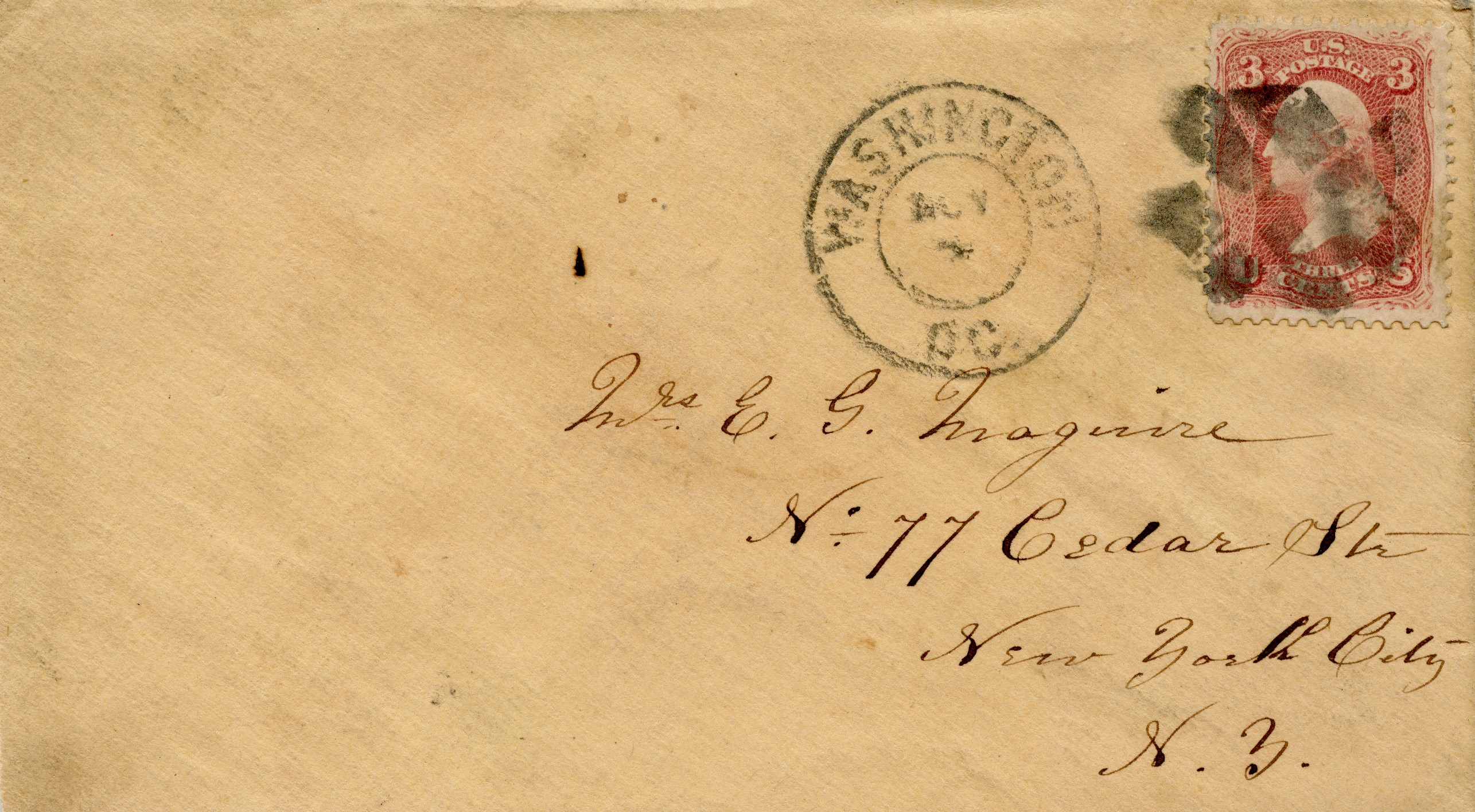
Envelope for Captain Michael McGuire’s letter. Provided by The American Military Heritage Museum Of North Carolina

I find it harder than to fight or march. I did make an attempt to write to you on the 26th, But the order came for us to get ready for a march with six days rations. So, we started at 2 o’clock p.m. that afternoon and marched until about 8 o’clock next day when we got engaged with the enemy and our charged them two different times and them right into a place called Hatcher’s Run. At one time it looked like there was one canteen, roar of musketry all day and all might as there was only two divisions of our corps engaged and we whipped them well for the manner in which General Egan handles the troops. He was breveted a Major General.
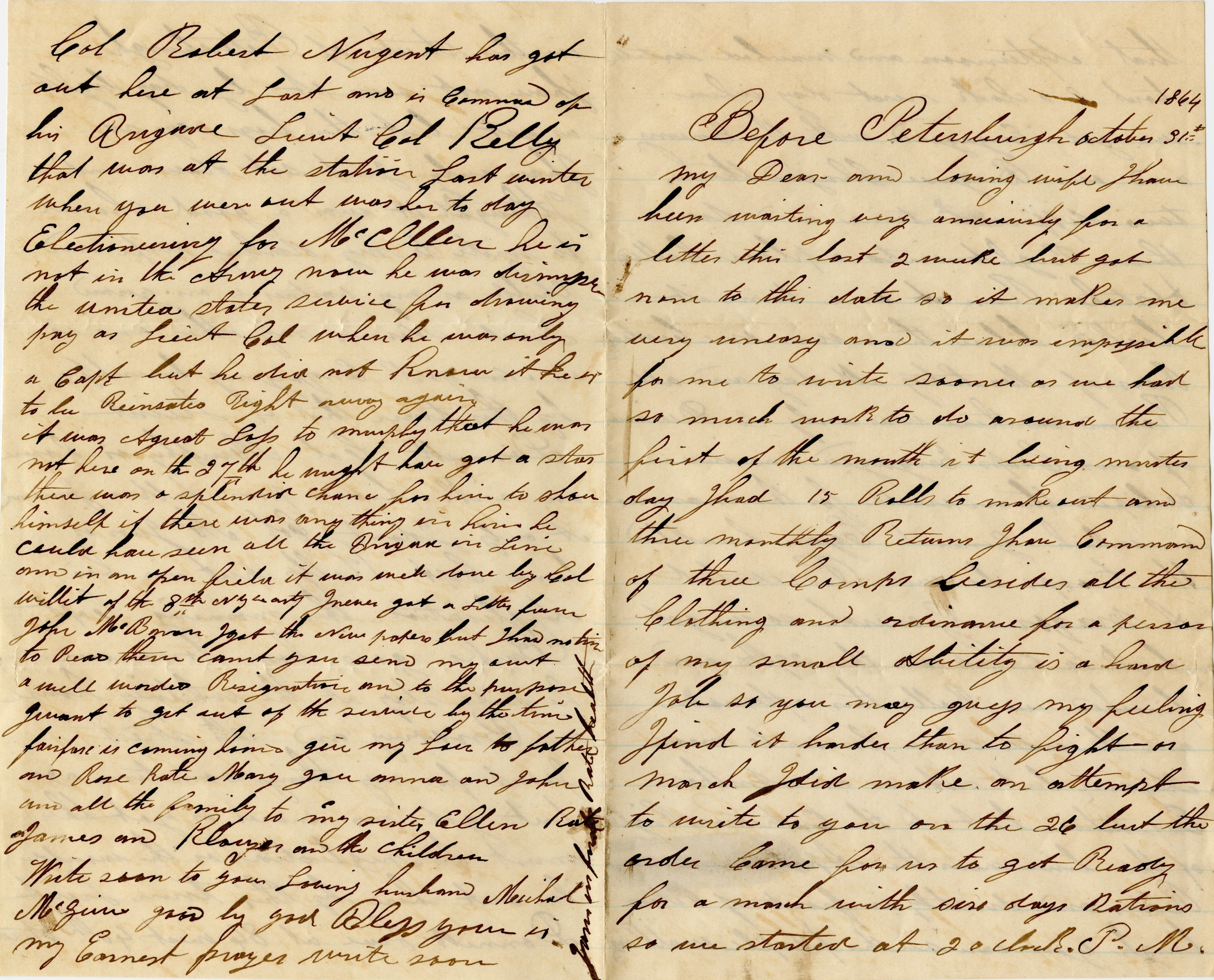
Front of Captain Michael McGuire’s letter. Provided by, The American Military Heritage Museum Of North Carolina

So, we got back to camp on the 29th and finished our rolls this afternoon. And the order came for us to move again. But not on another expedition. But to the extreme right of the line near the Appomattox River and directly in front of Petersburg. You can see the people walking in the streets of Petersburg. I have not seen it by daylight as yet. But the boys say so. I have only just sat down and I thought it was a good chance to write to my darling wife and child. As my partner is on guard., Lieutenant Nevin. My other one, is in New York enjoying himself by this time. That is Lieutenant Donett. Colonel Murphy is home on sick leave. Poor fellow. I mean it, only I don’t. Colonel McGunn is home. Captain Kelly put in his application this morning. Captain Burke goes home tomorrow. He will stay at the Whitney House on Broadway and 12th Street. I sent for my things sometime ago. But got no answer as yet. They must be neglecting or they would be out here by this time.

Lieutenant Donett lives at 86 West 40th Street. Colonel Robert Nugent has got out here at last and in command of his Brigade. Lieutenant Colonel Kelly that was at the station last winter when you were out, was here today electioneering for McClellan. He is not in the army now. He was dismissed from the United States service for drawing pay as lieutenant colonel when he was only a captain. But he did not know it. He is to be reinstated right away again. It was a great loss to Murphy that he was not here on the 27. He might have got a star.There was a splendid chance for him to show himself if there was anything in the fight. He could have seen all the Brigade in line and in an open field. It was not done by Colonel Willett of the 8th New York Artillery.
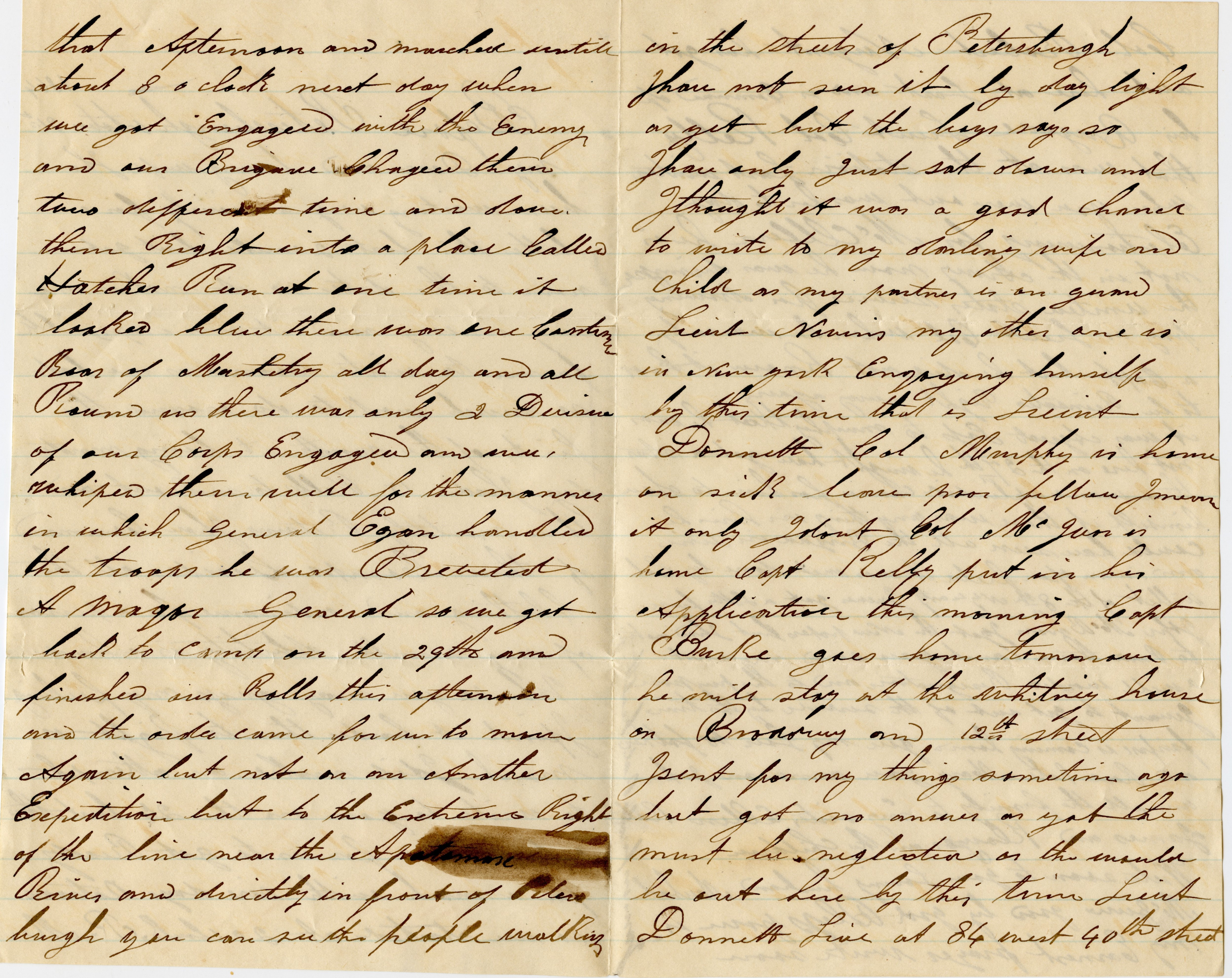
Back of Captain Michael McGuire’s letter. Provided by, The American Military Heritage Museum Of North Carolina


I never got a letter from John McBowen. I got the newspapers but I had no time to read them.
Can’t you send me out a well worded resignation and to the purpose I want to get out of the service by the time Fairfax is coming soon.

Give my love to Father and Rose Kate, Mary, you, Anna and John and all the family. To my sister Ellen, Kate and James and Klayer and the children.

Write soon to your loving husband,

Michael McGuire,

Goodbye. God Bless You. It is my earnest prayer. Write soon.
James is in first rate health.”
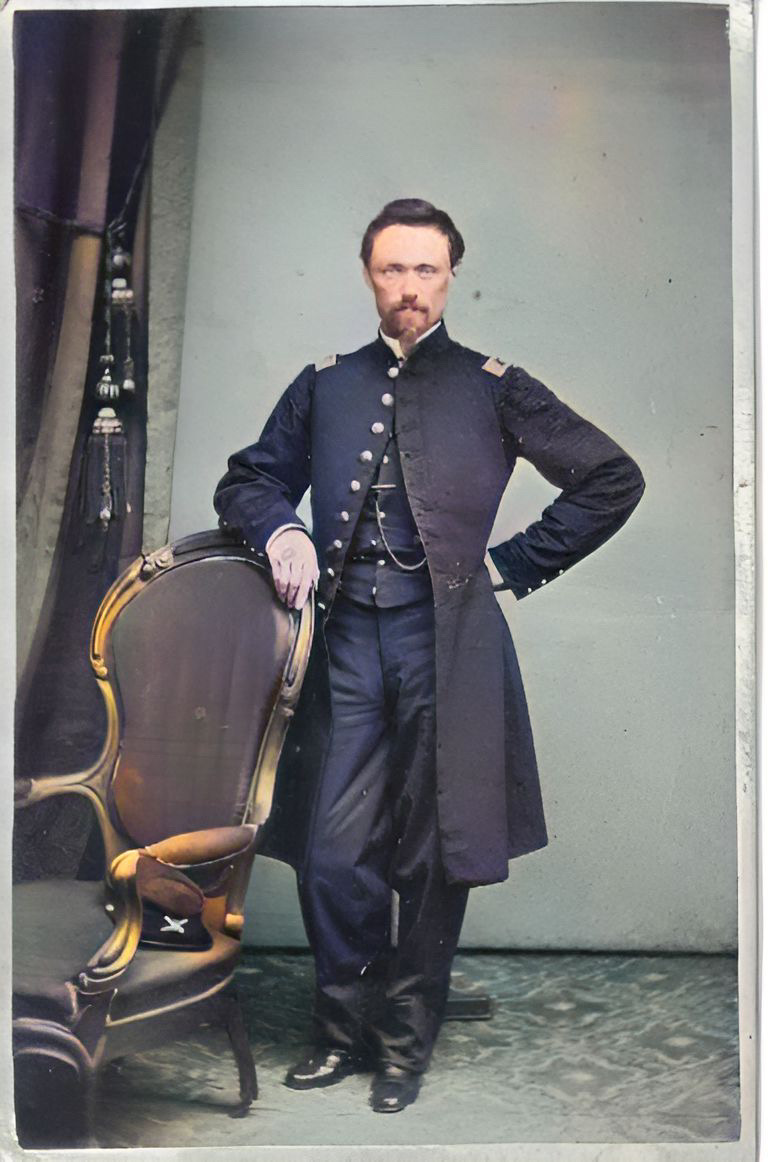
Image of Capt. McGuire retrieved from: https://www.beyondthecrater.com/…/182nd-new-york-infantry/
Colorized by @Pixelup

                McGuire was born in Caltra, County Galway Ireland on September 3rd, 1833. [1]The famine would force him to emigrate from Ireland abord the Clipper “Fidelia”, on October 6th, 1847.[2] He was described as five feet seven inches tall with blue eyes, brown hair, and a light complexion.[3] McGuire would settle into New York City and become a naturalized citizen in 1856.[4] Before the outbreak of the American Civil War McGuire would marry Elizabeth Moore. They would have a son in February of 1861.[5]

                McGuire would enlist on April 20th, 1861,[6] and be mustered into company “D” 69th New York State Militia as a private. He would be with the regiment during First Bull Run where he was wounded. McGuire would be promoted to Captain of the 69th and later enlist in the 182nd New York. He would be commissioned a Capt. of that regiment on November 17th, 1862.[7]  

Captain McGuire participated in the following engagements, The Battle of Deserted House, The Siege of Suffolk, Spotsylvania Court House, North Anna River (wounded left forearm), and Hatchers Run (wounded right side of chest). He would be promoted to Brevet Major on July 15th, 1865.[8]

After the war McGuire was promoted to Lieutenant Colonel of the 69th N.G.S.N.Y. Sadly, his wife Elizabeth would die of consumption on September 18th, 1869,[9]. He and his son would own a successful contracting company in Brooklyn. McGuire would marry Eliza T. Cloonan in 1873[10] and they would have one son. Lieutenant Colonel McGuire would die of Pneumonia in 1909.[11] The local chapter of the Grand Army of The Republic, provided full military honors at his burial. McGuire now rests in New York’s’ Calvary Cemetery.


[1] Maguire47. (n.d.). Dad’s Great G Pops, Lt. Col Michael Maguire GAR Obit 10-1-09. Ancestry.Com. Retrieved from https://www.ancestry.com/mediaui-viewer/tree/5960414/person/-1368421212/media/ba18d35a-8540-4f73-b53b-f807e410c755

[2] “New York, U.S., Arriving Passenger and Immigration Lists, 1820-1850.” Ancestry. Accessed July 28, 2023. https://www.ancestry.com/discoveryui-content/view/839884:7485?ssrc=pt&tid=30840402&pid=12456814137.

[3] Maghe, Joseph. Captain Michael McGuire. May 2, 2016. Https://Tinyurl.Com/3nruc2m3.

[4] McGuire, Nadine Freeman. “Naturalization.” Ancestry, n.d. https://www.ancestry.com/family-tree/person/tree/30840402/person/12456814137/facts?_phsrc=csG378&_phstart=successSource.

[5] McGuire, Nadine Freeman. “Birth of Son” Ancestry, n.d. https://www.ancestry.com/family-tree/person/tree/30840402/person/12456814137/facts?_phsrc=csG378&_phstart=successSource.

[6] Maghe, Joseph. Captain Michael McGuire. May 2, 2016. Https://Tinyurl.Com/3nruc2m3.

[7] “Michael McGuire New York Civil War Muster Roll Abstracts.” Fold3. Accessed July 29, 2023. https://www.fold3.com/image/316249792?terms=war%2Cyork%2Cus%2Ccivil%2Cnew%2Cunited%2Camerica%2Cmcguire%2Cmichael%2Cstates.

[8] Maghe, Joseph. Captain Michael McGuire. May 2, 2016. Https://Tinyurl.Com/3nruc2m3.

[9] Ibid

[10]   McGuire, Nadine Freeman. “Marriage 1872” Ancestry, n.d. https://www.ancestry.com/family-tree/person/tree/30840402/person/12456814137/facts?_phsrc=csG378&_phstart=successSource.

[11] McGuire, Nadine Freeman. “Death” Ancestry, n.d. https://www.ancestry.com/family-tree/person/tree/30840402/person/12456814137/facts?_phsrc=csG378&_phstart=successSource
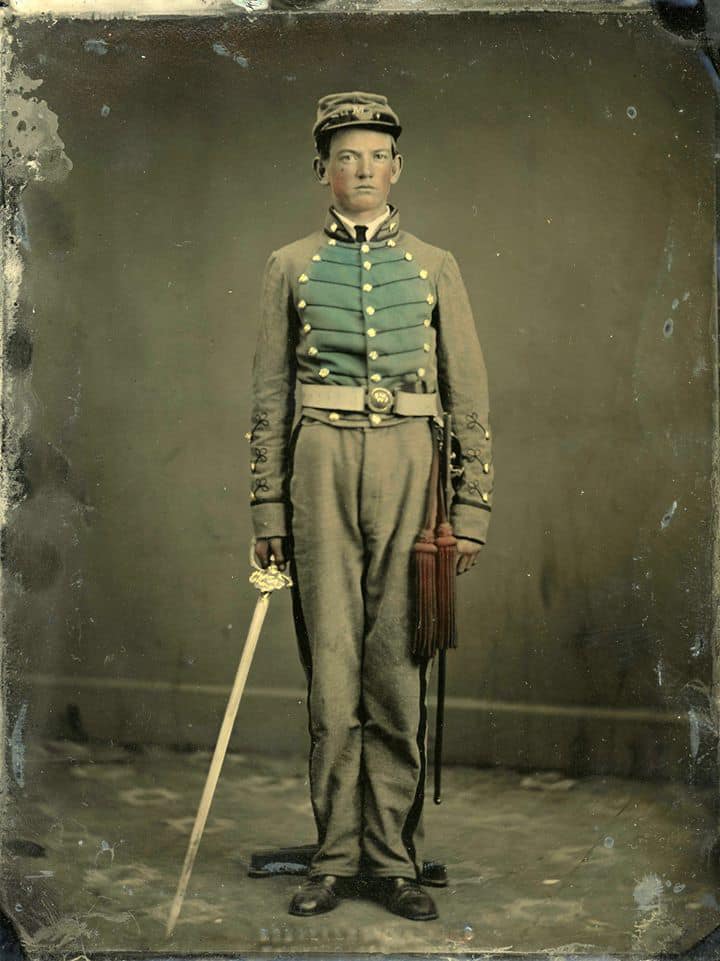
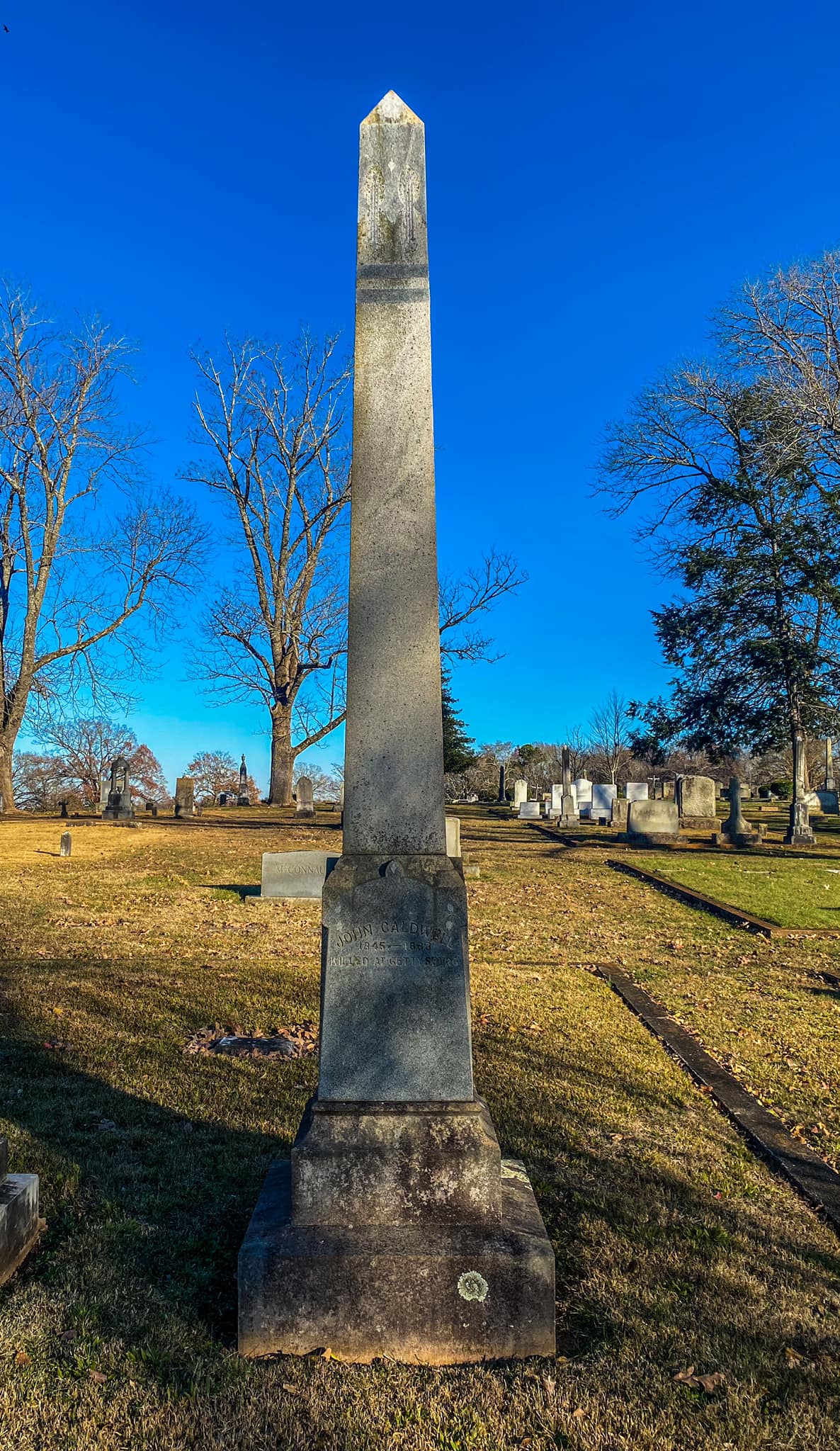
A soldier’s story at Forest hill Cemetery Morganton North Carolina.

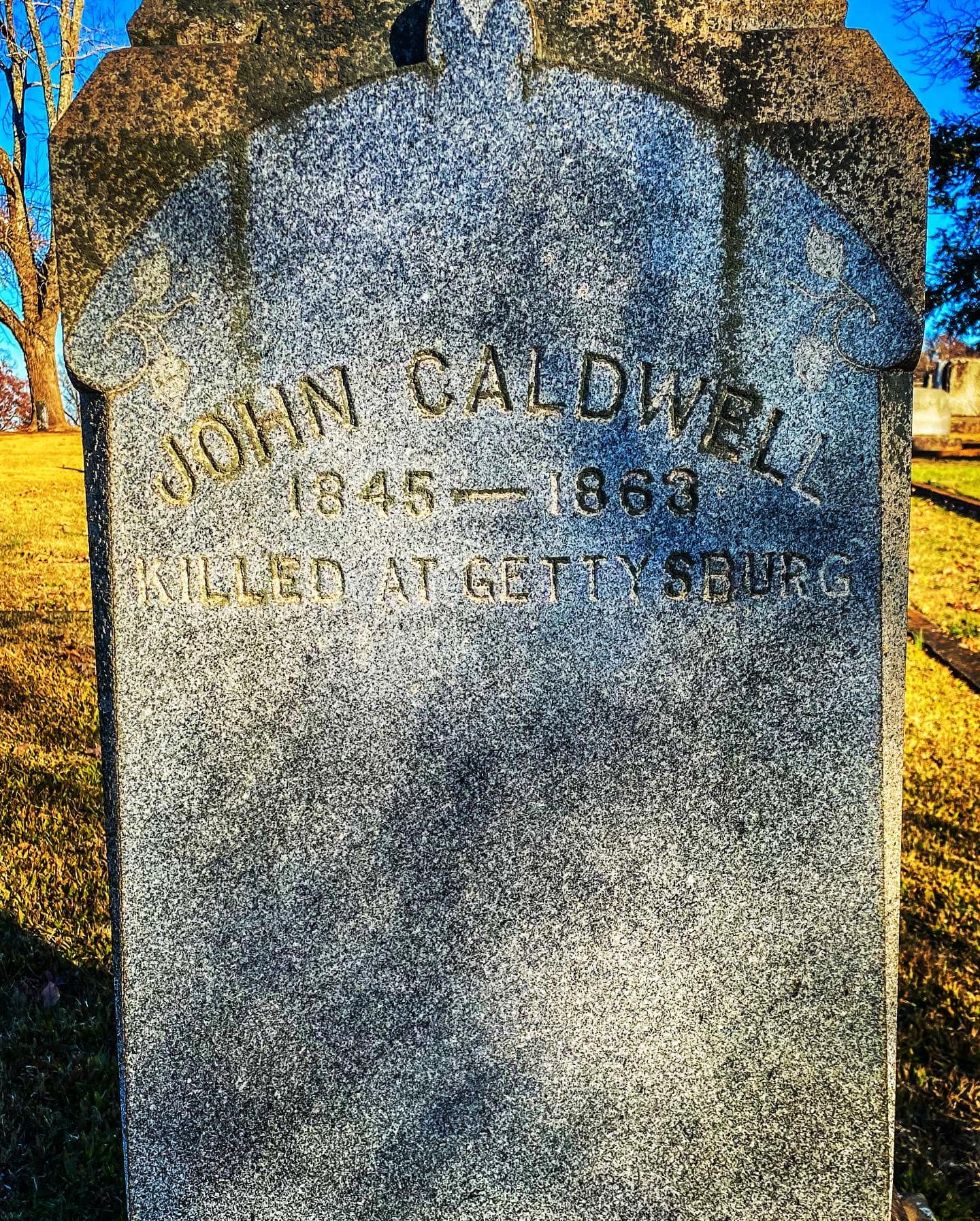
On my way back from Asheville I made a quick stop in Morganton. Here I paid respects to Lieut. John Caldwell. He was born in 1845 at Morganton, North Carolina to Tod & Minerva Caldwell. John grew up and worked on his family farm. In 1861 John who was known as “Jack”, was a Cadet at the Hillsboro Military Academy.[1] His father was a Unionist, but John went against his father’s wishes and chose to join his friends and defend his state. In July of 1861 John Was a member of the 6th North Carolina Volunteers stationed in Staunton Virginia.[2] By December of 1861, Caldwell was serving as a Drill Instructor for the state of North Carolina in a training camp at Asheville.[3]  He continued in this capacity through 1862, until most of the volunteer regiments had organized and marched off. On May 5th, 1863, John Caldwell was mustered into “E” Co. 33rd North Carolina Infantry as a Private.[4]

1/4 plate tintype of Lieut. John Caldwell Courtesy of the Brem Family Collection.

He would be immediately promoted to Lieut. in order to replace the 33rd’s loses from the Battle of Chancellorsville.[5]  Upon hearing of Young Johns promotion his father sent him a letter containing some wise fatherly advice… “Don’t be tyrannical or overbearing toward your men. Be kind and obliging to everyone no matter how low or humble his position may be, and if you get into battle be like a man and a true soldier. Be kind and merciful to your enemies if any should be placed in your power. It is a badge of true courage and of a gentlemanly Christian spirit to show mercy and kindness to your enemies and it may in the fortunes of war happen that you may need the friendship of those you are fighting against. Observe vigorously the golden rule, “to do unto others as you would have them do unto you.” Oh what would I not give if this cruel and unnatural war was ended and you and your army and in honor return home to your friends.”[6]            

Lieut. Caldwell led his men during the march into Pennsylvania, he and his men were shelled along the way, and performed picket duty. They would reach Gettysburg on July 1st at around 15:30 they “on the right of the Division in the final and successful movement against the Union forces on Seminary Ridge held back Union Cavalry which threatened the flank and had a sharp conflict at the stone wall on Seminary Ridge just south of Fairfield Road.”[7]  On the second day the 33rd was involved in some heavy skirmishing. “our line of battle was not engaged but there was a very strong picket fighting in front of us and as it was the turn of his company to go out on skirmish he (John Caldwell) was skirmishing all day and was not relived until about sundown. He took his skirmishers out in gallant style and during the day lost two of his company killed and several wounded.”[8]  On the third day Lieut. Caldwell and the 33rd took part in the Pickett–Pettigrew–Trimble Charge, as part of Longstreet’s assault. During the assault Lieut. Caldwell and Lieut. Wilson Lucas were ordered by General Pender to command 75 men and take a farm lane. Lieut. Wilson Lucas writes of this action saying…. 

Gravestone of Lieut. John Caldwell 33rd North Carolina Infantry at Forest hill Cemetery Morganton North Carolina Photo By @firefightinirish

“We formed the men in line, I commanded the right and Lieut. Caldwell the left. We had to charge through an open field, with no protection whatever. … When we got within two hundred yards of the Federals, we charged with a yell, and they stood their ground until we were within ten steps of the road, then a part of them ran, but 26 surrendered. And the very last time they fired upon us, which was not more than twelve or fourteen feet from them, they shot Lieut. Caldwell in the left breast. I did not see him fall. As soon as we were in the road one of the men told me Lieut. Caldwell was killed. I went at once to the left and found him, lying partly on his back and side … I called two men, and we placed him on his back and spread his oil cloth over him. He was warm and bleeding very freely when I got to him. I could not send him out to the regiment, for it was such an exposed placed the Federal skirmishers would have killed a man before he could get a hundred yards, as we were lying close to each other.”[9] 

Currier & Ives. The battle of Gettysburg, Pa. July 3d. United States, 1863. [New York: Published by Currier & Ives, ?] Photograph. https://www.loc.gov/item/90709061/.

Lieut. Caldwell’s commanding officer Col. Avery in letter to John’s father wrote “You may have the satisfaction to know that he fell where we would all wish to fall (if it be God will) with his face to the enemy.’[10] Lieut. John Caldwell’s body was buried on Seminary Ridge that night “near “two honey-pod trees … not far from an old two-story house.”[11] Even with the reports of Lieut. Caldwell falling before the enemy, his father refused to believe his son was killed.

Inscription on Lieut. John Caldwell’s grave at Forest hill Cemetery Morganton North Carolina. Photo By @firefightinirish

It was not until Tod R, Caldwell was governor of North Carolina, that he found out his son’s fate. It was told to him by Lieut. Wilson Lucas who was then a state legislature. It was said that the Governor “locked himself in his room and was all day in tears”.[12] Gov. Caldwell kept this secret from his wife for 14 years, she found out when Lieut. Caldwell’s bloodied commission to Lieut. Was sent home by a New Yorker who had found it on the Battlefield. Lieut. Caldwell’s body would be returned to North Carolina and reinterned at Forest Hill Cemetery in Morganton.  Let us never forget this young man’s sacrifice for his state and his country.   


[1] “Tod Robinson Caldwell Papers, 1801-1890.,” UNC University Libraries, accessed November 28, 2021, https://finding-aids.lib.unc.edu/00128/#folder_5#1.  Scan 12

[2] Ibid, Scan 14

[3] Ibid, Scan 25

[4] “Page 2 Civil War Service Records (CMSR) – Confederate – North Carolina,” Fold3, accessed November 29, 2021, https://www.fold3.com/image/45066577.

[5] Ibid

[6] Christopher M. Watford, The Civil War in North Carolina: Soldiers’ and Civilians’ Letters and Diaries, 1861-1865 (Jefferson, North California: McFarland & Company, Inc., Publishers, 2009). Pg. 278

[7] “History of the 33rd North Carolina Infantry Regiment in the Civil War,” The Civil War in the East, May 17, 2021, https://civilwarintheeast.com/confederate-regiments/north-carolina/33rd-north-carolina-infantry-regiment/.

[8] Don Ernsberger, Also for Glory: The Pettigrew-Trimble Charge at Gettysburg July 3, 1863 (United States: Xlibris Corp, 2008). Pg. 57

[9] Michael C. Hardy, General Lee’s Immortals: The Battles and Campaigns of the Branch-Lane Brigade in the Army of Northern Virginia, 1861-1865 (El Dorado Hills, CA: Savas Beatie LLC, 2018). Pg. 330

[10] Biff Hollingsworth, “18 July 1863: ‘You May Have the Satisfaction to Know That He Fell Where We Would All Wish to Fall (If It Be God Will) with His Face to the Enemy.”: Civil War Day by Day,” 18 July 1863: “You may have the satisfaction to know that he fell where we would all wish to fall (if it be God will) with his face to the enemy.” | Civil War Day by Day, accessed November 29, 2021, https://web.lib.unc.edu/civilwar/index.php/2013/07/18/18-july-1863-you-may-have-the-satisfaction-to-know-that-he-fell-where-we-would-all-wish-to-fall-if-it-be-god-will-with-his-face-to-the-enemy/.

[11] Michael C. Hardy, General Lee’s Immortals: The Battles and Campaigns of the Branch-Lane Brigade in the Army of Northern Virginia, 1861-1865 (El Dorado Hills, CA: Savas Beatie LLC, 2018). Pg. 350

[12] John Hartwell, “Lt. John Caldwell, 33rd North Carolina, Pender’s Brigade,” Civil War Talk, n.d., https://civilwartalk.com/threads/lt-john-caldwell-33rd-north-carolina-penders-brigade.135030/?amp=1.

A Letter From John Curran of the Irish Brigade

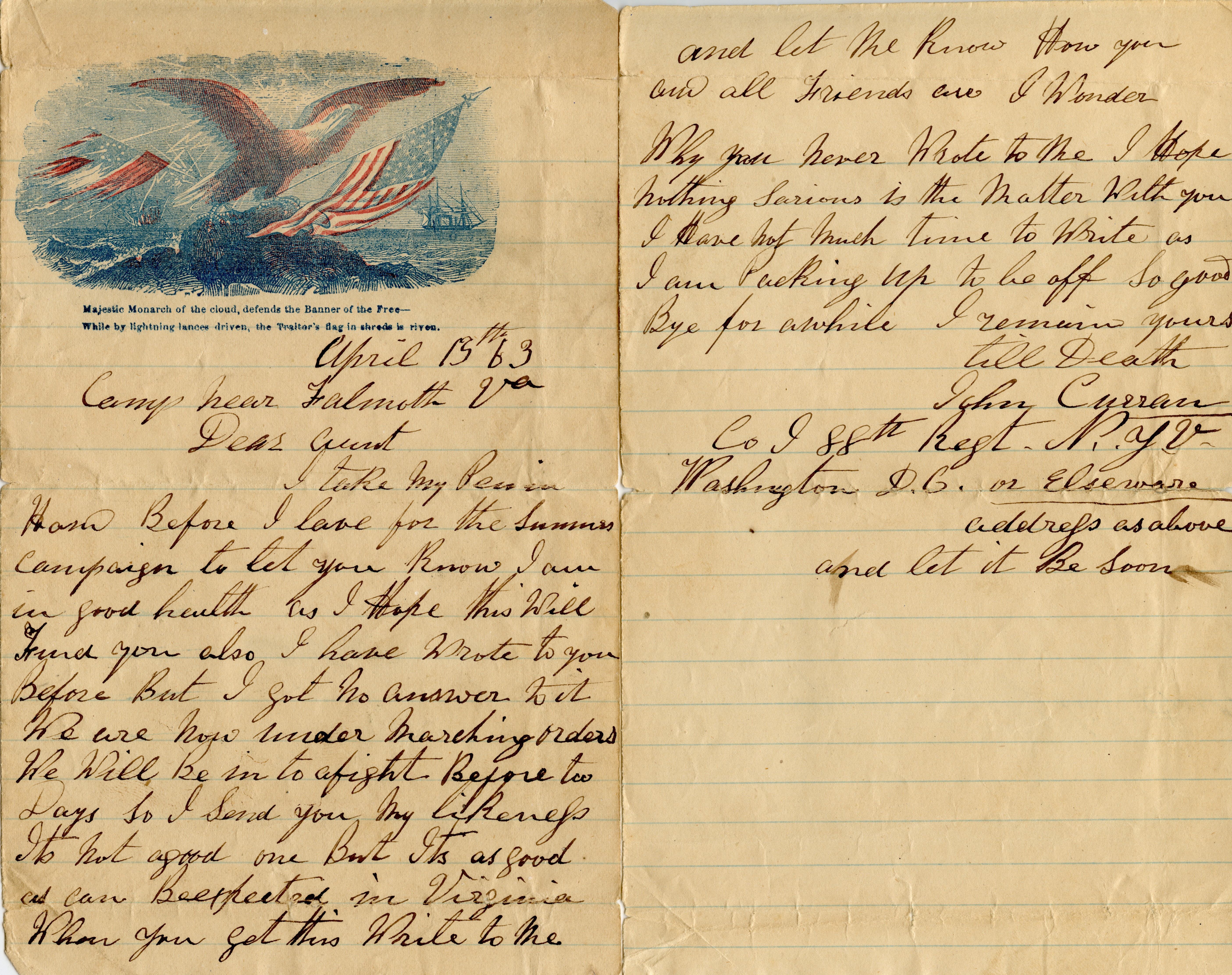
The Irish American experience in the Civil War takes on many facets. These can be seen in documents and stories. One such document is this letter composed by John Curran, of “I” Co. 88th Regiment New York Volunteers (Irish Brigade). The letter reads….


Camp Near Falmouth, Virginia
April 13th 1863

Dear Aunt,

I take my pen in hand before I leave for the Summer Campaign to let you know I am in good health. As I hope this will find you also. I have wrote to you before, but I got no answer to it.

We are now under marching orders. We will be into a fight before two days. So I send you my likeness. It is not a good one. But it’s as good as can be expected in Virginia.When you get this, write to me and let me know how you and all friends are. I wonder why you never wrote to me. I hope nothing serious is the matter with you. I have not much time to write as I am packing up to be off.
So good bye for a while.
I remain yours till death,

John Curran
Company I, 88th Regiment New York Volunteers
Washington, DC or elsewhere
Address as above and let it be soon.

John Curran was born in Ireland in 1843[1]  Curran would arrive in America and become a butcher. Soon after the outbreak of the American Civil War John heard the call. He would enlist in New York City on September 27th, 1861.[2] John would be mustered into “I” Co. 88th New York Infantry part of the famed Irish Brigade that same day. On the muster roll John Curran is listed as a Private.

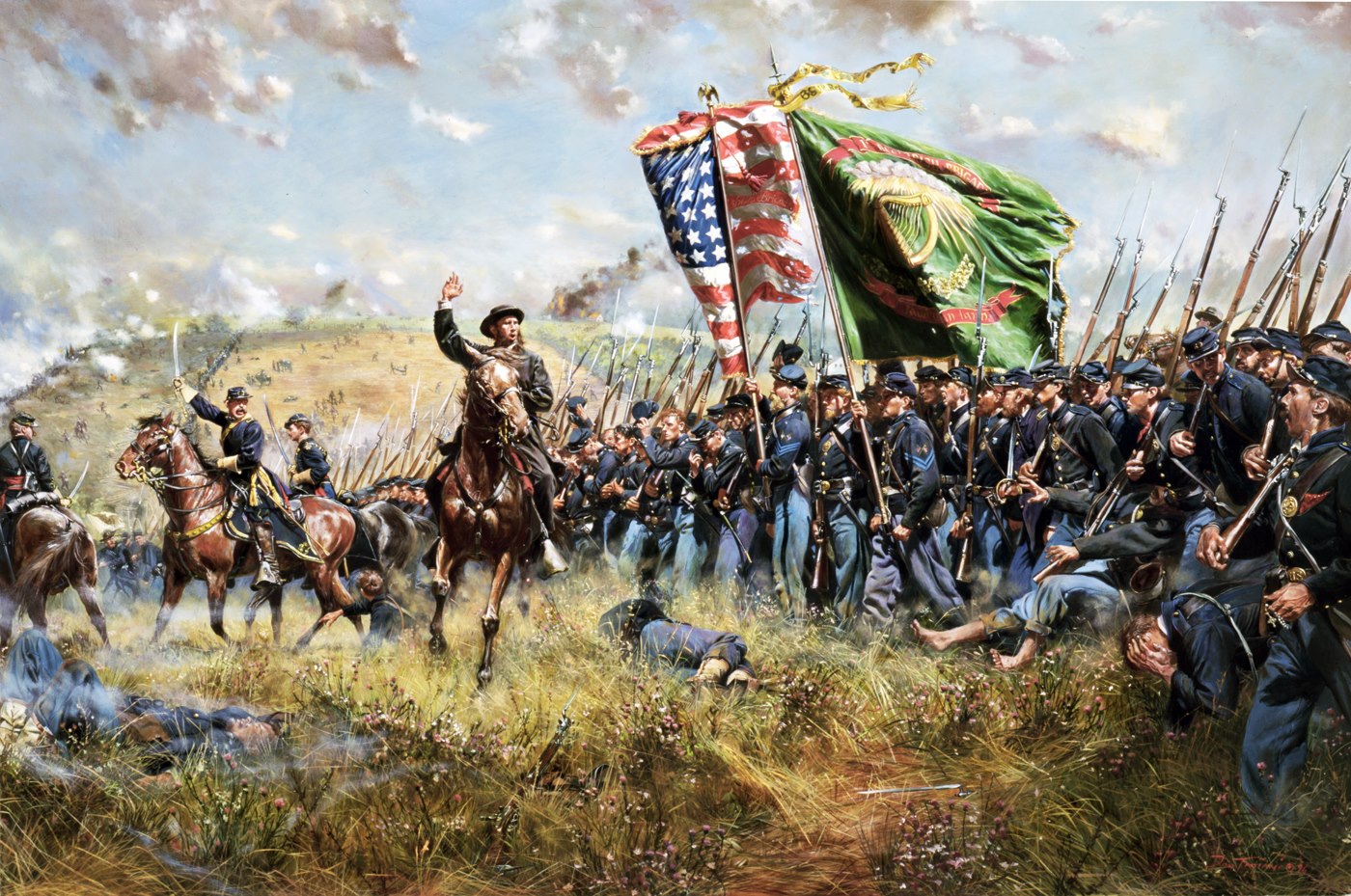
Father Corby blesses the Irish Brigade as they advance during the Battle of Antietam. Painting by Don Troiani Historical Artist

He was described as being five feet eight inches tall, with light hair, grey eyes, and a fair complexion. In December Curran and the 88th left for The Capital. They would remain to defend Washington till April of 1862, when the regiment participated in the siege of Yorktown. The 88th and Private Curran would be engaged at White Oak Swamp, Battle of Fair Oaks, The Seven days before Richmond, and Battle of Antietam. Here the 88th New York,

“crossed Antietam Creek (9:30 a.m.) at Pry’s Ford. As it formed at the edge of a cornfield Father William Corby, Chaplain rode along the line, giving absolution to the soldiers. The 88th New York crossing the cornfield, the command encountered a rail fence which was torn down under severe fire an opposing Confederate column advanced within 300 paces of the brigade. After several volleys, the Irish Brigade charged with fixed bayonets. At 30 paces it poured buck and ball into General George B. Anderson’s Brigade (2nd, 4th, 14th and 30th North Carolina Infantry Regiments) which fell back to “Bloody Lane”. After fierce combat its ammunition exhausted the Irish Brigade was relieved.”[3]

The next engagement Private Curran would be involved in would be the Battle of Fredericksburg. Before the battle..

“The men of the Irish Brigade placed sprigs of boxwood in their caps in honor of their Irish heritage. Later in the day, they took part in the futile assaults against confederate positions on Marye’s Heights. After the battle, the Union dead closest to the Confederate positions wore sprigs of boxwood in their caps.”[4]

At the time of this letter Private Curran and the 88th were posted in Falmouth Virginia. In the letter he states “We are now under marching orders. We will be into a fight before two days” This is a reference to the upcoming “Mud March”, and the Chancellorsville Campaign. During the Battle of Chancellorsville the regiment lost 5 men killed or mortally wounded, 4 officers and 18 men wounded, and 19 men missing.[5]

                In July of 1863 Private Curran would fight at Gettysburg.

 “The brigade entered the battle under command of Colonel Patrick Kelly 530 strong, of which this contingent, composing three battalions of two companies each, numbered 240 men. The original strength of these battalions was 3,000 men. The brigade participated with great credit to itself and the race it represented”[6]

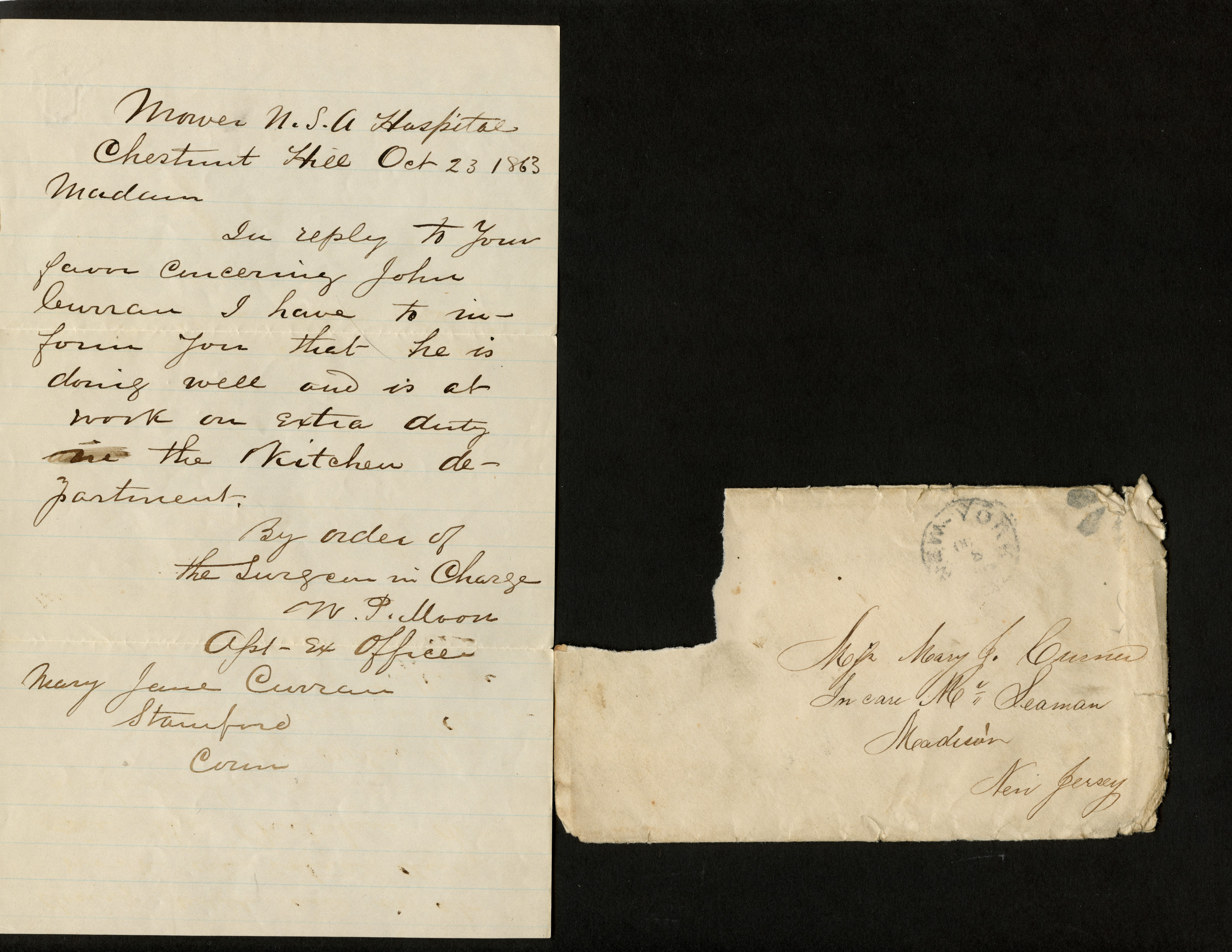
Campaigning and the toll of battle must have weighed heavily on Private Curran. According to a letter, written by Assistant Surgeon William Parkinson Moon in October of 1863.[7] Curran was on kitchen duty at Mower Hospital in the Chestnut Hill neighborhood of Philadelphia. It is unclear why he was there, however since Curran was not listed as wounded one can assume he was admitted for either disease, or “soldier’s heart” (The 1860’s term for PTSD).  

Letter, written by Assistant Surgeon William Parkinson Moon in October of 1863. Provided by, The American Military Heritage Museum of North Carolina.

                Private Curran would re-enlist in the 88th on March 22nd, 1864. He would participate in the following engagements: the Wilderness, Spotsylvania Court House, Po River, and the assault on the Salient or “Bloody Angle”.  He would desert while on furlough on May 16th, 1864.[8]

                After seeing all that death, one cannot blame Private Curran for his desertion. He served his adopted country honorably till his desertion. One could surmise that a lack of knowledge about the psychological toll of combat, and its treatment damaged Private Curran in an irreparable manor. His story ends here since no further records can be found.


[1] “Page 1 New York Civil War Muster Roll Abstracts,” Fold3, accessed January 7, 2022, https://www.fold3.com/image/315858065.

[2] Ibid

[3] “88th New York Infantry Regiment,” The Civil War in the East, May 28, 2019, https://civilwarintheeast.com/us-regiments-batteries/new-york-infantry/88th-new-york/.

[4] Ibid

[5] Ibid

[6] Ibid

[7] Moon, William Parkinson. Letter to Mary Jane Curran. “William Parkinson Moon RE: John Curran.” Chestnut Hill, Pennsylvania: Mower Hospital, October 23, 1863.

[8] “Page 1 New York Civil War Muster Roll Abstracts.” Fold3. Accessed January 7, 2022. https://www.fold3.com/image/315858065.

Image of an Immigrant Soldier Who Never Made it Home.

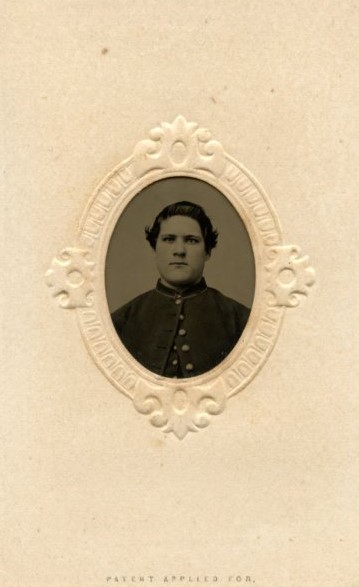
Every image has a story. This is the tail is of Private Michael Malone 14th New York Heavy Artillery. He was born in Ireland around 1828.[1] He was described as being five feet eight inches tall, with brown hair, blue eyes, and a light complexion.[2]

Tintype of Private Michael Malone 14th New York Heavy Artillery. From The The American Military Heritage Museum Of North Carolina

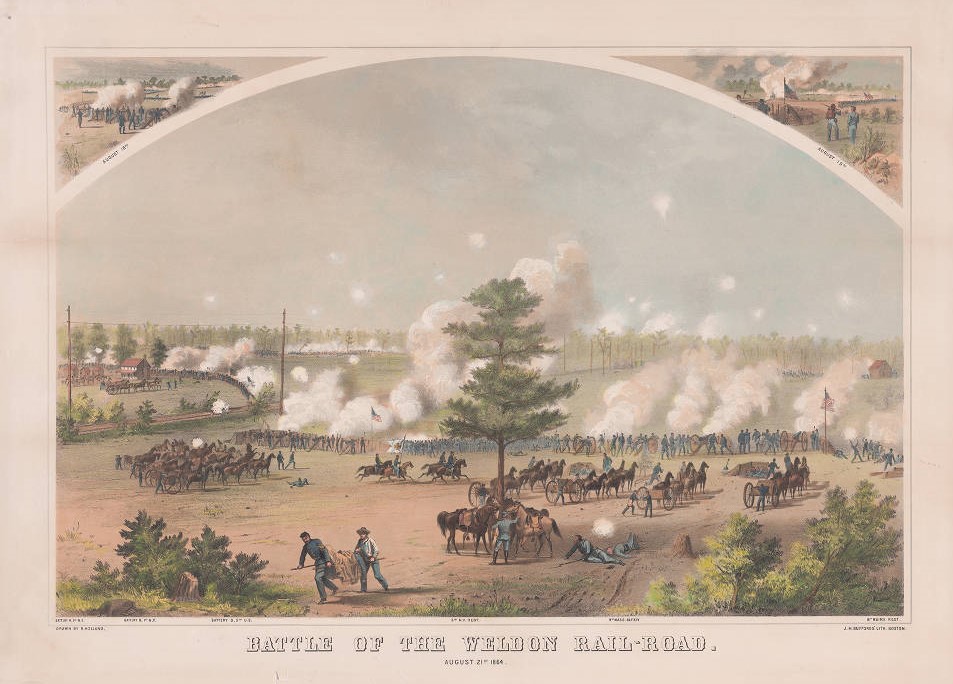
Michael would marry Mary Byrnes or Burns on January 17th, 1855, they would have four children.[3] Before the war Michael was employed as a day laborer in 1860[4] and as a farmer at the time of his enlistment.[5] Malone would enlist on September 4th 1863, and would muster into “D” Co. 14th New York Heavy Artillery eight days later. He would be assigned to garrison duty in New York Harbor till April 23, 1864.[6] From there he and the 14th would be in the following engagements, The Wilderness, Spottsylvania Court House, North Anna River, Totopotomoy, Cold Harbor, Siege of Petersburg, The Battle of the Crater, and Weldon Railroad where he was killed in action on August 19th, 1864.[7]

Battle of The Weldon Rail-Road August 21st 1864. Creator Holland, R., artist. J.H. Bufford’s Lith., printer.
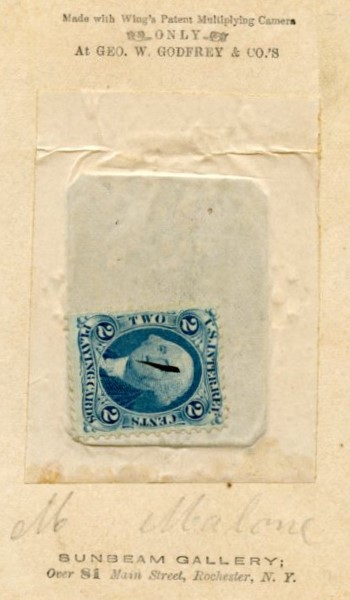
Back of tintype card for Private Michael Malone 14th New York Heavy Artillery. From The The American Military Heritage Museum Of North Carolina

Michael would be survived by his wife and his children Ellen age nine, Bridget seven, Mary five, and John who was just one year old.[8] His wife Mary would apply for and receive a widows pension of $12 a month.[9] She would never remarry and worked as a housekeeper[10] till her death on July 12th, 1912.[11]

Private Michael Malone, a soldier in the 14th New York Heavy Artillery, exemplifies the sacrifices made during the Civil War, having served valiantly before being killed in action, leaving behind a widow and four young children who faced the challenges of life without him. His story highlights the personal toll of war on families and the enduring legacy of those who served.


[1] “New York Civil War Muster Roll Abstracts 14th Artillery Malone, Michael (25) Page 1.” Fold3. Accessed December 8, 2019. https://www.fold3.com/image/316624979.

[2] Ibid

[3] “Civil War ‘Widows’ Pensions’ New York Heavy Artillery Regiment 14 Company D Malone, Michael (WC40894).” Fold3. https://www.fold3.com/image/300805013. Accessed December 8, 2019. https://www.fold3.com/.

[4] “1860 United States Federal Census for Michael Malone New York Monroe Pittsford .” Ancestry. Accessed December 8, 2019. https://tinyurl.com/wkcydpf.

[5] “New York Civil War Muster Roll Abstracts 14th Artillery Malone, Michael (25) Page 1.” Fold3. Accessed December 8, 2019. https://www.fold3.com/image/316624979.

[6] “Battle Unit Details UNION NEW YORK VOLUNTEERS 14th Regiment, New York Heavy Artillery.” National Parks Service. U.S. Department of the Interior. Accessed December 8, 2019. https://www.nps.gov/civilwar/search-battle-units-detail.htm?battleUnitCode=UNY0014RAH.

[7] “Civil War ‘Widows’ Pensions’ New York Heavy Artillery Regiment 14 Company D Malone, Michael (WC40894).” Fold3. https://www.fold3.com/image/300805018. Accessed December 8, 2019. https://www.fold3.com/.

[8] Ibid

[9] “Civil War ‘Widows’ Pensions’ New York Heavy Artillery Regiment 14 Company D Malone, Michael (WC40894).” Fold3. https://www.fold3.com/image/300805022. Accessed December 8, 2019. https://www.fold3.com/.

[10] “1880 United States Federal Census for Mary Malone New York Monroe Pittsford 062.” Ancestry. Accessed December 8, 2019. https://tinyurl.com/wpej7e7.

[11] “Civil War ‘Widows’ Pensions’ New York Heavy Artillery Regiment 14 Company D Malone, Michael (WC40894).” Fold3. https://www.fold3.com/image/300805022. Accessed December 8, 2019. https://www.fold3.com/.

An American Flyer in Greensboro North Carolina: The Story of First Lieutenant Collier Carlton Olive.

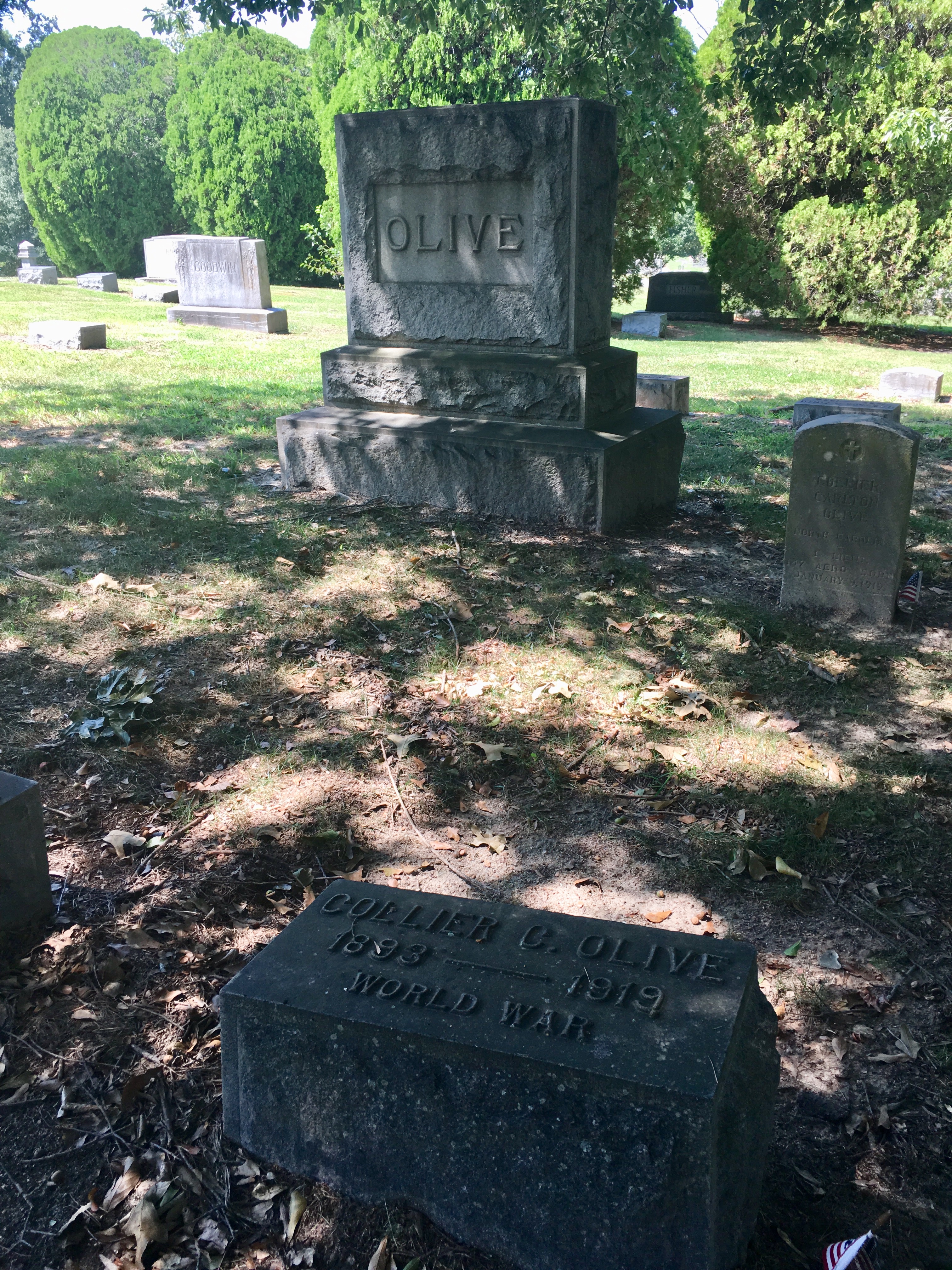
I recently took a trip to Green Hill cemetery in Greensboro North Carolina. Here I discovered the final resting place of First Lieutenant Collier Carlton Olive. He was born in Mount Airy North Carolina to Johnson and Margrett Olive on June 6th, 1893. He was of medium height and build, with blue eyes and brown hair[1].  Collier graduated from Greensboro High School before attending Mars Hill Academy. He later entered Wake Forest University as Junior. While attending Wake Forest Collier wrote humorous articles for the Greensboro Daily News.

Grave of First Lieutenant Collier Carlton Olive. At Green Hill cemetery Greensboro North Carolina. Photo By @firefightinirish

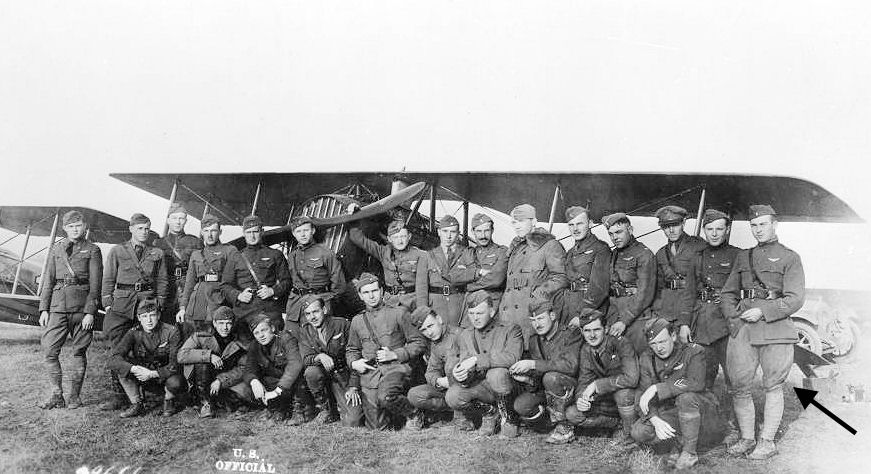
After graduating with honors, he would work as a journalist, and later be employed with Vick Chemical Company in their advertising department. With the First World War on the horizon Collier enlisted as a cadet at the officers’ training school Fort Oglethorpe Georgia, in May 1917.  During the time in OCS he applied for and was accepted into the aviation service. Collier was sent to ground school at the Georgia School of Technology and completed his course in the fall of 1917.[2]  He would set sail for Europe as an aviation cadet aboard the S.S. Kroonland on November 2nd, 1917.[3] Collier would earn his wings and commission in the 147th Aero Squadron on May 23rd 1918.[4] The 147th was assigned as a Day Pursuit (Fighter) Squadron as part of the 1st Pursuit Group, First United States Army. Its objective was to engage and clear enemy aircraft from the skies. As well as provide escort to reconnaissance and bombardment squadrons over enemy territory.

Photo of the 147th Aero Squadron group photo with a SPAD XIII. Likely taken at Rembercourt Aerodrome, France, November 1917. First Lieutenant Collier Carlton Olive is on the extreme right highlighted with an arrow. Photo provided by the Air Service, United States Army – Air Service, United States Army photograph.

The 147th also targeted enemy observation balloons, performed close air support, and tactical bombing attacks of enemy forces along the front lines.[5]  First Lieutenant Collier Carlton Olive participated in operations in the Toul Sector, Marne Sector, as well as Saint Mihiel. In a letter home dated December 22nd, 1918, he spoke of being wounded before the armistice and that he was suffering from influenza but was discharged from the hospital and feeling better. Sadly, Collier must have taken a turn for the worse as he would die of Pneumonia in Issoudun France on January 9th, 1919.[6] His body was sent home aboard the U.S.S Pocahontas on October 18th, 1920.[7] Colliers remains would arrive in Greensboro at 0645 on November 13th, he was interred at Green Hill cemetery at 1400 hrs. The services were conducted by Rev. J. Clyde Turner and were only attended by immediate family.[8]  Let us never forget this young man and his sacrifice to make the world safe for democracy.


[1] “U.S., World War I Draft Registration Cards, 1917-1918 for Rufus Eldrige Garrett.” Ancestry. Accessed September 12, 2019. https://www.ancestry.com/.

[2] “Lieut. Collier Olive Succumbs To Pneumonia.” Greensboro Daily News. January 30, 1919.

[3] “U.S., Army Transport Service, Passenger Lists, 1910-1939 for Collier C Olive” Ancestry. Accessed September 12, 2019. https://www.ancestry.com/.

[4] “Collier Olive Comissioned.” Greensboro Daily News. July 12, 1918.

[5]  Maurer, Maurer (1978), The US Air Service in World War I, The Office of Air Force History, Headquarters USAF Washington

[6] “Lieut. Collier Olive Succumbs To Pneumonia.” Greensboro Daily News. January 30, 1919.

[7] “U.S., Army Transport Service, Passenger Lists, 1910-1939 for Collier C Olive” Ancestry. Accessed September 12, 2019. https://www.ancestry.com/.

[8] “Body Of Lieut. Olive Buried In Green Hill.” Greensboro Daily News. November 14, 1920.

A Civil War Image Speaks: The story of Captain Garrett Brady and the 2nd New Jersey Infantry

Every artifact has a story. This Carte de visite of Captain Garrett Brady, of the 2nd New Jersey Infantry is no different. Brady was born in Ballykilageer, Wicklow, Ireland on March 9th, 1836.[1] His parents were Bryan Brady and Lucy Graham. He would live in Ireland, working on the family farm till 1860. That is the year when he boarded the Prinz Albert in Galway enroute to America. Brady would arrive in New York City on April 16th of that year. [2]  By June of 1860 he would be living in Newark New Jersey working as a Morroco Dresser.[3]

Shortly after the bombardment of Fort Sumter Brady would answer the call, enlisting on May 27th, 1861. He would be commissioned as a 1st Lieutenant, in “C” Co. 2nd New Jersey Volunteer Infantry that same day.[4] Brady and the 2nd N.J.V.I were held in reserve at Bull Run, before heading to Washington D.C to support its defense. 1st Lieutenant Brady was promoted to Captain during The Seven days before Richmond. He would fight at Second Battle of Bull Run, and the Battle of South Mountain, where he and his regiment…

Carte de visite of Captain Garrett Brady 2nd New Jersey Infantry. The American Military Heritage Museum Of North Carolina

“Advanced from the fields north and west of Burkittsville, charged up the mountain, carried this point, and followed the enemy to the west foot of the mountain.”[5]

A few days later Brady would be involved in The Battle of Antietam. Here he and the second…

“Arrived upon the field from Crampton’s Pass about noon, and was formed for a charge upon the Confederate line just North of the Dunkard Church. The order for the charge was countermanded, and the brigade took position across this road, in support of the 6rh Corps Artillery, the right of the brigade in woods North of the road, the left in the open field South, where it remained, under artillery fire, until the morning of the 19th.”[6]

The next engagements Captain Brady would be involved in were the Battles Fredericksburg, Gettysburg, and the battle of the Wilderness. During the heat of the fight at the Wilderness the Confederates mounted a large attack…

“The attack spread east into the New Jersey Brigade and south toward the right flank of Morris’ brigade. It caught the 2nd New Jersey at its coffee fires. The veterans leaped to their feet and fell in across the paths of the retreating soldiers. “Back! Back! You cowards,” the Jerseymen shouted at the refugees who were breaking through their ranks. Captain Garrett Brady (Company C) drew his sword and vainly tried slapping frightened soldiers back into the ranks. Sedgwick dismounted, sword in one hand, stood on a log near the Culpeper Mine Road, and screamed, “For God’s sake, hold it.”[7]

Currier & Ives. The battle of the Wilderness Va. May 5th & 6th. Virginia, 1864. [New York: Pubd. by Currier & Ives, ?] Photograph. https://www.loc.gov/item/9071491

On May 12th, 1864, during The Battle of Spotsylvania Court House, Captain Brady lead Company “C” in the assault on the Salient, “Bloody Angle”. Here he was wounded in the thigh and taken prisoner. He was imprisoned at Camp Oglethorpe, Camp Sorghum, and the infamous Libby Prison before being released. Captain Brady would be discharged on January 1st, 1865.[8]

L. Prang & Co. Battle of Spottsylvania sic / Thulstrup. Virginia Spotsylvania, 1887. [Boston: L. Prang & Co] Photograph. https://www.loc.gov/item/90712278/.

After the war Brady returned to Newark and resumed his career as a Morocco Manufacture. According to the 1870 United States Federal Census Brady was married to Mary A Brady. They had four children, James, Joseph, John, and Mary.

Brady died on July 18th, 1886, from “Chronic Phthisis Pulmonalis”.[9] He is interred at Holy Sepulcher Cemetery East Orange, Essex County, New Jersey.


[1] “Ireland, Catholic Parish Registers, 1655-1915,” Ancestry, accessed June 11, 2022, https://www.ancestry.com/discoveryui-content/view/7206245:61039?ssrc=pt&tid=83040556&pid=202067016551.

[2] “New York, U.S., Arriving Passenger and Crew Lists (Including Castle Garden and Ellis Island), 1820-1957,” Ancestry, accessed June 11, 2022, https://tinyurl.com/534n88b3.

[3] “1860 United States Federal Census for Garrett Brady,” Ancestry, accessed June 11, 2022, https://www.ancestry.com/discoveryui-content/view/54161188:7667?ssrc=pt&tid=83040556&pid=202067016551.

[4] “Garrett Brady,” American Civil War Research Database, accessed June 12, 2022, http://www.civilwardata.com/active/index.html.

[5] “2nd New Jersey Volunteer Infantry Regiment,” The Civil War in the East, May 23, 2019, https://civilwarintheeast.com/us-regiments-batteries/new-jersey/2nd-new-jersey/.

[6] Ibid

[7] John M. Priest, in Victory without Triumph: The Wilderness, May 6th & 7th, 1864 (Shippensburg, PA: White Mane Pub. Co., 1996), pp. 201-202.

[8] “Garrett Brady,” American Civil War Research Database, accessed June 12, 2022, http://www.civilwardata.com/active/index.html.

[9] “1886 Garrett Brady, Newark NJ, Death Certificate,” Ancestry, accessed June 13, 2022, https://tinyurl.com/2bp35x8t.

A Soldier’s Story: One Federal Soldier’s Tail as Told Through His Letter.

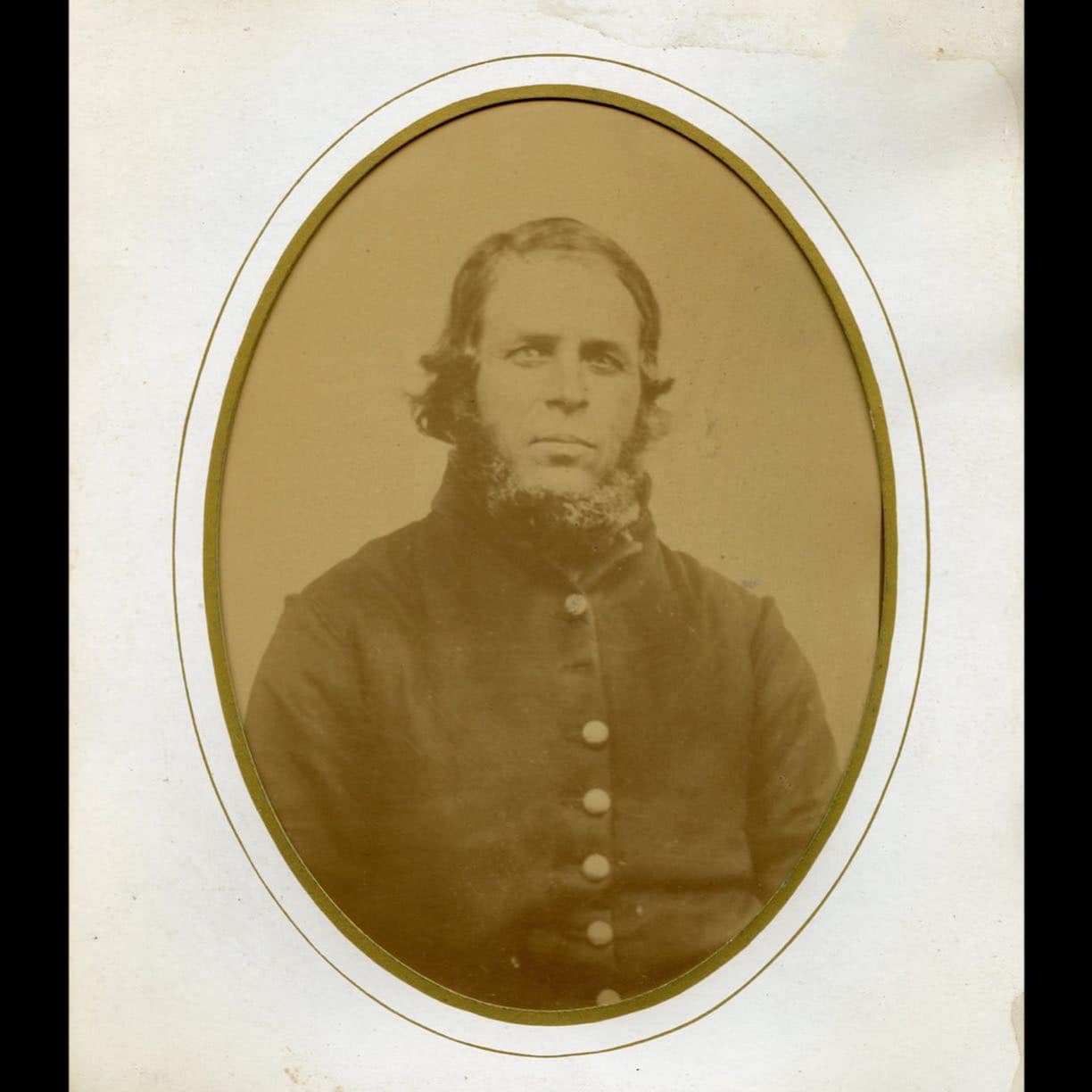
Sometimes one purchases an antique only to discover a fascinating story. This Post-war albumen of Pvt. Augustus H Dayton 14th New York Heavy Artillery, accompanied with letter composed by him is one of those pieces. Augustus Dayton was born in 1817, to Thomas and Almira Dayton in Vermont.[1] Prior to 1850[2] Augustus would marry Catherine Smith, they would have five children.

Before the war Dayton lived in Geneseo and worked as a farmer. In 1862 both of Dayton’s sons enlisted in the 136th NY.[3][4] Augustus would enlist on December 19th, 1863[5], at Genesee New York. He was described on the rolls as being, five feet ten inches tall, with brown hair, blue eyes, and a light complexion. Dayton would be mustered into “L” Co. 14th New York Heavy Artillery as a Private on January 8th, 1864[6].

Post-war albumen of Pvt. Augustus H Dayton 14th New York Heavy Artillery. Provided by, The American Military Heritage Museum Of North Carolina,

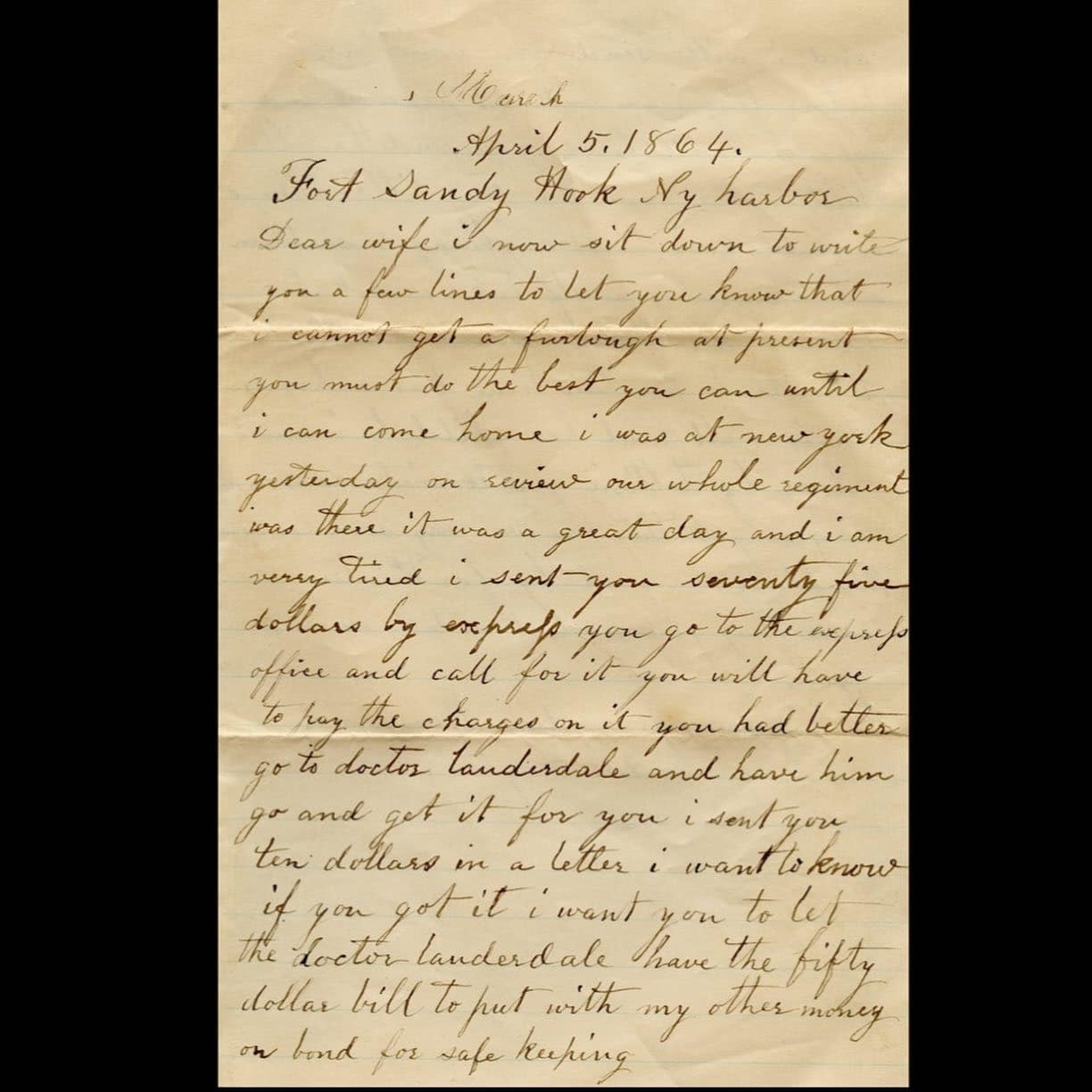
Private Dayton and the 14th N.Y.H.A were sent to New York to defend the harbor. Here is where he would write his wife this letter:

March, April 5, 1864,

Fort Sandy Hook Ny harbor.

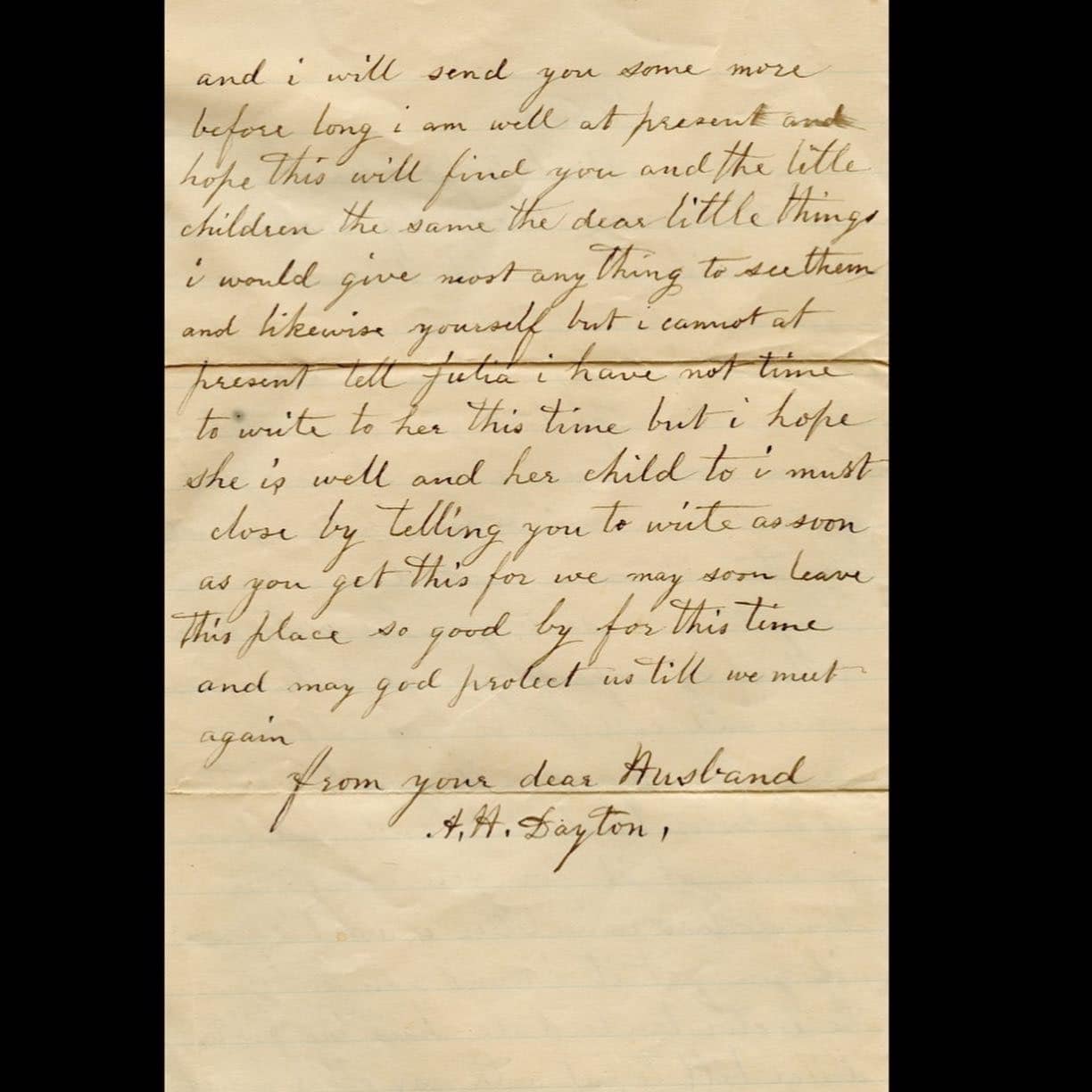
Dear wife I now sit down To write you a few lines to let you know that I cannot get a furlough at present you must do the best you can until I can come home I was at New York yesterday on service our whole regiment was there it was a great day and I am very tired I sent you seventy five dollars by express You go to the express office and call for it you will have to pay the charges on it you had better go to doctor lauderdale and have him go and get it for you I sent you ten dollars in a letter I want to know if you got it I want you to let the doctor lauderdale have the fifty dollar bill to put it with my other money on hand for safe keeping and i will send you some more before long i am well at present and hope this will find you and the little children the same the dear little things I would give most anything to see them and likewise yourself but i cannot at present tell Julia i have not time to write to her this time but I hope she is well and her child is to i must i must close by telling you to write as soon as you get this for we may soon leave This place so good by for This Time and may god protect us till we meet again.

From your dear Husband,

A.H. Dayton,

Front of Dayton letter, The American Military Heritage Museum Of North Carolina,


From the forts of New York harbor the 14th was sent south where they were in the following engagements, the Rapidan Campaign, Battle of the Wilderness, Battle of Spotsylvania Court House, The Battle of North Anna, Battle of Totopotomoy Creek, Battle of Cold Harbor, The Siege of Petersburg (including the Mine Explosion), The Battle of the Weldon Railroad, and The Battle of Peebles’s Farm.

Private Dayton was sent to the hospital at City Point Virginia on October 6th 1864[7] suffering from chronic diarrhea. He would later be sent home on furlough. Private Dayton arrived in Rochester New York on December 15th, 1864.[8] Here he would receive hospital care for his illness. Sadly, Private Dayton would die on March 28th 1865[9]. Dayton’s wife Catherine would apply for a widow’s pension, for her and the two youngest children. Dr. Lauderdale would testify that he attended to Private Dayton, and Dayton also had dropsy as well as insanity before he passed. Dr. Lauderdale would also say that Dayton was a healthy man and a “devoted father”[10].

Back of Dayton letter, The American Military Heritage Museum Of North Carolina,

Catherine would ultimately receive a widow’s pension of eight dollars a month. This would be the equivalent of about one hundred and thirty-seven dollars today.

Let us never forget the sacrifice that Private Dayton made for his country. As well as the loss his family had to suffer in his absence.

[1] “1850 United States Federal Census for Augustus H Dayton New York Livingston Geneseo.” Ancestry®. Accessed January 12, 2022. https://www.ancestry.com/imageviewer/collections/8054/images/4197497-00120?pId=7026585.

[2] Ibid

[3] “Lewis A. Dayton.” American Civil War Research Database. Accessed January 12, 2022. http://civilwardata.com/.

[4] “Henry A. Daton.” American Civil War Research Database. Accessed January 12, 2022. http://www.civilwardata.com/active/index.html.

[5] “New York Civil War Muster Roll Abstracts Dayton, Augustus H .” Fold3. Accessed January 17, 2022. https://www.fold3.com/image/316571763.

[6] Ibid

[7] Ibid

[8] “Page 3 Civil War ‘Widows’ Pensions’ Augustus H Dayton.” Fold3. Accessed January 17, 2022. https://www.fold3.com/image/283724325.

[9] “New York Civil War Muster Roll Abstracts Dayton, Augustus H .” Fold3. Accessed January 17, 2022. https://www.fold3.com/image/316571763.

[10] Page 3 Civil War ‘Widows’ Pensions’ Augustus H Dayton.” Fold3. Accessed January 17, 2022. https://www.fold3.com/image/283724325.

Sergeant Thomas Wilson: A Tragic Tail of Irish Immigration.

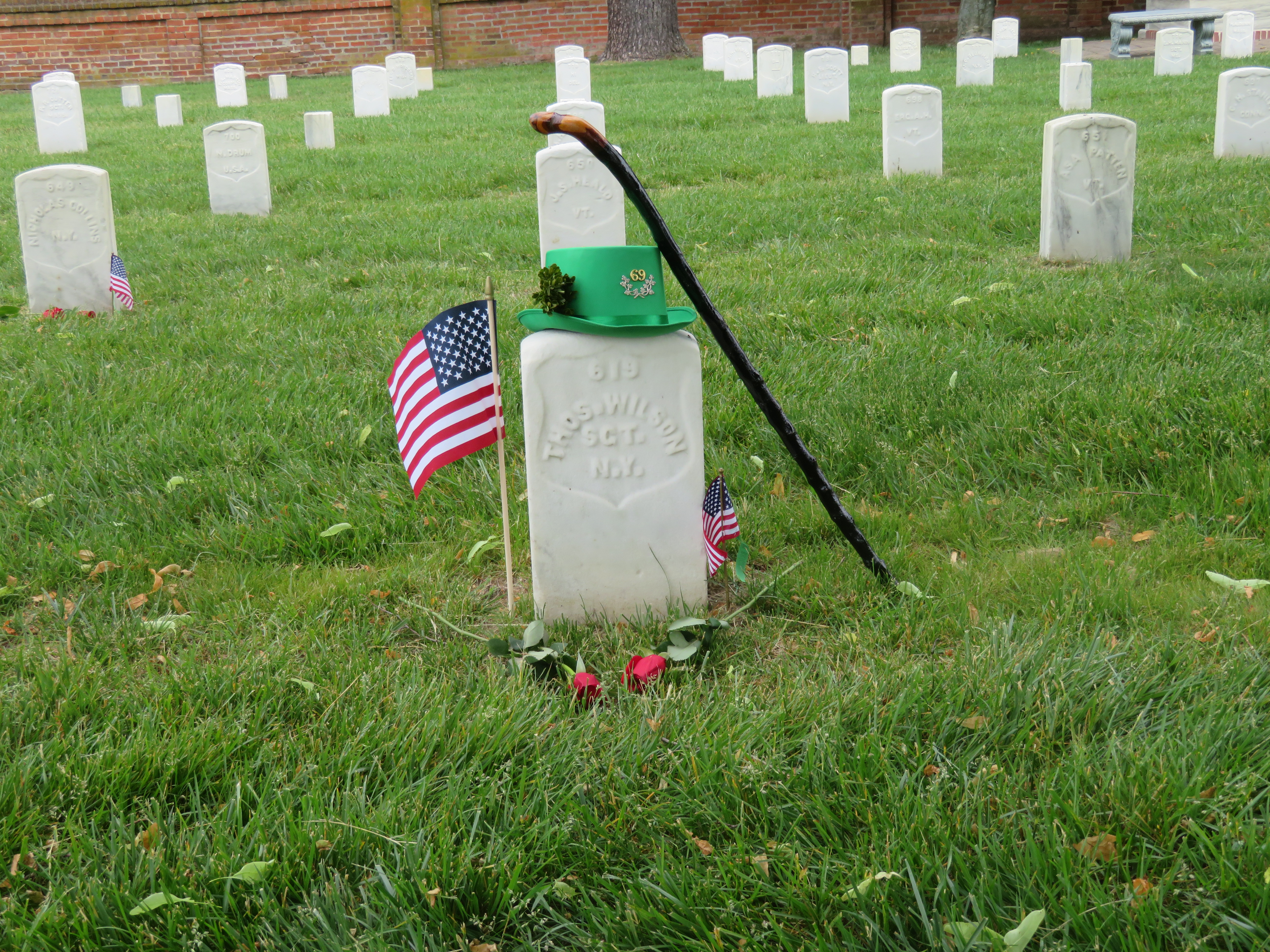
I recently took a trip to Cold Harbor National Cemetery. Here I discovered the final resting place of Sergeant Thomas Wilson. I also unearthed a a tragic tail of Irish immigration. Wilson was born in Ireland around 1834[1], and immigrated to New York to find a better life. Thomas would find a job as an Oyster Shucker at the St. Nicholas Hotel. Here he met Ms. Frances Connor who also worked there as a laundress. They would marry in 1861[2] and shortly after Thomas would enlist.  

Grave of Sgt. Thomas Wilson at Cold Harbor National Cemetery Photo By @firefightinirish

He was mustered into “I” Co. 69th New York as a Corporal on September 17, 1861[3]. Corporal Wilson was in the following engagements: The Siege of Yorktown, Battle of Fair Oaks, The Seven Days Battles, Antietam, and Fredericksburg. It is possible he then deserted, as his name is not on the rolls again until June of 1863[4] with a reduced rank. He was present at The Battle of Gettysburg and promoted to Corporal. Wilson was then assigned to guard a “farmhouse”[5], which was presumably a headquarters, in October of 1863[6]. Wilson reenlisted as a veteran volunteer on December 21, 1863[7] and was assigned to “B” Co. 69th New York Infantry. In 1864 he was promoted to Sergeant. In March of that year, his wife Frances Wilson would have a child named Mary Ellen[8]. Sergeant Wilson would later fight in the battles of The Wilderness, Spotsylvania Court House, Totopotomoy, and Cold Harbor. Sergeant Wilson was killed in action at Cold Harbor and never laid eyes on his daughter.

Wilson’s wife would eventually receive a widow’s pension of two dollars a month, which is about thirty-two dollars in today’s money. Mrs. Wilson was extremely poor. Her pension was not enough to survive on without taking up work, so she returned to her job at the hotel. Before long it was too hard for Mrs. Wilson to care for Mary Ellen, so she would give the child to Mary Score. Mrs. Score lived in a tenement house on “Mulberry Bend”[9], which is an area known for its overwhelming crime and filthy living conditions. Mrs. Wilson would regularly visit her daughter and would “hold and kiss her”[10]. Mrs. Score would also find it a struggle to care for an extra child and would place Mary Ellen with the Department of Public Charities and Corrections. Mrs. Score told Mrs. Wilson that Mary Ellen was dead, driving Mrs. Wilson to alcoholism. Frances Wilson died of a lung hemorrhage in a hospital on Wards Island in 1872[11] and was buried in a Potters field.

The very much alive Mary Ellen was placed in the Alms House at Blackwell Island on July 10, 1865.[12] Orphanages, at the time had an 85% death rate.[13] Mary Ellen would beat the odds and was adopted by Thomas and Mary McCormick on January 2, 1866[14]. The adoption was granted on the grounds that Thomas McCormick claimed to have an affair with a “no good woman”[15], and that she had left the child (Mary Ellen) at the Alms House.  Although there was no actual evidence of this affair the adoption was never contested. More than likely this is because children at this time had no rights and were often adopted for use in household labor. Thomas McCormick died of cholera in August of 1866.[16] Mary McCormick would remarry to Frances Connolly in August 1867.[17]

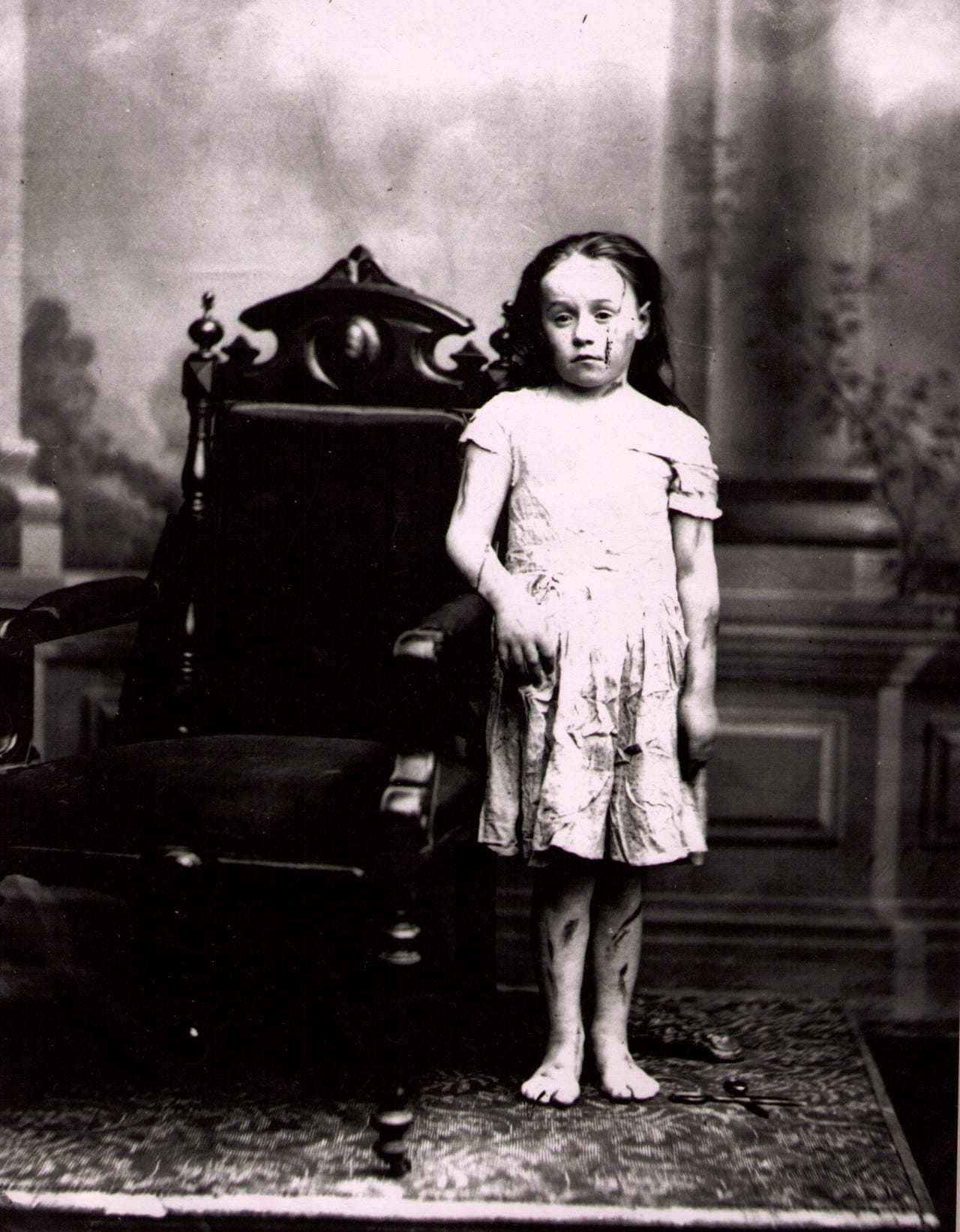
While under the care of Mary (McCormick) Connolly and her new husband, Mary Ellen would suffer severe abuse. She was made to sleep on a small cloth in the corner, had only one set of cloths, made to do strenuous labor, and beaten. In 1874[18] the neighbors suspected abuse and called Etta Angell Wheeler, a Methodist missionary who worked in the area. Ms. Wheeler checked in on the child and what she found was shocking. Ms. Wheeler contacted the police but due to the lack of child abuse laws on the books they were not able to do anything. So, Ms. Wheeler decided to contact Henry Bergh, who was an advocate for the animal humane movement and the founder of the American Society for the Prevention of Cruelty to Animals. Mr. Bergh was instrumental in getting Mary Ellen removed from the home and charges brought against Mrs. Connolly. During the trial shocking eyewitness testimony was given about the abuse,

Mary Ellen Wilson-McCormac in 1874. From: Markel, Howard. “Case Shined First Light on Abuse of Children.” The New York Times, December 14, 2009. https://www.nytimes.com/2009/12/15/health/15abus.html?ref=science.

“During the first week after the Connolly’s came there witness saw the cowhide lying on the table; it is like what a man uses when on horseback; it is about two and a half feet long; it has lashes (she doesn’t know how many) about the size of a finger, something like a cat-o-nine-tails; she used to hear Mrs. Connolly licking the child every morning “up and down, up and down” the room, the child crying “Oh, Mama! Mama!” all the time;”[19]

Mary Connolly was convicted of child abuse and sentenced to one-year imprisonment with hard labor.

Mary Ellen Wilson would live till the age of 91. Her case was the was the first documented case of child abuse in the United States. It also led to the founding of the New York Society for the Prevention of Cruelty to Children. It is amazing to think that out of so much tragedy good could come out of it. The events in this case were and continue to be instrumental in saving many more children.  


[1] “Wilson, Thomas (26) Page 1 New York Civil War Muster Roll Abstracts,” Fold3, accessed July 10, 2020, https://www.fold3.com/image/315769745.

[2] Eric A. Shelman and Stephen Lazoritz, The Mary Ellen Wilson Child Abuse Case and the Beginning of Children’s Rights in 19th Century America (Jefferson, NC: McFarland & Co., 2005). Pg. 20

[3] “Wilson, Thomas (26) Page 1 New York Civil War Muster Roll Abstracts,” Fold3, accessed July 10, 2020, https://www.fold3.com/image/315769745

[4] “Wilson, Thomas (27) Page 1 New York Civil War Muster Roll Abstracts,” Fold3, accessed July 10, 2020, https://www.fold3.com/image/315769764.

[5] Ibid

[6] Ibid

[7] Ibid

[8] Eric A. Shelman and Stephen Lazoritz, The Mary Ellen Wilson Child Abuse Case and the Beginning of Children’s Rights in 19th Century America (Jefferson, NC: McFarland & Co., 2005). Pg. 21

[9] Ibid, Pg. 22

[10] Ibid

[11] Ibid. Pg. 107

[12] Ibid. Pg. 23

[13] Ibid.

[14] Ibid. Pg.24

[15] Ibid. Pg. 23

[16]. Shelman, Eric A.; Lazoritz , Dr. Stephen. Case #1: The Mary Ellen Wilson Files (Kindle Location 575). Dolphin Moon Publishing. Kindle Edition.

[17] Ibid

[18] Shelman, Eric A.; Lazoritz , Dr. Stephen. Case #1: The Mary Ellen Wilson Files (Kindle Location 1896). Dolphin Moon Publishing. Kindle Edition.

[19] “Mary Ellen Wilson Further Testimony As To The Child’s Ill Treatment By Her Guardians,” New York Times, April 12, 1874, p. 12.

A Letter Speaks

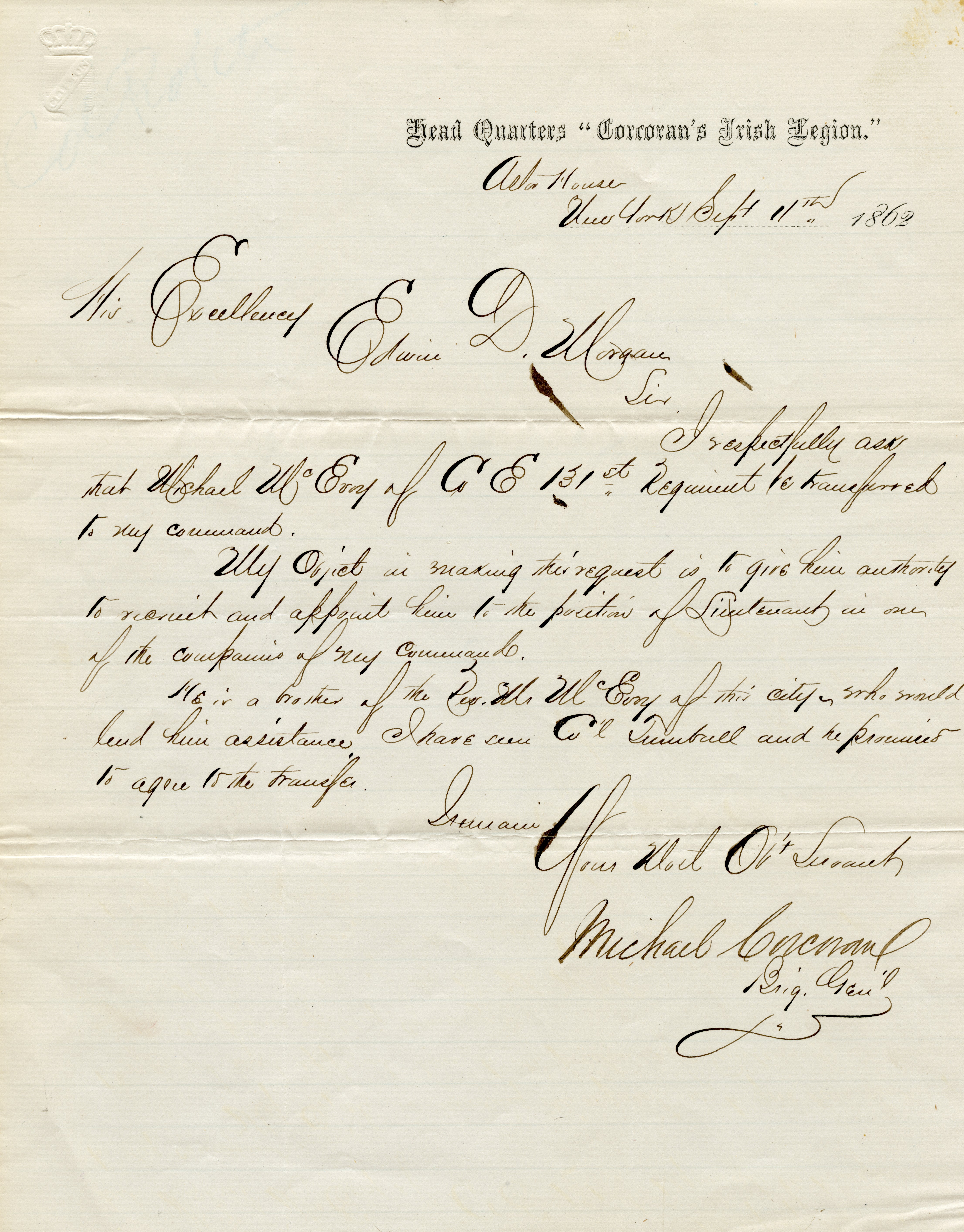
A letter to some is just a piece of paper with words on it. However when one digs deep they can find a hidden story. This letter is written and signed by Brigadier General Michael Corcoran. The letter’s recipient is then Governor of New York Edwin D. Morgan. In this post I am not going to just focus on the “big names” associated with the piece (We can all use Google for that). There is also the interesting tail of Michael McEvoy of Company E, 131st New York. So without further adieu may I present the The letter it reads……

“Sir,

I respectfully ask that Michael McEvoy of Company E, 131st Regiment be transferred to my command.

My object in making this request is to give him authority to recruit and appoint him to the position of Lieutenant in one of the companies of my command.

He is a brother of the Provost Marshal McEvoy of this city, who would lend his assistance. I have seen Colonel Turnbull and he promised to agree to the transfer.

I remain,

Your Most Obedient Servant,

Michael Corcoran

Brigadier General” [1]

Corcoran Letter, provided by The American Military Heritage Museum Of North Carolina
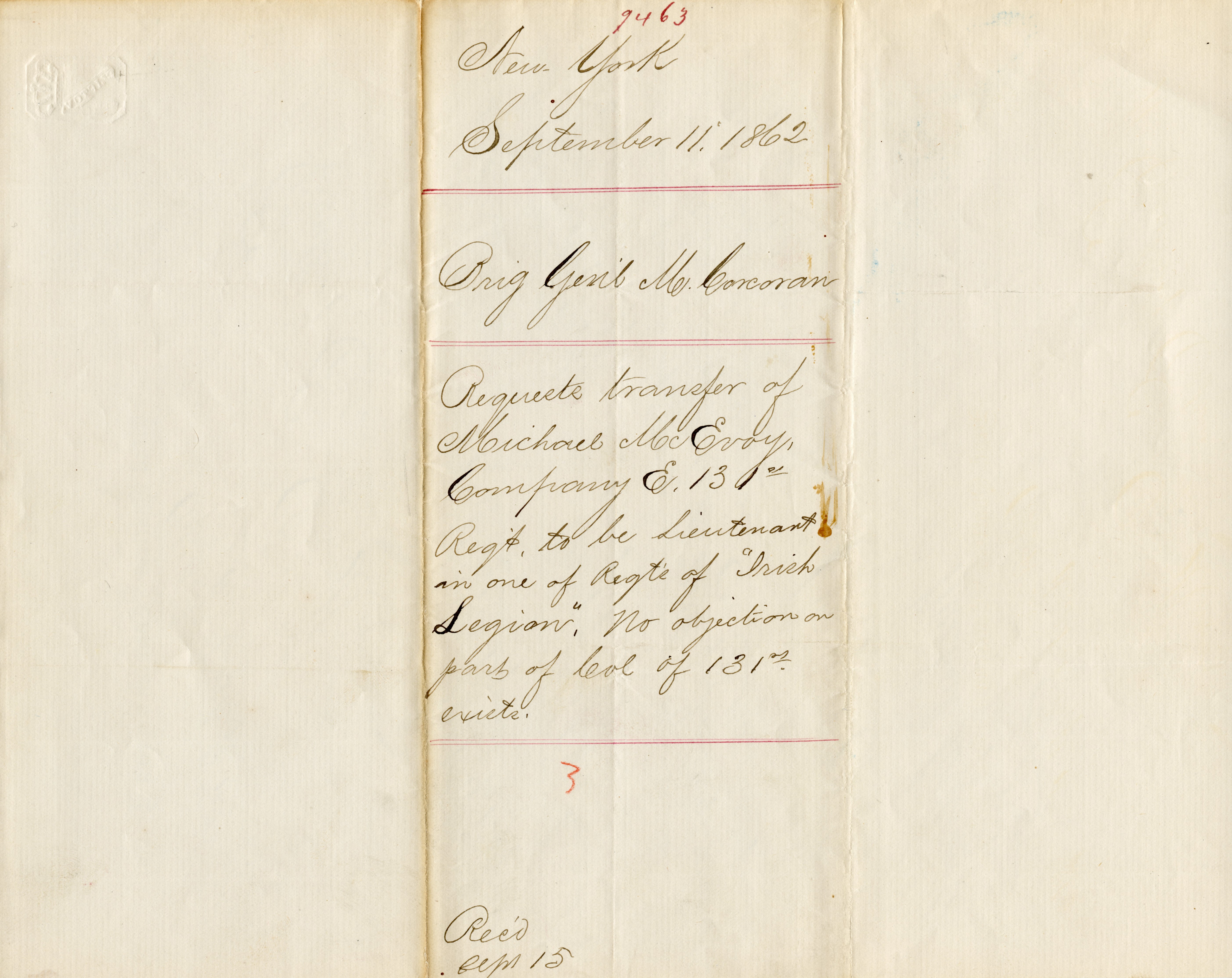
Back of the Corcoran Letter, provided by The American Military Heritage Museum Of North Carolina

Michael McEvoy was born in Ireland around 1828[2]. He was described as five feet nine inches tall, with blue eyes, light hair, and a light complexion.[3] McEvoy would immigrate to America prior to 1850. He was listed on the 1850 United States Federal Census as being a farmer, and married to Cath McEvoy, they had one child James.[4] McEvoy was employed as a Teamster, at the time of his enlistment in the Union army on August 13th, 1862.[5]

. He would be mustered into “E” Co 131st infantry as a private on September 6th.[6] Per General Corcoran’s request McEvoy would be transferred to “D” Co. 170th New York on September 19th, 1862.[7] He would be mustered in as a private on October 7th, 1862. Private McEvoy would participate in the battle of Deserted House. He would later be granted leave on March 21st, 1863, McEvoy would never return to service[8]. Private McEvoy would be listed as a deserter from camp at Suffolk Virginia on April 3rd, 1863.[9] That is where his trail ends for now.

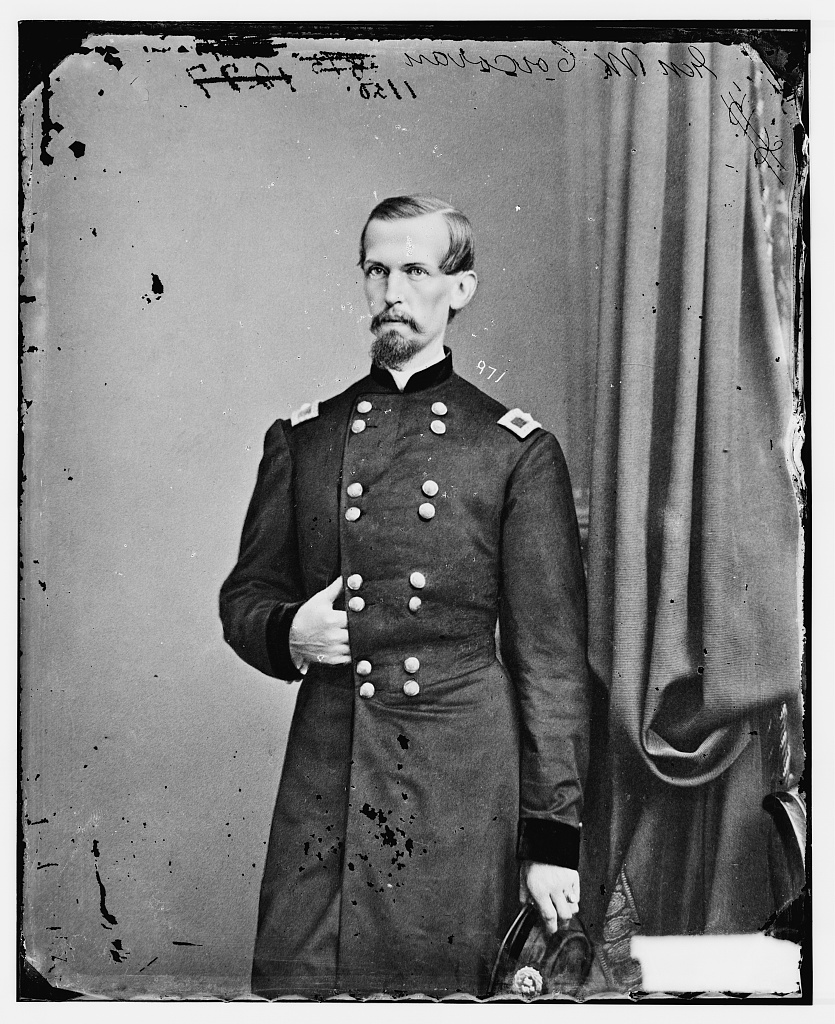
Michael Corcoran was born in Carrowkeel, county Sligo Ireland. He was a member of the Irish Nationalist Guerrilla force known as the Ribbonman. His ties to this group were eventually discovered in 1849, so he immigrated to New York City in order to avoid capture.[10] To gain a position in society Corcoran joined the 69th New York State Militia as a private. He would advance rapidly due to, “his military passion and his previous knowledge of military tactics were a great advantage to him.”[11] Corcoran moved up in rank and became a Colonel.  It was in this capacity that Corcoran became a hero to the Irish Nationalist, as well as the overall Irish immigrant population of New York. When he chose not to parade the 69th  in front of the Prince of Whales upon the Princes visit, saying that “as an Irishman he could not consistently parade Irish-born citizens in honor of the son of a sovereign, under whose rule Ireland was left a desert and her best sons exiled or banished.”[12] His action resulted in a court-martial. However, it was overturned due to the need of good officers to fight in the Civil War.


General Michael Corcoran, U.S.A. United States, None. [Between 1860 and 1865] Photograph. https://www.loc.gov/item/2018667330/.

Corcoran resumed his rank in the 69th New York and was present at that Battle of First Manassas, where he was captured. Corcoran spoke of this later by saying, “I did not surrender until I found myself after having successfully taken my regiment off the field, left with only seven men and surrounded by the enemy.”[13] Corcoran was eventually exchanged over a year later, and was received back with acclaim. He was given the rank of Brigadier General and put in command of his own troops, known as Corcoran’s “Irish Legion.” The first battle of the Legion took place during the Battle of Deserted House Virginia. Although not one of the biggest battles of the war, Corcoran demonstrated calmness under fire and his men showed how they admired Corcoran by following his every commanded under intense battle conditions. Sadly this would be Corcoran’s last major battle as he was killed later that year when he fell from his horse. Even though Corcoran’s life was cut short his legend and the Prince of Wales incident continued to inspire men, especially those of his Legion who were fighting for their adopted homes as well as Irish pride.

The National Governors Association has written this about Gov. Edwin D. Morgan.

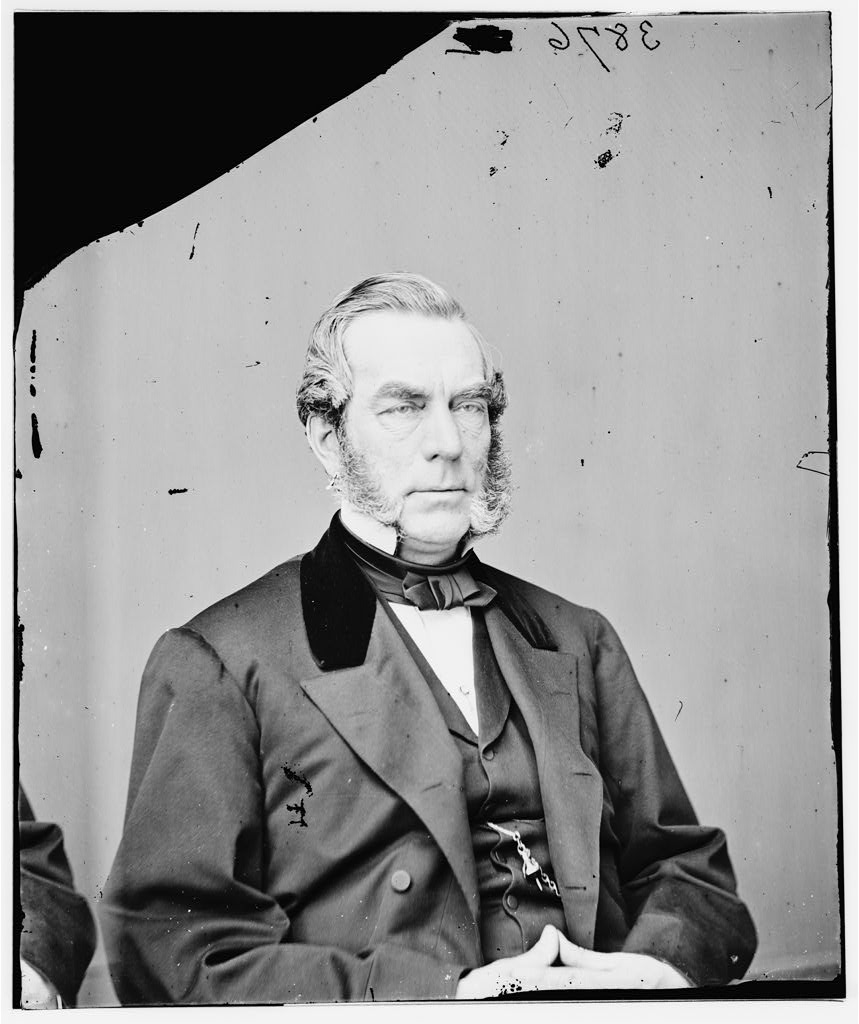
“EDWIN D. MORGAN, the twenty-third governor of New York, was born in Washington, Massachusetts on February 8, 1811. His education was attained at the Bacon Academy in Colchester, Connecticut, where his family moved to in 1822. Morgan established a successful business career, with holdings in the banking and brokerage industries. He first entered politics in Connecticut, serving as a member of the Hartford city council, a position he held in 1832. After moving to New York, he served as alderman of New York City in 1849; was a member of the New York State Senate from 1850 to 1851; and served as the state immigration commissioner from 1855 to 1858. He also chaired the Republican National Committee from 1856 to 1864. Morgan next secured the Republican gubernatorial nomination, and was elected governor by a popular vote on November 2, 1858.

Edwin D. Morgan
. United States, None. [Between 1860 and 1870] Photograph. https://www.loc.gov/item/2018669639/.

He was reelected to a second term in 1860. During his tenure, the state’s canal system was advanced; Vassar College was founded; and volunteers were raised and equipped for service in the Civil War. Morgan also served as major general of volunteers during the war, as well as serving as the commander for the Department of New York. After leaving the governorship, Morgan was elected to the U.S. Senate, an office he held from 1863 to 1869. From 1872 to 1876 he chaired the Republican National Committee; and in 1881 he turned down an appointment to serve as U.S. secretary of treasury. Governor Edwin D. Morgan passed away on February 14, 1883, and was buried in the Cedar Hill Cemetery in Hartford, Connecticut.” [14]

Although these three men are from completely different backgrounds, their stories intersect in this one document. Historical stories are everywhere, you just need to dig under the surface to find them.


[1] Corcoran, Michael. Letter to Gov. Edwin D, Morgan. “Brigadier General Michael Corcoran Request For Michael McEvoy.” New York, New York: Astor House, September 11, 1862.

[2] “Page 1 New York Civil War Muster Roll Abstracts McEvoy, Michael.” Fold3. Accessed December 31, 2022. https://www.fold3.com/image/315981459.

[3] Ibid

[4] “Michael McEvoy in the 1850 United States Federal Census.” Ancestry. Accessed December 31, 2022. https://www.ancestry.com/discoveryui-content/view/7008512:8054?tid=&pid=&queryId=6a9bb6ca9453a20b805c27f011dfac83&_phsrc=csG312&_phstart=successSource.

[5] Page 1 New York Civil War Muster Roll Abstracts McEvoy, Michael.” Fold3. Accessed December 31, 2022. https://www.fold3.com/image/315981459

[6] Ibid

[7] “Page 1 New York Civil War Muster Roll Abstracts Michael McEvoy.” Fold3. Accessed December 31, 2022. https://www.fold3.com/image/316135643.

[8] Ibid

[9] Ibid

[10] Pritchard, Russ A. The Irish Brigade : a Pictorial History of the Famed Civil War Fighters. (Philadelphia,

[11] Conyngham, The Irish Brigade and It’s Campaigns , 537

[12] Ibid 

[13] Ibid, 538

[13] Shiels, Damian. Irish in the American Civil War Exploring Irish involvement in the American Civil War . March 18, 2012. http://irishamericancivilwar.com/2012/03/18/baptism-of-fire-the-corcoran-legion-at-deserted-house-virginia-30th-january-1863/ (accessed 11 20, 2013).

[14] Sobel, Robert, and John Raimo. “Edwin Denison Morgan.” National Governors Association. Accessed November 3, 2023. https://www.nga.org/governor/edwin-denison-morgan/.

An Artifact Speaks

I feel every artifact has a story. This identification shield worn by Sergeant Thomas Wood (Woods) is no exception. Sgt. Woods was a member of Company “B”, 69th New York National Guard. This unit would later become the 182nd New York Infantry, part of Corcoran’s Irish Legion.

 Identification shield worn by Sergeant Thomas Wood (Woods). Provided by The American Military Heritage Museum Of North Carolina.
Identification shield worn by Sergeant Thomas Wood (Woods). Provided by The American Military Heritage Museum Of North Carolina.

Woods was born in Ireland around 1827[1] and arrived in the United States prior to 1850.[2] He married Margaret Begnan at St. James Roman Catholic Church in Manhattan on October 13, 1850.[3] By 1860 he was making a living as a butcher. He and his wife, along with their two children Patrick and Elizabeth, resided in the 18th Ward of Lower Manhattan.[4]  In November of 1861 Thomas and Margaret would have another child, Thomas Frances.[5]

As the American Civil War unfolded, Woods made the decision to enlist. On September 18, 1862, Woods enlisted in the 69th New York National Guard.[6]  On November 17, 1862, he was officially mustered in as a Sgt. in “B” Co. 69th N.Y.N.G. This regiment was organized by Col. Mathew Murphy as the first regiment of the Corcoran Brigade, also known as Corcoran’s Irish Legion.  The regiment left New York state on November 10, 1862, to serve at Newport News, VA. The unit first served in Corcoran’s Brigade, part of Peck’s Division, Department of Virginia. Then in December 1862 at Suffolk, as part of Murphy’s Brigade, Corcoran’s Division.[7] Sgt. Woods and the 69th N.Y.N.G spent most of their time guarding Federal naval yards at Portsmouth and Norfolk.

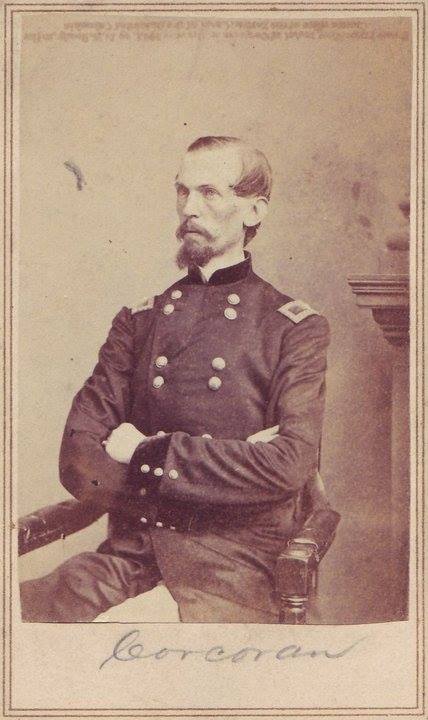
In January of 1863 Confederate Brigadier-General Roger Atkinson Pryor would move 1,800[8] men towards Suffolk, VA. His hope was to disturb Union activity in the region.  Early in the morning of January 30[9] Brigadier-General Corcoran ordered his men to march in the direction of the enemy.

Carte-de-visite of Michael Corcoran Provided by The American Military Heritage Museum Of North Carolina.

The men of the 69th N.Y.N.G were both anxious and eager to see their first combat. Their energy led them to be boisterous and the men had to be ordered to keep quiet, as to not alert the confederate soldiers that were in close proximity. Sgt. Wood and the men of Co. “B” slogged through the mud for nine miles before reaching the enemy.  Brigadier General Corcoran first sent in his cavalry and artillery, who took heavy fire. Corcoran than ordered the 167th Pennsylvania into the fight. However, they were in a shambles due to the wounding of their commander. It was time for Sgt. Woods and the men of the 69th N.Y.N.G to see the elephant. They advanced through the blackness of the early morning….

This magnificent map of The Battle of Deserted House is the property of Baylor University. The image is reprinted with permission from the War of the Rebellion Atlas digital collection. It was produced by the US Government.

“Moving into a gully near the unfortunate 167th Pennsylvania, the Legion came into range of the Confederate artillery, and were ordered to lie down. Trees and houses were ripped apart during the ferocious barrage that followed…. In defense of the Pennsylvanians, the fire under which they had been exposed was extremely heavy, as the Legion were finding out. A piece of spiraling shrapnel struck the canteen of the 69th’s Captain Michael Kelly, carrying away his elbow. 30-year-old Sergeant Thomas Woods took a shell fragment in the stomach, killing him.”[10]

This action would be known as “Deserted House.” It was the first combat for the 69th N.Y.N.G but the last that poor Sgt. Woods would see.

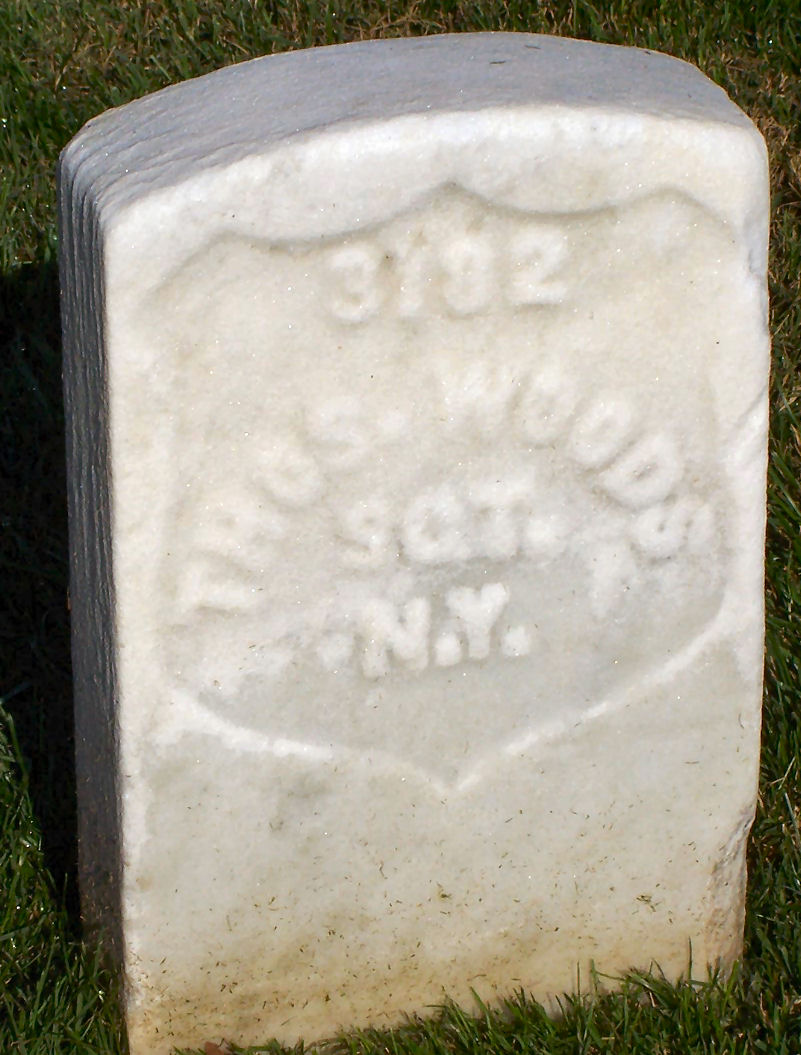
Sgt. Woods now rests in Hampton National Cemetery in section D number 3182.[11]

Photo by Dawn Bilik (prev. Stewart)
Grave of Sgt. Thomas Wood Photo by Dawn Bilik (prev. Stewart)

Margaret would apply for a widow’s pension for her and the three children on March 19, 1863.[12] She would receive a pension of $8.00 a month, which is about $108[13] in today’s money. Sadly, Margaret would die on July 4, 1864.[14] The children and the pension were then transferred to the custody of Mary Ann Grimes.

Let us never forget the sacrifice of Sgt. Woods and his family for their adopted country.


[1] “1860 United States Federal Census for Thomas Woods.” Ancestry. Accessed October 6, 2022. https://tinyurl.com/mr39du7m.

[2] “Thomas Woods Page 5 Civil War ‘Widows’ Pensions.’” Fold3. Accessed October 6, 2022. https://www.fold3.com/image/270483669.

[3] Ibid

[4] “1860 United States Federal Census for Thomas Woods.” Ancestry. Accessed October 6, 2022. https://tinyurl.com/mr39du7m.

[5] “Thomas Woods Page 11 Civil War ‘Widows’ Pensions.’” Fold3. Accessed October 6, 2022. https://www.fold3.com/image/270483681.

[6] “Thomas Woods Page 1 New York Civil War Muster Roll Abstracts.” Fold3. Accessed October 6, 2022. https://www.fold3.com/image/316281613.

[7] “New York State Military Museum and Veterans Research Center.” 182nd Infantry Regiment :: New York State Military Museum and Veterans Research Center. Accessed October 6, 2022. https://museum.dmna.ny.gov/unit-history/infantry-2/182nd-infantry-regiment.

[8] Shiels, Damian. “Baptism of Fire: The Corcoran Legion at Deserted House, Virginia, 30th January 1863.” Irish in the American Civil War, March 25, 2020. https://irishamericancivilwar.com/2012/03/18/baptism-of-fire-the-corcoran-legion-at-deserted-house-virginia-30th-january-1863/.

[9] Ibid

[10] Ibid

[11] “Thomas Woods (Unknown-1863) – Find a Grave…” Find a Grave. Accessed October 6, 2022. https://www.findagrave.com/memorial/3097387/thomas-woods.

[12] “Thomas Wood Page 21 Civil War ‘Widows’ Pensions.’” Fold3. Accessed October 6, 2022. https://www.fold3.com/image/270483701.

[13] “Inflation Rate between 1863-2022: Inflation Calculator.” $8 in 1863 → 2022 | Inflation Calculator. Accessed October 6, 2022. https://www.in2013dollars.com/us/inflation/1863?amount=8.

[14] “Thomas Woods Page 2 Civil War ‘Widows’ Pensions.’” Fold3. Accessed October 6, 2022. https://www.fold3.com/image/270483662.