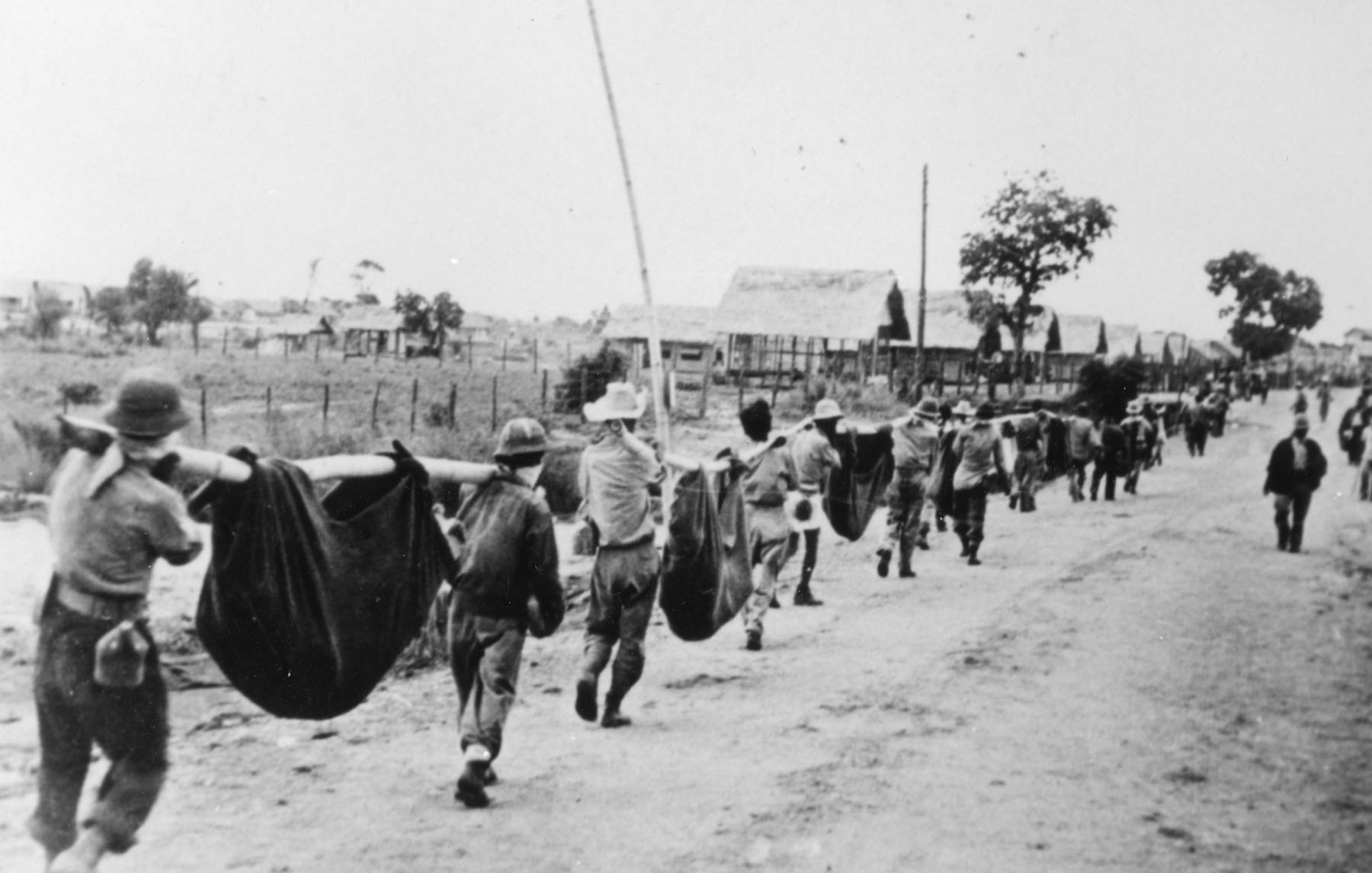
Uncovering the Heroism: Bedford’s Sons in the Shadows of D-Day

Eighty years ago today, the town of Bedford Virginia suffered perhaps the greatest single tragedy of the second world war. Twenty of its sons were killed in a matter of hours while storming the beaches of Normandy. To put this in perspective the total population of Bedford was four thousand, had this catastrophic event happened in New York City, the number would be the equivalent of forty-five thousand young men killed. (1)

A few weeks ago, I paid my respect to a portion of those young men. The ones whose bodies were repatriated or had cenotaphs in local cemeteries in the area. stories. Let us celebrate their lives as well as their sacrifice upon the altar of freedom.

1) Astor, Gerald. JUNE 6, 1944 (THE VOICES OF D DAY). New York, NY: Dell Publishing, 1994. Pg. 7

Photo of Staff Sergeant Leslie C. “Dickie” Abbott and his grave. Image created by @firefightinirish

Staff Sergeant Leslie C. “Dickie” Abbott was born on October 7th, 1921 in Bedford Virginia. At the age of seventeen Abbott convinced his father to sign papers, so young Dickie could join the National Guard early. In the meantime, according to author Alex Kershaw “he (“Dickie”) rode around town on horseback, rolled his own cigarettes from tobacco he grew himself, kept an elaborate scrapbook, and was utterly devoted to his large God-fearing family.

There was nothing he enjoyed more than sitting down with them after a long day in the fields and feasting on fresh buttermilk, cornbread, and fried chicken.” (1) Before the war he was working in a textile plant and living with his grandmother who had raised him. It is said that he got his sense of humor from her “He loved to laugh. You could tell him anything and he’d just laugh.” His cousin Morris Scott would say years later. (2)

Eventually war would come, and Leslie C. “Dickie” Abbott would be assigned to “A” Co. 116th Infantry along with many other boys from Bedford. The 116th was attached to the 29th Division and sent to train in England. They boarded the Queen Mary with an escort of five destroyers and a British cruiser, HMS Curacoa. As the Queen Mary approached Scotland it was the Curacoa that guided her to the Forth of Clyde. It was a routine operation but at 2.12pm on October 2, 1942, disaster struck. The Queen Mary collided with the Curacoa. The Queen Mary suffered minimal damage but the Curacoa sank almost immediately from the impact of the huge ocean liner 338 lives were lost. Shaken, but safely on dry land in Scotland, the 29th moved by train to London and from there to Tidworth Barracks just ten miles from Stonehenge.

Dickie would write home often to his grandma he wrote, “he would like to work on the farm with Uncle Jerry.” But in (his last) letter, he was “sad, blue and all down in the dumps.” His grandmother wrote back expressing so many other grandparents’ hopes: “I pray our Dear Lord to be with you, protect and help you and bring you safely home. God bless and be with you, and each dear child in the service of our country. Dear God, be with dear little Dickie is the prayer of Grandmother and all the folks back home.” (3)
On June 6th, 1944, Staff Sergeant Abbott was most likely assigned to LCA 910, their mission storm Omaha beach.

Sub-Lieutenant Jimmy Green witnessed the men exit LCA 910 and hit the beaches of Normandy, his account is as follows. “They didn’t need to be ushered out and about they knew what they had to do.” It took over a minute for the other two rows to get out of the boat. The enemy still held their machine-gun fire. Green watched as (the) men waded, guns above their heads, through the water, snaking onto the beach in a long line. Green examined the bluffs above the D-1 draw. “They looked menacing, dark. You knew the Germans were there. It was creepy, especially because of the silence. We’d been expecting the Germans to open up as soon as we arrived. But they didn’t. It was the calm before the storm.” Green saw (the) men lie down on a slight incline. Green went back to work, ordering his coxswain to pull off the beach” (4) Kershaw describes the next moments of battle “(The) men started to advance, German officers finally ordered their men to fire. Above the Vierville draw, the (Germans) opened up with at least three MG-42 machine guns, firing over a thousand rounds per minute, and several mortars. Two dozen snipers lurked in nearby trenches. The slaughter was fast and merciless. (Abbott) and the twenty-nine men in his boat died in a matter of minutes, riddled by machine-gun bullets from several directions. “(5)
Staff Sergeant Abbott’s remains were the first to return to Bedford. His flag draped coffin was displayed on the courthouse steps on December 7th, 1947, the sixth anniversary of Pearl Harbor. Over two thousand people gathered to pay their respects, as the Bedford Fireman’s Band played “Nearer My God to Thee.” (6) He now rests at Oakwood Cemetery in Bedford Virginia, his duty complete.

1) Kershaw, Alex. The Bedford Boys: One American Towns Ultimate D-Day Sacrifice. Cambridge, MA: Da Capo Press, 2003. Pg. 25

2) Ibid, Pg. 26

3) Ibid, Pg. 66

4) Ibid, Pg. 86

5) Ibid, Pg. 87

6) Ibid, Pg. 194 

Photo of Captain Taylor N. Fellers and his grave. Image created by @firefightinirish

Captain Taylor N. Fellers was born on June 10th, 1914 in Goode’s Township, Bedford County Virginia. “Fellers was tall and thin, with a prominent chin and rolling gait”. (1) He was a natural leader and a great athlete throughout High School. In fact his prowess on the track team earned him the nickname “Tail Feathers”. (2) After High School Fellers got a job immediately with the highway department. His leadership ability would earn him a position as foreman. His income was extremely good for the depression allowing him to buy his sister piano lessons, and himself a Buick coupe. He used to driver her to Sunday school at the local Nazareth Methodist Church. In 1932, Fellers joined the National Guard. He was promoted to sergeant in 1935 and then took military correspondence courses to qualify for officer training. In 1940 Fellers married his sweetheart “a striking blonde named Naomi Newman.” (3)

When the war came Fellers was a Captain and made commanding officer of “A” Co. 116th Infantry. The 116th was attached to the 29th Division and sent to England on the Queen Mary to train for D-Day.

On June 2nd Captain Fellers took ill and was ordered to a military hospital. Fellers refused the order. He marched with his men to board the trucks that would take them to the shore. Once they arrived, they boarded the British troopship, the Empire Javelin.

Just after Breakfast on June 6th, 1944 Captain Fellers went for a walk and stopped to look off the deck of the Empire Javelin. He looked out at the dark waters thinking about what they were about to do. Despite telling his men “Company A would come back alive.”, (4) he knew the odds “having studied the Allied intelligence and countless aerial shots and concluded that Company A was being sent to face certain slaughter.” (5) Then “An anti-aircraft gun broke the silence, tracer bullets spitting through the sky, and then a searchlight caught the blaze of an exploding plane.” (6) This was it!

The Captain was put in charge of the men in LCA 910, and suffered the fate referenced in Staff Sergeant Abbott’s story.

The Fellers family found out about Taylor’s fate on July 10th Kershaw sets the scene…

“That afternoon, they (The Fellers family) sat in the shade of a tree in front of their home in the foothills of the Blue Ridge Mountains. Taylor’s youngest sister, Bertie, suddenly saw a car pull up in the dusty driveway. The local mailman, a Mr. McCauley, his wife, and dark-haired teenage daughter, Ellen, got out of the car. “The whole family had decided to bring a letter to us,” recalled Bertie, “because they knew we were so anxious to hear the news.” 18 Bertie had sent her brother a card for his thirtieth birthday on June 10 but it had been returned to sender. She knew her mother and father had begun to suspect the worst. McCauley handed Taylor’s mother a letter postmarked from England. She couldn’t bear to open it, so she handed it to Ellen and asked her to read it. The letter was from Taylor’s friend in England, Mrs. Lunscomb. “Taylor had been to her home (shortly before D-Day),” recalled Bertie. “Several of the other Bedford boys went by her place too. She had kept in touch with my mother, sending her news.” 19 According to Mrs. Lunscomb, Taylor had died on D-Day. Ellen stopped reading. Bertie ran to her mother as she started to cry: “It was a long time before anybody could say anything.” (6)

“On Saturday, July 15, the Bedford Bulletin contained the following lines: I mourn for you in silence No eyes can see me weep But many a silent tear is shed While others are asleep. Never did I know that the gift that I sent Would mean so little to you on your birthday, June tenth; It will always break my heart and will cause many a tear Just to know your burial day would have been your thirtieth year.” (7) The poem was written by Naomi Newman, Taylor Fellers’s wife.

On June 6, 1954, in front of a sobbing crowd, Taylor Fellers’s mother unveiled the memorial of polished granite. It was carved from the very cave near Vierville sur Mer that served as the first command post of Major General Charles H. Gerhardt. It seemed to gleam in the sunshine.

Captain Fellers now rests in Greenwood Cemetery along with some of the men in his command.

1) Kershaw, Alex. The Bedford Boys: One American Towns Ultimate D-Day Sacrifice. Cambridge, MA: Da Capo Press, 2003. Pg. 12

2) Ibid, Pg. 23

3) Ibid, Pg. 24

4) Ibid, Pg. 12

5) Ibid, Pg. 12

6) Ibid, Pg. 179-180

7) Ibid, Pg. 180

Photo of Technical Sergeant Frank P. Draper Jr. and his grave. Image created by @firefightinirish

Technical Sergeant Frank P. Draper Jr. was born on September 16th, 1918. His family was poor even for Bedford standards. As a child Frank would grab coal that fell off the railroad cars running near his home to help keep his family warm. He was a star athlete in baseball, basketball, football and track at Bedford High School. Frank worked in the spinning department at Hampton Looms. He was the centerfielder and lead-off batter for the company team; he also played for Mud Alley a tough neighborhood team. Draper, like many of the local young men, was also a member of the National Guard. He was enticed by the promise of a dollar every Monday night after marching practice at the Bedford Armory. (1)

As war loomed in 1940, the United States began to strengthen its military. In October, it was declared that Bedford’s National Guard Company “A” would be mobilized into the federal Army for a period of one year.

Four months later, on February 3, 1941, Draper and the other members of Company “A” reported to the Bedford Armory where they were issued new uniforms and sworn in. They were sent to Fort Meade, Maryland, home of the 29th Infantry Division where they were taught to be soldiers.

After their training was complete, they were ordered to England to prepare for the invasion. Before leaving Draper would get engaged to his sweetheart Nellie McKinney. While in England Draper put his baseball skills to use. He played for the 116th Infantry Regiment Yankees in a four-day tournament in London. The 116th team was an underdog, but Tech Sergeant Draper with his three hits, including two triples in the 6-3 final against 8th Air Force Fighter Command, gave the 116th team the ETO championship. (2) This was the last time Draper would play ball before the invasion.

“At 0400 on June 6th “the Bedford boys stood on deck ready to climb into the British LCAs that hung over the sides of the Empire Javelin suspended from davits. For a few moments, they stood in silence. It seemed that whatever each man was thinking formed part of some communal prayer. The silence was broken as an officer read Eisenhower’s final words of encouragement over the Javelin ’s public address system: Soldiers, sailors and airmen of the Allied Expeditionary Force! You are about to embark upon the Great Crusade, toward which we have striven these many months. The eyes of the world are upon you. The hopes and prayers of liberty-loving people everywhere march with you. In company with our brave allies and brothers in arms on the other fronts, you will bring about the destruction of the German war machine, the elimination of Nazi tyranny over the oppressed peoples of Europe, and security for ourselves in a free world.” (3)

Shortly after the words of encouragement from the Supreme Allied Commander, Tech Sgt. Draper boarded his LCA. As the LCA approached its objective it was struck with an antitank rifle bullet, Draper was hit, and his upper arm was torn off. Company A’s Private Russell Pickett recalls “Draper was still alive but unconscious (The) antitank rifle bullet had gone through his left shoulder and upper arm. You could see his heart beating.” (4) Drapers sister Verona was told that the men on the LCA urged Draper to lay down as he was covered in blood, but he refused. After much blood loss Drapers body gave out falling to the wet vomit covered deck, he would die a few hours later.

Draper’s mother was at work when she got the news, she ran out and never came back. His sister Verona recalls ““By the time I got home, one of the neighbors had brought the message to my mother that my brother Frank was dead. He was her first born. . . . There was no conversation, just a lot of crying and carrying on. My mother [Mary Draper] was in bed. She had just given up.” (4) Franks brother David was serving as a Navy Seabee in the Pacific Theater when he got the news David recalls, “He was cleaning his eating utensils when his lieutenant commander took him aside and told him that his brother Frank was dead. “He said I could take two days off. I said: ‘No, I don’t want to.’ I had a job to do beating the Japanese. . . . They weren’t like us. They were brutal. But we got to be just like ’em in the end. Just like animals. That’s what it took to win.” (5)

To mark Franks twenty sixth birthday his mother wrote a poem that was featured in the Bedford Bulletin it reads,

“I can’t even see your grave except in a dream. Now my mind wanders thousands of miles across the mighty deep. To a lonely little mound in a foreign land where the body of my dear soldier boy might be lain away. This tired, homesick soldier boy who attended church in Bedford all his life. He was not buried in a nice casket, flowers and funeral procession. His dear body was laid to rest in a blood-soaked uniform. Maybe it was draped in an American flag. There will not be any more cruel wars where you have gone, dear Frank. . . . The old rugged cross has a two-fold meaning for me, for my own dear boy shed his precious blood like Jesus on the cross at Calvary. For our religious freedom, they say. A dear price to pay.” (6)

Franks body was returned to the United States in 1947. His family met the train at night and Frank’s coffin was draped in a flag surrounded by an honor guard. Draper’s mother wanted the casket to be brought back to the house so that Frank could be at home. The undertaker had to squeeze the casket through the window to fulfill this request. A few days later as the family gathered at the funeral parlor. Frank’s mother wanted to see her son one last time, they opened the coffin to see Frank still in his uniform. Verona remembers that “His face looked like if you blew on it the skin would just float away.” (7)

Tech. Sgt. Draper now rests in Greenwood Cemetery Bedford Virginia. His head stone reads…..

“Erected In Sad But Loving Memory Of Our Dear Son And Brother, Technical Sergeant Frank Draper Jr. Co. A 116TH, Inf. Reg. Va. National Guard 29TH Division,
Who Was Killed In The Invasion Of Normandy, France, June 6, 1944, Aged 26 Years.

Our Precious Son From Us Is Gone, His Voice We Loved is Still, His Place Is Vacant In Our Home Which Never Can Be Filled, We loved You, Juney. Dearly Loved you. But God Loved You Best. He Took You Home To Heaven Where All Is Peace And Rest.
Our Loss Is Heaven Gain. Father, Mother, Brother, And Sister.”

1) Kershaw, Alex. The Bedford Boys: One American Towns Ultimate D-Day Sacrifice. Cambridge, MA: Da Capo Press, 2003. Pg.14
2) Stars and Stripes, October 1, 1943
3) Kershaw, Alex. The Bedford Boys: One American Towns Ultimate D-Day Sacrifice. Cambridge, MA: Da Capo Press, 2003. Pg.79
4) Ibid, Pg. 185
5) Ibid, Pg. 186
6) Ibid Pg. 189
7) Ibid, 195

Photo of Private John D. Clifton and his grave. Image created by @firefightinirish

Private John D. Clifton Was born on June 18th, 1923 in Bedford Virginia. Like many young boys John had a job delivering newspapers. He attended Bedford High School and was a known as a “quiet, trustworthy pupil with a gentle sprite”. (1) An example of his spirit, is the story his mother told about when J.D. (as he was known) ignored the harassment he received for dating a Jewish girl and continued to see her through High School. After High School J.D. Joined National Guard. On February 3rd, 1941 the unit was activated, and like the others he was assigned to “A” Co. 116th Infantry. The 116th was attached to the 29th Division and sent to England on the Queen Mary to train for D-Day.
While in England Clifton established himself as quite the ladies’ man. This was due to “an unbeatable combination of Southern charm, penetrating brown eyes, courtesy of his Cherokee Indian ancestry, and a slim but muscular build.” (2)

He would eventually stop tomcatting when he met an English girl at a dance, and they became engaged. Private Clifton was made a radio operator, and on D-Day as his LCA was approaching the beach the antenna broke off his radio set. Clifton asked if he should abandon it and was told to take it with him as radio communications were vital for a successful mission. Private Clifton shouldered his set, and after a slight ramp malfunction he hit the beach. As this was the second wave of the attack the first site J.D. would have seen were the bodies of his dead and wounded comrades scattered about the shore. Private Clifton was last seen alive by Lt. Nance the squad leader, who witnessed Clifton “crawling, his radio still on his back. The radio was useless, and it made him a sitting target. He should dump it fast, thought Nance. “Keep moving, keep moving,” shouted Nance. “I’m hit,” cried Clifton. “Can you move?” asked Nance. Clifton didn’t answer. Nance ducked and then looked up again. Clifton had disappeared.” (3)

Private Clifton’s body was returned to Bedford in 1947, and the arrangements were taken care by J.D.’s father. Clifton now rests in Greenwood Cemetery.

1. Kershaw, Alex. The Bedford Boys: One American Towns Ultimate D-Day Sacrifice. Cambridge, MA: Da Capo Press, 2003. Pg. 46
2. Ibid, Pg. 46
3. Ibid, Pg. 90

Photo of Private John F. Reynolds and his grave. Image created by @firefightinirish

Private John F. Reynolds was born in Bedford Virginia on November 22nd, 1922. Throughout High School Reynolds worked on the family farm. He was very close to his family especially, his mother whom he convinced to let him join the National Guard. On February 3rd, 1941 the unit was activated, and like the others he was assigned to “A” Co. 116th Infantry. The 116th was attached to the 29th Division and sent to England on the Queen Mary to train for D-Day.
While in England Reynolds got a reputation for being wild guy, a friend recalls “He drank so much one night he came back to the barracks and peed in John Clifton’s bed. He was like a lot of those boys. Most of them didn’t have much chance here in Bedford but they were good-looking, and over there they put that uniform on and they were something.” (1)

Reynolds sure was something he soon met and fell in love with Kathleen Bradshaw, a nurse from Quinby, Virginia. According to family they were head over heels and where to be married as the end of the war.
Private Reynolds was made a runner for Co. “A”. His job was to run messages from Captain Fellers to HQ. Reynolds was assigned the same LCA as Private Clifton, he reached the beach as a swarm of bullets surrounded the men. Lt. Nance saw a member of Co. A running to avoid the machine gun fire and recognized him as Reynolds.

Lt. Nance describes Pvt. Reynolds last moments as such “Reynolds stopped, knelt down and raised his rifle to return fire. He never got to pull the trigger. Nance saw him fall dead.” (2)

Pvt. Reynolds sister remembers when the telegram informing the family of his death was delivered. Her mom read it and immediately sat down and cried. She also has memories of her mother reading Pvt. Reynolds letters on Sunday afternoons for years later.

His sweetheart Kathleen Bradshaw sent a poem to the Bedford Bulletin in order to remember her lost love it reads….

“How sad I was that lonely day When I heard that you’d been called away . . .
I can’t forget your smiling face, Full of love,
friendship and grace; God called you on that other shore,” (3)

He now rests in Greenwood Cemetery, Bedford Virginia.

1) Kershaw, Alex. The Bedford Boys: One American Towns Ultimate D-Day Sacrifice. Cambridge, MA: Da Capo Press, 2003. Pg. 55
2) Ibid, Pg. 90
3) Ibid, Pg. 189

Photo of Master Sergeant John L Wilkes and his grave. Image created by @firefightinirish

Master Sergeant John L Wilkes was born in North Fork Virginia on July 20th, 1919. He grew up on a 149-acre farm. His father was a miner in West Virginia who was seldom home but would send money back for the family. The Wilkes’s were poor, but they never were in need. John left High School at 16 and started work as part-time mining feldspar on a local farm. Wilkes joined the National Guard to make some extra money. He rapidly showed himself to be as robust a soldier as Company “A” had ever seen. Because of his honesty and immense self-control, both inherited from his father, he was soon promoted to master sergeant. He wanted things done by the book, the army way, or not at all.

John Wilkes would meet Bettie Peters Krantz at a football game at her high school, the New London Academy, just outside Bedford. She said that what she saw in John was a romantic, sensitive, passionate man. She described their relationship as such “John and I were probably typical of most young people growing up in the prewar America of the late 1930s,” she recalled. “[We] had not traveled far beyond the confines of the farm or village, but there were things like the jitterbug to be learned at local dances, songs like “Deep Purple” to be sung, money to be saved to see Gone with the Wind , a movie which was an unheard-of four hours long! A time to be envied in most respects, safe and carefree.” (1)

However, the carefree times would soon come to an end. A few months after their marriage the Japanese would bomb Pearl Harbor, thrusting the United States into war. On September 22nd, 1942 the Bedford Boys of “A” Co. 116th Infantry would be leaving their base in Florida to head north and then overseas. Bettie would travel down too see her husband off she recalls the scene in Kershaw’s book “I’m coming back, you can believe that,” John Wilkes told Bettie. There was time for one last kiss. Then Master Sergeant Wilkes stepped away. “Well, looks like time we got to shove off,” he said. Wilkes turned towards Company A. “All right, men!” he shouted. “Fall in!” The men snapped into perfect formation. Not a head turned towards the women. “Forward, march!” Wilkes ordered. “Hut, two, three, four! Hut . . . ” Bettie and the other Bedford girls waved goodbye. “Oh my, they looked very fine,” recalled Bettie. “They made us feel proud.” (2)
Msg. Wilkes was a hard disciplinarian while in the England. He had put on some weight and was an imposing figure when angry, one solder from New York said of the Master Sergeant that “he looked like a huge “wall” about to fall on him.” (3) Wilkes had good reason to be hard on his men he was preparing them for combat.

That combat came on June 6th, Msg, Wilkes LCA approached the beach and the British bowman, shouted ““We’re going to drop this ramp and as soon as we do, we’re going to back out, so you guys better be ready.” (4) Then the ramp crashed into the ground and the doors flung open Wilkes ran out into a burst of machine gun fire men were falling all around him. Msg. Wilkes was one of the ones who made it onto the shore. He and another soldier started firing, when Wilkes asked the solder what they were firing at neither knew. Master Sergeant John L Wilkes was last seen firing his M-1 Garand rifle at the defensive installations when he was shot and killed. The man next to him was cut in two by machinegun fire.

Bettie was on her way home from work. She made a quick stop to pick up one last item for a care package she was sending to John, when she first found out Johns fate. “Bettie stared in disbelief and shock. She managed somehow to make her way back to the rooms she shared with her sister at Ramsey Apartments, the first new building in Bedford since the war started. The next few days were a blur. but within a week, she recalled, “Family and friends had just about convinced me that the letter could not be true, and that I would have been notified by the government first. They insisted I wait until I got official word before I gave up hope. They kept telling me it was probably a mistake even though no letters or news was yet received from John. So I decided to go back to work and wait for official word.” (5) Official word came on July 17th while Bettie was at work she broke down in tears and immediately thought “the love of my life is dead” (6) She would write ““Life seems so useless without you darling, There is only one hope left now, to meet you up there where there is no night but eternal rest and peace.” (7)

Msg. Wilkes now rests at Greenwood Cemetery in Bedford, Virginia.

1) Kershaw, Alex. The Bedford Boys: One American Towns Ultimate D-Day Sacrifice. Cambridge, MA: Da Capo Press, 2003. Pg. 24
2) Ibid, Pg. 28-29
3) Ibid, Pg. 55
4) Ibid, Pg. 87
5) Ibid, Pg. 179
6) Ibid, Pg. 184
7) Ibid, Pg. 187

Photo of Master Sergeant Private Jack Powers  and his grave. Image created by @firefightinirish

Private Jack Powers was born on April 18th, 1920, In Bedford Virginia. He was an imposing man standing six feet tall and weighing two hundred pounds “all of in muscle”. (1) Jacks sister Eloise remembers Jack as being “handsome, bighearted man who loved to dance and play the guitar.” (2) Private Powers could jitterbug to Tommy Dorsey tunes and many a Bedford girl enjoyed a spin around the dance floor with him. Jack had a job in a rubber plant before joining the National Guard. Like most of the Bedford boys Jack was assigned to “A” Co. 116th Infantry. When the war came Jack marched out of Bedford with the men of the 116th while his sister played clarinet in the Fireman’s Band.

While in England Jack was selected for the Ranger program and took part in specialized training for several weeks. During this time Jack was promoted to Sergeant, however this group of rangers was disbanded. Jack although happy to be back with his friends from Bedford, was also upset at losing an opportunity to be a member of such an elite force. This anger lead Jack to go AWOL and be reduced in rank back to private. By all other accounts Jack was a great soldier, he even developed games for the men that helped to inspire trust amongst them.

On the early morning hours of June 6th one of the Bedford Boys Sgt. Roy Stevens had a run in with Private Powers “He was just carrying on, all nervous. Things were very tense. Everybody was ready to go, ready to do something at last.” Stevens looked around. It seemed that the men fell into two groups. Those who had already decided they were “going to die,” and those who hoped “to make it through.” (3) Private Powers would not survive the Invasion.

On June 11th Sgt. Roy Stevens and Jacks Brother Clyde (also a member of “A” Co.) decided to walk through a makeshift cemetery. Here is where they found Jack’s dog tags affixed to a cross. Beneath the cross was Jacks body wrapped in a bed roll as coffins were not available. Private Jack Powers body remains in France at the Normandy American Cemetery and Memorial. This cenotaph was place in Greenwood cemetery Bedford Virginia so his family could honor his memory.

1) Kershaw, Alex. The Bedford Boys: One American Towns Ultimate D-Day Sacrifice. Cambridge, MA: Da Capo Press, 2003. Pg. 19
2) Ibid
3) Ibid, Pg. 79 

Photo of Master Staff Sergeant Earl L. Parker and his grave. Image created by @firefightinirish

Staff Sergeant Earl L. Parker was born on January 22nd, 1914 in Bedford Virginia. He was known for being lighthearted and having a great sense of humor. Parker enjoyed baseball and hunting, in fact Earl was also a great shot recalled his brother Billy “(Earl Was) Able to hit a dime at thirty-five yards with a .22 rifle,”. (1) After High School Earl worked at the Piedmont Label Company, which printed labels for canned goods. He also joined the National Guard for the extra money. Earl would be assigned to “A” Co. 116th infantry.

On January 26th, 1942 Earl would marry Annie Viola Shrader. Viola would say that Earl was the love of her life. Later that year the boys of the 116th would move out. Viola would see Earl off at the train station and informed him she was pregnant. Viola would give birth to their daughter while Earl was in England. He was convinced they were going to have a boy so before Earl left, he and Viola agreed on the name Danny, Viola named their daughter just that. While in England Earl missed his family, especially around Christmas he wrote Danny saying “I sure hope I will be there next Christmas. I don’t suppose you will know your Daddy when he comes home. I don’t believe it will take us long to get acquainted. Don’t tell mother that I said this, but I love her a lot and think she is real sweet. I wish I could be there with you and Mother tonight. With all my love, Daddy.” (2)

On June 4th the time came to board the troop ship to begin the invasion, Earl entertained the men by walking down some stairs with his hands to break the tension. Later in the evening the mood darkened, Sergeant Roy Stevens recalled SSG. Parker pulling out a picture of his daughter and saying, “If I could just see her once,” Parker said, “I wouldn’t mind dying.” (3) When Staff Sergeant Earl Parker hit the beach, he was struck by a mortar and killed instantly. His body was then washed out to sea.
On June 17th Earl’s parents received a telegram that informed them that he was missing. A few weeks later Viola still hopefully that Earl was alive received a package containing the letters she had sent to him in England, she still refused to believe the worst. Viola later got a telegram confirming her fears in an interview recalling that day she stated, “You’re so hit that you don’t cry, you don’t do anything,”. (4) Later that day she thought that she needed to dust and ended up dusting the entire house. She than picked up Danny and went for a walk. When she stopped at Earl and her favorite spot Viola told Danny “Well, Danny,” we’re going to make it . . . we’re going to make it.” (5) They did.

Earls parents were hit particularly hard, Earl would die on the 6th of June 1944, their other son Joseph would be KIA on August 27th, and Billie would be a POW for a year. When Billie came home in 1945, he was not aware of his brothers’ deaths his father had to break the news to him.

Staff Sergeant Earl L. Parker’s body was never recovered. He is memorialized on two cenotaphs one at the Wall of the Missing at Normandy American Cemetery in France, and the other at Oakwood Cemetery in Bedford Virginia.

1) Kershaw, Alex. The Bedford Boys: One American Towns Ultimate D-Day Sacrifice. Cambridge, MA: Da Capo Press, 2003. Pg. 25
2) Ibid, Pg. 52
3) Ibid, Pg. 77
4) Ibid, Pg. 184 

Photo of Sergeant Gordon H. White and his grave. Image created by @firefightinirish

Sergeant Gordon H. White, Jr was born on December 31st in Forest Virginia. He was quiet, religious, and loved to farm. His sister recalls “As a young boy, he had raced home from school every afternoon, changed into work clothes and stuffed apples into his pockets to snack on as he labored until nightfall on (the) family’s farm. He liked to plow, he just liked to be out on the farm, He just liked the dirt.” (1) After High School White found a job on a farm, and in 1939 he joined the National Guard. He too was assigned to “A” Co. of the 116th Infantry.


White and the Bedford Boys shipped out to England in 1942. While in England White longed for his mother’s cooking, as he was not a fan of Army or English food. On the morning of June 6th SSG. White was most likely assigned to LCA 910. He suffered the same fate as Capt. Fellers, and SSG. Abbott.

His body was returned to the United States on February 19th ,1948. Whites mother would have a massive stroke the next day. Gordon’s father postponed the funeral as long as he could, but it took place while White’s mother was still in a coma. She would die in 1958. SSG. White’s father had to run the household and never got over his sons’ death. The elder White held on to his grief, and all his sons’ possessions. Going so far as to not put down Gordon’s favorite horse Major. even though it was old an infirm.

Staff Sergeant Gordon H. White, Jr now rests at ​Forest Baptist Church Cemetery in Forest Virginia.

1) Kershaw, Alex. The Bedford Boys: One American Towns Ultimate D-Day Sacrifice. Cambridge, MA: Da Capo Press, 2003. Pg. 17

Photo of Tech. Sergeant Ray Stevens and his grave. Image created by @firefightinirish

Tech. Sergeant Ray Stevens was born on August 19th, 1919. Ray was one of fourteen children; he went to school in a one room schoolhouse before finding a job to help his family with the depression. Ray and his twin brother Roy would also stage boxing matches, at the local gas station for extra money. However, their brother would usually take it all and visit his girlfriend. Ray and Roy were thick as thieves, they went out together all the time and even dated sisters. In 1938 the twins purchased a 136-acer farm so that their parents would have a place to live, and as a place they can work once the depression was over. While the Stevens brothers waited for crop prices to rise, they made ends meet by working day jobs, and joining the National Guard. They were assigned to “A” Co. 116th Infantry.

In September of 1942 the men of “A” Co. were sent to New York before embarking to England. While in New York The Stevens twins were issued a 24hr pass, they decided to go to Washington D.C. While in D.C. they went out and visited some friends, after a few drinks Ray opened up about his thoughts on the war saying, “if I go over, I won’t be coming back.” (1) The day came to ship off and the 116th climbed aboard the Queen Mary. While on the deck the twins watched the New York City Skyline fade away “I feel scared,” Ray told Roy, voicing many of the men’s feelings. “I never felt scared like this before.” (2)

During the trip Ray spent time below decks reading the Bible. When they got to England Ray was assigned to lead a mortar squad. He became the most proficient man with a mortar in the company and was put in charge of training others.

After 4am on June 6th aboard the troop ship the Bedford Boys went to their assigned boat stations. Roy and Ray had different assignments; Roy found Ray to wish him luck. In an interview Roy recalled the scene “Ray stuck out his hand for Roy to shake. Roy refused it. “I’ll shake your hand in Vierville sur Mer,” he said, “up at the crossroads above the beach, later this morning sometime.” Ray bowed his head and held out his hand again. “I’m not gonna make it.” Of course, he would (Roy thought). Roy still refused to shake Ray’s hand. He’d do it later . . . after they’d crossed Omaha Beach.” (3) They would never get that chance. Ray’s prediction came true, he was killed trying to take Omaha Beach.

On June 11th Sgt. Roy Stevens and Jack Powers Brother Clyde (also a member of “A” Co.) decided to walk through a makeshift cemetery. Roy went to the section marked S and started to scrape the mud off some dog tags they were his brother Rays.

Roy wrote a poem to his mother about the loss of Ray….

“I’ll never forget that morning. It was the 6th day of June. I said farewell to brother. Didn’t think it would be so soon. I had prayed for our future. That wonderful place called home, but a sinner’s prayer wasn’t answered. Now I would have to go there alone . . . Oh brother, I think of you all through this sleepless night. Dear Lord, he took you from me and I can’t believe it was right. This world is so unfriendly. To kill now is a sin. To walk that long narrow road. It can’t be done without him. Dear Mother, I know your worries. This is an awful fight. To lose my only twin brother and suffer the rest of my life. Now, fellas, take my warning. Believe it from start to end. If you ever have a twin brother, don’t go to the battle with him.” (4)

When the telegram got to the Stevens residence in Bedford it had said Roy was listed as missing on June 6th. The Stevens family was confused having received a letter from Roy post marked after the 6th. For a time, they thought both sons may have been killed. When Roy returned home, he met his parents on the front they were crying. Their father was really shaken by Ray’s death since they were very close and would work on the farm together often. Roy too was deeply affected he took to drinking “I tried to forget, wash the memories away,” he said. “But you can’t. As soon as that whiskey dries out it all comes right back.” (5) Roy said in an interview.

On the 50th Anniversary of the invasion Roy Stevens would return to Normandy. When he crossroads in Vierville sur Mer, the promised rendezvous with his brother. Roy stuck his hand out as if to shake his brother hand like they agreed to do 50 years prior.
Ray Stevens now rests in Greenwood Cemetery in Bedford Virginia.

1) Kershaw, Alex. The Bedford Boys: One American Towns Ultimate D-Day Sacrifice. Cambridge, MA: Da Capo Press, 2003. Pg. 30
2) Ibid, Pg. 34
3) Ibid, Pg. 80
4) Ibid, Pg. 175
5) Ibid, Pg. 193

Photo of Tech. Private Wallace R. Carter and his grave. Image created by @firefightinirish

Private Wallace R. Carter Was Born on January 23rd, 1923 in Bedford Virginia. Wallace was known as a fun-loving guy. He grew up poor in the same neighborhood as Technical Sergeant Frank P. Draper, Jr. Like Draper, Carter played for the Mud Alley Wildcats Baseball Team. Wallace worked at the Bedford Pool Hall where he hustled extra money by playing eight ball. Private Carter also had an emotional side according to Roy Stevens “(Carter) jumped off a bridge after falling out with a girlfriend. Fortunately, his fall was broken by a bank and he was only slightly injured.” (1) When Carter turned eighteen, he would join the National Guard and be assigned to “A” Co. 116th infantry.

While on the Queen Mary Carter occupied his time by playing cards and dice, earning the name “Snake-Eyes”. When they reached England, Private Carter would begin to drink heavily. At one point he even brought a canteen full of black-market whisky with him when they switched camps and “took a good swig every few miles.” (2)

On the morning of June 6th, Private Wallace R. Carter was assigned to LCA 910, and was killed as soon as the gangplank was lowered to storm the beach.

Private Carters mother applied for the military headstone he lies beneath, at Greenwood Cemetery in Bedford Virginia.

1) Kershaw, Alex. The Bedford Boys: One American Towns Ultimate D-Day Sacrifice. Cambridge, MA: Da Capo Press, 2003. Pg. 19
2) Ibid, Pg. 42 

FRANCE. Normandy. Omaha Beach. June, 1944. French fishermen looking at corpses on the beach after the D-Day landing. Robert Capa

These men are just a mere fraction of the at least 10,000 allied casualties that gave their last full measure of devotion on the beaches and cliffs of Normandy on June 6th 1944. Let us never forget their sacrifice that was given to make other people free.
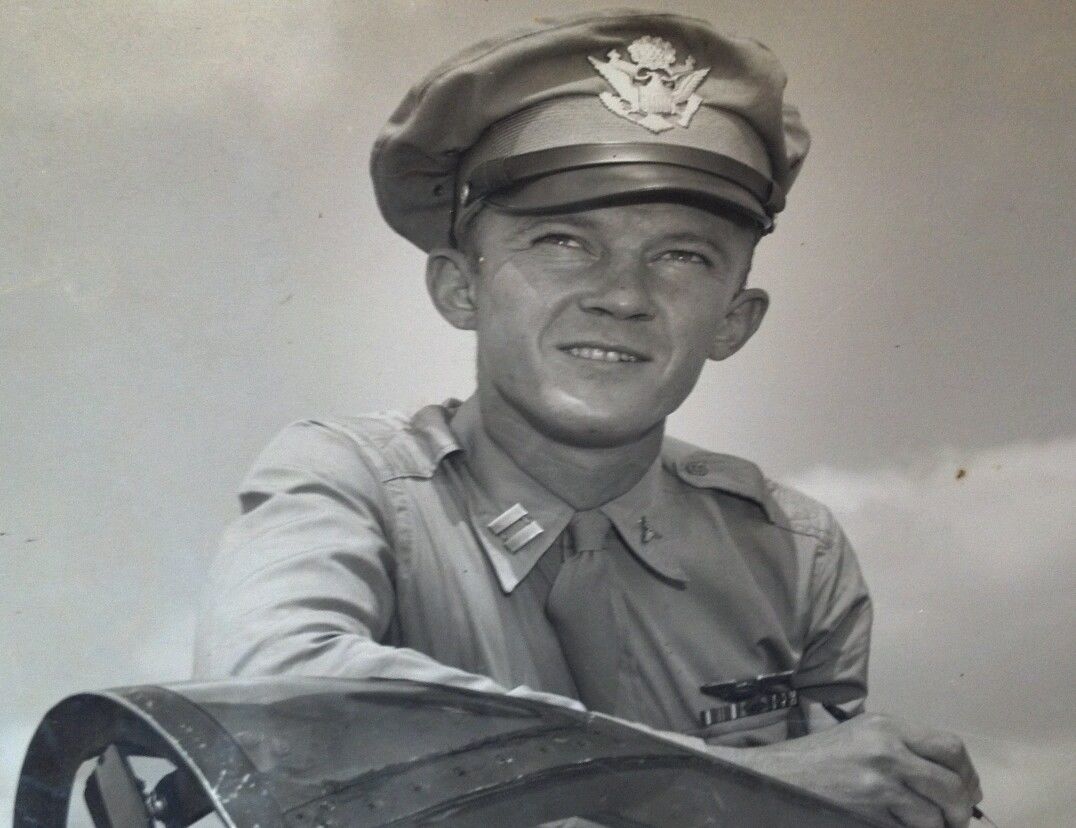
“Unveiling Untold Valor: The Remarkable Journey of Captain Gaston Ward Callum, the Hero Known as ‘Killer'”

I recently made a trip to Greensboro North Carolina. Here I discovered the final resting place of Captain Gaston Ward “Killer” Callum. He was born in Asheville North Carolina to William and Elsie Callum, on June 27th, 1917. Capt. Callum was five feet nine inches tall with blond hair, grey eyes and a light complexion. By 1930 the family moved to Greensboro where Gaston attended Greensboro High School. He would eventually become a student at U.N.C.

Capt.Gaston Ward Callum, of the 79th Fighter-Bomber Group… By  Michel Beckers 

A family friend related a story. Stating that in late 1939 or early 1940, Gaston and a friend went to New York City to enlist in the French Ambulance Corp. However, in May of 1940 France became over run dashing their hopes.[1] On October 16th Callum registered for the draft. He was living in Wilmington NC at the time, He listed his employer as General Motors Acceptance Corporation. Capt. Cullum would enter the United States Army Air Corps on February 25th, 1942. He would earn his wings and fly P-40s and P-47s, with the 79th Fighter Group. Callum would serve in North Africa, Sicily and Italy. Capt. Cullum would go on to fly 110 combat missions in 13 months. He would earn the name “killer” when he was flying cover for the Anzio landings. Callum would shoot down two aircraft in four days. During this same time period Capt. Callum would lead his squadron of six fighters against 15 German Messerschmitt’s scoring one of his kills. “According to Walt Brown, Callum followed one of the Luftwaffe fighters all the way to Rome before he was able to complete the kill.”[2]

79TH-FG-P-47S-During Aerial Parade Over Udine Italy On The 28th of May-1945. From the Robert Kelley Collection

 While in Italy Callum was shot down and crashed in enemy territory. With his plane destroyed, and suffering injuries the Captain crawled towards friendly ground. He would eventually be picked up by a U.S. patrol then returned to his unit. Capt. Callum would later register a direct hit on a German tank in what he recalled as his closest call. “When we went in on them, we discovered it was a convoy of heavy tanks and every one of them started shooting back at us!” Said Harry Thetford a member of the 79th. [3] Capt. Callum would receive many awards. These included the Distinguished Flying Cross (for the aforementioned action), The Silver Star, and an Air Medal, with as he described “more oak leaf clusters than I can recall,”.[4] His Silver Star was earned for “Meritorious achievement in a bombing mission over Italy”.[5]

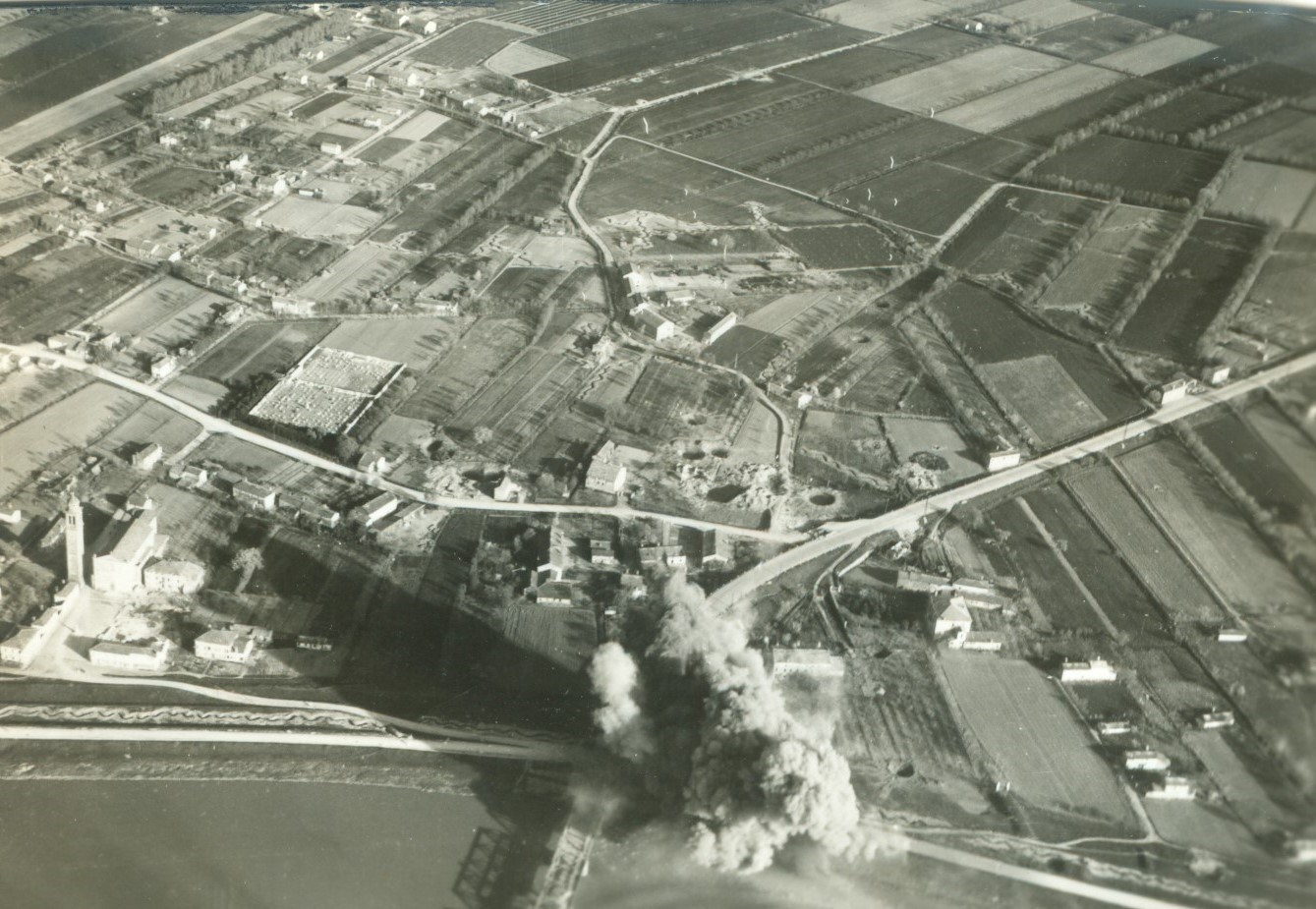
79th Fighter group hits a bridge Roy A. Larson Collection

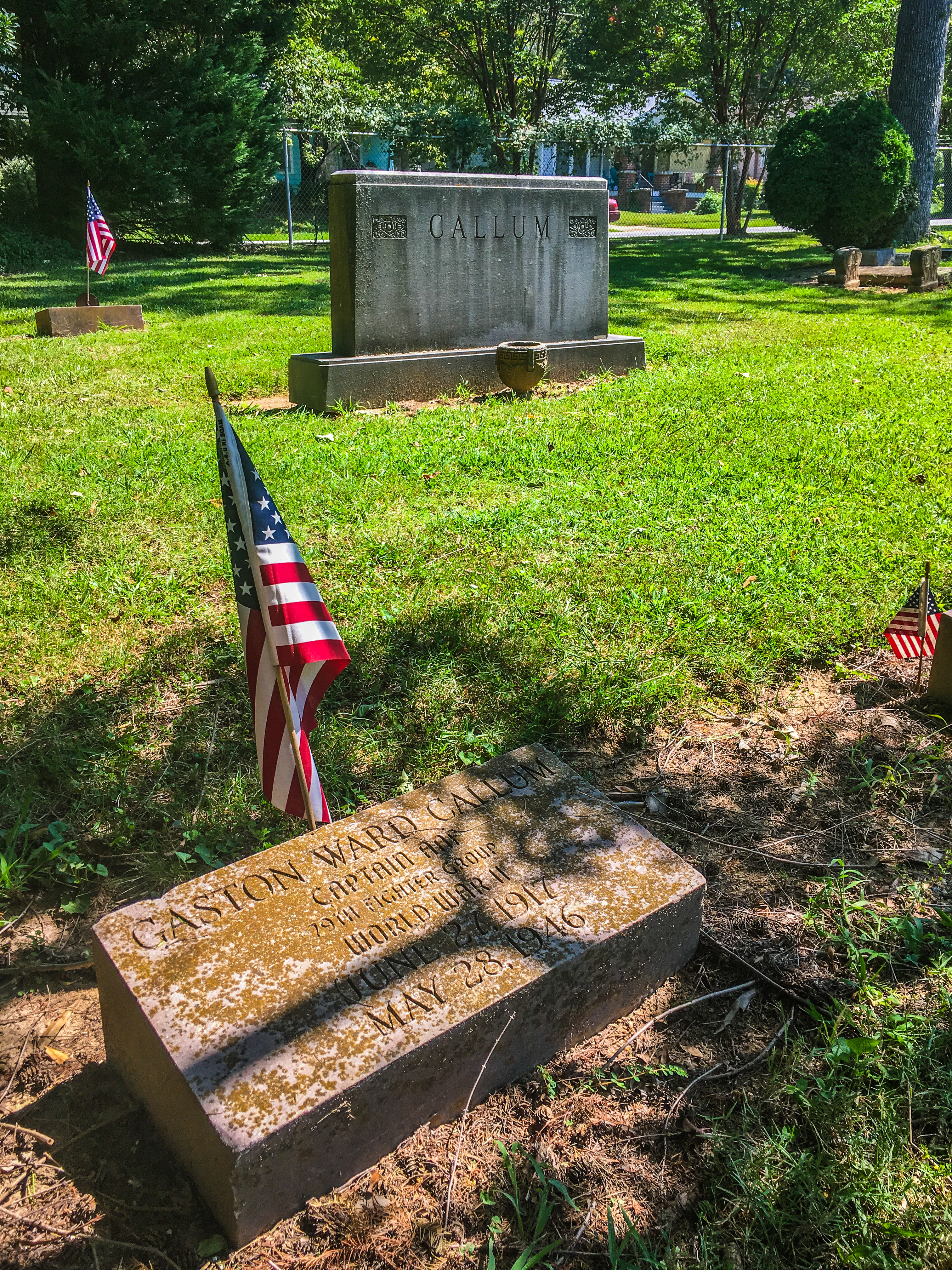
Capt. Callum is reported to have made a direct hit on a bridge destroying it in a low level attack. Even though his aircraft was heavily damaged the Capt. would make repeated attacks on multiple targets These included an ammunition dump. In the Spring of 1944 Capt. Callum would be sent stateside to be a flight instructor, He was stationed at Moore Field in Texas. Here he would marry Kyte Trice. “Killer” Callum would later be sent to the USAAF Airfield at Linz, Austria. Here he became the provost. Tragically this is where he met his fate. The Captain was flying a P-47 with a history of maintenance issues. He was waved off his first landing attempt, and on his second Capt. Callum’s engine stalled. He crashed and his aircraft exploded killing him instantly.[6] His remains were sent home, and a graveside service was performed at Green Hill Cemetery on January 26th, 1949. Let us never forget his sacrifice for our freedom.

Grave of Captain Gaston Ward “Killer” Callum at Green Hill Cemetery, Greensboro North Carolina. Photo By @firefightinirish

[1] Thetford, Harry. “Remembered” . Harry Thetford, 2019. Pg.371

[2]  Ibid. Pg. 372

[3] Ibid. Pg. 373

[4] Ibid.

[5] Ibid.

[6] Ibid. Pg. 375

The Inspiring Story of Henry F. Warner, North Carolina Hero & Medal of Honor Recipient.

I took a trip to Troy North Carolina earlier in the week. Why Troy you ask? Answer; It is the final resting place of Corporal Henry F. Warner; this is his story.

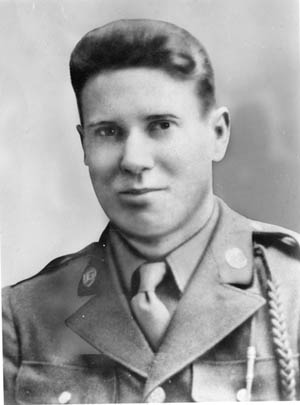
Henry was born to Earnest and Minnie Warner on August 23rd, 1923 in Troy North Carolina.[1] Sadly, Henry’s father would be a homicide victim when Warner was only five.[2] Henry would attend the local schools, and took a job as a machine operator in the Troy Textile Mill after graduation. He entered the army on January 11th, 1943.[3]

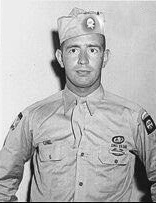
Photo of Corporal Henry F. Warner From: https://www.cmohs.org/recipients/henry-f-warner

Corporal Warner was listed on his draft card as being six feet tall, 135 pounds, with red hair, and a light complexion. He would be assigned as a 57mm anti tank gunner with the 2nd battalion of 26th Infantry regiment, in the 1st Division (The Big Red One).[4] He would accompany them during the D-day landings, as well as fighting through France and Belgium. 

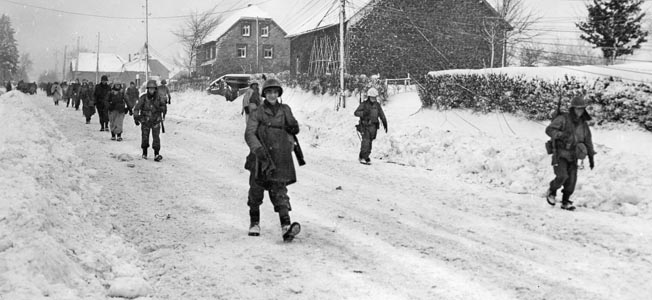
On December 16th, 1944, the German army launched a large offensive into Belgium known as “Battle of the Bulge”.   By the 20th of December the allies were practically surrounded and under constant attack, the 26th Infantry was no exception. Early that morning 20 German tanks broke through their line with almost complete surprise due to a dense fog.[5], this is when Corporal Henry Warner sprung into action.  Staff Sergeant Stanley Oldenski, witnessed Warner’s actions and describes them as such,

Soldiers of the Big Red One enter snowy Butgenbach, Belgium, From: https://warfarehistorynetwork.com/article/from-omaha-beach-to-victory/

Two (tanks) headed straight toward Corporal Warner’s position, firing tank cannon and machineguns, He answered the fire and his first round hit the lead tank and set it afire. Four more shots set it afire and destroyed it. “The second tank was firing and coming right at him, but he carefully placed four rounds into it and silenced its cannon and machineguns, “‘then he saw the third Mark V was bearing down on him he didn’t seem to pay any attention. He was working at the breach lock of his weapon and didn’t stop trying to make it work until the tank was within five yards of him. “Then, jumping to the side of the gun pit, he fired his pistol at the tank as it came on and the tank commander fired back with a pistol. Corporal Warner kept firing until the German tank commander threw up his hands and slumped over the side of the tank. The tank retreated. “On the following day, the Jerries threw in a very heavy barrage and again the tanks broke through the battalion line and started machinegunning our riflemen in an attempt to drive them out of their foxholes so the German riflemen could break through. A German Mark IV appeared in front of Corporal Warner’s position and he fired, setting the motor on fire. But its machineguns got off a burst that killed Corporal Warner.”[6]

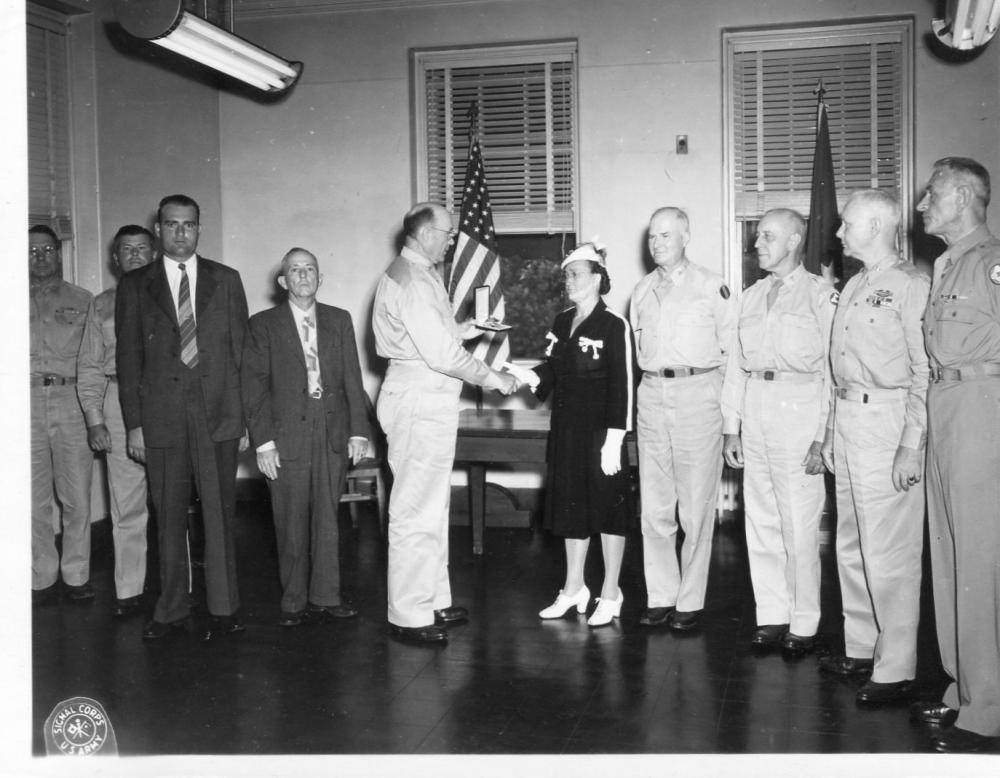
For his actions those two days Corporal Warner was posthumously awarded the Medal of Honor. The decoration was presented to his mother by General John T. Kennedy in a ceremony at Fort Bragg on July 6th, 1945.[7]

General John T. Kennedy presenting the Medal of Honor during a ceremony at Fort Bragg on July 6th, 1945. . https://www.facebook.com/photo/?fbid=3984364528254729&set=a.466699133354637

His official citation reads; “Serving as 57-mm. antitank gunner with the 2d Battalion, he was a major factor in stopping enemy tanks during heavy attacks against the battalion position near Dom Butgenbach, Belgium, on 20-21 December 1944. In the first attack, launched in the early morning of the 20th, enemy tanks succeeded in penetrating parts of the line. Cpl. Warner, disregarding the concentrated cannon and machine gun fire from 2 tanks bearing down on him, and ignoring the imminent danger of being overrun by the infantry moving under tank cover, destroyed the first tank and scored a direct and deadly hit upon the second. A third tank approached to within 5 yards of his position while he was attempting to clear a jammed breach lock. Jumping from his gun pit, he engaged in a pistol duel with the tank commander standing in the turret, killing him and forcing the tank to withdraw.

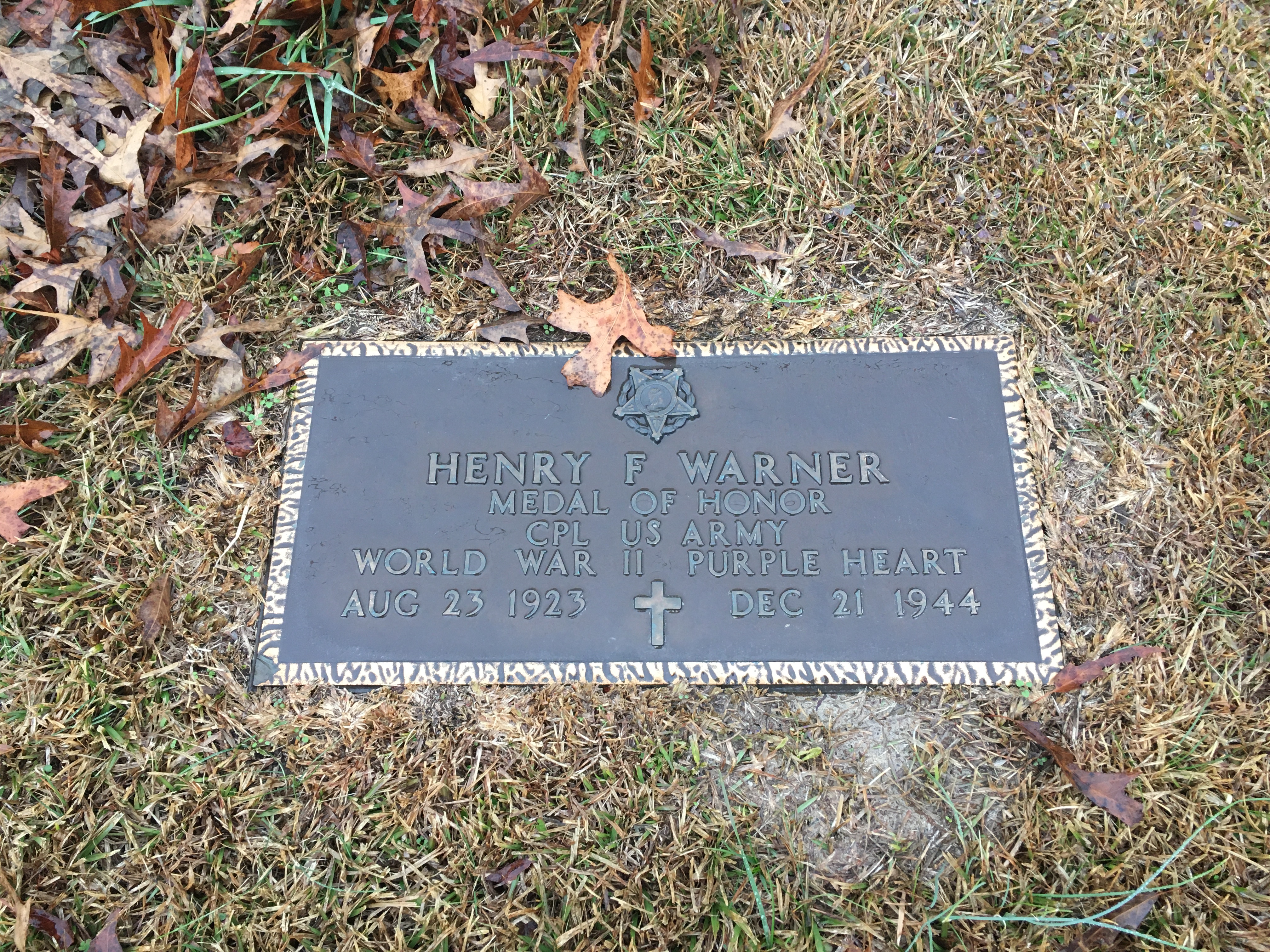
Grave of Corporal Henry F. Warner at Southside Cemetery in Troy North Carolina. Photo By @firefightinirish

Following a day and night during which our forces were subjected to constant shelling, mortar barrages, and numerous unsuccessful infantry attacks, the enemy struck in great force on the early morning of the 21st. Seeing a Mark IV tank looming out of the mist and heading toward his position, Cpl. Warner scored a direct hit.

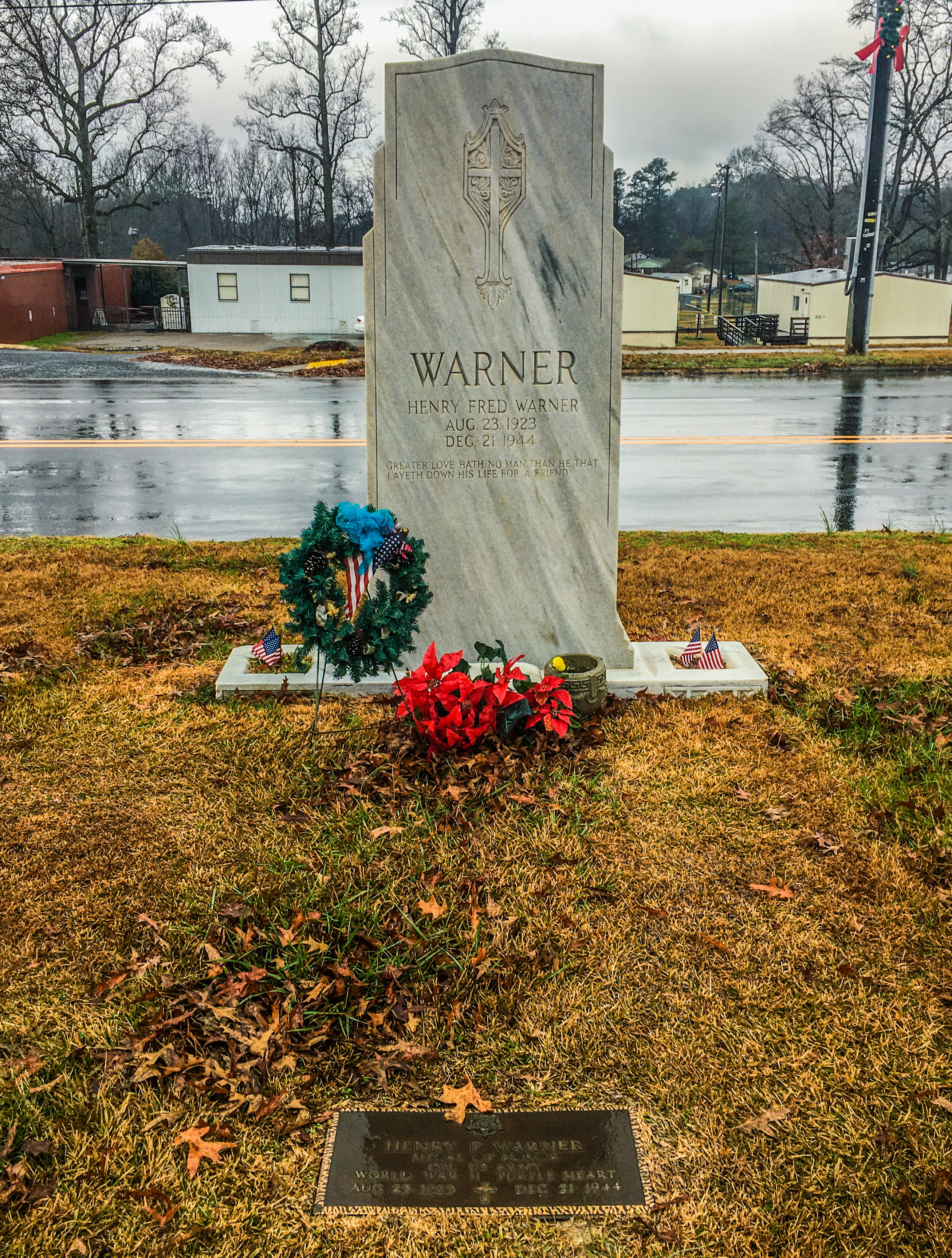
Grave of Corporal Henry F. Warner at Southside Cemetery in Troy North Carolina. Photo By @firefightinirish

Disregarding his injuries, he endeavored to finish the loading and again fire at the tank whose motor was now aflame, when a second machine gun burst killed him. Cpl. Warner’s gallantry and intrepidity at the risk of life above and beyond the call of duty contributed materially to the successful defense against the enemy attacks.”[8]

Corporal Warner’s body was repatriated in November of 1947,[9] and he was interred at Southside Cemetery in Troy North Carolina. He was survived by his mother, brother, and sister.[10]

Grave of Corporal Henry F. Warner at Southside Cemetery in Troy, North Carolina. Photo By @firefightinirish


[1] “Henry Fred Warner U.S. WWII Draft Cards Young Men, 1940-1947.” Search. Accessed December 29, 2019. https://tinyurl.com/rh8lrgq.

[2] “North Carolina, Deaths, 1906-1930 Earnest Coll Warner.” Search. Accessed December 29, 2019. https://tinyurl.com/r3tm78e.

[3] “U.S., War Department, Press Releases and Related Records, 1942-1945 Box 14: B 951 – C 270.” Ancestry.com. Accessed December 29, 2019. https://search.ancestry.com/search/db.aspx?dbid=3026. Pg. 3

[4] Ibid

[5] Ibid, Pg. 1 & 2

[6] Ibid

[7] “MOTHER RECEIVES MEDAL OF HONOR AWARDED HER SON.” Asheville Citizen-Times, July 7, 1945.

[8] “CPL Henry F. Warner.” First Division Museum. Accessed December 29, 2019. https://www.fdmuseum.org/about-the-1st-infantry-division/medal-of-honor-recipients/cpl-henry-f-warner/.

[9] “Carolinas War Dead To Arrive This Week.” The Charlotte Observer , November 23, 1947.

[10] “Henry F Werner in the 1940 Census: Ancestry.” Ancestry.com. Accessed December 29, 2019. https://tinyurl.com/u53ot2h.

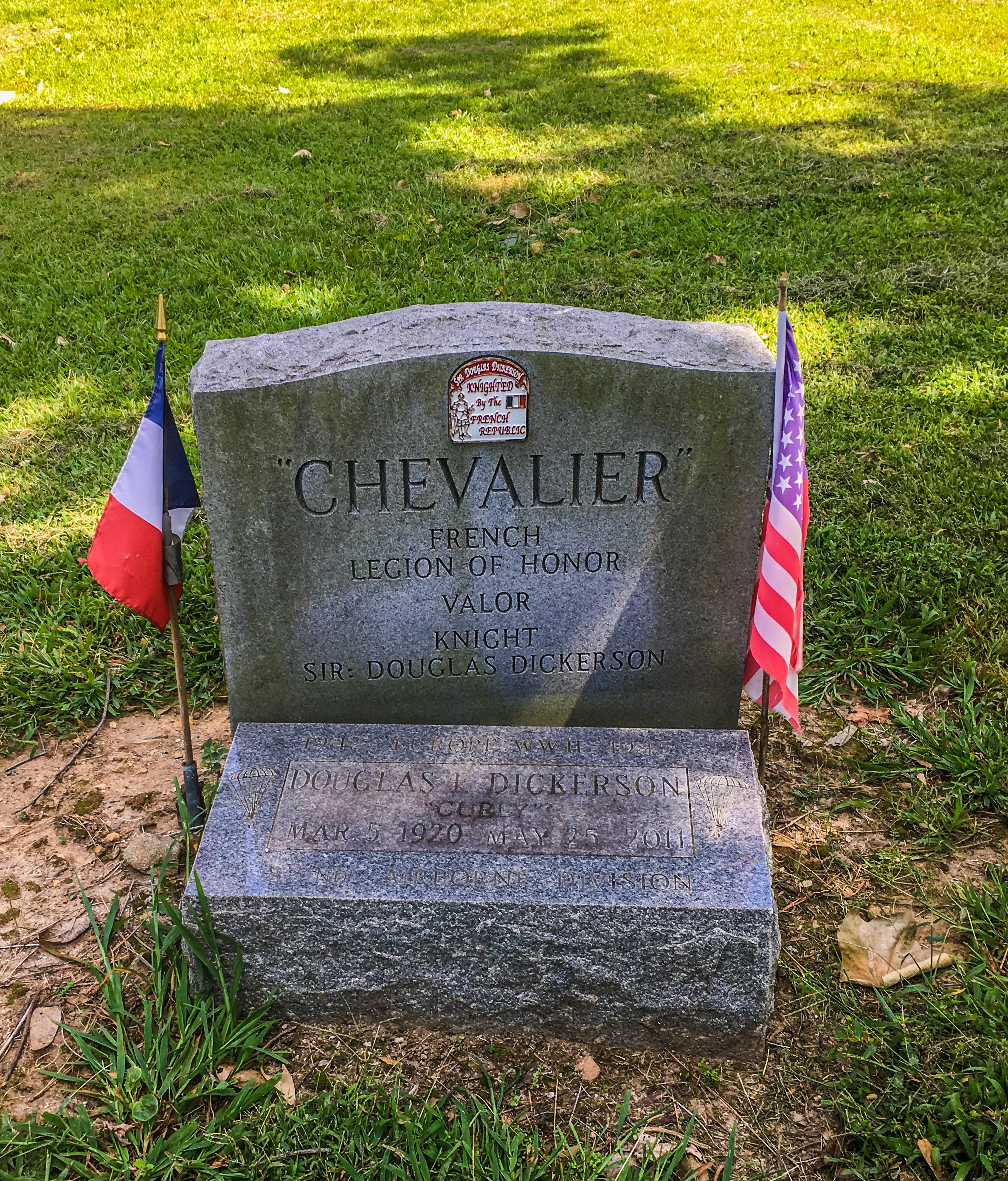
Sir Douglas F. Dickerson: Airborne All The Way!

Green Hill Cemetery in Greensboro North Carolina, is a beautiful place with many interesting stories. One such story is that of Sir Douglas F. Dickerson. He was born to Raymond and Blanche Dickerson in Greenville South Carolina on March 5th, 1920.[1] Douglas was described as 6’ tall, 165 pounds, with brown hair, brown eyes, and a light complexion. He would attend college at North Carolina State College of Agriculture and Engineering (now North Carolina State University) in Raleigh, N.C.. Here he would play quarterback for the football team and outfield in baseball. Dickerson registered for the draft on July 1st, 1941.[2]

Douglas F. Dickerson 82nd Airborne.

During his Junior year at State the Japanese bombed Pearl Harbor, and Douglas’s number was called. Dickerson was given a deferment to finish out the semester and would become part of the 302nd Ordnance Co. made up of local boys. He was with them at Fort Jackson, and Fort Lewis. While Douglass was at Fort Lewis his brother who was an officer in the 82nd Airborne, personally recommend Douglass for the outfit to then Col. James Gavin. Gavin would call Douglass personally to ask him to join the Paratroopers. Dickerson agreed and his orders would arrive in a week. As Douglass would say later in an interview “he (Gavin) didn’t mess around.”[3] Dickerson would take a train from DC to Fort Benning Georgia and reported for Airborne training. He would later be sent to Camp Claiborne, LA. for commando training. Dickerson would finish his Airborne training at Fort Bragg. Here he was made part of a thirty man “hit squad”, they would be split up in teams of three and placed in each company of the 505th Parachute Infantry Regiment 82nd Airborne. The men of the hit squad were sworn to secrecy and finished their training as “ordinary” paratroopers. Before being sent oversees Douglas would don his jumpsuit and marry Edna Lee Kearns.

His first oversees station was in Tunisia. Douglas’s hit squad would be the first men to jump into Sicily and he was the first man out the door. Their objective was to take an airfield. They killed 108 men, destroyed the barracks, and all German aircraft on the field.[4] Douglass and the hit squad would later meet up with the rest of the 82nd. They would become engaged at Biazza Ridge, where he was almost run down by a German tank. During Dickerson’s 14th day of combat in Sicily he was wounded when a sniper’s bullet hit a grenade in his pocket. The grenade exploded outward embedding the top half in his leg. Dickerson pulled it out by the pin with a pen taking a large chink of skin with it. He bandaged the wound and remained on the line for three more days before being evacuated. Fifty years later a Doctor would find that Dickerson still had that sniper’s bullet in his leg.  Returning to action Dickerson and his commandos would jump into Italy again, this time he would land on a cow. Their mission was to destroy a group of German trucks, they would only find a single vehicle and promptly blew up its engine. On the way to extraction they encountered two German patrols of 25 men each and killed them all.[5]

His next combat jump was during the Normandy invasion where he was first out the door as well, this time he landed on an outhouse. Their objective was a major communications unit near Cherbourg. They would destroy it in forty minutes and head to Sainte-Mère-Église. He reached Sainte-Mère-Église in time to see the famous Paratrooper on the church steeple and the town ablaze.[6] Dickerson would be wounded again in the leg, he patched it up and spent 33 straight days on the line during the Normandy Campaign.

Dickerson would then jump into Holland as part of Operation Market Garden. Their objective was Groesbeek where they went house to house to root out the Germans. They then went to Nijmegen to support the other men of the 82nd in taking the bridge. He would spend two months on the line in Holland. Dickerson was then sent to France to a little R & R, however this would only last three days as the Bulge had begun. He and his commando unit were loaded into trucks and sent to St. Vith in order to help free surrounded allied troops. They would use bazookas to hold off German armor, and successfully rescued their beleaguered comrades.

Dickerson would be sent to the Siegfried Line. It was shortly after crossing that he had his most traumatic experience of the war. Dickerson was showing a young replacement where to position his gun when a mortar round exploded near them. The round blew off the young replacements legs, the young man was screaming, and Dickerson held him till the medics had to pry them apart. Douglass then went behind a tree and wept.[7] According to a 1999 interview he still had flashbacks to this incident.

After the fighting around the Siegfried Line Dickerson, and the four remaining original members of the “hit squad” met with General Gavin. Gavin would send them to the rear for a physical and mental checkup. During the exam the Doctors fund that Dickerson had a bleeding ulcer. He would receive a medical discharge in March of 1945.

Dickerson would spend 371 days in combat receiving two Bronze Stars, two Purple Hearts, the Expert Infantry Badge, Triple Combat Infantryman Badge, and the Presidential Unit Citation. He would also receive Croix de Guerre medals from both France and Belgium.

Grave of Sir Douglas F. Dickerson at Green Hill Cemetery. Photo By @firefightinirish

After the war Dickerson would return to Greensboro and resume his education at his education at Guilford College and then High Point College. He graduated in 1949 with a teaching certificate in Social Studies and Physical Education.[8] He was briefly employed as a teacher before working for the United States Postal Service. Dickerson would also coach High School football ant Little League Baseball. He would enjoy showing people his memorabilia gathered during his time overseas as well as items donated by other veterans and their families. The items were displayed in a “mini museum” in his pool house. In 1998 Dickerson published his wartime memoirs, “Doing My Duty”, in which he vividly described his wartime exploits.

In 2006 The French Legion of Honor gave Dickerson the rank of “Chevalier” or “Knight”. Douglas F. Dickerson died

Grave of Sir Douglas F. Dickerson at Green Hill Cemetery. Photo By @firefightinirish

on May 25, 2011 in Greensboro, N.C., and was buried in Green Hill Cemetery in the same city.


[1] Froggatt, Errin. “Sir Douglas Farnum ‘Curly’ Dickerson.” Ancestry. Accessed November 6, 2019. https://www.ancestry.com/family-tree/person/tree/38740921/person/28890718647/facts.

[2] “U.S. WWII Draft Cards Young Men, 1940-1947 .” Ancestry. Accessed November 7, 2019. https://www.ancestry.com/family-tree/person/tree/38740921/person/28890718647/facts.

[3] Harrington, Sion, and John Durham. “Douglas F. Dickerson Interview, 1999-12-20 [MilColl OH 228] : Free Borrow & Streaming.” Internet Archive, December 20, 1999. https://archive.org/details/MilCollOH228Dickerson.

[4] Ibid

[5] Ibid

[6] Ibid

[7] Ibid

[8] “Doug Dickerson Papers, 1939-2006.” Greensboro History Museum. Accessed November 9, 2019. http://archives.greensborohistory.org/wp-content/uploads/sites/2/pdf/MssColl-204-Dickerson.pdf.

Brigadier General William “Billy” Mitchell A Hero Ahead Of His Time

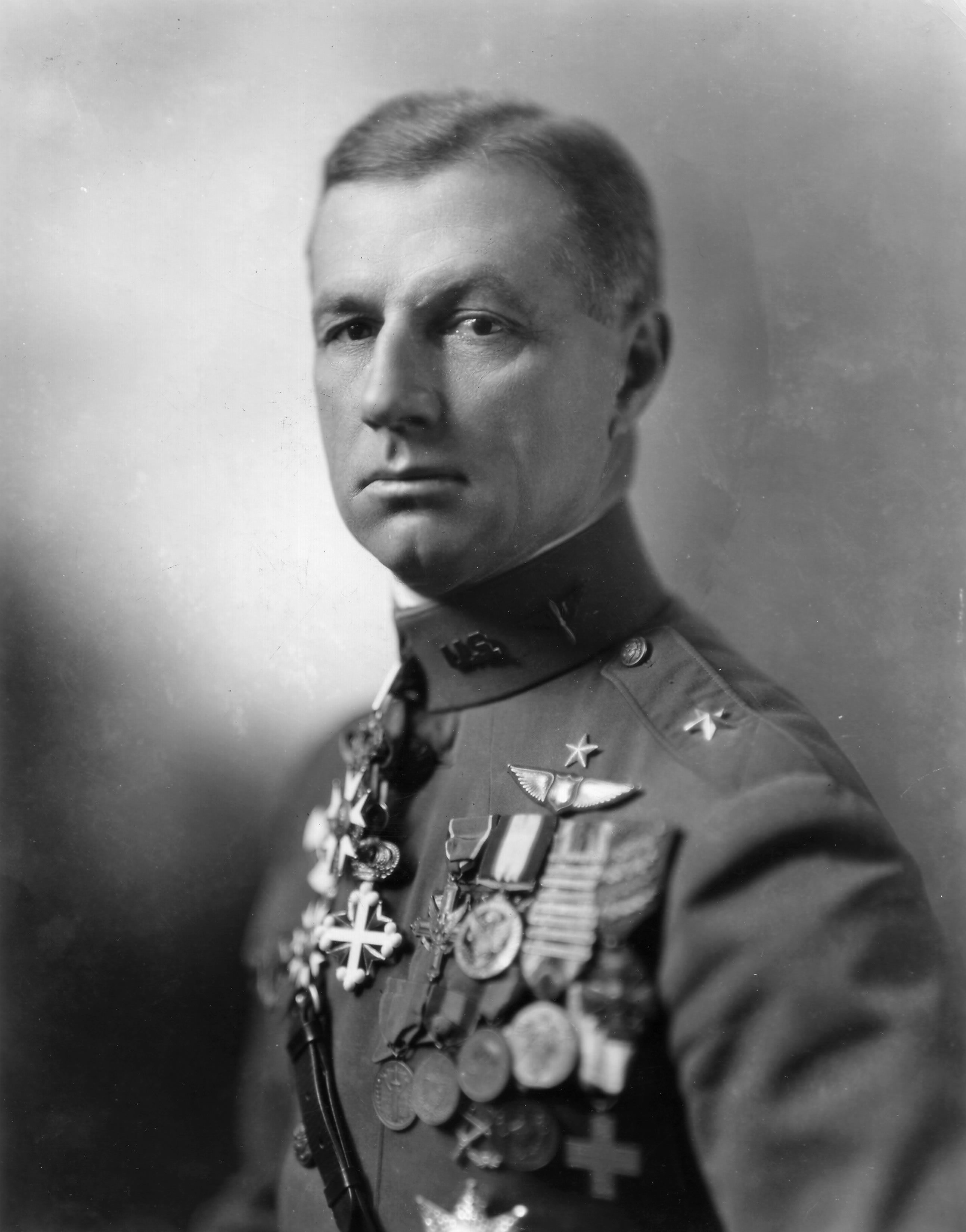
Brigadier General Billy Mitchell, United States Army Air Service

Brigadier General Billy Mitchell, United States Army Air Service

Brigadier General William “Billy” Mitchell was a born leader and a military visionary. He made numerous contributions to the United States and its use of air power. Even though his career ended in disgrace, Brigadier General Billy Mitchell’s ideas were ahead of his time. Mitchell personally saw the power of the air force in World War I. Stating, in 1918, “The day has passed when armies on the ground or navies on the sea can be the arbiter of a nation’s destiny in war. The main power of defense and the power of initiative against an enemy has passed to the air.” (1) Mitchell would spend the rest of his military career trying to prove this statement true by conducting tests and writing theory’s that are still used to this day.

William “Billy “Mitchell was born December 29th 1879 into a family of wealth and privilege. This gave him the advantage of a good education, as well as giving him opportunities not afforded to the average individual. These opportunities included travel. As a child, Mitchell’s father, 1st lieutenant John L. Mitchell who fought with the 24th Wisconsin Infantry Regiment during the American Civil War, would take young Billy to Waterloo and other battle sites around the world. There Billy was told of the gallant deeds and heroism that took place at these battle sites. Mitchell’s sister Ruth stated, “Willie could see the old battles going on as if they were unfolding before his eyes.” (2) In 1898 the United States was on the verge of conflict in Cuba. It was at this time, based on his background, that a youthful Billy Mitchell would sign up for service seeking adventure, thus beginning his twenty-eight year military career.

Billie Mitchell's Father John L. Mitchel

Billie Mitchell’s Father John L. Mitchel

Mitchell was sent to Florida with the First Wisconsin Volunteers. Within a week he made the rank of Second Lieutenant, becoming the youngest officer in service at just eighteen years of age. (3) During this campaign, Mitchell did not see any action. This frustrated him, he remarked to his father, “Here I have been since the war without any foreign service to speak of and have not been in any engagements as of yet. How would you have felt in the Civil War if you had been out of the way somewhere?” (4) In 1899 there was an insurrection in the Philippines and on November 1st of that year, Mitchell arrived there under the command of General Arthur Macarthur to help put down the insurgency. This would give Billy his wish to see combat and he did so as a member of the Signal Corps. It was the job of the Signal Corps to travel with the infantry and sometimes ahead of them to lay down wires to establish telegraph communications. This put Mitchell in the thick of the fighting. He related one particularly dangerous operation in Mabalang to his sister Ruth saying, “I got our line into the rebel trenches ahead of the troops. The insurrectionists ran, blowing up a big railroad bridge. We had a pretty good scrap there. As they retreated along the railroad track they were not more 300 yards away from us in columns of fours; but there was not a single company of our troops insight of them. I thought I could bring somebody down with my pistol, they looked so near, but I had to use my carbine.” (5) By the end of the Philippine insurrection Mitchell’s signalmen had broken up several rebel bands and captured seventy insurgent flags, furthermore Mitchell was promoted to the rank of Captain for his efforts. (6)

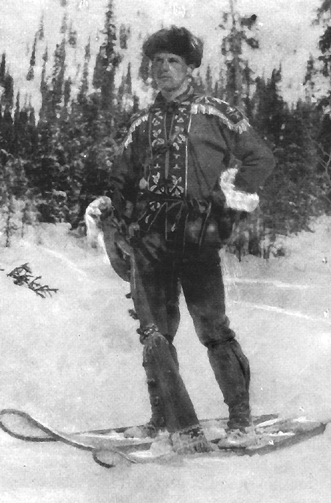
Mitchell in Alaska with the Signal Corps

Mitchell in Alaska with the Signal Corps

Mitchell decided to make the Army his career and spent time in Alaska with the Signal Corps engineering communications between isolated outposts and the United States as well as Canada, again with much success. After this he was assigned to Fort Leavenworth known back then as the “intellectual center of the army.” (7) It was there in 1906 that Mitchell first discovered the importance that the air would play in future warfare. He introduced his findings in a presentation given to the Signal Corps School entitled “The Signal Corps with Divisional Cavalry and Notes on Wireless Telegraphy, Searchlights and Military Ballooning.” (8) In this presentation, Mitchell spoke of dirigibles saying they may “Cruise at will over a battlefield, carrying messages out of a besieged fortress or sail alone above a beleaguered place, immune from the action of men on the earth’s surface.” (9) In the same article, Mitchell went on to say, “By towing another balloon, loaded with explosives, several hundred pounds of guncotton could be dropped from the balloon which it is towing in the midst of an enemy’s fortifications.” (10) These ideas were groundbreaking. As the awareness in the use of air combat was in its infancy, Mitchell saw its potential by concluding his work with this statement. “Conflicts, no doubt, will be carried on in the future in the air” (11)
Mitchell took a staff position in Washington DC where he stayed in till 1916 when due to his frustration at the lack of promotion and a desire to see field service he joined the Armies Aviation Squadron. In this capacity, Mitchell was promoted to Major and assigned to bolster military aviation training. He took part in the training getting fifteen hours of flight time while taking thirty-six flights. (12) Although Mitchell did not earn his wings with this training, he was considered one of America’s top aviation experts. It was due to this fact that on March 19th 1917 then Lieutenant Colonel Mitchell was sent to France as an aeronautical observer. By the time he arrived, the United States had declared war on Germany beginning American involvement in the First World War.

While Mitchell was in France, he was amazed to see the advancements the French had made in military aircraft. He remarked, “I had been able to flounder around with the animated kites that we called airplanes in the United States, but when I laid my hand to the greyhounds of the air they had in Europe, which went twice as fast as ours, it was an entirely different matter.” (13) It was this experience that started to display to Mitchell the full potential of modern air power. He immediately petitioned the United States Army to manufacture or purchase these new advanced aircraft, but he was rebuffed on multiple occasions making Mitchell most frustrated. Another experience that opened Mitchell’s eyes was when he was caught in an air raid noticing “…another series of strong explosions, then the machine gun and anti-aircraft fire. The whole town was, of course, in darkness and everyone had taken to the vaces or vaulted wine cellars inside of houses.” (14) This had a profound effect on Mitchell as he now could see the effect of air power on the morale of the enemy, as well as the reach that such power can have as to make a quick strike from a distance in a short amount of time. An additional event that facilitated Mitchell understanding about the future of air power was a reconnaissance flight that he took with a French pilot over the German lines. Mitchell wrote that he could gain a better picture of the troop formations by air then on the ground. He said, “A very significant thing to me was that we could cross the lines of these contending armies in a few minutes in our airplane, whereas the armies had been locked in the struggle, immovable, powerless to advance for three years…” (15) The combination of these revelations made Mitchell even more fervent in his requests for more support from the United States Army to strengthen and improve their air capabilities. He was looked at by those in Washington as someone of little value when it came to his grasp of aviation, where as he was considered an expert in France. Mitchell would later use his relationship with French premier Alexandre Ribot to coax him to send a message to Washington DC restating Mitchell’s plan, under the guise that it was Ribot’s, requesting twenty thousand planes and forty thousand mechanics. These numbers were much more than the United States could spare, however it awoke the bureaucrats in the American capital and started the process that would eventually lead to a massive aerial force three times the size of the French. (16)

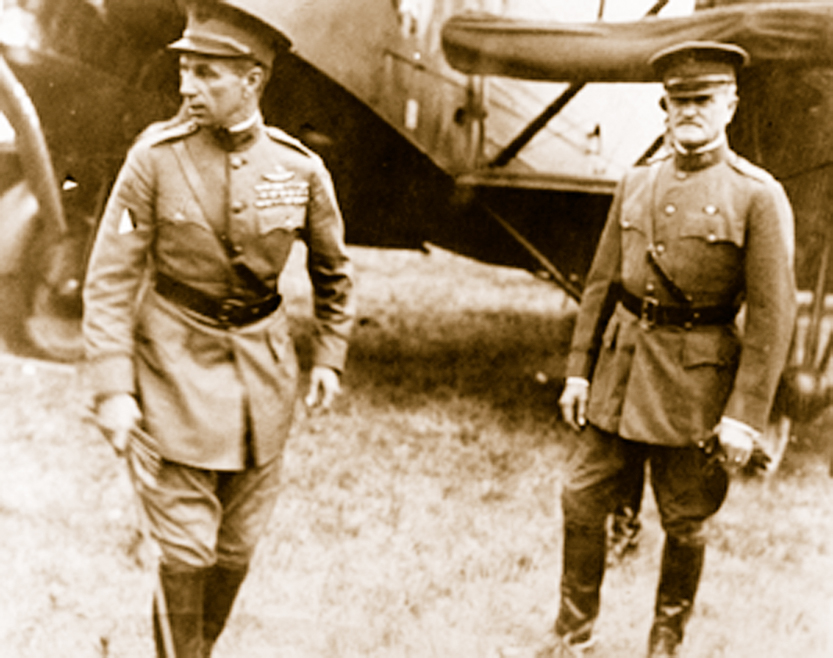
Although this was a victory for Mitchell, his problems with getting the United States aviation capabilities up to date were just starting. The arrival of General John “Black Jack” Pershing added a whole new set of challenges for Mitchell, who felt, “General Pershing himself thought aviation was full of dynamite and pussyfooted just when we needed the most action.” (17) These two strong characters, Mitchell and Pershing, would have many heated discussions on the role of air power and who would command it. Mitchell was tired of having to go through

Billy Mitchell and General Pershing

Billy Mitchell and General Pershing

Washington for all of his requests and wanted one man to be the head of aviation, where Pershing did not see the need for this, feeling that aviation was just a whim. The discussions got so heated between the two that Pershing threatened to send Mitchell back to the states. Mitchell however was not intimidated and became unrelenting in this matter. So as to not have to make due on his threat, Pershing seeing the value of Mitchell, appointed Major General William Kenly as Chief of the Air Service in the fall of 1917 in order to calm Mitchell down and to keep peace. (18)
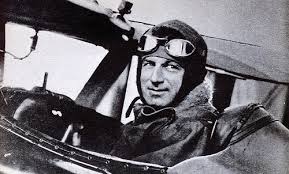
At this time, Mitchell was known as a bit of a highflier, racing around in his Mercedes and entertaining several up and coming flyers and dignitaries. On one occasion, Mitchell’s Mercedes broke down on a small French road when an Army driver stopped to help him. The driver ended up being able to fix the car due to the fact that he was a racing driver back in America. The driver wanted to be in the Air Service and Mitchell helped make that happen. The driver’s name was Eddie Rickenbacker, America’s first Ace Flyer and one of Mitchell’s greatest contributions to the Air Service. (19)

However, Mitchell’s life was still not all parties and leisure. There was still plenty of work to be done and arguments to be made. A new advisory rose to challenge Mitchell in the form of American Brigadier General Benny Foulois, who was put in command of the United States Air Service. Foulois was an experienced aviator who had no time for Mitchell’s brashness saying Mitchell had an “extremely childish attitude”, and was “mentally unfit for further field service”. (20) This posed yet another issue for Pershing who again saw the value of Mitchell not only as a tactician but also as a liaison to the French. So in order to mediate the situation, Pershing sent Mitchell to the front, and made him commander of all aviation forces there. This was where Mitchell shined the most.

Mitchell about to fly an air mission during the First World War

Mitchell about to fly an air mission during the First World War

Mitchell, much like his friend future General George S. Patton Jr., always led from the front and in Mitchell’s case this meant flying missions. One such mission took place when the French and American Armies were being squeezed by the Germans in an attempt to out flank them and head into Paris. A plan was devised to use a combined British and American squadron to patrol the sky. Straightaway, Mitchell saw only disaster for this proposal and made a counter suggestion to fly a reconnaissance mission. This offer was accepted and Mitchell decided to fly the mission himself. He took off after a quick few hours of sleep and headed toward the enemy. Mitchell discovered thousands of Germans marching in columns towards a series of bridges. He quickly turned his aircraft in the direction of the closet allied air field touched down and found the commander spreading the word to start an aerial attack on the bridges. A secondary aerial attack on the German supply base at Fere-en-Tardenois was also suggested by Mitchel and approved by command. Mitchell’s vision saw that this plan, if successful, would turn the German Army around and trap them, thus destroying any chance they had for victory. (21) The action that took place was intense and resulted in the first allied success in the air. Although this success was limited, it started to turn the tide of the war. For his brave reconnaissance flight, Mitchell was awarded the Distinguished Service Cross. (22)

Mitchell’s next large scale maneuver was the largest aerial operation of the war consisting of fifteen hundred aircraft, this assault was known as the St. Mihiel offensive. Between September 12th and 16th , the Americans where in total command of the air making thirty three hundred flights into enemy territory racking up four thousand hours of flight time firing thirty thousand rounds of ammunition, making more than one thousand separate bomb attacks using seventy five tons of munitions. This operation resulted in the destruction of sixty enemy planes and twelve enemy balloons, all of this during bad weather. (23)

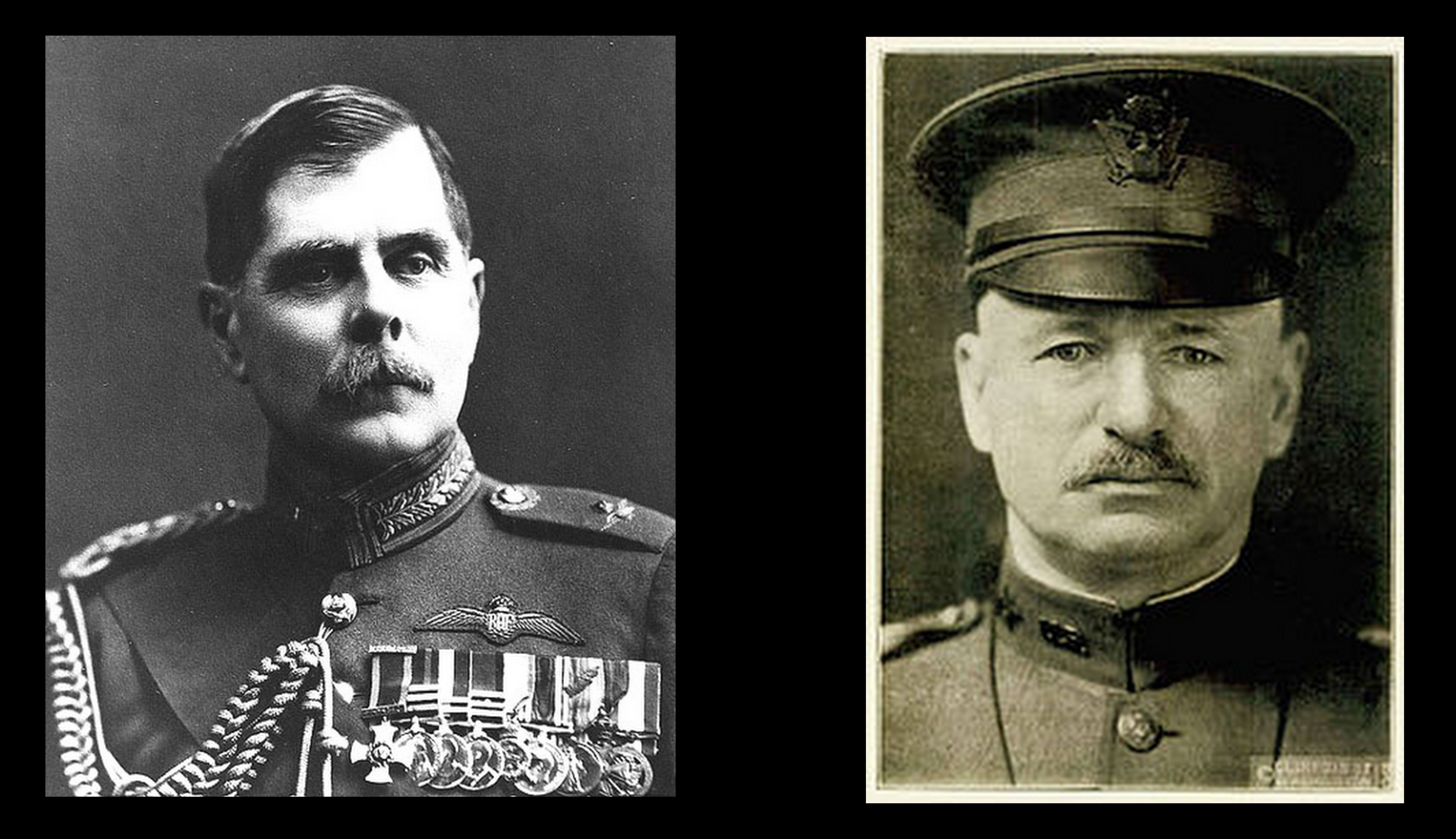
The First World War established the career of Billy Mitchell; he entered France as a Lieutenant Colonel and was now leaving a Brigadier General with a reputation for having extraordinary leadership and being perhaps the most experienced airmen in the service of the United States Army. On November 11th 1919, the armistice ending the First World War was signed. Before returning to the United States, Mitchell went to London to discuss air strategy with the Chief of the British Air Staff, General Hugh Trenchard. The focus of this discussion was on air independence, concentrating on the theory that the aviation wing of the Army should be a separate service all together. Mitchell was a propionate of this theory and after the talks upon his return to the United States it became one of his major goals. (24)

Left: Sir Huge Trench Right:  Major General William Hann

Left: Sir Huge Trench Right: Major General William Hann

Mitchell’s constant speeches and writings to the Army War Department concerning a separate aviation service and the possibility of air attack from across the globe, made him very unpopular. He was also making enemies amongst members of the Army who were not flyers by questioning their authority on matters of air combat. He had a large quarrel with General William G. Hann, who was a very well established commander at the time. Mitchel insisted that air power alone could win a war and that infantry was a thing of the past. Hann, an infantry commander, took offence and the argument ended in a great deal of destine between both men, Mitchel wrote about the situation saying, “it impressed on me more than ever that, under the control of the army, it will be impossible to develop an air service.” (25) Mitchell’s challengers were not only in the army, he was developing enemies in the navy as well, due to two factors; the aforementioned separate aviation service, as well as a tight military budget. A battle erupted between the Navy and Mitchell over these issues.

The Navy went so far as to send then Assistant Secretary of the Navy Franklin Delano Roosevelt out on a speaking tour to campaign against the idea of a separate air wing claiming it was ill conceived and would take money away from the navy, making them weaker and a strong navy was essential to keep America safe. (26) Mitchell long felt that the navy was almost obsolete and vulnerable to air attack saying in his book Winged Defense The Development and Possibilities of Modern Air Power –Economic and Military “From a military standpoint, the airmen have to study the effect that air power has on navies and what their future will be. They know that within the radius of air power’s activities, it can completely destroy any surface vessels or war ships. They know that in the last war, surface ships, battleships, cruisers and other sea craft took comparatively little active part.” (27)
mitchell.6Mitchell’s ideas were put to the test in a series of experiments conducted by both the Army and the Navy on the bombing of ships from the air. Multiple vessels were used. One of the vessels used in this series of experiments was the captured German battleship Ostfriesland. The navy had the first chance at destroying the mighty craft, but only succeeded in damaging her. Then Mitchell’s army squadron flew in and obliterated the German warship, sinking her in minutes. Mitchell described the scene this way, “When a death blow has been dealt by a bomb to a vessel, there is no mistaking it. Water can be seen to come up under both sides of the ship and she trembles all over…In a minute the Osterfriesland was on her side in two minutes she was sliding down by the stern; in three minutes she was bottom-side up, looking like a gigantic whale, in a minute or more only her tip showed above water.” (28)

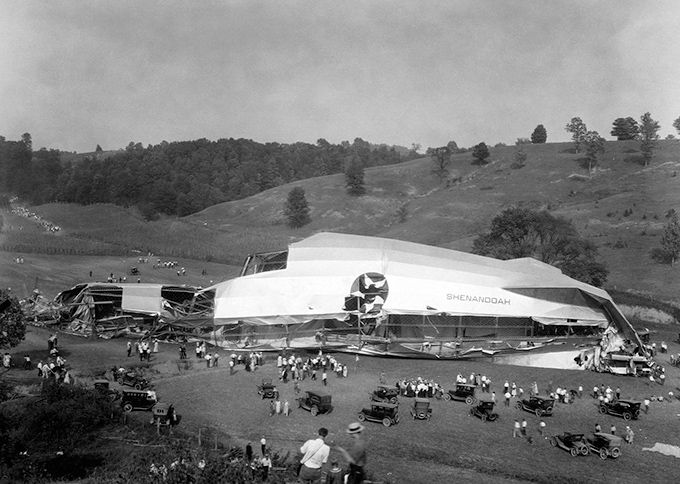
Although this proved Mitchell’s theory that air power can defeat sea power, his fight to gain funding and a separate aviation service went on to no avail and resulted in his demotion from Assistant Chief of the Air Service. He reverted to his permanent rank of Colonel and was transferred to San Antonio, Texas, as air officer to a ground forces corps. (29) This is where he heard the news about the tragedies of the Shenandoah as well as the ill-fated attempt to fly from San Pablo Bay to Hawaii. Both incidents happened within

1925: Caught in a squall over southeastern Ohio, the Navy dirigible USS Shenandoah breaks up and crashes into a field, killing 14 of the 43 men aboard.

1925: Caught in a squall over southeastern Ohio, the Navy dirigible USS Shenandoah breaks up and crashes into a field, killing 14 of the 43 men aboard.

days of one another and were put on by the navy as well publicized attempts to show naval air superiority they ended in failure and death. The Secretary of the Navy not wanting to admit any wrongdoing issued a statement, “The failure of the Hawaiian flight and the Shenandoah disaster we have come to the conclusion that the Atlantic and the Pacific are still our best defenses. We have nothing to fear from enemy aircraft that is not on this continent.” (30) This enraged Mitchell as it was a slap in the face to everything he stood for and was warning against, therefore he felt compelled to make this statement, about the incidents; to the press, “My opinion is as follows: These accidents are the result of the

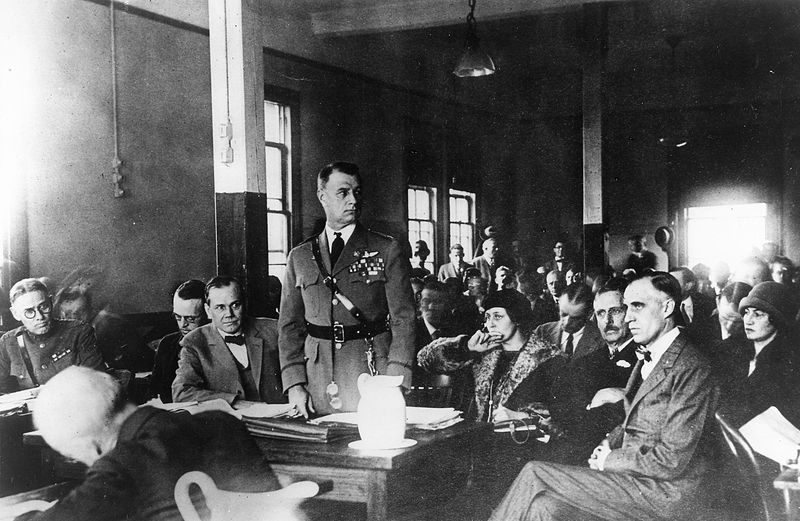
incompetency, the criminal negligence, and the almost treasonable administration of our national defense by the Navy and War Departments.” (31) Mitchell was court marshaled and charged with “Conduct to the prejudice of good order and military discipline and in a way to bring discredit upon military service” (32) Mitchell left for Washington DC and was placed under arrest a few days after his arrival. The court-martial record has one million four hundred thousand words and consists of seven large volumes, but in all of those words there was not enough to help Mitchell out of this predicament. (33) By Special order 248 on October 20Th 1925 Mitchell was found guilty and received what was considered a light sentence due to his heroic service in the First World War. The sentence consisted of a suspension of rank and command, plus forfeiture of pay for five years. Mitchell retired from the service one year later in disgrace. (34) The next ten years Mitchell spent time with his family and traveled around the country discussing air power still as feisty as he was during his many campaigns before Congress. He died of heart failure in 1936 a man ahead of his time but looked

The Court Martial of Billy Mitchell

The Court Martial of Billy Mitchell

upon then as an agitator and a crackpot.
Billy Mitchell is now revered by many and his doctrine has become the bases for the American Air Force which is now a separate branch of service something Mitchell fought so hard for but would never see in his life. He is a true war hero and a visionary whose grandiose ideas were way ahead of his time ending his career in disgrace. He was a man who never faltered from his beliefs, making him one of the greatest military leaders in the history of the United States of America.
1) Jones, Johnny R. William “Billy” Mitchell’s Air Power. Honolulu: University Press of the Pacific, 2004 Pg. 3

2) Davis, Burke. The Billy Mitchell Affair. New York: Random House, 1967. Pg. 15

3) Davis, Pg. 17

4) Ibid

5) Mitchell, Ruth. My Brother Bill. New York: Harcourt, Brace And Company, 1953. Pg. 49

6) Davis, Pg.’s 18-19

7) Hurley, Alfred F. Billy Mitchell, Crusader for Air Power. New ed. Bloomington: Indiana University Press, 1975. Pg. 10

8) Ibid, Pg. 11

9) Ibid,

10) Ibid,

11) Ibid,

12) Ibid, Pg. 21

13) Davis, Pg. 29

14) Schwarzer, William. The Lion Killers Billy Mitchell and the Birth of Strategic Bombing. Mt. Holly: Aerial Perspective, 2003. Pg. 20

15) Davis, Pg. 30

16) Ibid, Pg. 32

17) Ibid, Pg. 35

18) Ibid, Pg. 35

19) Ibid, Pg. 36

20) Ibid

21) Levine, Isaac Don. Mitchell Pioneer of Air Power. New York: Duell, Sloan and Pearce, 1943. Pg.’s 120-121

22) Ibid, Pg. 127

23) Ibid, Pg.’s 132-135

24) Cook, James. Billy Mitchell. Boulder: Lynne Reinner Publishing, 2002. Pg. 107

25) Cooke, Pg. 114

26) Ibid, Pg. 115

27) Mitchell, William. Winged Defense The Development and Possibilities of Modern Air Power, Economic and Military. New York: G.P. Putman’s Sons, 1925. Pg. 99

28) Ibid, Pg. 72

29) Burlingame, Roger. General Billy Mitchell Champion of Air Defense. New York: McGraw-Hill , 1952.Pg. 141

30) Ibid, Pg. 148

31) Mitchell, Pg. 301

32) Cooke, Pg. 180

33) Gaureau, Emile, and Cohen, Lester. Billly Mitchell Founder of Our Air Force and Prophet Without Honor. New York: E.P. Dutton & Co , 1942.Pg. 135

34) Cooke, Pg. 217

Fortress Metz: The 3rd Army’s Toughest Battle

In the fall of 1944, after the Normandy break out, a three-month long struggle was fought during World War II around the fortress city of Metz, France. This fight would pit the United States 3rd Army, under General George Smith Patton Junior, against the German 1st Army, commanded by the newly appointed General der Panzertruppen Otto Von Knobelsdorff. This clash would be forgotten and pushed aside by history but it is one of great importance for the men who fought and died there. This campaign was one of the hardest fought during World War II due to the nature of Metz and its fortifications.
By September of 1944 the mighty 3rd Army had been reduced into only two corps after its triumphant march to Paris. The XII Corps was under the command of Major General Manton Eddy, while the XX Corps was under the command of Major General Walton Walker. After the three months of fighting and marching the troops were fatigued and were short on supplies. The indomitable 3rd Army although weakened  would soon be up against one of the most fortified sections of the western German front.

The Allies knew they would need a no nonsense general that would fight hard, which is why they chose General Patton to tackle the challenges of Metz.

Figure 1 General    George S. Patton

Figure 1: General George S.   Patton

Patton was fascinated by the military throughout his childhood and was regaled by stories from his dad, who served in the confederacy with distinction during the Civil War. Another man who was close to the Patton family also influenced young George this man was Colonel John Mosby, more famously known as “The Grey Ghost,” Mosby was part of Major general J.E.B Stuart’s Confederate Calvary . (1) During the summer Mosby would reenact battles from the Civil War with Patton on horseback. Patton would play the part of General Robert E. Lee and Mosby would play himself. (2) This influence and young George’s obsession with all things military, led Patton to attend the Virginia Military Institute, and then West Point. He saw his first combat in Mexico during the Mexican expedition of 1916, which was led by General “Black Jack” Pershing. During this expedition he would encounter his first experiences with close quarter combat, this took place when Patton killed three banditos with his pistol during a raid on a hacienda. He then strapped the bodies over the hood of his Dodge Touring car and drove back to Pershing with his trophies. (3) This action made Patton the first person in American history to engage an enemy in warfare using a motorized vehicle, which officially marshaled motorization into combat. (4)   His knowledge of mechanized warfare, vast knowledge of military history,and  close quarter combat would become useful during the 3rd Armies attack on the city of Metz.
During World War I Patton was again an aid to Pershing. During this time Patton focused on the idea of tank warfare; throwing himself into it with an almost religious fever writing manuals and virtually single handedly forming the tank corp. (5) He led the tank corps into combat during the Meuse-Argonne Offensive in France, and was severely wounded when a bullet pierced through his leg ripping out a large chunk of flesh from his backside. Patton nearly bled to death and before his recovery was complete the armistice was signed, Patton would not see combat again until World War II. (6)
Patton’s impressive resume continued into The second World War. He was given the assignment of creating the desert training corps in 1942. This group became proficient in tank warfare and was the first American force to land on enemy soil in World War II during Operation Torch in Africa. In 1943 after a devastating and embarrassing defeat of the United States forces at Kasserine in Africa, Patton was put in charge of the II Corps. With his strict discipline and attention to detail he turned this group of men from a loose group of misfits into a finally tuned fighting force that would achieve a sound victory in the battle of El Guettar. After his success in Africa, Patton moved onto Operation Husky. This invasion of Sicily fueled a rivalry between himself and General Bernard Montgomery of the British forces. This competition brought out the best and worst in Patton as he achieved victory in Palermo and Mesina. However the stress of these battles may have led Patton to his controversial “Slapping Incidents” in which on two separate occasions he slapped two soldiers that were suffering from battle fatigue in the face. This was almost the end of the Generals career; many high ranking officials were calling for his dismissal,but the army knew Patton’s value and suspended him from combat till 1944.
Patton was a natural born warrior and was feared by the Axis because of his reputation as an unrelenting attacker. The allies used his name and reputation while he was suspended to deceive the Germans into believing that the D-day landings would be led by Patton and that he would strike at Pas-de-Calais. To achieve this  the Allies employed special effects men from Hollywood to create a whole fictitious army that was built around Patton. They constructed fake tank barracks and fake radio chatter. This deception paid off because the German high command thought the Normandy landings were just a diversion and refused to release there reserve corps from Pas-de-Calais, allowing allied success. (7) The Allied Commanders knew they could not win the war without Patton; his reputation, experience and motto to never fight for the same piece of land twice lead to his re-instatement, and by late 1944 he was given command of the Third Army that would become the spearhead of Operation Cobra. Patton and his stout Third had success after success throughout Europe then they hit a wall in Metz.

The German commander of fortress Metz was, General Otto von Knobelsdorff. Like Patton, he was a decorated infantry officer during World War I where he earned the Iron Cross twice for his heroism. After World War I Knobelsdorff commanded a regiment that in 1935 was part of the Polish campaign that touched off World War II. During the beginning of the war he commanded divisions in the fight for France and Belgium.

Figure 2 General der Panzertruppen Otto von Knobeldorff

Figure 2: General der Panzertruppen Otto von Knobeldorff

He distinguished himself on the Russian front, receiving the Knights Cross for his division’s actions in 1942. Later that year he was promoted to General and commanded a Panzer Corp. He was decorated again for his leadership of that Corp during the battle of Kursk with a Knights Cross with Oakleaves, a very high honor in the German Army. For his battle command at Nikopol Bridgehead he was awarded yet another Knights Cross, this one with Oakleaves and Sword. This made him one of the highest decorated German commanders of the war. By the time he was put in command of the defenses around Lorraine in which Fortress Metz was a part of  there was a bit of trepidation due to his health, which would play a role in the battle’s outcome due to the fact that Knoblsdorff  during the height of this battle had to take a brief leave due to his health issues. (8)

Taking the city of Metz would be a challenging task for the allies. There were a series of natural as well as man-made obstacles these included, the Moselle River, a multitude of forts and a plethora of pill boxes. Patton’s army made attempt after attempt to cross the Moselle River but these fortresses rained heavy artillery fire down upon them making it a daunting task. These forts and pill boxes dated back to the 19th century making them almost a natural part of the landscape this made the structures much harder to detect and therefore defeat. (9) another reason the pill boxes created a challenge was, because of their small size. Two German soldiers could easily hide inside and shot a .50 caliber machine gun at the Allies and have little chance of being hit by small arms fire. The Combination of these natural and unnatural defenses had made the city of Metz  a formidable opponent for invaders for more then 1500 years since it is placed superbly for defense on the east bank of the Moselle River. As well as being surrounded by barbed wire and earth fortifications that had been built around the city. Its best defense however, was the fact it was surrounded by hills that were turned into dominating underground forts composed of passageways and well dug in steel and concrete doors placed in a fashion that not only concealed them but protected them from artillery fire.

Figure 3 German Pill Box

Figure 3: German Pill Box

These doors were also impervious to air attack since they were defended by earthen banks. (10) It would take multiple operations in order to take the city of Metz. A lull in the action took place during most of October before General Eisenhower authorized Operation Madison with the objective of taking Metz. He gave the task to General Patton and his 3rd Army.

Figure 4: Map of Fortress Metz and Surrounding Forts

Figure 4: Map of Fortress Metz and Surrounding Forts (Click to enlarge)

On November 8, 1944, General Eddy’s XII Corps began Operation Madison. Eddy had objections to starting the operation due to the muddy terrain as a result of heavy rains and flooding. He asked Patton to delay the attack to which Patton responded “Attack or name your replacement.” (10) At 0600 the attack on German forces that were blocking the way to Metz began with an artillery barrage that took the Germans by surprise. The attack was well camouflaged since the foggy weather the previous night allowed the 3rd Army to move the battery into position without being noticed. This led to a disruption in the forward German defenses. At the American right flank, Hill 310 was being defended by a regiment from the 361 Volksgreadier-Divison, leading to a three day intense engagement. This action created a breach between two German Volksgrenadier Divisions that was exploited by General Eddy. Eddy used the 4th Armored Division to try and seize the Morhange road junction, which was a vital peace of real-estate since it would help move men and material towards their ultimate objective. This move by the 4th Armored Division was such a threat  it forced the German Commander Knobeldorff to divert his reserve in defense and to equalize the front. (11) By the evening of the 8th the Allies held ten bridges over the Seille River. However, the ridge was still held by two German infantry units, the 48th and most of SS-Panzergrenadier 37th. The American 80th division was given the task of taking this ridge. (12) This push began early in the morning of the 9th and taxed the German defenses of the Delme Ridge forcing Gen. Knobelsdorff to transfer a division in relief. This only delayed the American advance and did not stop it.

Figure 5 Map Denoting The Battle Lines Of Operation Madison

Figure 5: Map Denoting The Battle Lines Of Operation Madison

Later in the day on the 9th, XX Corp got into the fray after the 95th division staged an attack that was intended to divert the Germans away from an incursion made by the 90th division at the most prominent river crossing. The weather played a factor in this action as well as the Germans were again caught off guard by the advance and the minefield they had put in place was rendered obsolete by a flood that turned the ground into a small body of water. The allies overran the German positions and advanced. Almost simultaneously the 358th infantry advanced to Fort Koenigsmacker and split up leaving companies A and B to deal with this nemesis. As it happened, the 358th was accompanied by a regiment of engineers who helped in the attack of the Fort by using improvised explosives to take down the observation domes. (13) By night fall the Americans had control of the western side of the fort but the fight was not over. It took till November 11th to gain total control of Fort Koenigsmacker. With this control the allies were on the precipice of the Fortress City Of Metz.

On November 18, 1944 the siege of the Fortress City Of  Metz commenced. This attack was reliant upon taking and securing the rest of the bridges over the Moselle River. This operation was made extremely difficult due to the destruction of almost all the bridges by German forces. The 95th infantry and 379th Infantry regiment moved in from the west but left two companies behind to deal with German resistance. They succeed in cutting off Fort Jeanne d’Arc and reached their bridge objective by the evening only to discover its destruction. A boat crossing was considered but determined not plausible so they were ordered to hold Ft Jeanne D’Arc and stop any further German resistance. (15) At this time the 378th infantry was in trouble as well, they had their full attention on engaging Fort Plappeville. This fort was in a good location for the Germans due to the fact that they could share supplies with a neighboring fort. Together both forts totaled 650 men, but that withstanding the Germans where still running low on food and ammunition. However, they were willing to hold these two forts till the last man due to their strategic position overlooking the Moselle and their ability to rain artillery fire down on all those who dare cross. If these forts were properly supplied they would have been able to greatly slow the American advance. US troops began to enter the city later that day with little resistance due to a lack of communication between the Germans as a result of the blown bridges disrupting their lines of communication. By the end of the day on the 18th the German high command made a decision to concentrate all their forces around their command post on the Isle of Chambiere as to hold this post to the last.

Figure 6 Envelopment Of Metz From The South 8-19 November 1944

Figure 6: Envelopment Of Metz From The South 8-19 November 1944 (Click to enlarge)

The next day, November 19th, The 377th American Infantry unit was returning to the area of Fort Bellacroix when they discovered one of the bridges had not been blown. They quickly overtook the small German opposition force and captured the important real estate. (16) A company with tank support crossed the bridge under heavy sniper fire and faced approximately 700 men. The German forces were not organized though and their commander surrendered. The US forces now had control of most of the city. An attempted was made by the Germans to air drop supplies to the desperate men in Fort Plappeville but failed, adding to their problems. By the evening of the 19th The American forces were well into Metz, even destroying a Gestapo Headquarters. All means of German retreat were sealed by the evening and the capture of the Fortress  City Of Metz was assured. (17)
On November 20th to the 21st American forces took part in bloody and chaotic house to house fighting. as the German army was desperate to hold the city and fought with tenacity. William Lake, a riflemen in the 377th infantry, stated “They fought like tigers that’s the something we would have done had it been reversed.” (18)

Figure 7 House To House Fighting In The City Of Metz

Figure 7: House To House Fighting In The City Of Metz

He also described just how rough the fight was when he said “These mortars walked down the street, they don’t come as a barrage, they come BOOM BOOM BOOM!! It turned out Sgt. Garsline lost one of his legs….and Schagle got hit in the stomach…During the same barrage one of the fragments went down the hallway where our squad was and hit another man in our squad in the spine.” (19) This hard fighting paid off when on the morning of the 21st German General Kittel was captured after he was wounded acting as an infantrymen. By the 22nd of November the resistance in the city had ended and the Allies held Metz. (20) Even though the battle for the city was over, the fight for the forts on the outskirts of town raged on into December.

The capture of Metz led the Allies to have a clear road across the Rhine and into Germany.  It was a long and hard fought struggle and resulted as a loss for the Germans. This victory did however delay the Allied advance, allowing the Germans to retreat and save their army for a later engagement, the Battle of the Bulge.

Figure 8 Capture of Ft Jeanne d'Arc December 13, 1944

Figure 8: Capture of Ft Jeanne d’Arc December 13, 1944

One can look at this battle to see the true character of the greatest generation in action. These brave men faced death every day but had a job to do and did it with the honor and courage that only an American would posess. The American men who fought in Metz would never forget the carnage and violence of that fight. A captured German Officer spoke of these men saying “You men must be made of Iron to take this city,”  . (21) These words most certainly sum up the character of the valiant 3rd Army soldiers who risked it all for the greater good.


Notes;
1) Province, Charles M.: The Unknown Patton (New York: Bonanza Books., 1983) Pg., 3
2) Ibid., Pg. 3
3) Ibid., Pg. 14
4) Ibid., Pg.16
5) Province, Charles M.: George S. Patton, Jr. U.S. Army 02605 1885-1945 (Oregon City, OR: The Patton Society), Retrieved From Http:// http://www.pattonhq.com/pattonbio.pdf, Pg. 2

6) Ibid., Pg. 2

7) America In WWII The Magazine of a People at War 1941-1945, “Patton’s ghost army” : Brian, John Murphy (310 Publishing 2009) Retrieved from http:// http://www.americainwwii.com/stories/pattonsghostarmy.html

8) Zaloga, Steven J.: Metz 1944 “Patton’s fortified nemesis” (Oxford, England: Osprey Publishing., 2012) Pg.’s 15-16

9) Ibid., Pg. 4

10) Ibid., Pg. 53

11) Wallace, Gen. Brenton G.: Patton & Third Army ( Mechanicsburg, Pa: Military Service Publishing, 1946) Pg. 117

12) Ibid., Pg. 57

13) Ibid., Pg. 57

14) Ibid., Pg. 60

15) Combat Studies Institute Battle Book 13-A: The Battle Of Metz (Ft. Leavenworth, TX: CSI Publishing, 1984) Pg. 55-56

16) Ibid., Pg.’s. 59-60

17) Ibid., 61

18) Vogt, Tobias O.: The Iron Men Of Metz Reflections Of Combat With The 95th Infantry Division( San Diego, CA: Aventine Press, 2005) Pg. 106

19) Ibid., Pg. 106

20) Combat Studies Institute., 64

21) Vogt., 113


Figures;
1) Retrieved From: http://www.biographyonline.net/military/general-patton.html
2) Retrieved From: http://imageshack.us/f/458/0193mz.jpg/
3) Retrieved From: Zaloga, Steven J. Metz 1944 “Patton’s fortified nemesis” (Oxford, England: Osprey Publishing., 2012) Pg. ,35

4) Retrieved From: http://www.ww2museums.com/article/27295/German-Pillbox-Bl%26%23299%3Bdene%26%238206%3B.html

5) Retrieved From: http://www.ibiblio.org/hyperwar/AAF/III/AAF-III-17.html
6) Retrieved From: http://www.ibiblio.org/hyperwar/USA/USA-E-Lorraine/maps/USA-E-Lorraine-XXXII.jpg

7) Retrieved From: http://www.ibiblio.org/hyperwar/USA/USA-E-Lorraine/img/USA-E-Lorraine-p445b.jpg

8) Retrieved From: Zologa, Pg. 76


The Bataan Death March: An Atrocity We Must Never Forget

A burial detail carries the remains of POWs who survived the Death March, but who later succumbed to exhaustion, disease, or execution after reaching Camp O'Donnell. (U.S. Air Force photo).

A burial detail carries the remains of POWs who survived the Death March, but who later succumbed to exhaustion, disease, or execution after reaching Camp O’Donnell. (U.S. Air Force photo).

The Bataan Death March began on April 9, 1942, following the three month battle of Bataan during World War II. It was the transfer of Filipino and American prisoners of war by the Imperial Japanese Army. This march was the worst atrocity on United States soldiers during the Second World War. This was because of its wide-ranging physical abuse and murder. During the march there was a very high fatality rate inflicted by the Japanese Army upon prisoners and civilians alike.

On December 7, 1941 the Japanese bombed Pearl Harbor, declaring war on the United States of America. On the 8th they launched a full scale assault on the American bases in the Philippian Islands. During the first day of the Japanese attack on the Philippian Islands, most of the American aircrafts got caught on the ground and were destroyed. Inside of a week, the Naval Yard at Manila was flattened by Japanese bombs, and many of the war ships left to find cover in the Dutch East Indies. Without sufficient air and sea support the Americans stationed in the Philippines were in a desperate situation, with little to no prospects of reinforcements. (1) After three months of fighting, the battered bloody and ill equipped American forces were forced to surrender to the well supplied and superior numbers of the Japanese forces. On April 9th Major General Edward P. King, commander of the last remaining American troops, rode off to meet Japanese General Homma and officially capitulate. The remaining American soldiers were now Japanese prisoners of war.

The uncertainty of how these American Soldiers would be treated was palpable amongst the American soldiers. As reported in the memoir of Army Captain Manny Lawton, entitled Some Survived, he wrote that some men expected to be shot on sight, as others were cautiously optimistic. The men found out quickly what they were in for when a truck of Japanese soldiers pulled up and motioned for the men to move forward. When they did not respond in time, the men got their first taste of Japanese brutality, “immediately they charged forward and began kicking and slapping us while indicating that we were to start marching….Our guard was assigned to heard us along while the others continued south to round up other prisoners. Threating with a bayonet, he kept us moving at a rapid pace almost a run.” (2) Thus began the treacherous journey known forever as the Bataan Death March.

More than seventy thousand Americans and Filipinos were sent on this forced march of sixty five miles. Approximately seven to ten thousand of them would die, from exhaustion, starvation and cruelties, before arriving at their destination, Camp O’Donnell, a Japanese prison camp.(3) The first of these fatalities would happen as early as the first day of the march, when the Japanese were searching the POWs for anything made in or from Japan. Their thinking being that these articles would have come from the corpse of a dead Japanese soldier. One unlucky prisoner, a Captain in the United States Army, was found with some Yen in his pocket. Lieutenant Colonel William Edwin “Ed” Dyess, a Bataan survivor, described what happened next, “The big Jap looked at the money. Without a word he grabbed the Captain by the shoulder and shoved him down to his knees. He pulled the sword out of the scabbard and raised it high above his head…Before we could grasp what was happening the black faced giant had swung his sword…. The Captains head seemed to jump off his shoulders … The body feel forward. I have seen wounds but never such a gush of blood as this.” (4) This was just one of the many unspeakable atrocities committed by the Japanese during the march.

Another shocking account is that of 3rd Lieutenant Corban K. Alabado. Lieutenant Alabado witnessed a fellow soldier break ranks to drink from a spring. He stated, “Just as he was about to drink, the Japanese sentry struck his bayonet into his back shouting “Kura Kura!” As our comrade struggled to get back into line, a Japanese truck ran him over like paper flat on the ground. A second truck whizzed by, its wheels running over the body and flattening it even more as if it were glued to the road.” (5) Lieutenant Alabado also observed the Japanese “fire volley after volley” at soldiers who broke rank to get sugar cane, since they were starving and thirsty. After they were wounded, the men lay bleeding on the ground as the Japanese fired into their defenseless bodies. Alabando was told to “Walk Faster” as he and the rest left those men suffering and bleeding in the middle of the road to die a horrible and slow death. (6)

In what can be argued as one of the most grotesque sites of the whole ordeal was what Sgt. Mario “Motts” Tonelli, a stand out football player for the University of Notre Dame, witnessed. He heard the hoof beats of a Japanese cavalry regiment approach and then suddenly stop. Tonelli looked up to see the Cavalry officer holding a Pike with a severed head on it. The morbid trophy was covered in flies and other insects. All Tonelli could say to a fellow soldier was, “We’re in trouble”. (7)
The brutality of the Japanese Guards was not the only problem facing the men during the march. Starvation was another pressing issue. Captain Manny Lawton recalls the rations being handed out only a few times during the entire march. These rations consisted of “one rice ball about the size of an orange.” (8) Captain Lawton also remembers that during their rare overnight stops more and more men would not awaken after they went to sleep, succumbing to both starvation and exhaustion. Lawton wrote, “Perhaps they were the fortunate ones, for more torment lay ahead for those who marched out.” (9)

The march culminated with the prisoners getting pushed and prodded at bayonet point into dark and dusty rail cars. “Temperatures in the poorly ventilated cars reached in excess of 100 degrees Fahrenheit, and a dreadful odor quickly filled the rolling kilns. The POWs had not bathed in weeks and their bodies stank. Floorboards were soon smeared with urine, feces, and vomit….In some cars, men died upright, unable to slump on the floor.” (10) When the train of horrors finally came to a stop, Lieutenant Colonel Dyess exited in a haze of hunger and exhaustion. The only thoughts swirling in his head were the horrors he had witnessed over the past few days. But he and the other prisoners had made it to Capas and Camp O’Donnell. The march was over. (11)

In both theaters of operation during the Second World War, the Bataan Death March was perhaps the most horrific war crime against the soldiers of the United States of America. One of the few other atrocities or World War II that stands out was the Malmedy massacre that took place during the Battle of the Bulge on December 17, 1944. This was when eighty six American soldiers were gunned down in cold blood after they surrendered by a German SS Division. (12) Although the Malmendy massacre was a dreadful atrocity, one can argue that Bataan was worse. First, one must look at the numbers. Over seventy thousand were involved in Bataan with several thousand dying from starvation, exhaustion, and being cut down by Japanese guards. Compare this to Malmandy, in which far less were affected. Second, we can look at the length of both occurrences. The Bataan Death March took place over days, with men suffering in agony over every hour and every mile dealing with starvation and overwhelming heat combined with exhaustion. Whereas by all accounts the Malmendy massacre lasted fifteen minutes with very little suffering, most of the men were killed instantly. (13) This is not to say that what happened in Malmendy was not a horrific and tragic event in the course of the Second World War, or to say that one life is worth more than another. However, the repeated atrocities and persistent agony that befell the men of Bataan make it the worst war crime committed against American soldiers during the Second World War.

Notes;
1) Lawton, Manny. Some Survived . Algonquin Books: Chapel Hill, 1984. 3
2) Ibid, 17
3) Reynoldson, Fiona. Key Battles of World War II. Chicago : Heinemann , 2001. 19
4) Alabado, Corban K. Bataan, Death March, Capas: A Tale of Japanese Cruelty and American Injustice. San Francisco: Sulu Books, 1995. 52-53
5) Ibid, 53
6) Lukacs, John D. Escape From Davao . New York: Simon & Schuster, 2010. 64
7) Lawton, 20
8) Ibid, 20
9) Ibid, 21
10) Lukacs, 72
11) Ibid, 73
12) Macdonald, Charles B. A Time for Trumpets: The Untold Story of the Battle of the Bulge. New York: William Morrow Paperbacks, 1997. 222
13) Ibid, 219

Matthew B. Ridgway: Fighting General and Statesman

  Matthew B. Ridgway was born to a military family on March 3, 1895. Like most army families, the Ridgways moved around quite a bit; it was not till Ridgway’s appointment to West Point in 1913 that he finally felt at home. (1) It was at West Point where Ridgway first was established as a leader, becoming cadet lieutenant, and was said to be “the busiest man in the place, handling well the jobs of several men” (2). This would serve him well in the future. After his West Point graduation in 1917, Ridgway looked forward to seeing combat in The Great War. However, this was not to be the case since he was recalled to West Point as an instructor after a brief stint in the infantry stationed in Texas. Ridgway was outwardly upset with his new assignment, saying, “To me, this was the death knell of my military career. The last Great War the world would ever see was ending, and there would never be another. Once the Hun was beaten, the world would live in peace throughout my lifetime.” (3) Nevertheless, Ridgway was wrong on all counts as the Japanese bombed Pearl Harbor on December 7th, 1941, thrusting America and then Lieutenant Colonel Ridgway into war. 

Ridgway was promoted to full Colonel and assigned to the War Plans department, where he stayed until 1942 when he was promoted to Brigadier General and assigned to help General Omar Bradley put together and train the 82nd Airborne Division. Upon Bradley’s reassignment, promoted again to Major General and given command of the 82nd.  During the Second World War, Ridgway led the 82nd into battle through every significant engagement, even jumping with them into Normandy.

Uniform worn by General Ridgeway when he jumped into Normandy, on display at The National Museum of the U.S. Air Force, located at Wright-Patterson Air Force Base near DaytonOhio. Photo by MGC

Ridgway even received a Purple Heart for actions that took place during Operation Varsity; General Ridgway describes the action in his memories: “I fired all five shots from my Springfield, shooting from the hip because the range was so close. Then I hit the ground to reload…There was quite an explosion then, very close to em’, and I felt the heat of a stinging fragment in my shoulder.” (4) He later states the grenade missed his head by three feet. General Ridgway was indeed a fighting general; he led the 82nd through the most formidable fighting and was loved by the men he commanded; he was dubbed “Old Iron Tits” because he always had a grenade and metal first aid kit strapped to him. However, the true sign of respect came from the saying, “There is a right way, a wrong way, and a Ridgeway,” the Ridgway being the best (5)

After World War II, Ridgway was assigned to multiple posts, including a United Nations liaison and a command in the Caribbean islands, before being selected by General Omar Bradley to be deputy chief of staff of the army in Washington, D.C.

Lieutenant General Matthew B. Ridgway, three-quarter length portrait, standing, facing front, in uniform. , 1952. Photograph. https://www.loc.gov/item/2002697883/.

In this position, in 1950, Ridgway was first exposed to the situation in Korea. He was deeply engrossed in high-level planning and feared that this conflict would lead to World War III. On December 22nd, 1950, after a long work day, Ridgway was out to dinner with his wife when he was informed he would head up the Eight Army in Korea due to the sudden death of its commander, General Walton Walker, in a car accident. (6) When Ridgway arrived in Korea, he found an American army in shambles and retreat. Ridgway’s aid, Walter Winton, described the situation in later years as “Weather terrible, Chinese ferocious, moral stinko” (7). Ridgway now had the daunting task of turning the war effort around. His first task was to instill a sense of order in the troops by teaching them discipline, feeling that this would put his men in an aggressive disposition. Another psychological maneuver that Ridgway employed was when he fired Colonel John R. Jeter when Jeter offered cautious plans. When Ridgway asked if Jeter had any more aggressive plans, Jeter responded that he did not and was sacked on the spot; this story was widely publicized and had the effect of officers under Ridgway focusing on attack from henceforth.

This constant state of aggression Ridgway believed was the only way to defeat the Chinese, and he used the American’s superior military capability to turn the Korean conflict into total war; Ridgway reorganized the Eight Army to make all the units self-supporting. Nonetheless, this new strategy did not work immediately as Ridgway was forced to evacuate Seoul in early January 1951, but the Chinese offensive was stopped. By the middle of the month, the UN forces were making great strides, and by March, Seoul was recaptured. A Regimental commander spoke of Ridgway’s part in the Eighth Army’s turnaround like this, “He not only made us attack, but he made us win. He made us into a professional army. The boys aren’t up there fighting for democracy. Now they are fighting because the platoon leader is leading them, and the platoon leader is fighting because of command, and so on right up.” (8)

General Ridgway’s success did not go unnoticed in Washington, and when Truman dismissed General Douglass McArthur later that year, Ridgway was given the title of theater commander. In this capacity, General Ridgeway initiated peace talks with a radio broadcast on June 30th, 1951; along with this, Ridgway supported the limited war strategy that Truman had recommended, and MacArthur refused. Ridgway poured all his effort into making the peace talks work and preventing what he thought may be a third world war. Foreign Service officer William N. Stokes noted, “Ridgway’s investment of personal time and effort demonstrates his extraordinary care to collect and face the facts before arriving at conclusions regardless of perceptions…. Ridgway then recommended to Washington against bombing….by this restraint the United States confined the war to Korea” (9). However, as General Dwight Eisenhower planned to run for President, Ridgway could not see the fruits of his labors. Ridgway was made supreme allied commander of Europe in 1952 before the peace talks in Korea were over.

In his job as supreme allied commander, Ridgway again applied his whole self to his work and tried to strengthen NATO, but this job also did not last long as he was appointed United States Army Chief of Staff in 1953 under Eisenhower; this was Ridgway’s most challenging assignment as he stated “The Vexations and frustrations I encountered in Europe, though they were many and great, were in no way comparable to the vexations, the frustrations, the sheer travail of spirit which were my final lot in my two-year tour as Chief of Staff”  (10) Ridgway’s main issue was Eisenhower’s armed forces reduction act wanting to reduce the military by 20 percent, Ridgway disagreed with this policy known as the New Look, and for this he was not reappointed to his post in 1955.

Ridgway retired after not retaining his Chief of Staff job but stayed in the spotlight. He was put on an advisory board about the Vietnam War, arguing against the “domino” theory and said the war was unwinnable.  Ridgway stayed in the public eye through the Regan administration till his death in 1993.

Placing a flag at General Ridgway’s grave in Arlington National Cemetery. Photo by @firefightinirish

General Matthew B. Ridgway was one of the most outstanding Americans of an already unique generation. Not only did he put his life on the line for freedom, but he stood firm in his convictions and used his experience and tireless effort to keep the Korean War from getting out of control and possibly prevent World War III.


1)  Soffer, Jonathan M. General Matthew B. Ridgway From Progressivism to Reaganism 1895-1993. (Westport: Praeger Publishers, 1998.) 12

2)  Ibid

3)  Mitchell, George C. Matthew B. Ridgway Soldier, Statesman, Scholar, Citizen. (Mechanicsburg: Stackpole Books, 2002.) 10

4)  Ridgway, General Matthew B. Soldier The Memoirs of Matthew B. Ridgway. (New York: Harper & Brothers, 1956.) 126

5)  Mitchell, Pg. 35

6)  Soffer, Pg. 116

7)  Ibid, Pg. 117

8)  Mitchell, Pg. 55

9)  Ibid, Pg. 97

10) Soffer, Pg. 175