A Soldier’s Story: One Federal Soldier’s Tail as Told Through His Letter.

Sometimes one purchases an antique only to discover a fascinating story. This Post-war albumen of Pvt. Augustus H Dayton 14th New York Heavy Artillery, accompanied with letter composed by him is one of those pieces. Augustus Dayton was born in 1817, to Thomas and Almira Dayton in Vermont.[1] Prior to 1850[2] Augustus would marry Catherine Smith, they would have five children.

Before the war Dayton lived in Geneseo and worked as a farmer. In 1862 both of Dayton’s sons enlisted in the 136th NY.[3][4] Augustus would enlist on December 19th, 1863[5], at Genesee New York. He was described on the rolls as being, five feet ten inches tall, with brown hair, blue eyes, and a light complexion. Dayton would be mustered into “L” Co. 14th New York Heavy Artillery as a Private on January 8th, 1864[6].
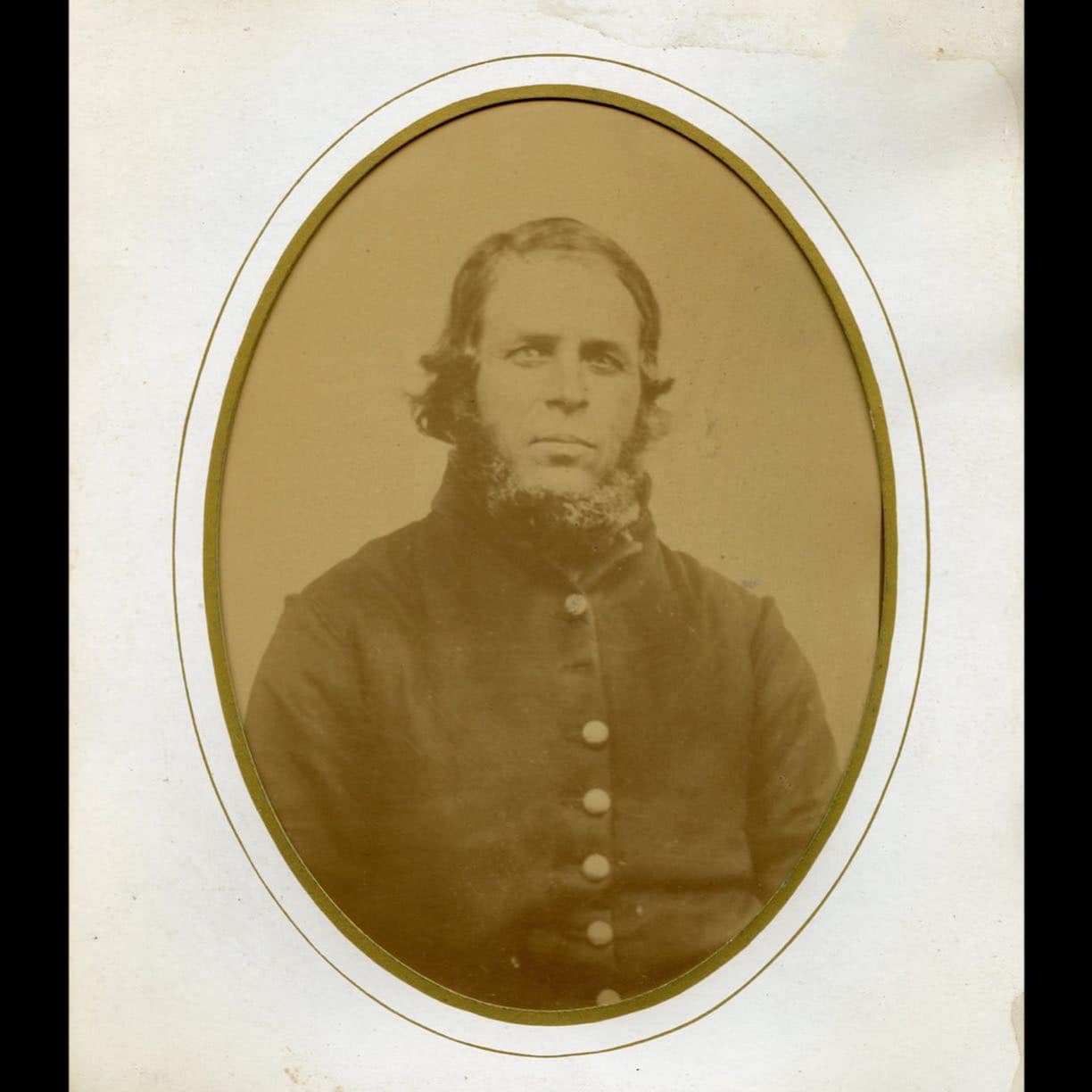
Post-war albumen of Pvt. Augustus H Dayton 14th New York Heavy Artillery. Provided by, The American Military Heritage Museum Of North Carolina,

Private Dayton and the 14th N.Y.H.A were sent to New York to defend the harbor. Here is where he would write his wife this letter:

March, April 5, 1864,

Fort Sandy Hook Ny harbor.

Dear wife I now sit down To write you a few lines to let you know that I cannot get a furlough at present you must do the best you can until I can come home I was at New York yesterday on service our whole regiment was there it was a great day and I am very tired I sent you seventy five dollars by express You go to the express office and call for it you will have to pay the charges on it you had better go to doctor lauderdale and have him go and get it for you I sent you ten dollars in a letter I want to know if you got it I want you to let the doctor lauderdale have the fifty dollar bill to put it with my other money on hand for safe keeping and i will send you some more before long i am well at present and hope this will find you and the little children the same the dear little things I would give most anything to see them and likewise yourself but i cannot at present tell Julia i have not time to write to her this time but I hope she is well and her child is to i must i must close by telling you to write as soon as you get this for we may soon leave This place so good by for This Time and may god protect us till we meet again.

From your dear Husband,

A.H. Dayton,
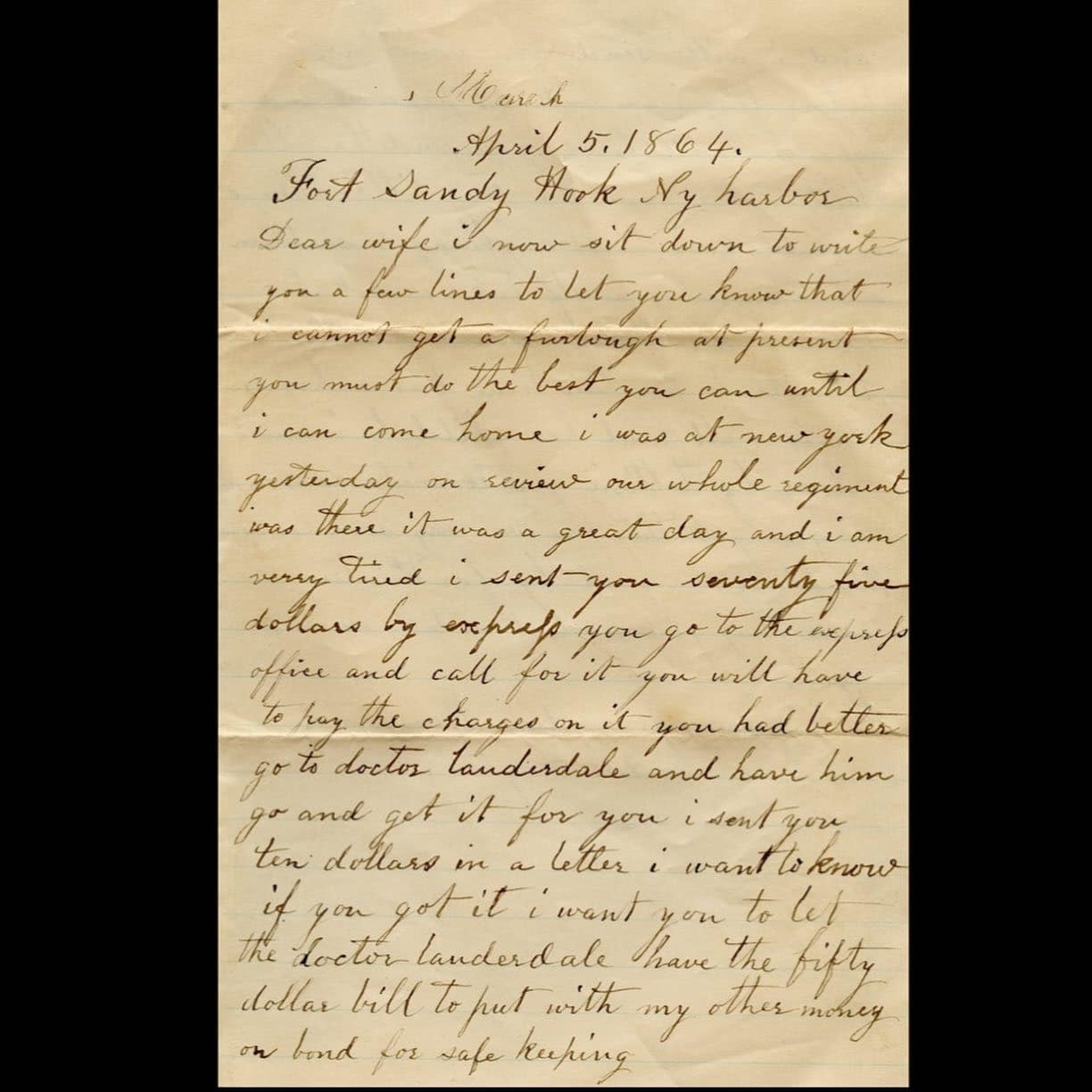
Front of Dayton letter, The American Military Heritage Museum Of North Carolina,


From the forts of New York harbor the 14th was sent south where they were in the following engagements, the Rapidan Campaign, Battle of the Wilderness, Battle of Spotsylvania Court House, The Battle of North Anna, Battle of Totopotomoy Creek, Battle of Cold Harbor, The Siege of Petersburg (including the Mine Explosion), The Battle of the Weldon Railroad, and The Battle of Peebles’s Farm.

Private Dayton was sent to the hospital at City Point Virginia on October 6th 1864[7] suffering from chronic diarrhea. He would later be sent home on furlough. Private Dayton arrived in Rochester New York on December 15th, 1864.[8] Here he would receive hospital care for his illness. Sadly, Private Dayton would die on March 28th 1865[9]. Dayton’s wife Catherine would apply for a widow’s pension, for her and the two youngest children. Dr. Lauderdale would testify that he attended to Private Dayton, and Dayton also had dropsy as well as insanity before he passed. Dr. Lauderdale would also say that Dayton was a healthy man and a “devoted father”[10].
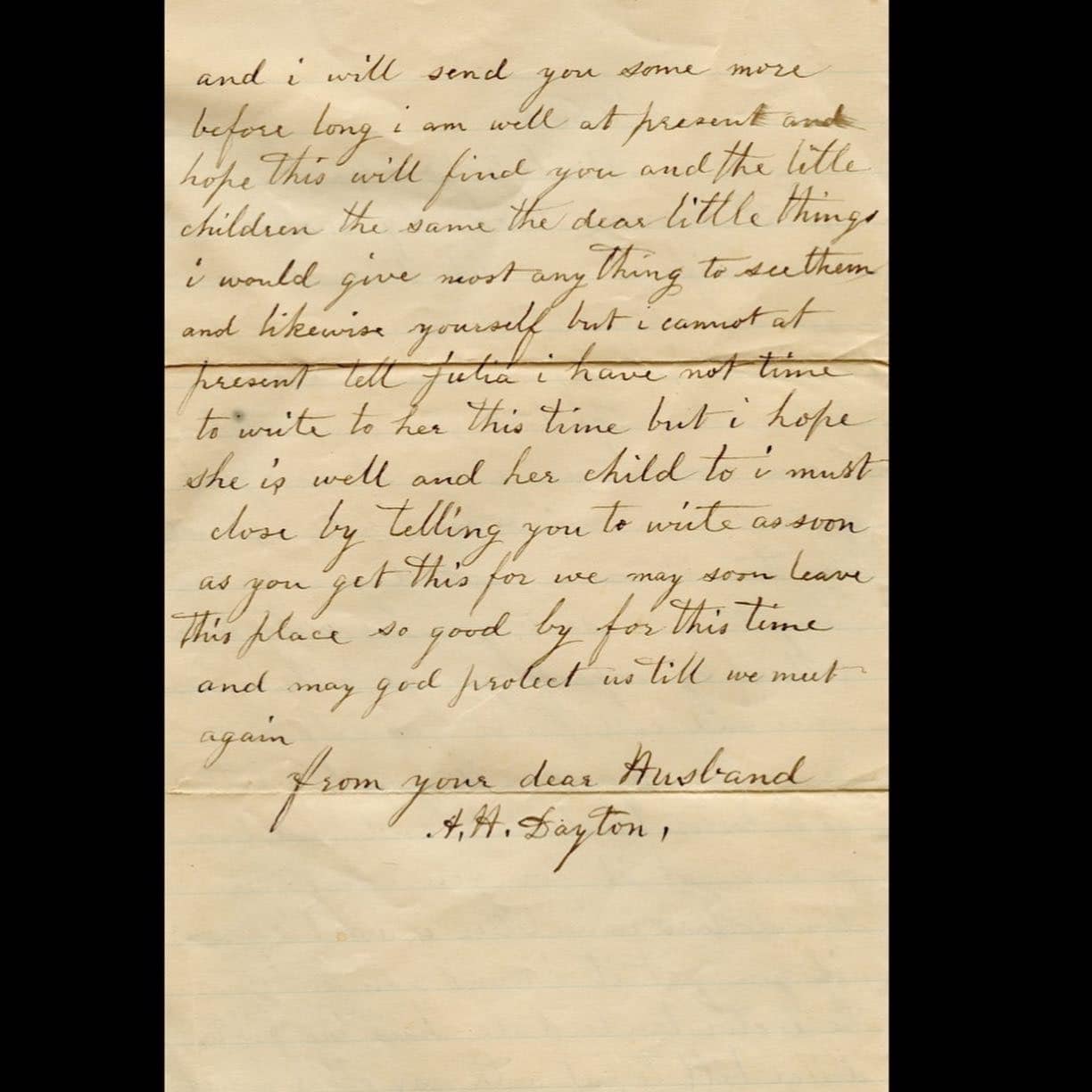
Back of Dayton letter, The American Military Heritage Museum Of North Carolina,

Catherine would ultimately receive a widow’s pension of eight dollars a month. This would be the equivalent of about one hundred and thirty-seven dollars today.

Let us never forget the sacrifice that Private Dayton made for his country. As well as the loss his family had to suffer in his absence.

[1] “1850 United States Federal Census for Augustus H Dayton New York Livingston Geneseo.” Ancestry®. Accessed January 12, 2022. https://www.ancestry.com/imageviewer/collections/8054/images/4197497-00120?pId=7026585.

[2] Ibid

[3] “Lewis A. Dayton.” American Civil War Research Database. Accessed January 12, 2022. http://civilwardata.com/.

[4] “Henry A. Daton.” American Civil War Research Database. Accessed January 12, 2022. http://www.civilwardata.com/active/index.html.

[5] “New York Civil War Muster Roll Abstracts Dayton, Augustus H .” Fold3. Accessed January 17, 2022. https://www.fold3.com/image/316571763.

[6] Ibid

[7] Ibid

[8] “Page 3 Civil War ‘Widows’ Pensions’ Augustus H Dayton.” Fold3. Accessed January 17, 2022. https://www.fold3.com/image/283724325.
[9] “New York Civil War Muster Roll Abstracts Dayton, Augustus H .” Fold3. Accessed January 17, 2022. https://www.fold3.com/image/316571763.

[10] Page 3 Civil War ‘Widows’ Pensions’ Augustus H Dayton.” Fold3. Accessed January 17, 2022. https://www.fold3.com/image/283724325.
A Letter Speaks

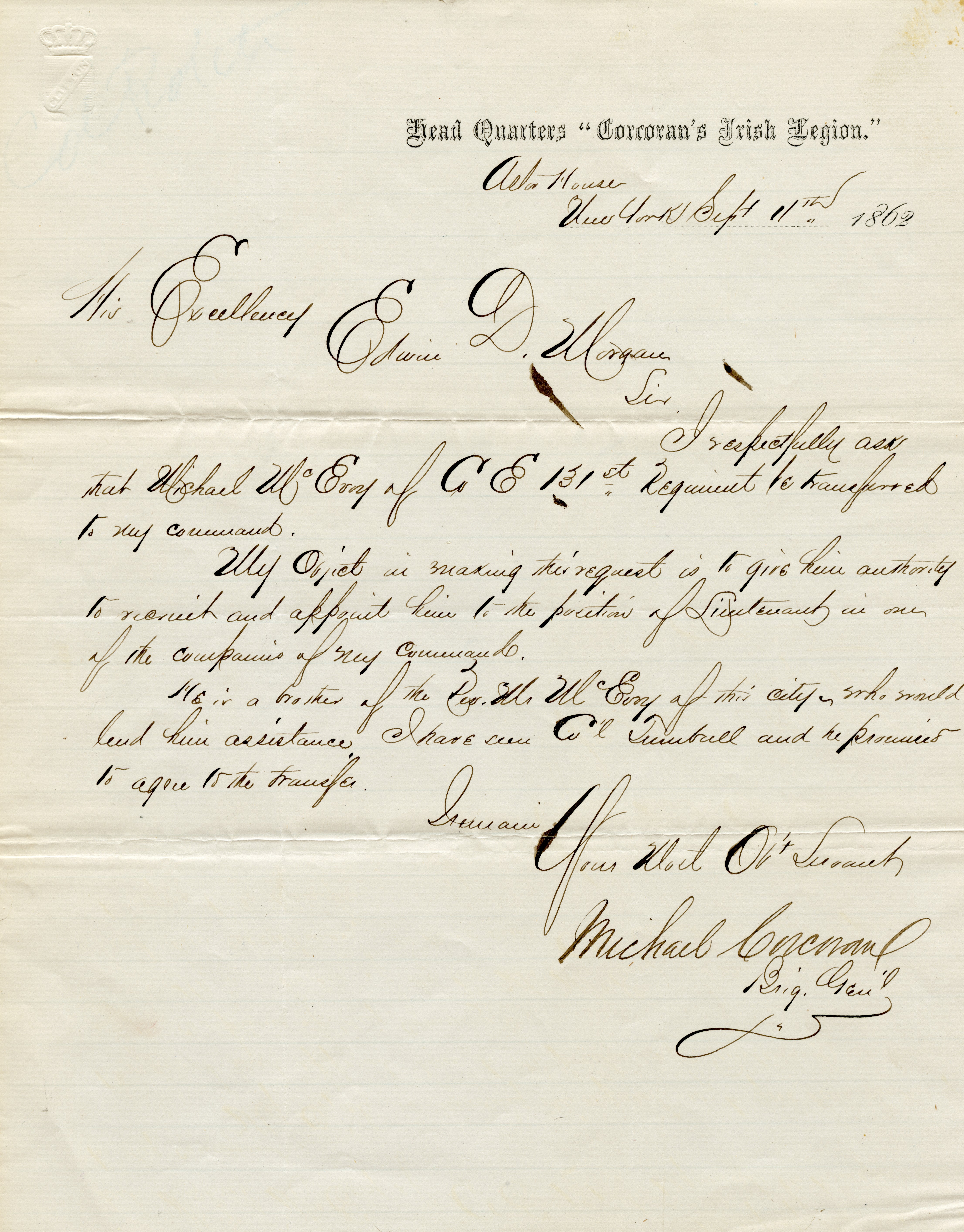
A letter to some is just a piece of paper with words on it. However when one digs deep they can find a hidden story. This letter is written and signed by Brigadier General Michael Corcoran. The letter’s recipient is then Governor of New York Edwin D. Morgan. In this post I am not going to just focus on the “big names” associated with the piece (We can all use Google for that). There is also the interesting tail of Michael McEvoy of Company E, 131st New York. So without further adieu may I present the The letter it reads……

“Sir,

I respectfully ask that Michael McEvoy of Company E, 131st Regiment be transferred to my command.

My object in making this request is to give him authority to recruit and appoint him to the position of Lieutenant in one of the companies of my command.

He is a brother of the Provost Marshal McEvoy of this city, who would lend his assistance. I have seen Colonel Turnbull and he promised to agree to the transfer.

I remain,

Your Most Obedient Servant,

Michael Corcoran

Brigadier General” [1]

Corcoran Letter, provided by The American Military Heritage Museum Of North Carolina
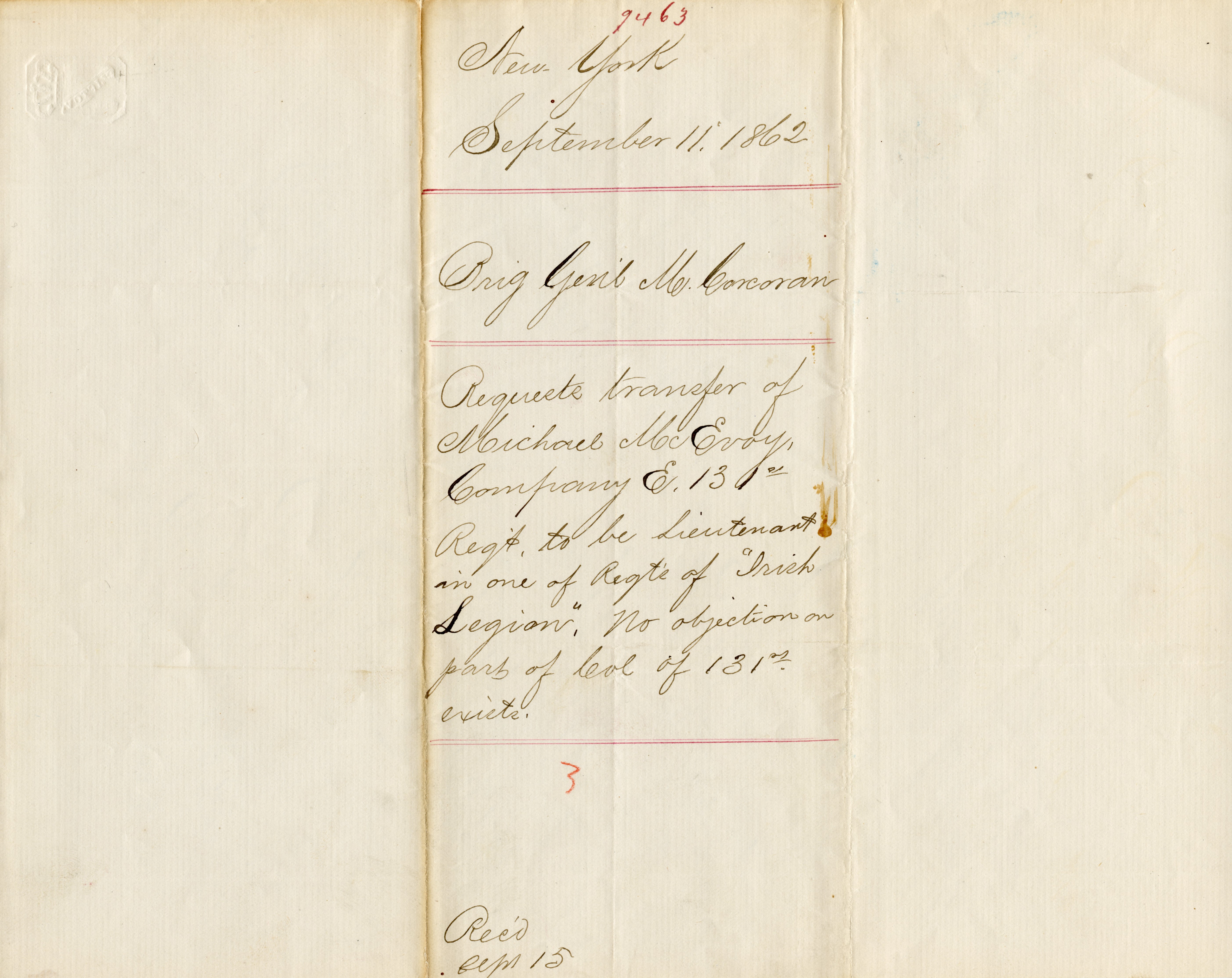
Back of the Corcoran Letter, provided by The American Military Heritage Museum Of North Carolina

Michael McEvoy was born in Ireland around 1828[2]. He was described as five feet nine inches tall, with blue eyes, light hair, and a light complexion.[3] McEvoy would immigrate to America prior to 1850. He was listed on the 1850 United States Federal Census as being a farmer, and married to Cath McEvoy, they had one child James.[4] McEvoy was employed as a Teamster, at the time of his enlistment in the Union army on August 13th, 1862.[5]

. He would be mustered into “E” Co 131st infantry as a private on September 6th.[6] Per General Corcoran’s request McEvoy would be transferred to “D” Co. 170th New York on September 19th, 1862.[7] He would be mustered in as a private on October 7th, 1862. Private McEvoy would participate in the battle of Deserted House. He would later be granted leave on March 21st, 1863, McEvoy would never return to service[8]. Private McEvoy would be listed as a deserter from camp at Suffolk Virginia on April 3rd, 1863.[9] That is where his trail ends for now.

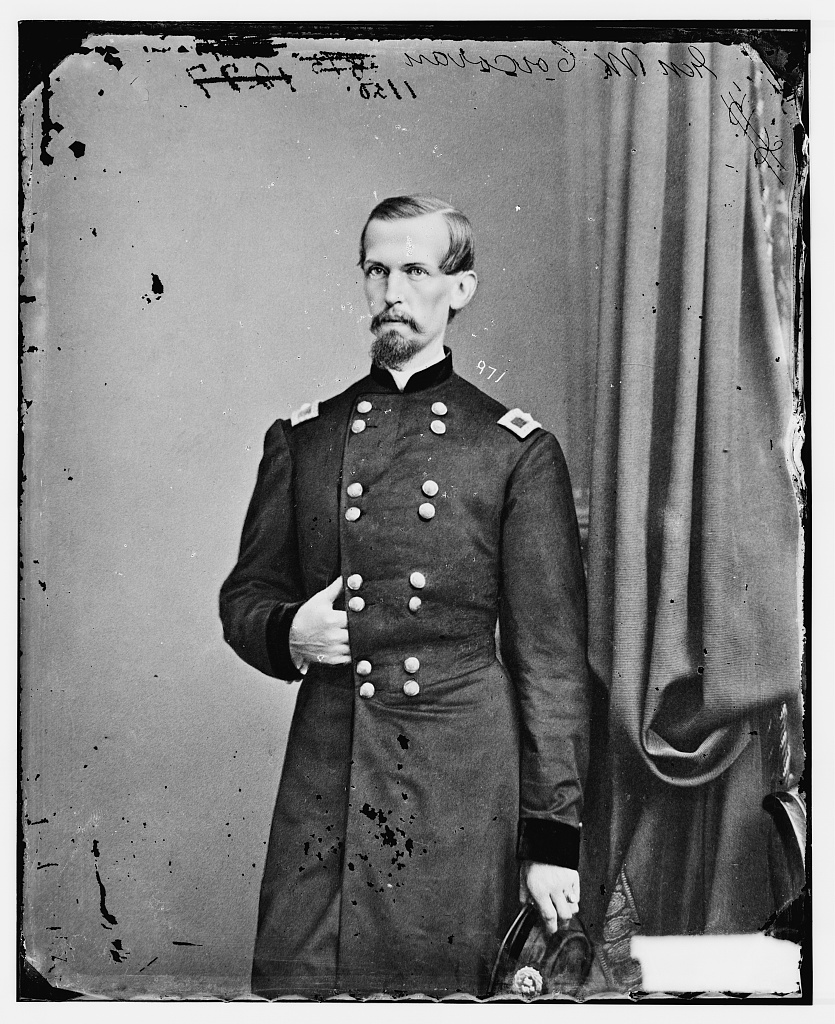
Michael Corcoran was born in Carrowkeel, county Sligo Ireland. He was a member of the Irish Nationalist Guerrilla force known as the Ribbonman. His ties to this group were eventually discovered in 1849, so he immigrated to New York City in order to avoid capture.[10] To gain a position in society Corcoran joined the 69th New York State Militia as a private. He would advance rapidly due to, “his military passion and his previous knowledge of military tactics were a great advantage to him.”[11] Corcoran moved up in rank and became a Colonel.  It was in this capacity that Corcoran became a hero to the Irish Nationalist, as well as the overall Irish immigrant population of New York. When he chose not to parade the 69th  in front of the Prince of Whales upon the Princes visit, saying that “as an Irishman he could not consistently parade Irish-born citizens in honor of the son of a sovereign, under whose rule Ireland was left a desert and her best sons exiled or banished.”[12] His action resulted in a court-martial. However, it was overturned due to the need of good officers to fight in the Civil War.


General Michael Corcoran, U.S.A. United States, None. [Between 1860 and 1865] Photograph. https://www.loc.gov/item/2018667330/.

Corcoran resumed his rank in the 69th New York and was present at that Battle of First Manassas, where he was captured. Corcoran spoke of this later by saying, “I did not surrender until I found myself after having successfully taken my regiment off the field, left with only seven men and surrounded by the enemy.”[13] Corcoran was eventually exchanged over a year later, and was received back with acclaim. He was given the rank of Brigadier General and put in command of his own troops, known as Corcoran’s “Irish Legion.” The first battle of the Legion took place during the Battle of Deserted House Virginia. Although not one of the biggest battles of the war, Corcoran demonstrated calmness under fire and his men showed how they admired Corcoran by following his every commanded under intense battle conditions. Sadly this would be Corcoran’s last major battle as he was killed later that year when he fell from his horse. Even though Corcoran’s life was cut short his legend and the Prince of Wales incident continued to inspire men, especially those of his Legion who were fighting for their adopted homes as well as Irish pride.

The National Governors Association has written this about Gov. Edwin D. Morgan.

“EDWIN D. MORGAN, the twenty-third governor of New York, was born in Washington, Massachusetts on February 8, 1811. His education was attained at the Bacon Academy in Colchester, Connecticut, where his family moved to in 1822. Morgan established a successful business career, with holdings in the banking and brokerage industries. He first entered politics in Connecticut, serving as a member of the Hartford city council, a position he held in 1832. After moving to New York, he served as alderman of New York City in 1849; was a member of the New York State Senate from 1850 to 1851; and served as the state immigration commissioner from 1855 to 1858. He also chaired the Republican National Committee from 1856 to 1864. Morgan next secured the Republican gubernatorial nomination, and was elected governor by a popular vote on November 2, 1858.

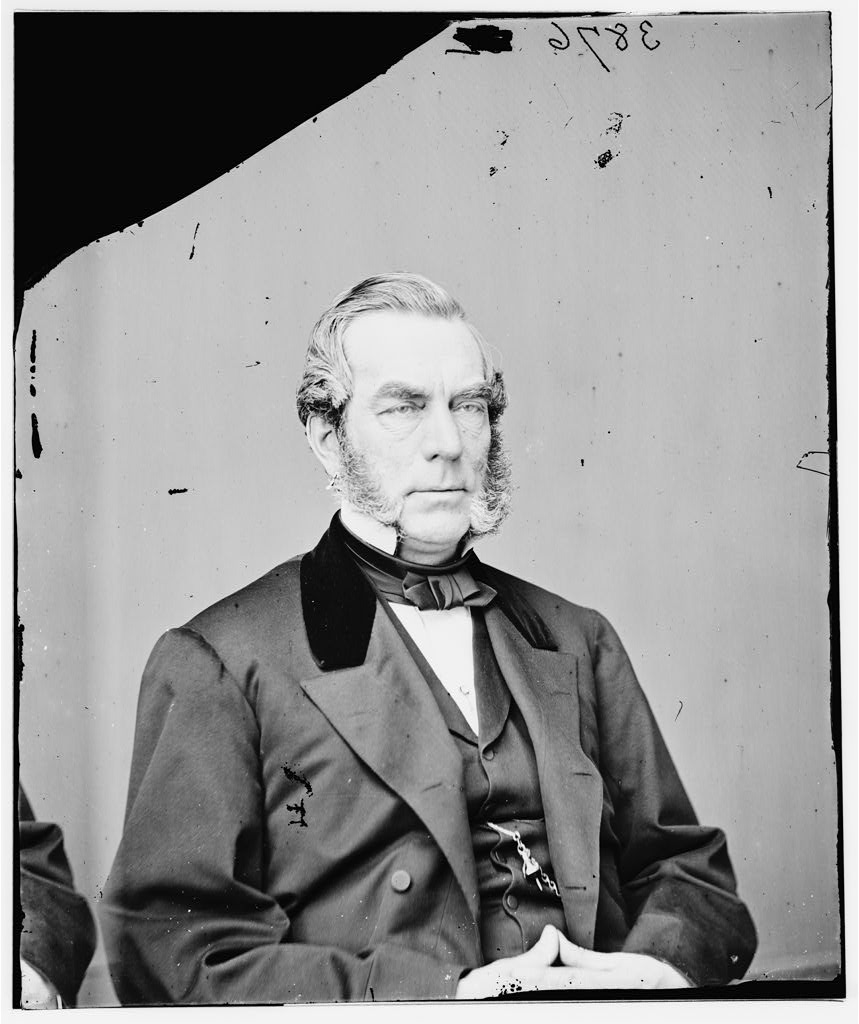
Edwin D. Morgan
. United States, None. [Between 1860 and 1870] Photograph. https://www.loc.gov/item/2018669639/.

He was reelected to a second term in 1860. During his tenure, the state’s canal system was advanced; Vassar College was founded; and volunteers were raised and equipped for service in the Civil War. Morgan also served as major general of volunteers during the war, as well as serving as the commander for the Department of New York. After leaving the governorship, Morgan was elected to the U.S. Senate, an office he held from 1863 to 1869. From 1872 to 1876 he chaired the Republican National Committee; and in 1881 he turned down an appointment to serve as U.S. secretary of treasury. Governor Edwin D. Morgan passed away on February 14, 1883, and was buried in the Cedar Hill Cemetery in Hartford, Connecticut.” [14]

Although these three men are from completely different backgrounds, their stories intersect in this one document. Historical stories are everywhere, you just need to dig under the surface to find them.


[1] Corcoran, Michael. Letter to Gov. Edwin D, Morgan. “Brigadier General Michael Corcoran Request For Michael McEvoy.” New York, New York: Astor House, September 11, 1862.

[2] “Page 1 New York Civil War Muster Roll Abstracts McEvoy, Michael.” Fold3. Accessed December 31, 2022. https://www.fold3.com/image/315981459.

[3] Ibid

[4] “Michael McEvoy in the 1850 United States Federal Census.” Ancestry. Accessed December 31, 2022. https://www.ancestry.com/discoveryui-content/view/7008512:8054?tid=&pid=&queryId=6a9bb6ca9453a20b805c27f011dfac83&_phsrc=csG312&_phstart=successSource.

[5] Page 1 New York Civil War Muster Roll Abstracts McEvoy, Michael.” Fold3. Accessed December 31, 2022. https://www.fold3.com/image/315981459

[6] Ibid

[7] “Page 1 New York Civil War Muster Roll Abstracts Michael McEvoy.” Fold3. Accessed December 31, 2022. https://www.fold3.com/image/316135643.

[8] Ibid

[9] Ibid

[10] Pritchard, Russ A. The Irish Brigade : a Pictorial History of the Famed Civil War Fighters. (Philadelphia,

[11] Conyngham, The Irish Brigade and It’s Campaigns , 537

[12] Ibid 

[13] Ibid, 538

[13] Shiels, Damian. Irish in the American Civil War Exploring Irish involvement in the American Civil War . March 18, 2012. http://irishamericancivilwar.com/2012/03/18/baptism-of-fire-the-corcoran-legion-at-deserted-house-virginia-30th-january-1863/ (accessed 11 20, 2013).

[14] Sobel, Robert, and John Raimo. “Edwin Denison Morgan.” National Governors Association. Accessed November 3, 2023. https://www.nga.org/governor/edwin-denison-morgan/.

An Artifact Speaks

I feel every artifact has a story. This identification shield worn by Sergeant Thomas Wood (Woods) is no exception. Sgt. Woods was a member of Company “B”, 69th New York National Guard. This unit would later become the 182nd New York Infantry, part of Corcoran’s Irish Legion.

 Identification shield worn by Sergeant Thomas Wood (Woods). Provided by The American Military Heritage Museum Of North Carolina.
Identification shield worn by Sergeant Thomas Wood (Woods). Provided by The American Military Heritage Museum Of North Carolina.

Woods was born in Ireland around 1827[1] and arrived in the United States prior to 1850.[2] He married Margaret Begnan at St. James Roman Catholic Church in Manhattan on October 13, 1850.[3] By 1860 he was making a living as a butcher. He and his wife, along with their two children Patrick and Elizabeth, resided in the 18th Ward of Lower Manhattan.[4]  In November of 1861 Thomas and Margaret would have another child, Thomas Frances.[5]

As the American Civil War unfolded, Woods made the decision to enlist. On September 18, 1862, Woods enlisted in the 69th New York National Guard.[6]  On November 17, 1862, he was officially mustered in as a Sgt. in “B” Co. 69th N.Y.N.G. This regiment was organized by Col. Mathew Murphy as the first regiment of the Corcoran Brigade, also known as Corcoran’s Irish Legion.  The regiment left New York state on November 10, 1862, to serve at Newport News, VA. The unit first served in Corcoran’s Brigade, part of Peck’s Division, Department of Virginia. Then in December 1862 at Suffolk, as part of Murphy’s Brigade, Corcoran’s Division.[7] Sgt. Woods and the 69th N.Y.N.G spent most of their time guarding Federal naval yards at Portsmouth and Norfolk.

In January of 1863 Confederate Brigadier-General Roger Atkinson Pryor would move 1,800[8] men towards Suffolk, VA. His hope was to disturb Union activity in the region.  Early in the morning of January 30[9] Brigadier-General Corcoran ordered his men to march in the direction of the enemy.

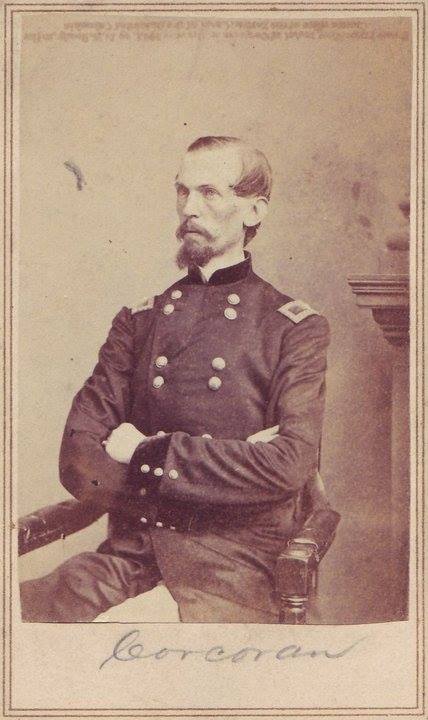
Carte-de-visite of Michael Corcoran Provided by The American Military Heritage Museum Of North Carolina.

The men of the 69th N.Y.N.G were both anxious and eager to see their first combat. Their energy led them to be boisterous and the men had to be ordered to keep quiet, as to not alert the confederate soldiers that were in close proximity. Sgt. Wood and the men of Co. “B” slogged through the mud for nine miles before reaching the enemy.  Brigadier General Corcoran first sent in his cavalry and artillery, who took heavy fire. Corcoran than ordered the 167th Pennsylvania into the fight. However, they were in a shambles due to the wounding of their commander. It was time for Sgt. Woods and the men of the 69th N.Y.N.G to see the elephant. They advanced through the blackness of the early morning….

This magnificent map of The Battle of Deserted House is the property of Baylor University. The image is reprinted with permission from the War of the Rebellion Atlas digital collection. It was produced by the US Government.

“Moving into a gully near the unfortunate 167th Pennsylvania, the Legion came into range of the Confederate artillery, and were ordered to lie down. Trees and houses were ripped apart during the ferocious barrage that followed…. In defense of the Pennsylvanians, the fire under which they had been exposed was extremely heavy, as the Legion were finding out. A piece of spiraling shrapnel struck the canteen of the 69th’s Captain Michael Kelly, carrying away his elbow. 30-year-old Sergeant Thomas Woods took a shell fragment in the stomach, killing him.”[10]

This action would be known as “Deserted House.” It was the first combat for the 69th N.Y.N.G but the last that poor Sgt. Woods would see.

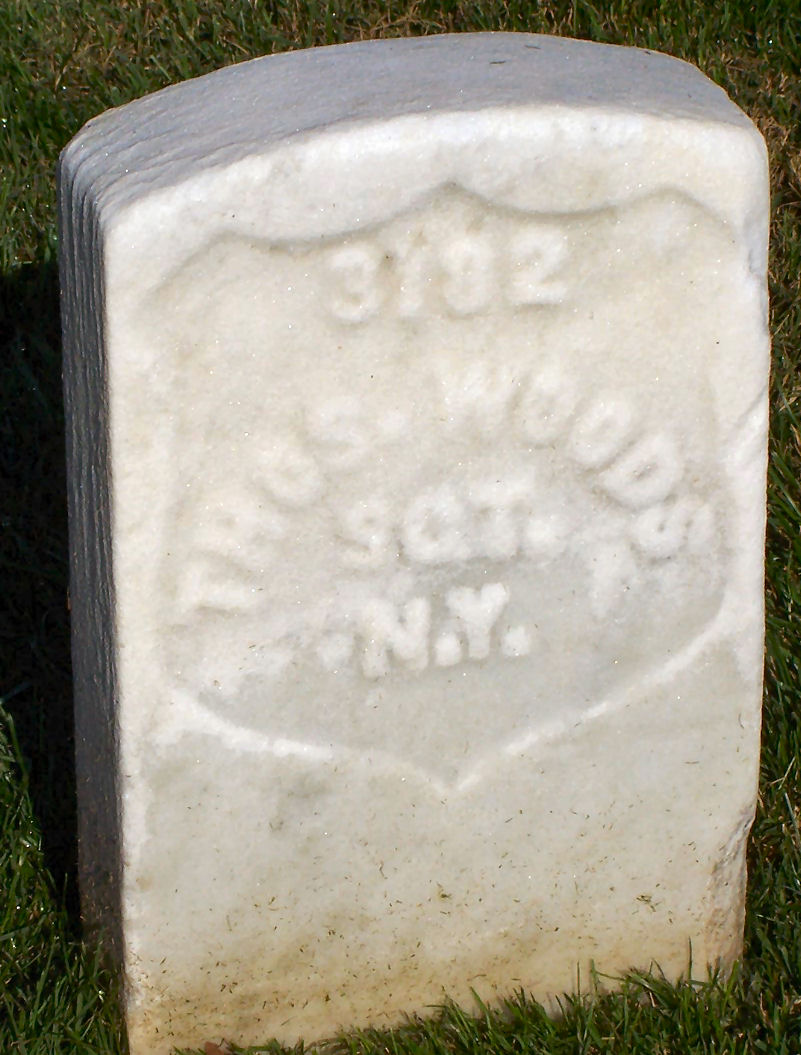
Sgt. Woods now rests in Hampton National Cemetery in section D number 3182.[11]

Photo by Dawn Bilik (prev. Stewart)
Grave of Sgt. Thomas Wood Photo by Dawn Bilik (prev. Stewart)

Margaret would apply for a widow’s pension for her and the three children on March 19, 1863.[12] She would receive a pension of $8.00 a month, which is about $108[13] in today’s money. Sadly, Margaret would die on July 4, 1864.[14] The children and the pension were then transferred to the custody of Mary Ann Grimes.

Let us never forget the sacrifice of Sgt. Woods and his family for their adopted country.


[1] “1860 United States Federal Census for Thomas Woods.” Ancestry. Accessed October 6, 2022. https://tinyurl.com/mr39du7m.

[2] “Thomas Woods Page 5 Civil War ‘Widows’ Pensions.’” Fold3. Accessed October 6, 2022. https://www.fold3.com/image/270483669.

[3] Ibid

[4] “1860 United States Federal Census for Thomas Woods.” Ancestry. Accessed October 6, 2022. https://tinyurl.com/mr39du7m.

[5] “Thomas Woods Page 11 Civil War ‘Widows’ Pensions.’” Fold3. Accessed October 6, 2022. https://www.fold3.com/image/270483681.

[6] “Thomas Woods Page 1 New York Civil War Muster Roll Abstracts.” Fold3. Accessed October 6, 2022. https://www.fold3.com/image/316281613.

[7] “New York State Military Museum and Veterans Research Center.” 182nd Infantry Regiment :: New York State Military Museum and Veterans Research Center. Accessed October 6, 2022. https://museum.dmna.ny.gov/unit-history/infantry-2/182nd-infantry-regiment.

[8] Shiels, Damian. “Baptism of Fire: The Corcoran Legion at Deserted House, Virginia, 30th January 1863.” Irish in the American Civil War, March 25, 2020. https://irishamericancivilwar.com/2012/03/18/baptism-of-fire-the-corcoran-legion-at-deserted-house-virginia-30th-january-1863/.

[9] Ibid

[10] Ibid

[11] “Thomas Woods (Unknown-1863) – Find a Grave…” Find a Grave. Accessed October 6, 2022. https://www.findagrave.com/memorial/3097387/thomas-woods.

[12] “Thomas Wood Page 21 Civil War ‘Widows’ Pensions.’” Fold3. Accessed October 6, 2022. https://www.fold3.com/image/270483701.

[13] “Inflation Rate between 1863-2022: Inflation Calculator.” $8 in 1863 → 2022 | Inflation Calculator. Accessed October 6, 2022. https://www.in2013dollars.com/us/inflation/1863?amount=8.

[14] “Thomas Woods Page 2 Civil War ‘Widows’ Pensions.’” Fold3. Accessed October 6, 2022. https://www.fold3.com/image/270483662.

Matthew B. Ridgway: Fighting General and Statesman

  Matthew B. Ridgway was born to a military family on March 3, 1895. Like most army families, the Ridgways moved around quite a bit; it was not till Ridgway’s appointment to West Point in 1913 that he finally felt at home. (1) It was at West Point where Ridgway first was established as a leader, becoming cadet lieutenant, and was said to be “the busiest man in the place, handling well the jobs of several men” (2). This would serve him well in the future. After his West Point graduation in 1917, Ridgway looked forward to seeing combat in The Great War. However, this was not to be the case since he was recalled to West Point as an instructor after a brief stint in the infantry stationed in Texas. Ridgway was outwardly upset with his new assignment, saying, “To me, this was the death knell of my military career. The last Great War the world would ever see was ending, and there would never be another. Once the Hun was beaten, the world would live in peace throughout my lifetime.” (3) Nevertheless, Ridgway was wrong on all counts as the Japanese bombed Pearl Harbor on December 7th, 1941, thrusting America and then Lieutenant Colonel Ridgway into war. 

Ridgway was promoted to full Colonel and assigned to the War Plans department, where he stayed until 1942 when he was promoted to Brigadier General and assigned to help General Omar Bradley put together and train the 82nd Airborne Division. Upon Bradley’s reassignment, promoted again to Major General and given command of the 82nd.  During the Second World War, Ridgway led the 82nd into battle through every significant engagement, even jumping with them into Normandy.

Uniform worn by General Ridgeway when he jumped into Normandy, on display at The National Museum of the U.S. Air Force, located at Wright-Patterson Air Force Base near DaytonOhio. Photo by MGC

Ridgway even received a Purple Heart for actions that took place during Operation Varsity; General Ridgway describes the action in his memories: “I fired all five shots from my Springfield, shooting from the hip because the range was so close. Then I hit the ground to reload…There was quite an explosion then, very close to em’, and I felt the heat of a stinging fragment in my shoulder.” (4) He later states the grenade missed his head by three feet. General Ridgway was indeed a fighting general; he led the 82nd through the most formidable fighting and was loved by the men he commanded; he was dubbed “Old Iron Tits” because he always had a grenade and metal first aid kit strapped to him. However, the true sign of respect came from the saying, “There is a right way, a wrong way, and a Ridgeway,” the Ridgway being the best (5)

After World War II, Ridgway was assigned to multiple posts, including a United Nations liaison and a command in the Caribbean islands, before being selected by General Omar Bradley to be deputy chief of staff of the army in Washington, D.C.

Lieutenant General Matthew B. Ridgway, three-quarter length portrait, standing, facing front, in uniform. , 1952. Photograph. https://www.loc.gov/item/2002697883/.

In this position, in 1950, Ridgway was first exposed to the situation in Korea. He was deeply engrossed in high-level planning and feared that this conflict would lead to World War III. On December 22nd, 1950, after a long work day, Ridgway was out to dinner with his wife when he was informed he would head up the Eight Army in Korea due to the sudden death of its commander, General Walton Walker, in a car accident. (6) When Ridgway arrived in Korea, he found an American army in shambles and retreat. Ridgway’s aid, Walter Winton, described the situation in later years as “Weather terrible, Chinese ferocious, moral stinko” (7). Ridgway now had the daunting task of turning the war effort around. His first task was to instill a sense of order in the troops by teaching them discipline, feeling that this would put his men in an aggressive disposition. Another psychological maneuver that Ridgway employed was when he fired Colonel John R. Jeter when Jeter offered cautious plans. When Ridgway asked if Jeter had any more aggressive plans, Jeter responded that he did not and was sacked on the spot; this story was widely publicized and had the effect of officers under Ridgway focusing on attack from henceforth.

This constant state of aggression Ridgway believed was the only way to defeat the Chinese, and he used the American’s superior military capability to turn the Korean conflict into total war; Ridgway reorganized the Eight Army to make all the units self-supporting. Nonetheless, this new strategy did not work immediately as Ridgway was forced to evacuate Seoul in early January 1951, but the Chinese offensive was stopped. By the middle of the month, the UN forces were making great strides, and by March, Seoul was recaptured. A Regimental commander spoke of Ridgway’s part in the Eighth Army’s turnaround like this, “He not only made us attack, but he made us win. He made us into a professional army. The boys aren’t up there fighting for democracy. Now they are fighting because the platoon leader is leading them, and the platoon leader is fighting because of command, and so on right up.” (8)

General Ridgway’s success did not go unnoticed in Washington, and when Truman dismissed General Douglass McArthur later that year, Ridgway was given the title of theater commander. In this capacity, General Ridgeway initiated peace talks with a radio broadcast on June 30th, 1951; along with this, Ridgway supported the limited war strategy that Truman had recommended, and MacArthur refused. Ridgway poured all his effort into making the peace talks work and preventing what he thought may be a third world war. Foreign Service officer William N. Stokes noted, “Ridgway’s investment of personal time and effort demonstrates his extraordinary care to collect and face the facts before arriving at conclusions regardless of perceptions…. Ridgway then recommended to Washington against bombing….by this restraint the United States confined the war to Korea” (9). However, as General Dwight Eisenhower planned to run for President, Ridgway could not see the fruits of his labors. Ridgway was made supreme allied commander of Europe in 1952 before the peace talks in Korea were over.

In his job as supreme allied commander, Ridgway again applied his whole self to his work and tried to strengthen NATO, but this job also did not last long as he was appointed United States Army Chief of Staff in 1953 under Eisenhower; this was Ridgway’s most challenging assignment as he stated “The Vexations and frustrations I encountered in Europe, though they were many and great, were in no way comparable to the vexations, the frustrations, the sheer travail of spirit which were my final lot in my two-year tour as Chief of Staff”  (10) Ridgway’s main issue was Eisenhower’s armed forces reduction act wanting to reduce the military by 20 percent, Ridgway disagreed with this policy known as the New Look, and for this he was not reappointed to his post in 1955.

Ridgway retired after not retaining his Chief of Staff job but stayed in the spotlight. He was put on an advisory board about the Vietnam War, arguing against the “domino” theory and said the war was unwinnable.  Ridgway stayed in the public eye through the Regan administration till his death in 1993.

Placing a flag at General Ridgway’s grave in Arlington National Cemetery. Photo by @firefightinirish

General Matthew B. Ridgway was one of the most outstanding Americans of an already unique generation. Not only did he put his life on the line for freedom, but he stood firm in his convictions and used his experience and tireless effort to keep the Korean War from getting out of control and possibly prevent World War III.


1)  Soffer, Jonathan M. General Matthew B. Ridgway From Progressivism to Reaganism 1895-1993. (Westport: Praeger Publishers, 1998.) 12

2)  Ibid

3)  Mitchell, George C. Matthew B. Ridgway Soldier, Statesman, Scholar, Citizen. (Mechanicsburg: Stackpole Books, 2002.) 10

4)  Ridgway, General Matthew B. Soldier The Memoirs of Matthew B. Ridgway. (New York: Harper & Brothers, 1956.) 126

5)  Mitchell, Pg. 35

6)  Soffer, Pg. 116

7)  Ibid, Pg. 117

8)  Mitchell, Pg. 55

9)  Ibid, Pg. 97

10) Soffer, Pg. 175