During an adventure at Green-Wood Cemetery in Brooklyn, I discovered the grave of Captain Alfred A. Donalds. He was born to David and Susan Donalds in Columbia County, New York, around 1835[1]. Captain Donalds was listed as a ship carpenter during the 1860 census. He was also the foreman of East River Engine Co. 17 part of The Fire Department of New York.


Soon after the outbreak of the American Civil War, Col. Elmer Ellsworth put out the following call:
“I want the New York firemen, for there are no more effective men in the country, and none with whom I can do so much. They are sleeping on a volcano at Washington, and I want men who are ready at any moment to plunge into the thickest of the fight.”[2]
On April 20th, 1861, Donalds answered that call, enlisting as a 1st Sergeant. He mustered into “I” Co. NY 11th Infantry (First Fire Zouaves) a few weeks later. On April 29th, 1861, Under the command of Col. Elmer Ellsworth, then Sgt. Donalds and the 11th New York infantry left for Washington, D.C.

In Washington, the regiment showcased their unique Zouave characteristics and effectiveness as firefighters when a severe fire erupted close to Willard’s hotel. Col. Ellsworth took up the task. Upon receiving the order, ten men from each company quickly hurried to the engine house, forced the door open, and swiftly arrived at the scene with the firefighting equipment. They were soon joined by most of their fellow soldiers, with Col. Ellsworth taking charge and, after strenuous effort, successfully extinguishing the flames. General Mansfield publicly thanked them for their assistance, and the citizens enthusiastically cheered for them. J. Frank Kernan’s book Reminiscences of the Old Fire Laddies and Volunteer Fire Departments of New York and Brooklyn describes one of the most heroic scenes of the incident.
“It was necessary to get the hose to the roof of the hotel, but the ladders were not long enough While in dilemma, Mr. Alfred Smith, one of the Zouaves…suggested that if his comrades would hold him suspended, by the legs he would reach down to the man on the ladder below and make a coupling of the hose Corporal Keese and a companion grasped the daring Smith by the feet and held head downward he made a connection to the butt. The water was then turned on, and Willard’s was saved.”[3]

On May 24th, 1861, Sgt. Donalds and the 11th New York boarded boats. They arrived in Alexandria and seized control of the dock and the city. At this point, Colonel Ellsworth

proceeded to the top of the Marshall House, removing the secession flag that had been flying there for several days. While descending the stairs with the flag, he was shot in the chest by a rebel named Jackson and died immediately. Private Brownell of Co. A quickly shot the assassin. The death of their faithful leader shook the regiment; however, they continued.
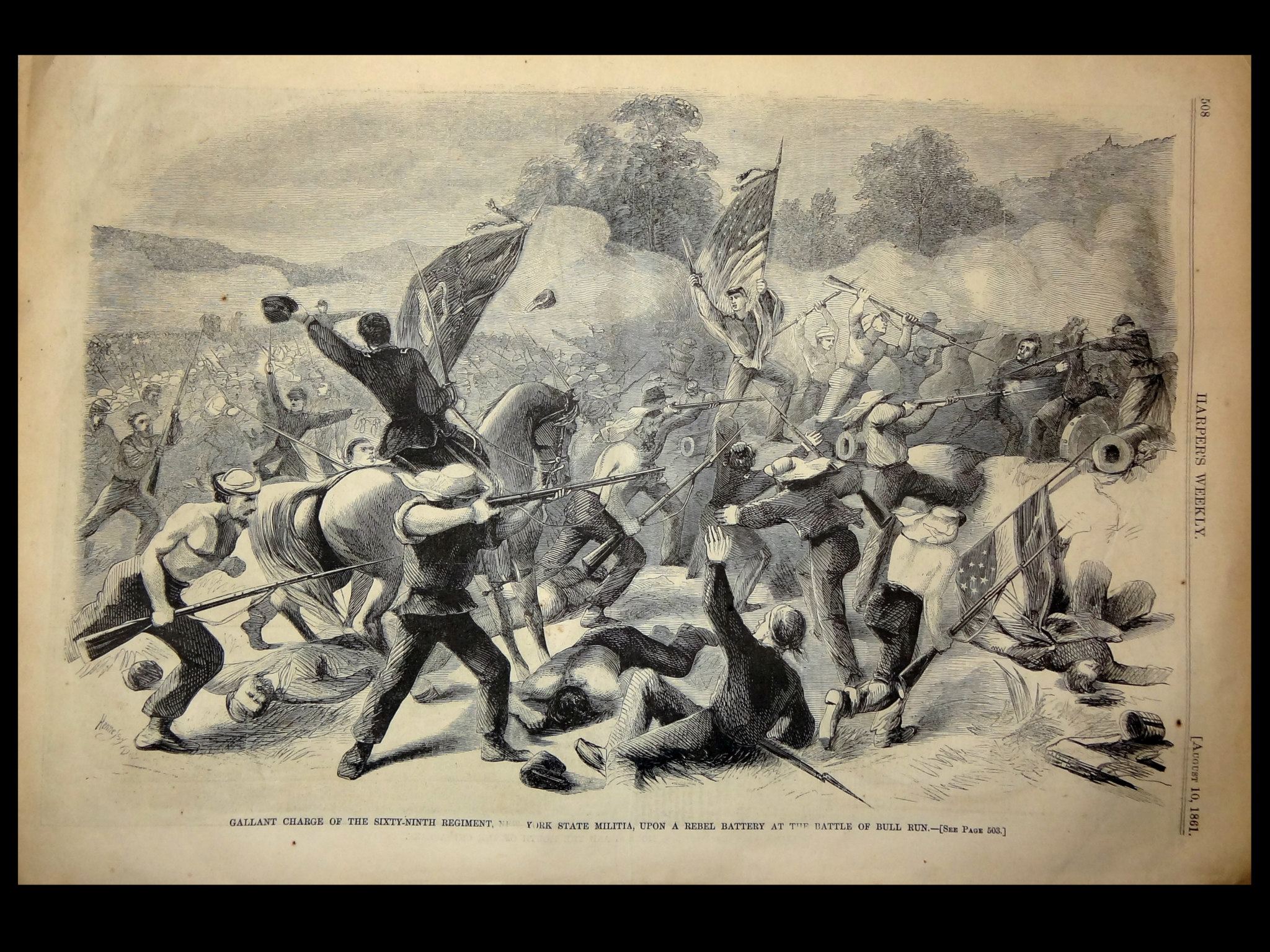
On June 21st, 1861, during the battle of First Bull Run, Sgt. Donalds and the 11th regiment effectively engaged in close combat with the renowned Black Horse cavalry. The rallying cry of “Ellsworth! Remember Ellsworth!”[4] accompanied each engagement, resulting in the fall of enemy horsemen. Amidst the chaos and fervor of battle, each soldier fought independently as the tumultuous conflict drowned out the officers’ commands. After failing to gain ground with their cavalry, the opposing forces unleashed their elite infantry and favored “Louisiana Zouaves” in overwhelming numbers upon the regiment. The opposing new force was pushed back three times, and only after two hours of fighting did it finally give up the ground. Before the 11th retired from the field, they ran to help other units in trouble. One of those units was the famed 69th N.Y.S.M.

The 69th were beaten back, and both their flag and a high-ranking officer had been captured. Men of the 11th, led by Captain John Wildey, rushed in to help the beleaguered 69th. This is an account of what transpired:
“At the fight at Bull Run, when the flag of the glorious Sixty-ninth Regiment was wrested from them by a superior force of the enemy, John Wildey rushed forward at the head of his brave men, and after a bloody contest, in which he killed two men,–one a rebel officer, whose sword he took from him as a trophy,–recaptured the flag, and after marching four miles he restored it to the gallant corps from whom it had been taken.”[5]
During this engagement, the 11th suffered twenty-four fatalities and forty-six injuries, and fifty-two soldiers went missing, with many of them being captured as prisoners.[6]
On August 1st, 1862, Donalds was discharged for promotion. He was commissioned into “F” Co. NY 73rd Infantry (Second Fire Zouaves) the same day[7]. Captain Donalds and the 73rd were involved in the following engagements: The Siege of Yorktown, The Battle of Williamsburg, and The Battle of Fair Oaks. After the battle of Fair Oaks, Commander of the 73rd NY, William R. Brewster, recognized him and other captains for their aid “…in urging forward the men when exposed to a galling fire and obliged to advance through a thick entanglement of brush and felled timber. Most of my men were shot while climbing over felled trees.”[8]
The 73rd and Captain Donald were also heavily engaged during the Seven Days Battles. After the battle of Malvern Hill, General Daniel Sickles wrote,
“I must especially commend the admirable conduct of Captain Alfred A. Donalds in commanding Fourth Excelsior. He was not assisted by a single officer above the rank of lieutenant, and of these, only four were on duty. Notwithstanding every embarrassment, the fragment of his brave command was most effectively and gallantly led by him throughout the day.”[9].

Brigadier General Joseph Hooker mentioned Donalds after the fight at Harrison’s Landing. He commended Captain Donalds for his admirable service, acknowledging that his “heroic conduct was conspicuous throughout the day.”[10]
On August 27th, 1862, Captain Donalds was killed in action as acting commander of the 73rd New York during a skirmish at Kettle Run near Bristoe Station, VA. On September 8th of that same year, in his field report from Fort Lyon, Virginia, Brigadier General Nelson Taylor of the United States Army saluted Captain Donalds by saying,
“In closing this report, I shall avail myself of the opportunity to express my admiration of the gallant conduct on the field of the officers and men who so nobly followed the fortunes of the brigade during the time which this report covers, particularly to the lamented Captain Alfred A. Donalds, of the Fourth Excelsior Regiment, who fell early in the action at Bristoe Station.…”[11]
The captain’s mortal remains were retrieved from Washington, D.C., and returned to New York. Here, Chief Engineer John Decker of the Fire Department of New York ordered to “call out the Department to attend the funeral. The various companies will wear their respective badges of mourning, the Chief and Assistants act as marshals, and the fire alarm bells will be tolled during the solemnities.” [12]
The Fire Department of New York passed the following resolution on the day of his funeral:
“Whereas It is with feelings of pain and regret we have heard of the death of our late brother, associate, and member, Captain Alfred A. Donalds of the Second Regiment Fire Zouaves, who fell while gallantly and nobly fighting in the cause of the Union; therefore, be it Resolved, That in the death of Captain Alfred A. Donalds, the country has lost the services of a brave and efficient officer, the Department an esteemed and faithful member, and his associates a true and devoted friend. Resolved, that we deeply deplore the death of our late friend and companion and beg to leave to tender our heartfelt sympathies to his relatives, recommending them for consolation to the mercy of Him who doeth all things for the best.” [13]
The commanding officer of the 73rd New York Infantry, Col. William R. Brewster, wrote the following letter to the Foreman of Engine Company No. 17:
“This week, the remains of the late Capt. Donalds of your company wounded at the battle of Bristol will be sent to New York for appropriate burial. Capt. Donalds had, by his gallant conduct in action, his courage and zeal, conspicuous among so many brave comrades, attracted the attention of his brigade and division Commanders and had been frequently noticed in their official reports in the most flattering terms.
During a long period of sickness and imprisonment under which I suffered, completely unfitting me for any service in the field, the command of my regiment devolved upon Capt. Donalds, and, by his close attention to the arduous duties required of a commanding officer through the Peninsular campaign and cheerfulness of disposition under the most trying circumstances, he had endeared himself to all. By the death of Capt. Donalds, the service loses a brave and gallant officer, while to myself, the loss is that of a true and tried friend upon whom I could at all times rely
The regiment which I have the honor to command was raised under the auspices of the Fire Department of the City of New York and composed almost entirely of members of that Organization. The courage they have shown in the many bloody contests which, as a portion of the celebrated Excelsior Brigade and Hooker’s (now Sickles’) Division, silences the clamor of those who say that firemen do not make good soldiers.The battle of Bristol, in which Capt. Donalds fell, was of short duration, but one of the most severely contested during the present war. The regiment went into action with but ninety men and eight officers, and in one hour and ten minutes, forty-eight men and five officers lay killed upon the field. It was while urging the reinforcements, both by voice and example, that Capt. Donalds fell, mortally wounded. The name of Capt. Alfred A. Donalds should always be held in fond remembrance, not only by all your company but by every member of the Fire Department of New York. So long as the memory of her brave soldiers is cherished by a grateful people, so long will Capt. Donalds be remembered with gratitude and affection While we mourn his untimely death, let us never forget that he fell while nobly defending his country’s flag, with his back to his friends and his face to the foe. I am, Sir, Very respectfully yours,
WM. R. BREWSTER,
Colonel Commanding Fourth Regiment.” [14]

Captain Donalds was interred with full military and firematic services at Green Wood cemetery on November 23rd, 1862.
Captain Alfred A. Donalds, a prominent figure, in the Fire Department of New York demonstrated exceptional bravery and leadership during the American Civil War. His legacy lives on through his gallant actions on the battlefield, where he ultimately sacrificed his life in service to his country.
[1] “1850 United States Federal Census for Alfred Donalds.” Ancestry. Accessed June 18, 2024. https://www.ancestry.com/imageviewer/collections/8054/images/4196779-00372?pId=11569853.
[2] About.com, Col. Elmer Ellsworth Became a Legend and Martyr Early in the Civil War [online version available at http://history1800s.about.com/od/civilwar/ss/Death-of-Elmer-Ellsworth_2.htm.%5D
[3] Kernan, J. Frank. Reminiscences of the old fire laddies and volunteer fire departments of New York and Brooklyn: Together with a complete history of paid departments of both cities. New York, NY: M. Crane, 1885.
[4] “New York State Military Museum and Veterans Research Center.” 11th New York Infantry Regiment’s Civil War Historical Sketch :: New York State Military Museum and Veterans Research Center. Accessed June 19, 2024. https://museum.dmna.ny.gov/unit-history/infantry/11th-infantry-regiment/historical-sketch.
[5] The New York Herald. (New York, NY), Jul. 27, 1861. https://www.loc.gov/item/sn83030313/1861-07-27/ed-1/.
[6] New York State Military Museum and Veterans Research Center.” 11th New York Infantry Regiment’s Civil War Historical Sketch :: New York State Military Museum and Veterans Research Center. Accessed June 19, 2024. https://museum.dmna.ny.gov/unit-history/infantry/11th-infantry-regiment/historical-sketch.
[7] Gwmain. “Civil War Biographies: Deuschle-Dunbar – Green-Wood.” Green-Wood Cemetery, June 15, 2024. https://www.green-wood.com/2015/civil-war-biographies-deuschle-dunbar/.
[8] Ibid
[9] Ibid
[10] Ibid
[11] Ibid
[12] “The Funeral of Capt. Donalds.” New York Times. November 23, 1862, Vol. XII No. 3484 edition.
[13] Ibid
[14] Ibid
 The Military History Traveler