The Unforgettable Impact of PFC. Dan Bullock: The Youngest American casualty of the Vietnam War.

The other day I ended up in Goldsboro. So, I decided to pay my respects to PFC. Dan Bullock, the youngest American casualty of the Vietnam War. Dan was born to James and Alma Bullock in Goldsboro North Carolina on December 21st, 1953.[1]
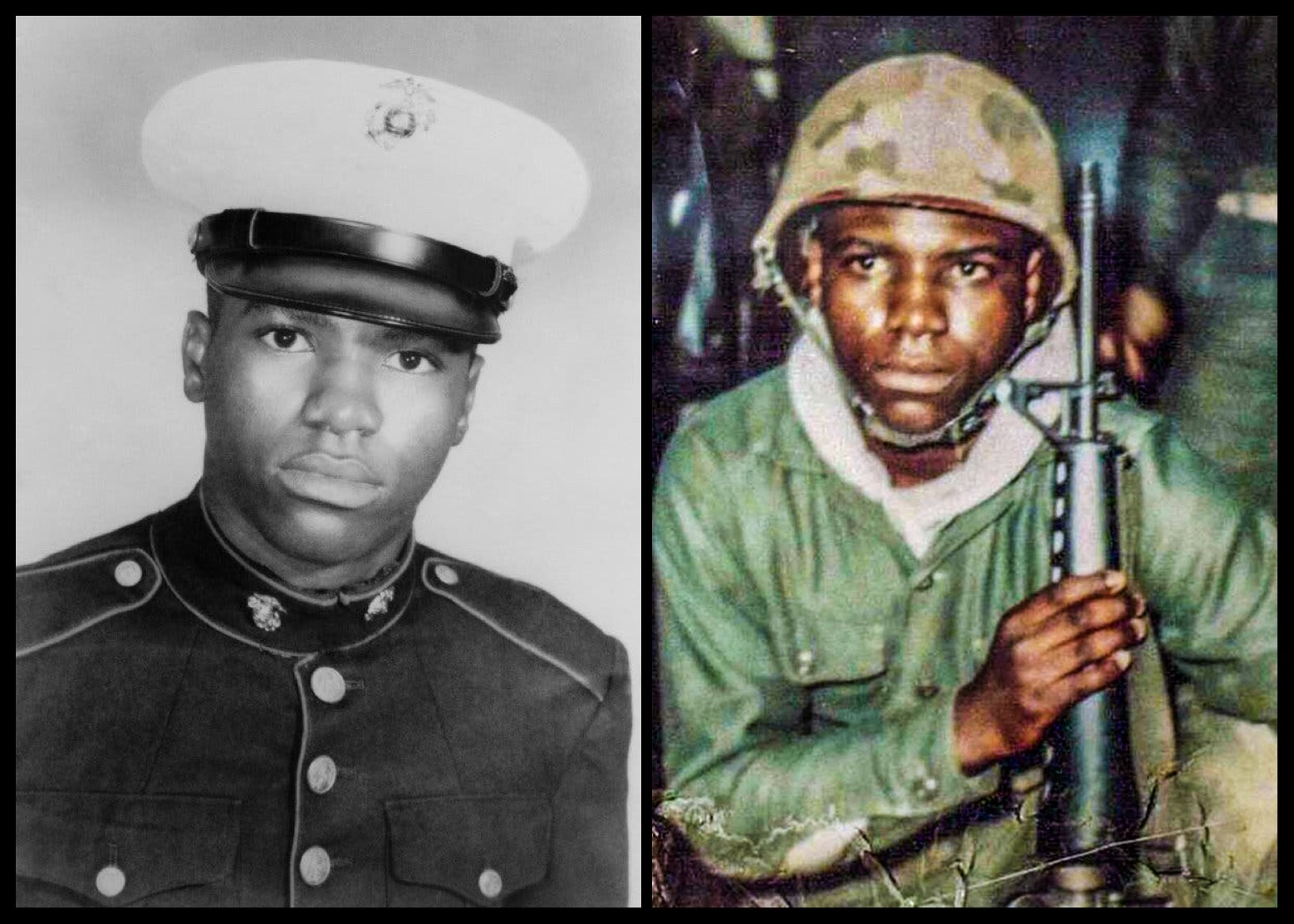
Photos of PFC. Dan Bullock. From, https://napavalleyveteransfoundation.com/dan-bullock/

As a child Dan and his young nephew Nathan Bullock would play soldier and have other “childhood escapades”. [2] Dan’s Father would also fuel his desire for adventure by telling him stories of the Tuskegee Airmen and Buffalo Soldiers.[3] Sadly PFC Bullocks mother would die when he was just 11. This prompted his father to move the family to Brooklyn in order to find work.[4]  Even with the move, the Bullock family was still struggling finically. This, along with Dan’s sense adventure, are possible motivations for him to join the United States Marine Corp. He enlisted on December 10, 1968 at the age of 14.[5] Dan changed his birth certificate to read December 21, 1949, instead of December 21, 1953 in order to join the Marines.[6] That combined with the fact that Dan was five feet nine inches tall, and 160 pounds fooled the recruiters.[7] His father was against Dan’s enlistment at first but due to PFC. Bullocks enthusiasm elder Bullock relented.[8] Dan was sent to Paris Island South Carolina, where according to Franklin McArthur his “Boot Camp Buddy” Dan almost washed out.[9] PCF Bullock would complete his basic training and be assigned as a rifleman to Fox Company, Second Battalion, Fifth Marine Regiment. He was sent to Vietnam on May 8, 1969 and was stationed at An Hoa Combat Base in Quang Nam Province.[10] According to his nephew Nathan Dan would right home and he once reported “I had a buddy who got shot, but I don’t have no holes in me yet.”[11] Even in his last letter home Dan added a post script “I don’t have no holes in me yet. “tragically his good fortune would change. On June 7th, 1969 PCF Bullock was at first assigned cleanup duties that night at the base, he was reassigned to take over a wounded Marine’s assignment, guarding a Delta Airship. At 1am a group of North Vietnamese Army attacked the base, PFC Bullock “constantly exposed himself to the enemy fire in order to keep the company supplied with the ammunition needed to hold off the attack, As the attack pressed on, Dan again went to get more ammunition when he was mortally wounded by a burst of enemy small arms and died instantly.” wrote Capt. R.H. Kingrey his commanding officer.[12] PFC Bullock was just 15 years old. His body was returned to Goldsboro, where he was laid to rest wearing his dress blues.
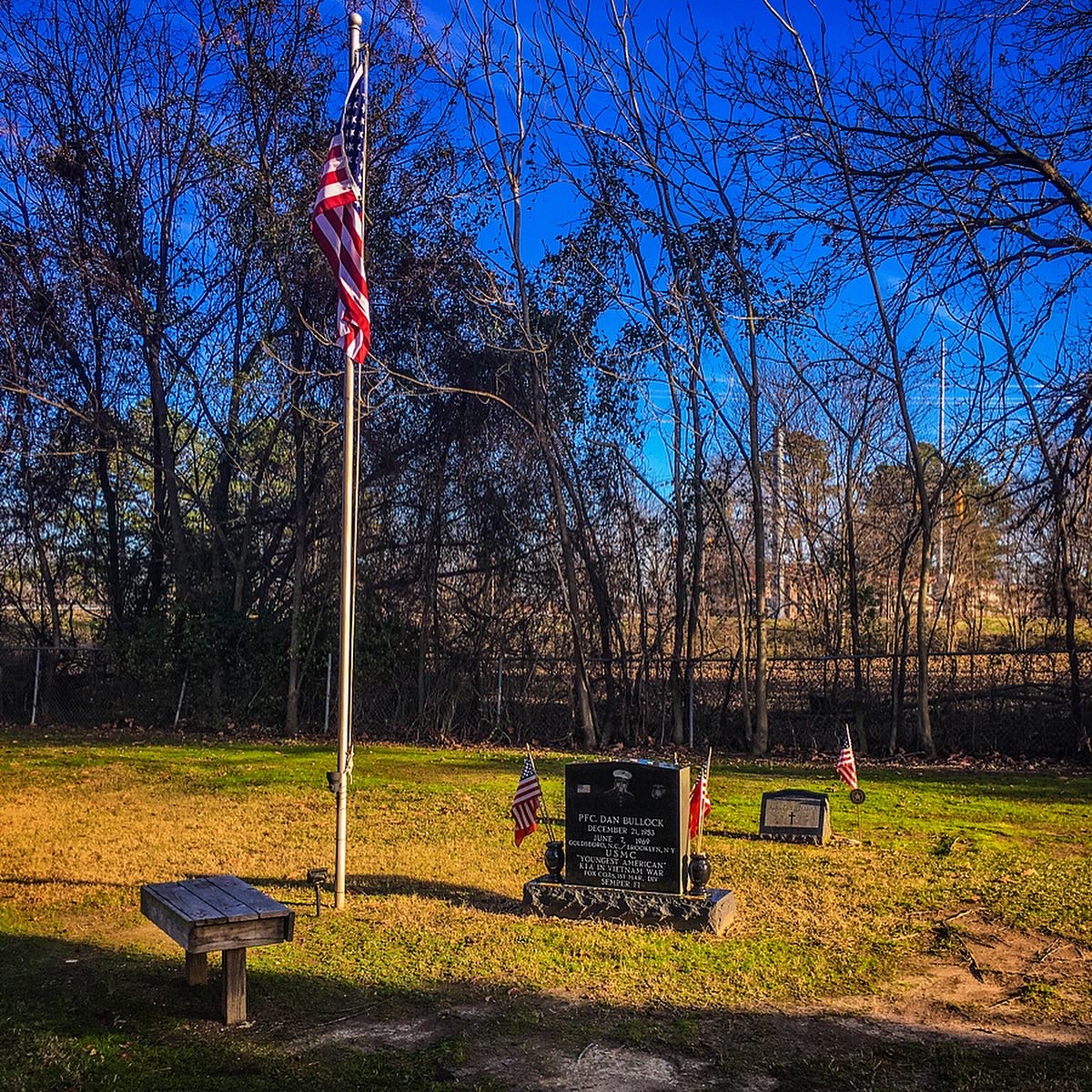
Grave of PFC. Bullock at Elmwood Cemetery in Goldsboro North Carolina. Photo by @firefightinirish

There was little fanfare as the casket was lowered into an unmarked grave at Elmwood Cemetery. Dan would be survived by his sister Gloria and his father. Thirty-one years later, talk show host Sally Jessy Raphael heard PFC Bullock’s story and was touched. She donated a headstone, and a memorial service for Bullock in Goldsboro to dedicate the stone was held.[13]  The New York Rolling Thunder and the North Carolina Rolling Thunder motorcycle clubs took part in a procession through the town in his honor. In 2003, a portion of Lee Avenue in Brooklyn where he had lived as a child, was renamed after him. In 2017, a highway marker was installed in Goldsboro in his honor, commemorating his service to the United States.[14]
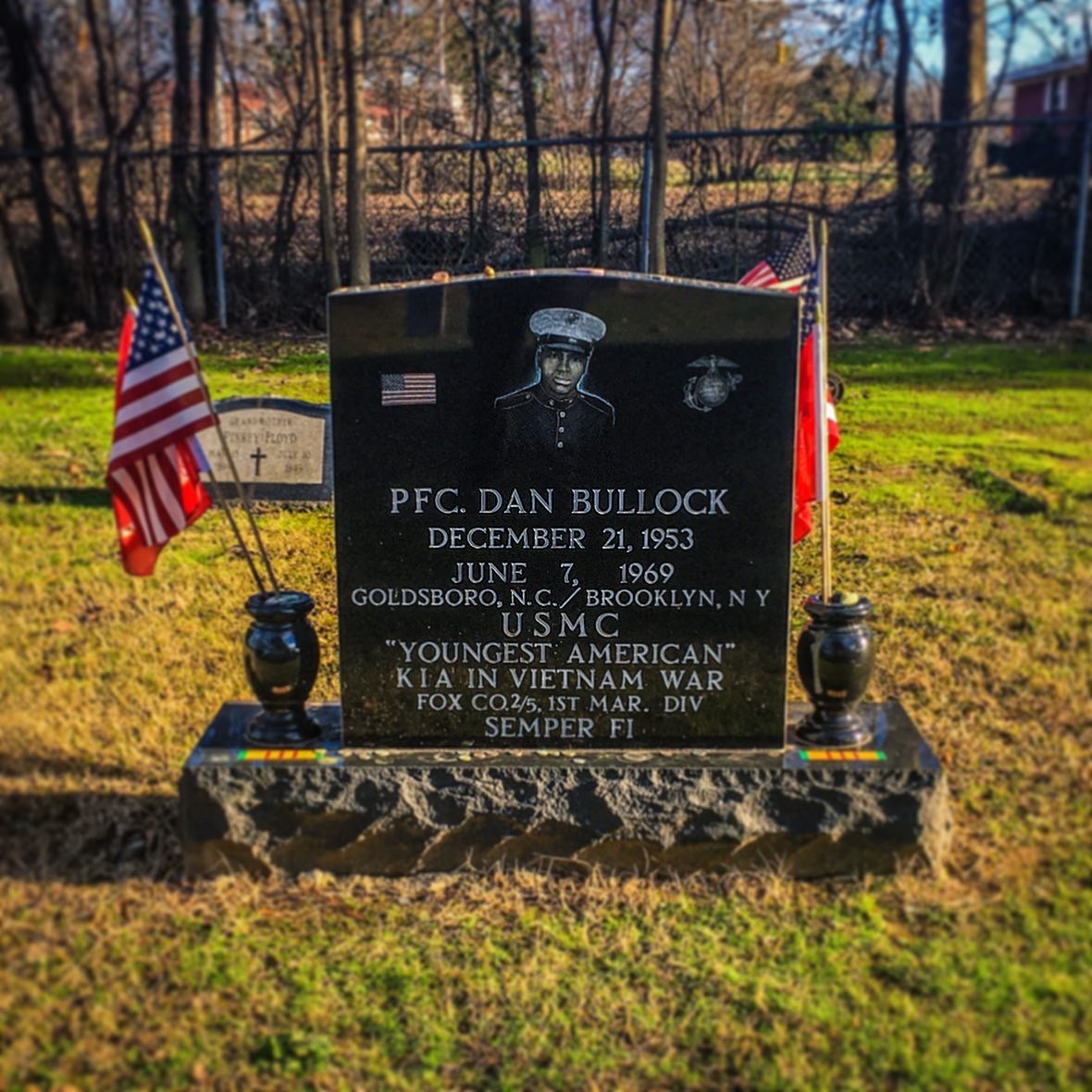
Grave of PFC. Bullock at Elmwood Cemetery in Goldsboro North Carolina. Photo by @firefightinirish

[1] “Dan Bullock Facts.” Public Member Trees. Accessed December 17, 2019. https://www.ancestry.com/family-tree/person/tree/67067937/person/230073682337/facts.

[2] SAUNDERS, BARRY. “Saunders: Remembering a Marine Who Died Way Too Young.” The News & Observer, November 10, 2014. https://www.newsobserver.com/news/local/news-columns-blogs/barry-saunders/article10124927.html.

[3] Ibid

[4] Momodu, Samuel. “Dan Bullock (1953-1969).” BlackPast, December 10, 2019. https://www.blackpast.org/african-american-history/dan-bullock-1953-1969/.

[5] Ibid

[6] Ibid

[7] Gallagher, Brian Thomas. “He Enlisted at 14, Went to Vietnam at 15 and Died a Month Later.” The New York Times. The New York Times, June 7, 2019. https://www.nytimes.com/2019/06/07/nyregion/youngest-american-soldier-killed-vietnam.html.

[8] Ibid

[9] McShane, Larry. “Dan Bullock Doctored His Birth Certificate at Age 14 in Order to Join the Marines. A Year Later, He Was Killed by Enemy Fire in Vietnam.” nydailynews.com. New York Daily News, January 9, 2019. https://www.nydailynews.com/new-york/brooklyn-marine-15-killed-vietnam-article-1.2003597.

[10] Momodu, Samuel. “Dan Bullock (1953-1969).” BlackPast, December 10, 2019. https://www.blackpast.org/african-american-history/dan-bullock-1953-1969/.

[11] SAUNDERS, BARRY. “Saunders: Remembering a Marine Who Died Way Too Young.” The News & Observer, November 10, 2014. https://www.newsobserver.com/news/local/news-columns-blogs/barry-saunders/article10124927.html.

[12] McShane, Larry. “Dan Bullock Doctored His Birth Certificate at Age 14 in Order to Join the Marines. A Year Later, He Was Killed by Enemy Fire in Vietnam.” nydailynews.com. New York Daily News, January 9, 2019. https://www.nydailynews.com/new-york/brooklyn-marine-15-killed-vietnam-article-1.2003597.

[13] Momodu, Samuel. “Dan Bullock (1953-1969).” BlackPast, December 10, 2019. https://www.blackpast.org/african-american-history/dan-bullock-1953-1969/.

[14] Ibid
Sir Douglas F. Dickerson: Airborne All The Way!

Green Hill Cemetery in Greensboro North Carolina, is a beautiful place with many interesting stories. One such story is that of Sir Douglas F. Dickerson. He was born to Raymond and Blanche Dickerson in Greenville South Carolina on March 5th, 1920.[1] Douglas was described as 6’ tall, 165 pounds, with brown hair, brown eyes, and a light complexion. He would attend college at North Carolina State College of Agriculture and Engineering (now North Carolina State University) in Raleigh, N.C.. Here he would play quarterback for the football team and outfield in baseball. Dickerson registered for the draft on July 1st, 1941.[2]

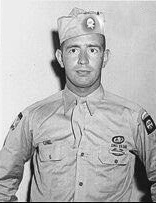
Douglas F. Dickerson 82nd Airborne.

During his Junior year at State the Japanese bombed Pearl Harbor, and Douglas’s number was called. Dickerson was given a deferment to finish out the semester and would become part of the 302nd Ordnance Co. made up of local boys. He was with them at Fort Jackson, and Fort Lewis. While Douglass was at Fort Lewis his brother who was an officer in the 82nd Airborne, personally recommend Douglass for the outfit to then Col. James Gavin. Gavin would call Douglass personally to ask him to join the Paratroopers. Dickerson agreed and his orders would arrive in a week. As Douglass would say later in an interview “he (Gavin) didn’t mess around.”[3] Dickerson would take a train from DC to Fort Benning Georgia and reported for Airborne training. He would later be sent to Camp Claiborne, LA. for commando training. Dickerson would finish his Airborne training at Fort Bragg. Here he was made part of a thirty man “hit squad”, they would be split up in teams of three and placed in each company of the 505th Parachute Infantry Regiment 82nd Airborne. The men of the hit squad were sworn to secrecy and finished their training as “ordinary” paratroopers. Before being sent oversees Douglas would don his jumpsuit and marry Edna Lee Kearns.

His first oversees station was in Tunisia. Douglas’s hit squad would be the first men to jump into Sicily and he was the first man out the door. Their objective was to take an airfield. They killed 108 men, destroyed the barracks, and all German aircraft on the field.[4] Douglass and the hit squad would later meet up with the rest of the 82nd. They would become engaged at Biazza Ridge, where he was almost run down by a German tank. During Dickerson’s 14th day of combat in Sicily he was wounded when a sniper’s bullet hit a grenade in his pocket. The grenade exploded outward embedding the top half in his leg. Dickerson pulled it out by the pin with a pen taking a large chink of skin with it. He bandaged the wound and remained on the line for three more days before being evacuated. Fifty years later a Doctor would find that Dickerson still had that sniper’s bullet in his leg.  Returning to action Dickerson and his commandos would jump into Italy again, this time he would land on a cow. Their mission was to destroy a group of German trucks, they would only find a single vehicle and promptly blew up its engine. On the way to extraction they encountered two German patrols of 25 men each and killed them all.[5]

His next combat jump was during the Normandy invasion where he was first out the door as well, this time he landed on an outhouse. Their objective was a major communications unit near Cherbourg. They would destroy it in forty minutes and head to Sainte-Mère-Église. He reached Sainte-Mère-Église in time to see the famous Paratrooper on the church steeple and the town ablaze.[6] Dickerson would be wounded again in the leg, he patched it up and spent 33 straight days on the line during the Normandy Campaign.

Dickerson would then jump into Holland as part of Operation Market Garden. Their objective was Groesbeek where they went house to house to root out the Germans. They then went to Nijmegen to support the other men of the 82nd in taking the bridge. He would spend two months on the line in Holland. Dickerson was then sent to France to a little R & R, however this would only last three days as the Bulge had begun. He and his commando unit were loaded into trucks and sent to St. Vith in order to help free surrounded allied troops. They would use bazookas to hold off German armor, and successfully rescued their beleaguered comrades.

Dickerson would be sent to the Siegfried Line. It was shortly after crossing that he had his most traumatic experience of the war. Dickerson was showing a young replacement where to position his gun when a mortar round exploded near them. The round blew off the young replacements legs, the young man was screaming, and Dickerson held him till the medics had to pry them apart. Douglass then went behind a tree and wept.[7] According to a 1999 interview he still had flashbacks to this incident.

After the fighting around the Siegfried Line Dickerson, and the four remaining original members of the “hit squad” met with General Gavin. Gavin would send them to the rear for a physical and mental checkup. During the exam the Doctors fund that Dickerson had a bleeding ulcer. He would receive a medical discharge in March of 1945.

Dickerson would spend 371 days in combat receiving two Bronze Stars, two Purple Hearts, the Expert Infantry Badge, Triple Combat Infantryman Badge, and the Presidential Unit Citation. He would also receive Croix de Guerre medals from both France and Belgium.

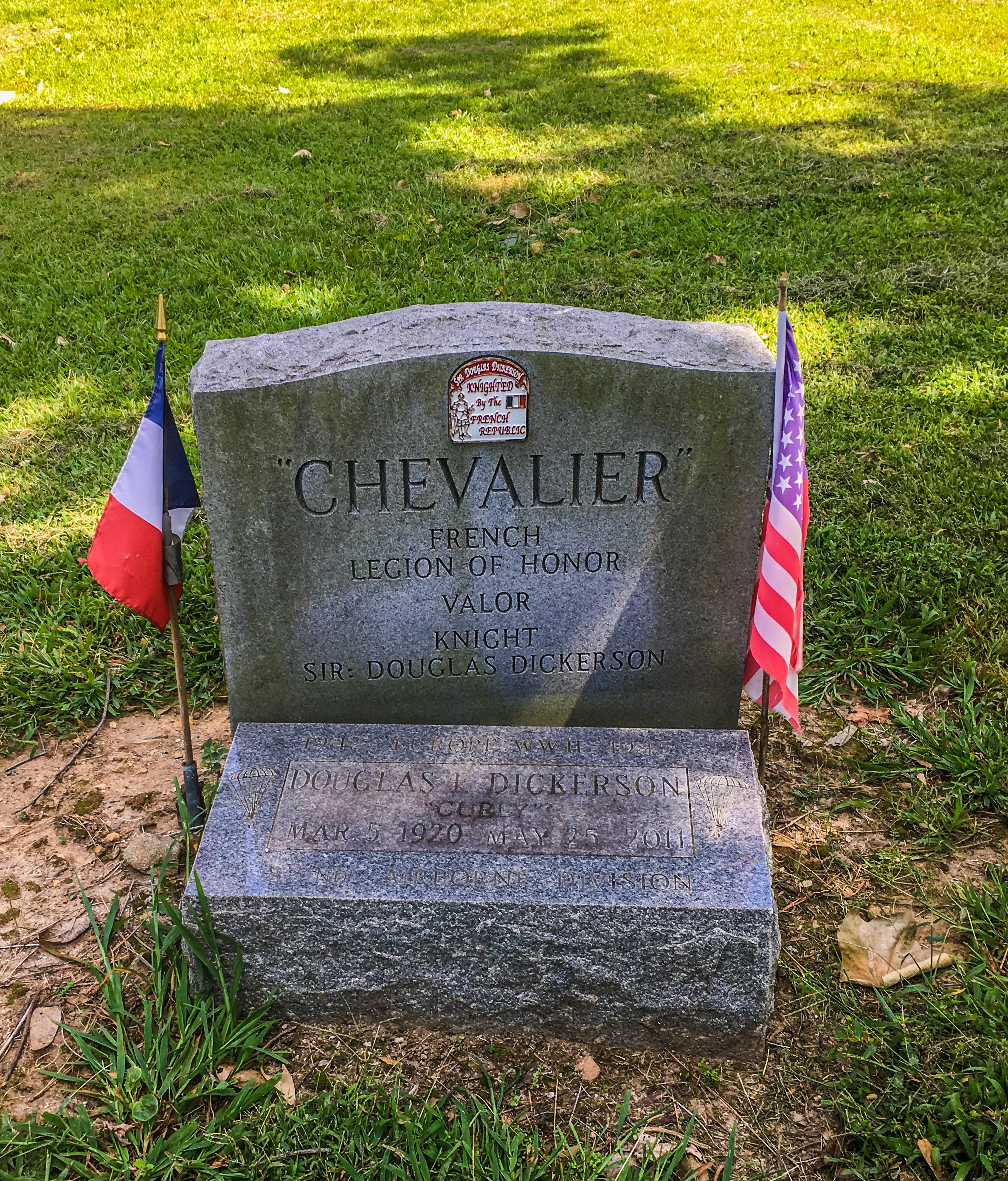
Grave of Sir Douglas F. Dickerson at Green Hill Cemetery. Photo By @firefightinirish

After the war Dickerson would return to Greensboro and resume his education at his education at Guilford College and then High Point College. He graduated in 1949 with a teaching certificate in Social Studies and Physical Education.[8] He was briefly employed as a teacher before working for the United States Postal Service. Dickerson would also coach High School football ant Little League Baseball. He would enjoy showing people his memorabilia gathered during his time overseas as well as items donated by other veterans and their families. The items were displayed in a “mini museum” in his pool house. In 1998 Dickerson published his wartime memoirs, “Doing My Duty”, in which he vividly described his wartime exploits.

In 2006 The French Legion of Honor gave Dickerson the rank of “Chevalier” or “Knight”. Douglas F. Dickerson died

Grave of Sir Douglas F. Dickerson at Green Hill Cemetery. Photo By @firefightinirish

on May 25, 2011 in Greensboro, N.C., and was buried in Green Hill Cemetery in the same city.


[1] Froggatt, Errin. “Sir Douglas Farnum ‘Curly’ Dickerson.” Ancestry. Accessed November 6, 2019. https://www.ancestry.com/family-tree/person/tree/38740921/person/28890718647/facts.

[2] “U.S. WWII Draft Cards Young Men, 1940-1947 .” Ancestry. Accessed November 7, 2019. https://www.ancestry.com/family-tree/person/tree/38740921/person/28890718647/facts.

[3] Harrington, Sion, and John Durham. “Douglas F. Dickerson Interview, 1999-12-20 [MilColl OH 228] : Free Borrow & Streaming.” Internet Archive, December 20, 1999. https://archive.org/details/MilCollOH228Dickerson.

[4] Ibid

[5] Ibid

[6] Ibid

[7] Ibid

[8] “Doug Dickerson Papers, 1939-2006.” Greensboro History Museum. Accessed November 9, 2019. http://archives.greensborohistory.org/wp-content/uploads/sites/2/pdf/MssColl-204-Dickerson.pdf.

A soldier’s story at Forest hill Cemetery Morganton North Carolina.

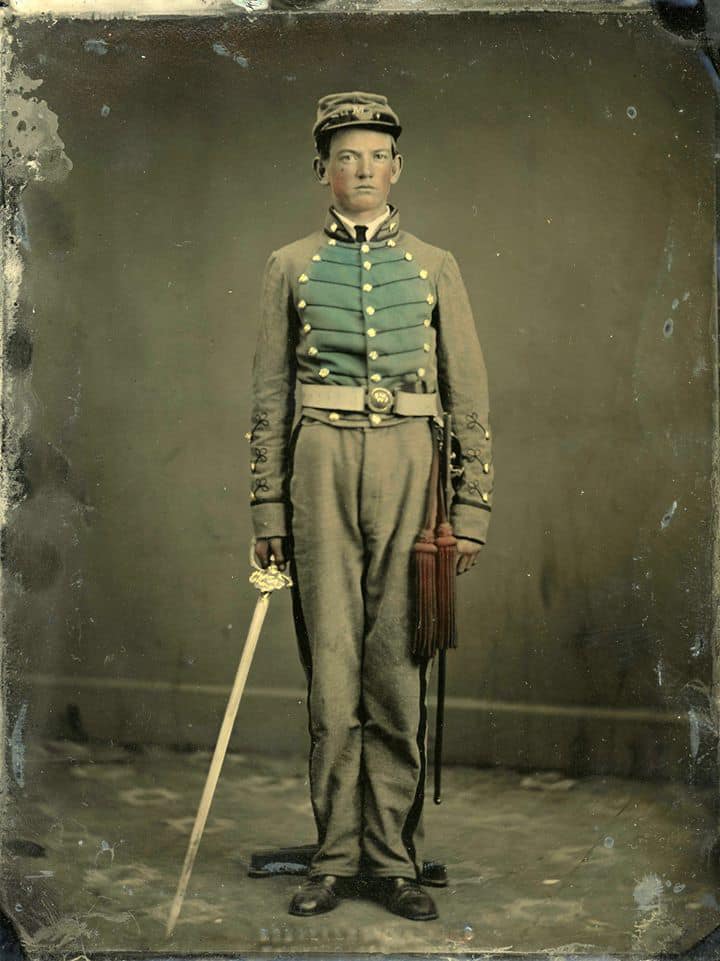
On my way back from Asheville I made a quick stop in Morganton. Here I paid respects to Lieut. John Caldwell. He was born in 1845 at Morganton, North Carolina to Tod & Minerva Caldwell. John grew up and worked on his family farm. In 1861 John who was known as “Jack”, was a Cadet at the Hillsboro Military Academy.[1] His father was a Unionist, but John went against his father’s wishes and chose to join his friends and defend his state. In July of 1861 John Was a member of the 6th North Carolina Volunteers stationed in Staunton Virginia.[2] By December of 1861, Caldwell was serving as a Drill Instructor for the state of North Carolina in a training camp at Asheville.[3]  He continued in this capacity through 1862, until most of the volunteer regiments had organized and marched off. On May 5th, 1863, John Caldwell was mustered into “E” Co. 33rd North Carolina Infantry as a Private.[4]

1/4 plate tintype of Lieut. John Caldwell Courtesy of the Brem Family Collection.

He would be immediately promoted to Lieut. in order to replace the 33rd’s loses from the Battle of Chancellorsville.[5]  Upon hearing of Young Johns promotion his father sent him a letter containing some wise fatherly advice… “Don’t be tyrannical or overbearing toward your men. Be kind and obliging to everyone no matter how low or humble his position may be, and if you get into battle be like a man and a true soldier. Be kind and merciful to your enemies if any should be placed in your power. It is a badge of true courage and of a gentlemanly Christian spirit to show mercy and kindness to your enemies and it may in the fortunes of war happen that you may need the friendship of those you are fighting against. Observe vigorously the golden rule, “to do unto others as you would have them do unto you.” Oh what would I not give if this cruel and unnatural war was ended and you and your army and in honor return home to your friends.”[6]            

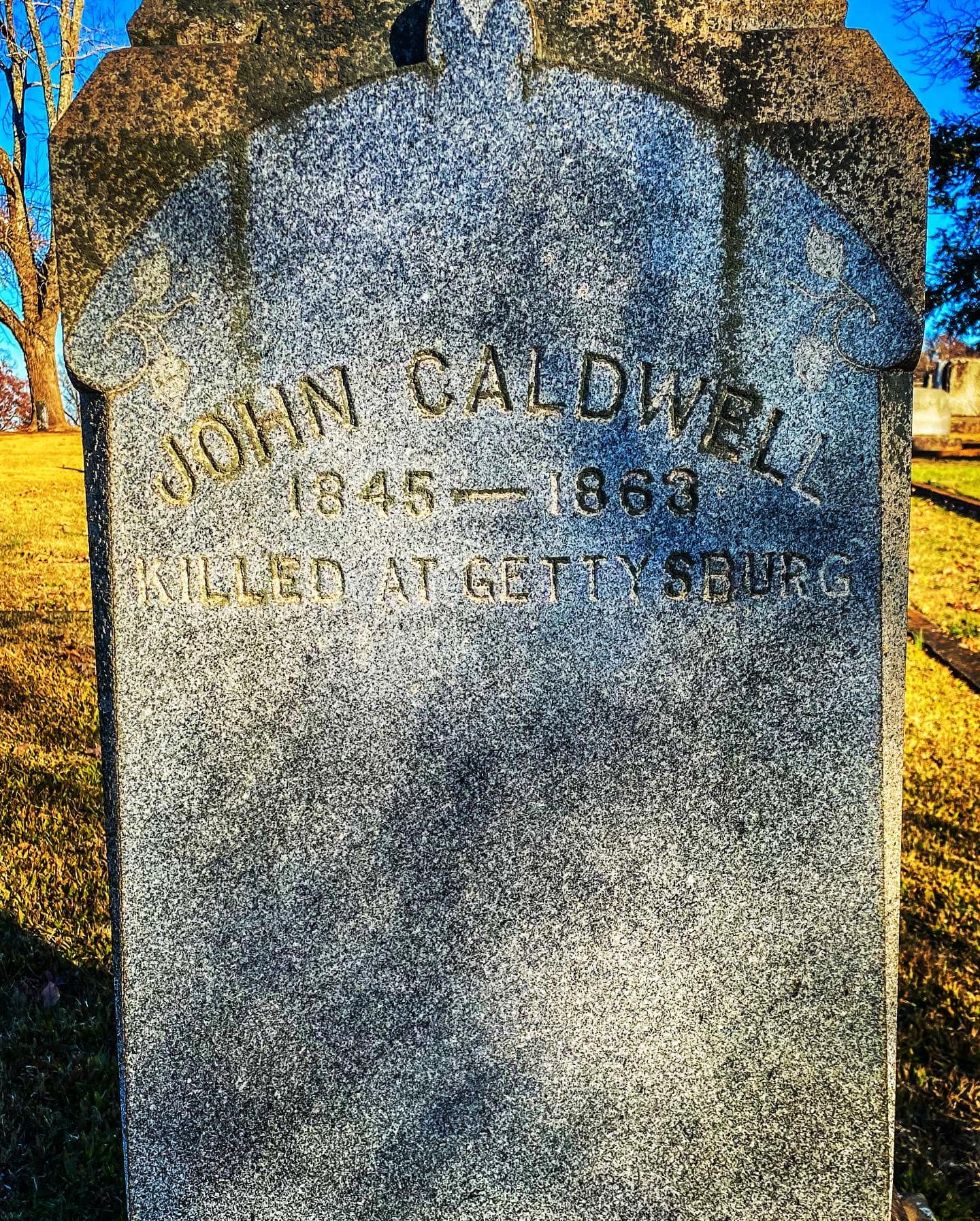
Lieut. Caldwell led his men during the march into Pennsylvania, he and his men were shelled along the way, and performed picket duty. They would reach Gettysburg on July 1st at around 15:30 they “on the right of the Division in the final and successful movement against the Union forces on Seminary Ridge held back Union Cavalry which threatened the flank and had a sharp conflict at the stone wall on Seminary Ridge just south of Fairfield Road.”[7]  On the second day the 33rd was involved in some heavy skirmishing. “our line of battle was not engaged but there was a very strong picket fighting in front of us and as it was the turn of his company to go out on skirmish he (John Caldwell) was skirmishing all day and was not relived until about sundown. He took his skirmishers out in gallant style and during the day lost two of his company killed and several wounded.”[8]  On the third day Lieut. Caldwell and the 33rd took part in the Pickett–Pettigrew–Trimble Charge, as part of Longstreet’s assault. During the assault Lieut. Caldwell and Lieut. Wilson Lucas were ordered by General Pender to command 75 men and take a farm lane. Lieut. Wilson Lucas writes of this action saying…. 

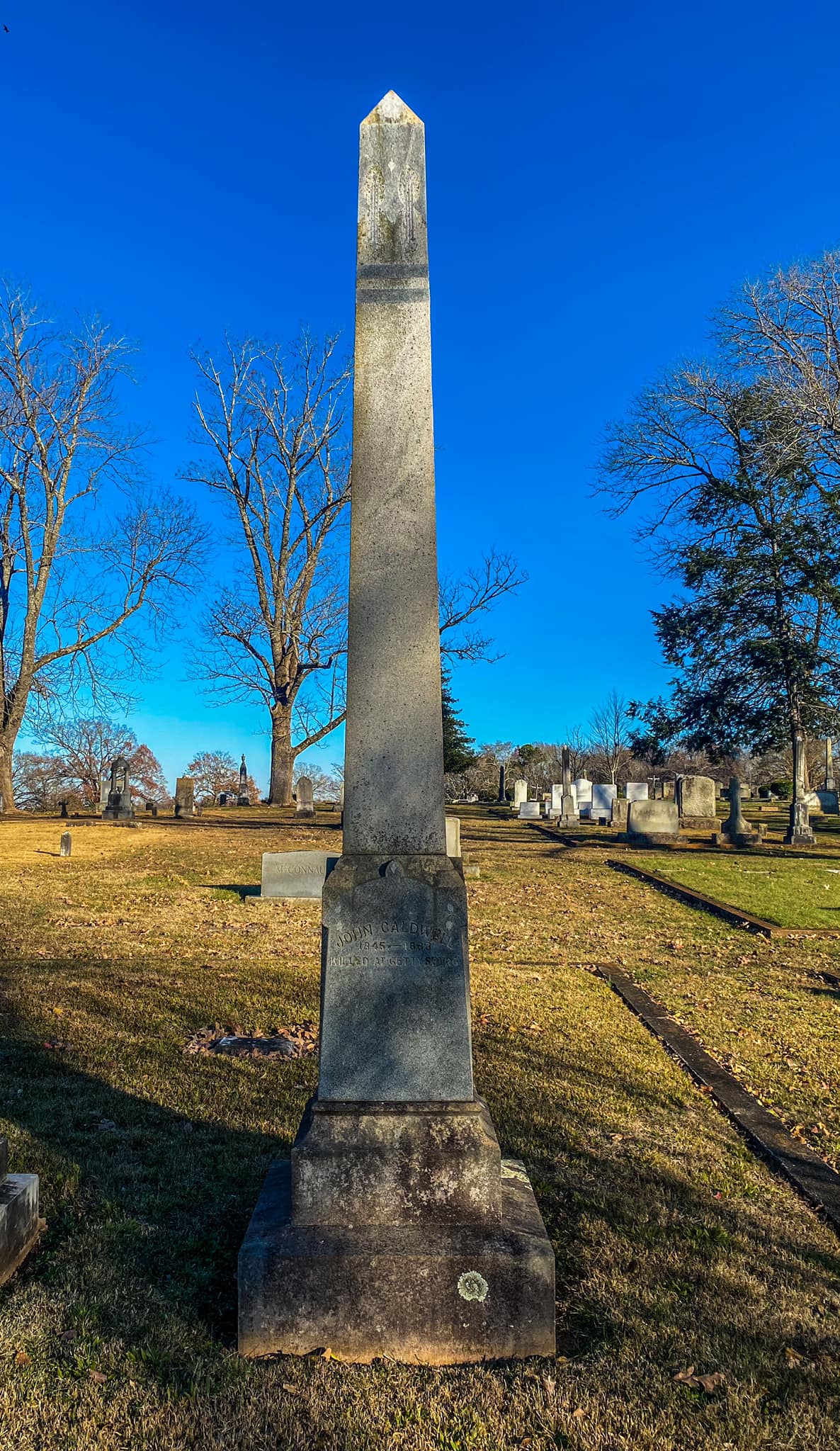
Gravestone of Lieut. John Caldwell 33rd North Carolina Infantry at Forest hill Cemetery Morganton North Carolina Photo By @firefightinirish

“We formed the men in line, I commanded the right and Lieut. Caldwell the left. We had to charge through an open field, with no protection whatever. … When we got within two hundred yards of the Federals, we charged with a yell, and they stood their ground until we were within ten steps of the road, then a part of them ran, but 26 surrendered. And the very last time they fired upon us, which was not more than twelve or fourteen feet from them, they shot Lieut. Caldwell in the left breast. I did not see him fall. As soon as we were in the road one of the men told me Lieut. Caldwell was killed. I went at once to the left and found him, lying partly on his back and side … I called two men, and we placed him on his back and spread his oil cloth over him. He was warm and bleeding very freely when I got to him. I could not send him out to the regiment, for it was such an exposed placed the Federal skirmishers would have killed a man before he could get a hundred yards, as we were lying close to each other.”[9] 

Currier & Ives. The battle of Gettysburg, Pa. July 3d. United States, 1863. [New York: Published by Currier & Ives, ?] Photograph. https://www.loc.gov/item/90709061/.

Lieut. Caldwell’s commanding officer Col. Avery in letter to John’s father wrote “You may have the satisfaction to know that he fell where we would all wish to fall (if it be God will) with his face to the enemy.’[10] Lieut. John Caldwell’s body was buried on Seminary Ridge that night “near “two honey-pod trees … not far from an old two-story house.”[11] Even with the reports of Lieut. Caldwell falling before the enemy, his father refused to believe his son was killed.

Inscription on Lieut. John Caldwell’s grave at Forest hill Cemetery Morganton North Carolina. Photo By @firefightinirish

It was not until Tod R, Caldwell was governor of North Carolina, that he found out his son’s fate. It was told to him by Lieut. Wilson Lucas who was then a state legislature. It was said that the Governor “locked himself in his room and was all day in tears”.[12] Gov. Caldwell kept this secret from his wife for 14 years, she found out when Lieut. Caldwell’s bloodied commission to Lieut. Was sent home by a New Yorker who had found it on the Battlefield. Lieut. Caldwell’s body would be returned to North Carolina and reinterned at Forest Hill Cemetery in Morganton.  Let us never forget this young man’s sacrifice for his state and his country.   


[1] “Tod Robinson Caldwell Papers, 1801-1890.,” UNC University Libraries, accessed November 28, 2021, https://finding-aids.lib.unc.edu/00128/#folder_5#1.  Scan 12

[2] Ibid, Scan 14

[3] Ibid, Scan 25

[4] “Page 2 Civil War Service Records (CMSR) – Confederate – North Carolina,” Fold3, accessed November 29, 2021, https://www.fold3.com/image/45066577.

[5] Ibid

[6] Christopher M. Watford, The Civil War in North Carolina: Soldiers’ and Civilians’ Letters and Diaries, 1861-1865 (Jefferson, North California: McFarland & Company, Inc., Publishers, 2009). Pg. 278

[7] “History of the 33rd North Carolina Infantry Regiment in the Civil War,” The Civil War in the East, May 17, 2021, https://civilwarintheeast.com/confederate-regiments/north-carolina/33rd-north-carolina-infantry-regiment/.

[8] Don Ernsberger, Also for Glory: The Pettigrew-Trimble Charge at Gettysburg July 3, 1863 (United States: Xlibris Corp, 2008). Pg. 57

[9] Michael C. Hardy, General Lee’s Immortals: The Battles and Campaigns of the Branch-Lane Brigade in the Army of Northern Virginia, 1861-1865 (El Dorado Hills, CA: Savas Beatie LLC, 2018). Pg. 330

[10] Biff Hollingsworth, “18 July 1863: ‘You May Have the Satisfaction to Know That He Fell Where We Would All Wish to Fall (If It Be God Will) with His Face to the Enemy.”: Civil War Day by Day,” 18 July 1863: “You may have the satisfaction to know that he fell where we would all wish to fall (if it be God will) with his face to the enemy.” | Civil War Day by Day, accessed November 29, 2021, https://web.lib.unc.edu/civilwar/index.php/2013/07/18/18-july-1863-you-may-have-the-satisfaction-to-know-that-he-fell-where-we-would-all-wish-to-fall-if-it-be-god-will-with-his-face-to-the-enemy/.

[11] Michael C. Hardy, General Lee’s Immortals: The Battles and Campaigns of the Branch-Lane Brigade in the Army of Northern Virginia, 1861-1865 (El Dorado Hills, CA: Savas Beatie LLC, 2018). Pg. 350

[12] John Hartwell, “Lt. John Caldwell, 33rd North Carolina, Pender’s Brigade,” Civil War Talk, n.d., https://civilwartalk.com/threads/lt-john-caldwell-33rd-north-carolina-penders-brigade.135030/?amp=1.

Sergeant Thomas Wilson: A Tragic Tail of Irish Immigration.

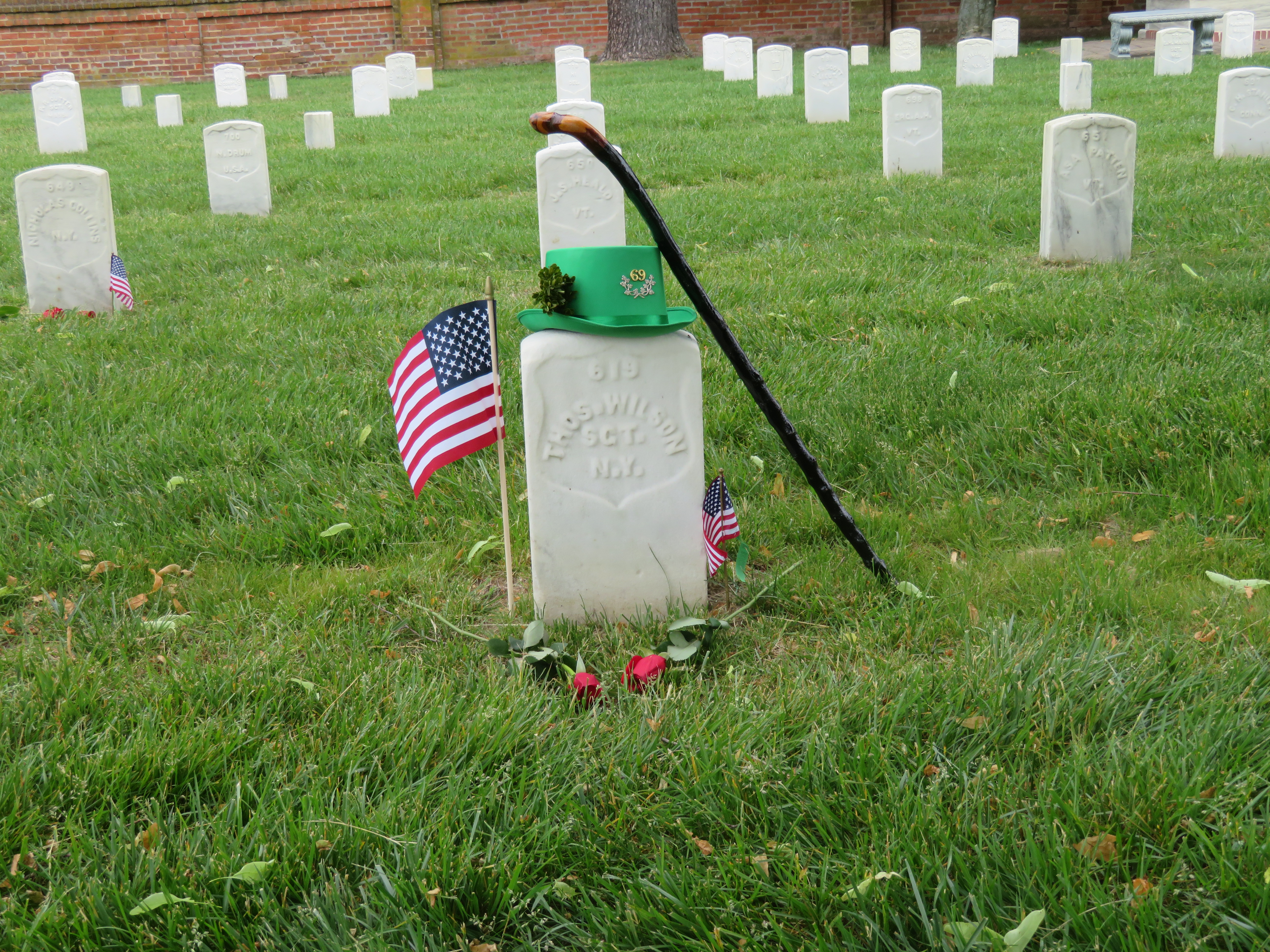
I recently took a trip to Cold Harbor National Cemetery. Here I discovered the final resting place of Sergeant Thomas Wilson. I also unearthed a a tragic tail of Irish immigration. Wilson was born in Ireland around 1834[1], and immigrated to New York to find a better life. Thomas would find a job as an Oyster Shucker at the St. Nicholas Hotel. Here he met Ms. Frances Connor who also worked there as a laundress. They would marry in 1861[2] and shortly after Thomas would enlist.  

Grave of Sgt. Thomas Wilson at Cold Harbor National Cemetery Photo By @firefightinirish

He was mustered into “I” Co. 69th New York as a Corporal on September 17, 1861[3]. Corporal Wilson was in the following engagements: The Siege of Yorktown, Battle of Fair Oaks, The Seven Days Battles, Antietam, and Fredericksburg. It is possible he then deserted, as his name is not on the rolls again until June of 1863[4] with a reduced rank. He was present at The Battle of Gettysburg and promoted to Corporal. Wilson was then assigned to guard a “farmhouse”[5], which was presumably a headquarters, in October of 1863[6]. Wilson reenlisted as a veteran volunteer on December 21, 1863[7] and was assigned to “B” Co. 69th New York Infantry. In 1864 he was promoted to Sergeant. In March of that year, his wife Frances Wilson would have a child named Mary Ellen[8]. Sergeant Wilson would later fight in the battles of The Wilderness, Spotsylvania Court House, Totopotomoy, and Cold Harbor. Sergeant Wilson was killed in action at Cold Harbor and never laid eyes on his daughter.

Wilson’s wife would eventually receive a widow’s pension of two dollars a month, which is about thirty-two dollars in today’s money. Mrs. Wilson was extremely poor. Her pension was not enough to survive on without taking up work, so she returned to her job at the hotel. Before long it was too hard for Mrs. Wilson to care for Mary Ellen, so she would give the child to Mary Score. Mrs. Score lived in a tenement house on “Mulberry Bend”[9], which is an area known for its overwhelming crime and filthy living conditions. Mrs. Wilson would regularly visit her daughter and would “hold and kiss her”[10]. Mrs. Score would also find it a struggle to care for an extra child and would place Mary Ellen with the Department of Public Charities and Corrections. Mrs. Score told Mrs. Wilson that Mary Ellen was dead, driving Mrs. Wilson to alcoholism. Frances Wilson died of a lung hemorrhage in a hospital on Wards Island in 1872[11] and was buried in a Potters field.

The very much alive Mary Ellen was placed in the Alms House at Blackwell Island on July 10, 1865.[12] Orphanages, at the time had an 85% death rate.[13] Mary Ellen would beat the odds and was adopted by Thomas and Mary McCormick on January 2, 1866[14]. The adoption was granted on the grounds that Thomas McCormick claimed to have an affair with a “no good woman”[15], and that she had left the child (Mary Ellen) at the Alms House.  Although there was no actual evidence of this affair the adoption was never contested. More than likely this is because children at this time had no rights and were often adopted for use in household labor. Thomas McCormick died of cholera in August of 1866.[16] Mary McCormick would remarry to Frances Connolly in August 1867.[17]

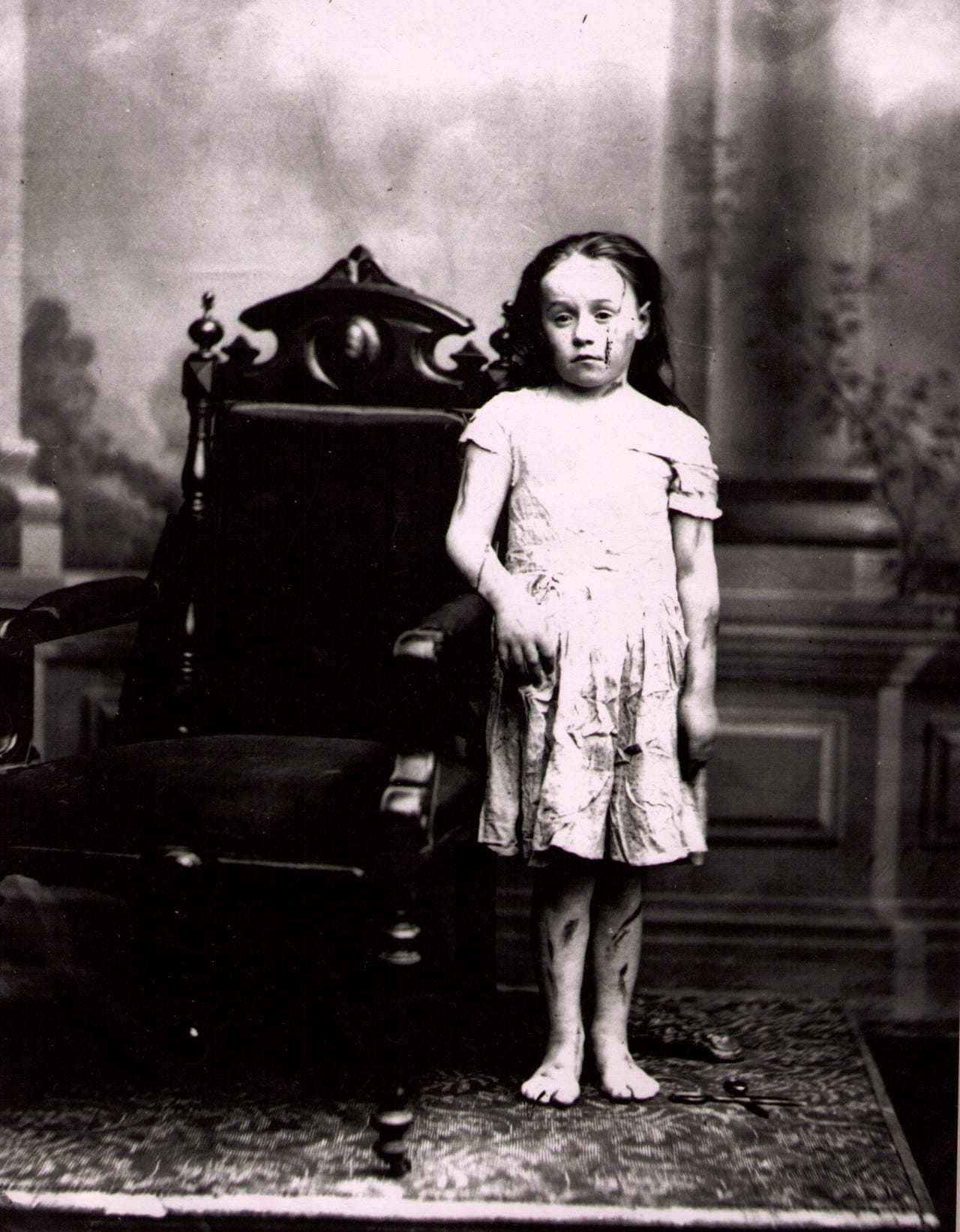
While under the care of Mary (McCormick) Connolly and her new husband, Mary Ellen would suffer severe abuse. She was made to sleep on a small cloth in the corner, had only one set of cloths, made to do strenuous labor, and beaten. In 1874[18] the neighbors suspected abuse and called Etta Angell Wheeler, a Methodist missionary who worked in the area. Ms. Wheeler checked in on the child and what she found was shocking. Ms. Wheeler contacted the police but due to the lack of child abuse laws on the books they were not able to do anything. So, Ms. Wheeler decided to contact Henry Bergh, who was an advocate for the animal humane movement and the founder of the American Society for the Prevention of Cruelty to Animals. Mr. Bergh was instrumental in getting Mary Ellen removed from the home and charges brought against Mrs. Connolly. During the trial shocking eyewitness testimony was given about the abuse,

Mary Ellen Wilson-McCormac in 1874. From: Markel, Howard. “Case Shined First Light on Abuse of Children.” The New York Times, December 14, 2009. https://www.nytimes.com/2009/12/15/health/15abus.html?ref=science.

“During the first week after the Connolly’s came there witness saw the cowhide lying on the table; it is like what a man uses when on horseback; it is about two and a half feet long; it has lashes (she doesn’t know how many) about the size of a finger, something like a cat-o-nine-tails; she used to hear Mrs. Connolly licking the child every morning “up and down, up and down” the room, the child crying “Oh, Mama! Mama!” all the time;”[19]

Mary Connolly was convicted of child abuse and sentenced to one-year imprisonment with hard labor.

Mary Ellen Wilson would live till the age of 91. Her case was the was the first documented case of child abuse in the United States. It also led to the founding of the New York Society for the Prevention of Cruelty to Children. It is amazing to think that out of so much tragedy good could come out of it. The events in this case were and continue to be instrumental in saving many more children.  


[1] “Wilson, Thomas (26) Page 1 New York Civil War Muster Roll Abstracts,” Fold3, accessed July 10, 2020, https://www.fold3.com/image/315769745.

[2] Eric A. Shelman and Stephen Lazoritz, The Mary Ellen Wilson Child Abuse Case and the Beginning of Children’s Rights in 19th Century America (Jefferson, NC: McFarland & Co., 2005). Pg. 20

[3] “Wilson, Thomas (26) Page 1 New York Civil War Muster Roll Abstracts,” Fold3, accessed July 10, 2020, https://www.fold3.com/image/315769745

[4] “Wilson, Thomas (27) Page 1 New York Civil War Muster Roll Abstracts,” Fold3, accessed July 10, 2020, https://www.fold3.com/image/315769764.

[5] Ibid

[6] Ibid

[7] Ibid

[8] Eric A. Shelman and Stephen Lazoritz, The Mary Ellen Wilson Child Abuse Case and the Beginning of Children’s Rights in 19th Century America (Jefferson, NC: McFarland & Co., 2005). Pg. 21

[9] Ibid, Pg. 22

[10] Ibid

[11] Ibid. Pg. 107

[12] Ibid. Pg. 23

[13] Ibid.

[14] Ibid. Pg.24

[15] Ibid. Pg. 23

[16]. Shelman, Eric A.; Lazoritz , Dr. Stephen. Case #1: The Mary Ellen Wilson Files (Kindle Location 575). Dolphin Moon Publishing. Kindle Edition.

[17] Ibid

[18] Shelman, Eric A.; Lazoritz , Dr. Stephen. Case #1: The Mary Ellen Wilson Files (Kindle Location 1896). Dolphin Moon Publishing. Kindle Edition.

[19] “Mary Ellen Wilson Further Testimony As To The Child’s Ill Treatment By Her Guardians,” New York Times, April 12, 1874, p. 12.