A Letter Speaks

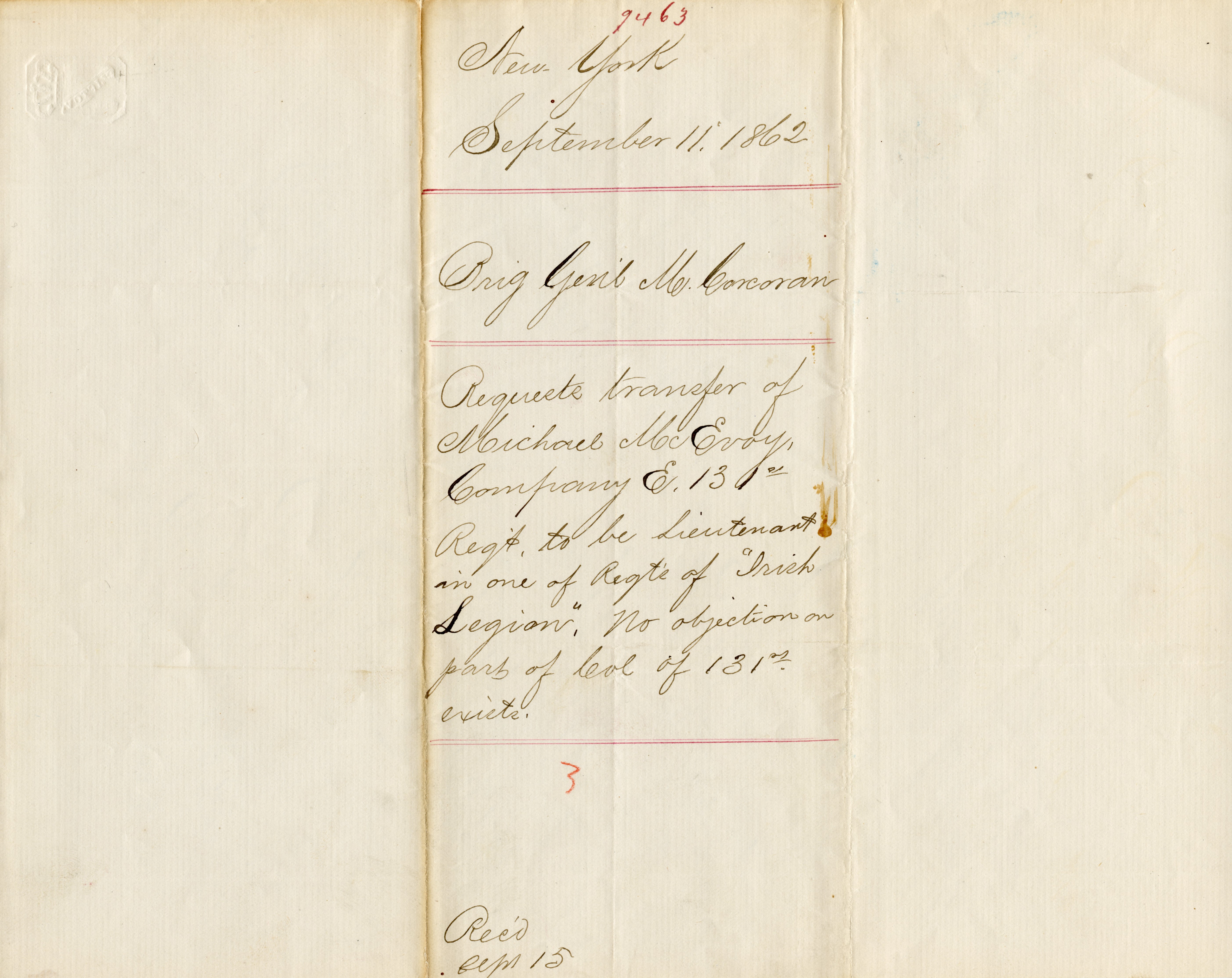
A letter to some is just a piece of paper with words on it. However when one digs deep they can find a hidden story. This letter is written and signed by Brigadier General Michael Corcoran. The letter’s recipient is then Governor of New York Edwin D. Morgan. In this post I am not going to just focus on the “big names” associated with the piece (We can all use Google for that). There is also the interesting tail of Michael McEvoy of Company E, 131st New York. So without further adieu may I present the The letter it reads……

“Sir,

I respectfully ask that Michael McEvoy of Company E, 131st Regiment be transferred to my command.

My object in making this request is to give him authority to recruit and appoint him to the position of Lieutenant in one of the companies of my command.

He is a brother of the Provost Marshal McEvoy of this city, who would lend his assistance. I have seen Colonel Turnbull and he promised to agree to the transfer.

I remain,

Your Most Obedient Servant,

Michael Corcoran

Brigadier General” [1]
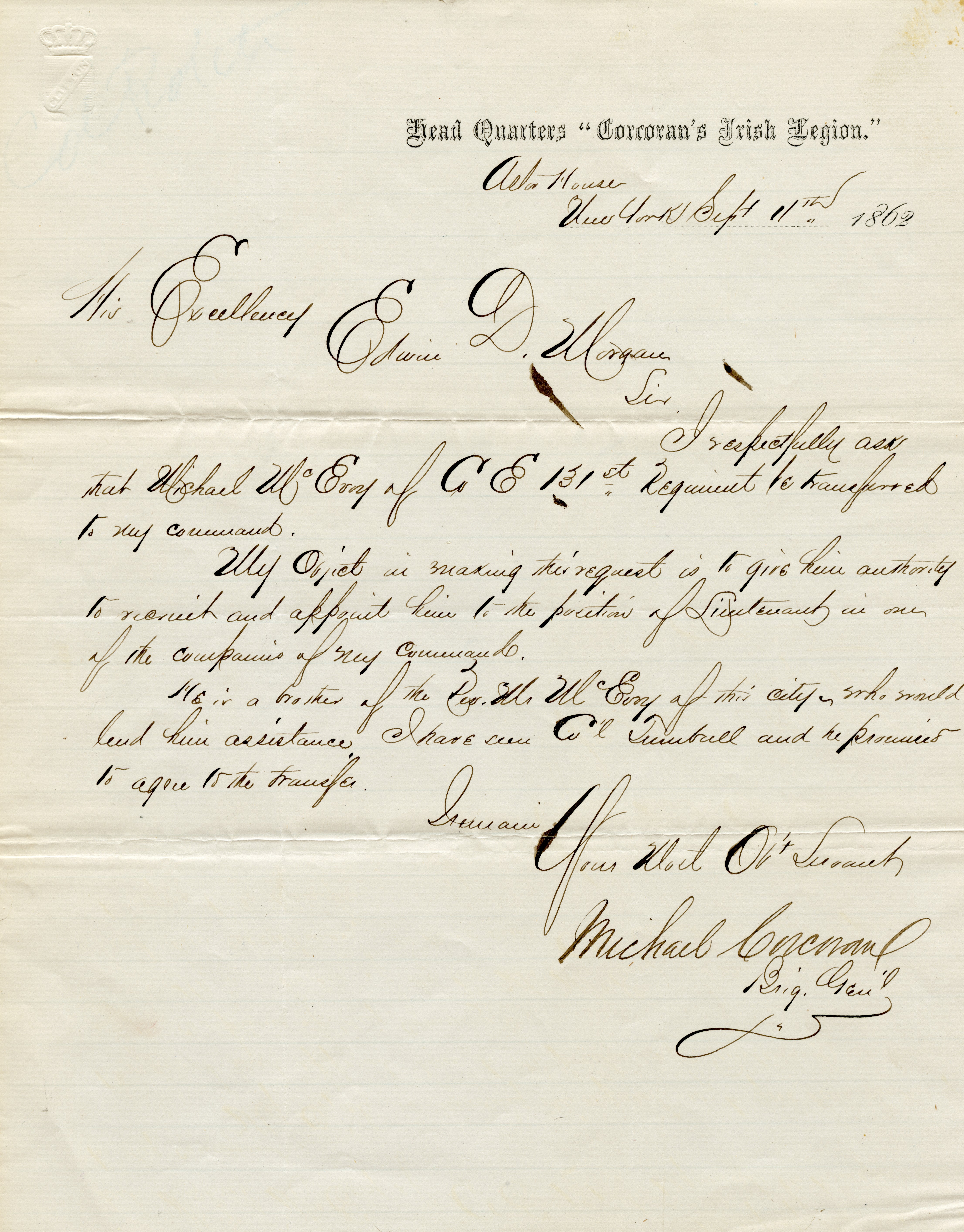
Corcoran Letter, provided by The American Military Heritage Museum Of North Carolina
Back of the Corcoran Letter, provided by The American Military Heritage Museum Of North Carolina

Michael McEvoy was born in Ireland around 1828[2]. He was described as five feet nine inches tall, with blue eyes, light hair, and a light complexion.[3] McEvoy would immigrate to America prior to 1850. He was listed on the 1850 United States Federal Census as being a farmer, and married to Cath McEvoy, they had one child James.[4] McEvoy was employed as a Teamster, at the time of his enlistment in the Union army on August 13th, 1862.[5]

. He would be mustered into “E” Co 131st infantry as a private on September 6th.[6] Per General Corcoran’s request McEvoy would be transferred to “D” Co. 170th New York on September 19th, 1862.[7] He would be mustered in as a private on October 7th, 1862. Private McEvoy would participate in the battle of Deserted House. He would later be granted leave on March 21st, 1863, McEvoy would never return to service[8]. Private McEvoy would be listed as a deserter from camp at Suffolk Virginia on April 3rd, 1863.[9] That is where his trail ends for now.

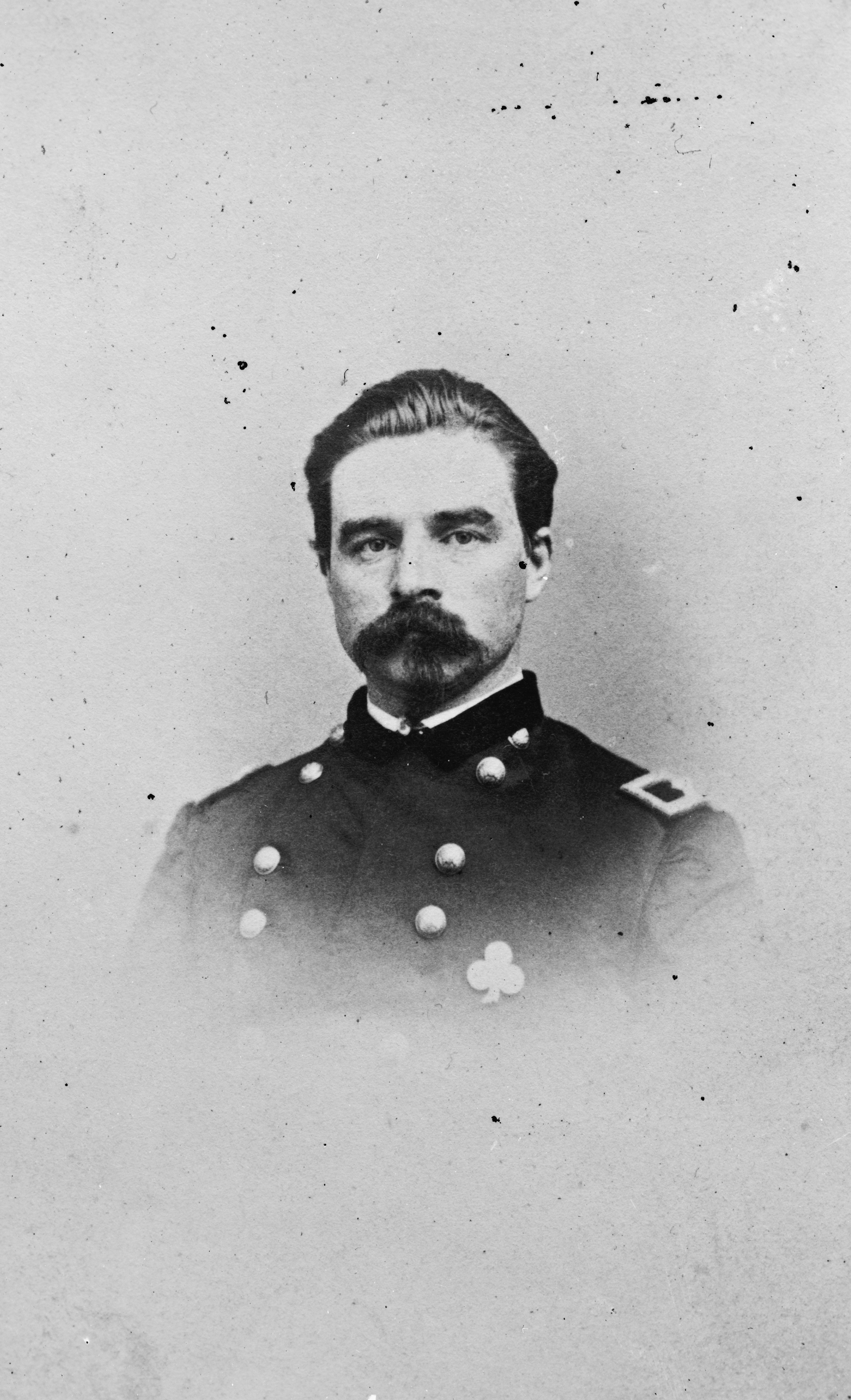
Michael Corcoran was born in Carrowkeel, county Sligo Ireland. He was a member of the Irish Nationalist Guerrilla force known as the Ribbonman. His ties to this group were eventually discovered in 1849, so he immigrated to New York City in order to avoid capture.[10] To gain a position in society Corcoran joined the 69th New York State Militia as a private. He would advance rapidly due to, “his military passion and his previous knowledge of military tactics were a great advantage to him.”[11] Corcoran moved up in rank and became a Colonel.  It was in this capacity that Corcoran became a hero to the Irish Nationalist, as well as the overall Irish immigrant population of New York. When he chose not to parade the 69th  in front of the Prince of Whales upon the Princes visit, saying that “as an Irishman he could not consistently parade Irish-born citizens in honor of the son of a sovereign, under whose rule Ireland was left a desert and her best sons exiled or banished.”[12] His action resulted in a court-martial. However, it was overturned due to the need of good officers to fight in the Civil War.
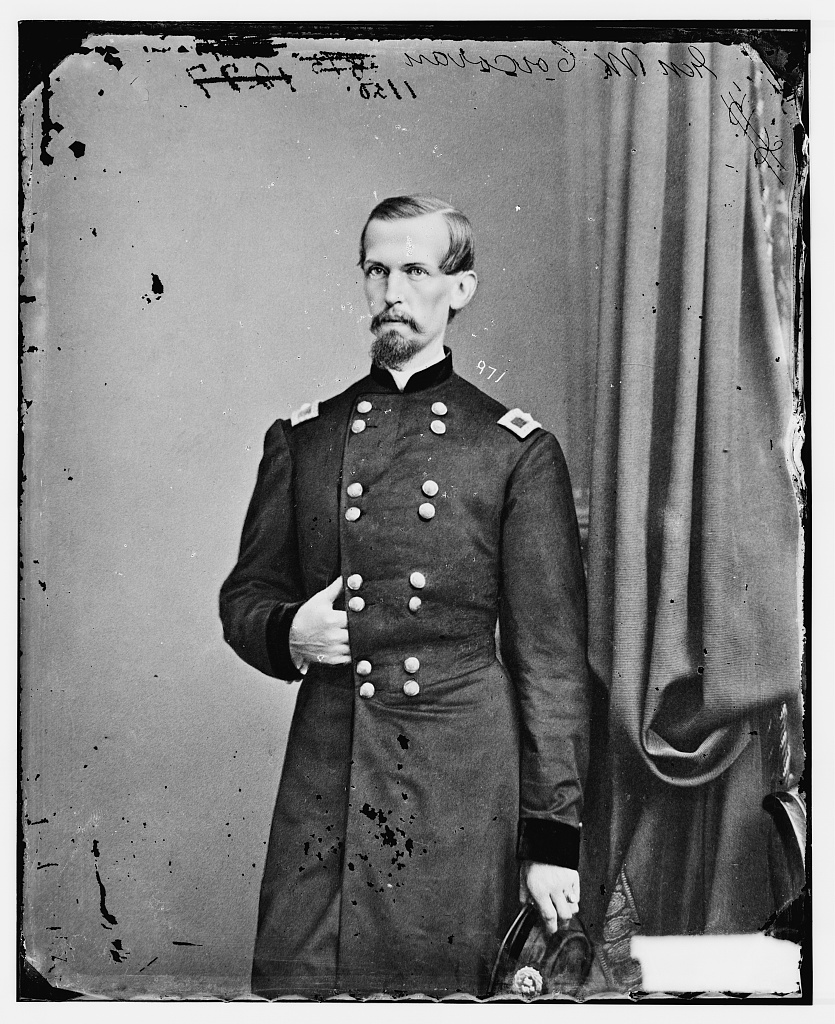

General Michael Corcoran, U.S.A. United States, None. [Between 1860 and 1865] Photograph. https://www.loc.gov/item/2018667330/.

Corcoran resumed his rank in the 69th New York and was present at that Battle of First Manassas, where he was captured. Corcoran spoke of this later by saying, “I did not surrender until I found myself after having successfully taken my regiment off the field, left with only seven men and surrounded by the enemy.”[13] Corcoran was eventually exchanged over a year later, and was received back with acclaim. He was given the rank of Brigadier General and put in command of his own troops, known as Corcoran’s “Irish Legion.” The first battle of the Legion took place during the Battle of Deserted House Virginia. Although not one of the biggest battles of the war, Corcoran demonstrated calmness under fire and his men showed how they admired Corcoran by following his every commanded under intense battle conditions. Sadly this would be Corcoran’s last major battle as he was killed later that year when he fell from his horse. Even though Corcoran’s life was cut short his legend and the Prince of Wales incident continued to inspire men, especially those of his Legion who were fighting for their adopted homes as well as Irish pride.

The National Governors Association has written this about Gov. Edwin D. Morgan.

“EDWIN D. MORGAN, the twenty-third governor of New York, was born in Washington, Massachusetts on February 8, 1811. His education was attained at the Bacon Academy in Colchester, Connecticut, where his family moved to in 1822. Morgan established a successful business career, with holdings in the banking and brokerage industries. He first entered politics in Connecticut, serving as a member of the Hartford city council, a position he held in 1832. After moving to New York, he served as alderman of New York City in 1849; was a member of the New York State Senate from 1850 to 1851; and served as the state immigration commissioner from 1855 to 1858. He also chaired the Republican National Committee from 1856 to 1864. Morgan next secured the Republican gubernatorial nomination, and was elected governor by a popular vote on November 2, 1858.
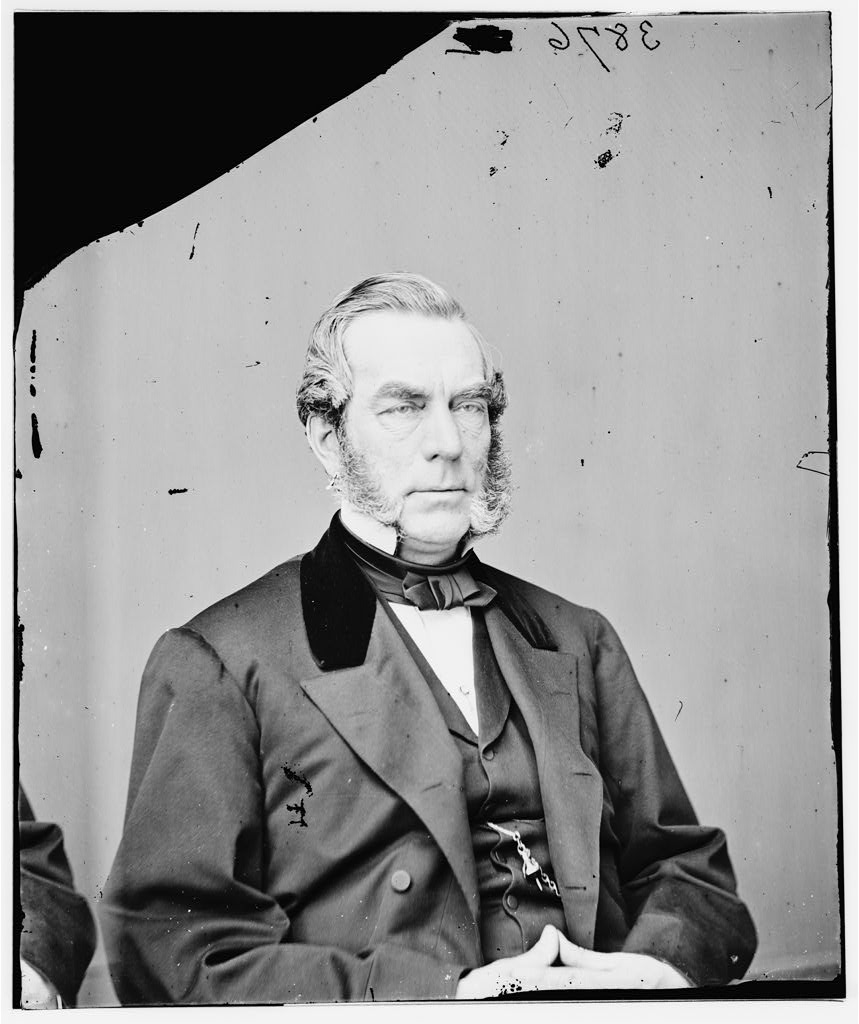
Edwin D. Morgan
. United States, None. [Between 1860 and 1870] Photograph. https://www.loc.gov/item/2018669639/.

He was reelected to a second term in 1860. During his tenure, the state’s canal system was advanced; Vassar College was founded; and volunteers were raised and equipped for service in the Civil War. Morgan also served as major general of volunteers during the war, as well as serving as the commander for the Department of New York. After leaving the governorship, Morgan was elected to the U.S. Senate, an office he held from 1863 to 1869. From 1872 to 1876 he chaired the Republican National Committee; and in 1881 he turned down an appointment to serve as U.S. secretary of treasury. Governor Edwin D. Morgan passed away on February 14, 1883, and was buried in the Cedar Hill Cemetery in Hartford, Connecticut.” [14]

Although these three men are from completely different backgrounds, their stories intersect in this one document. Historical stories are everywhere, you just need to dig under the surface to find them.


[1] Corcoran, Michael. Letter to Gov. Edwin D, Morgan. “Brigadier General Michael Corcoran Request For Michael McEvoy.” New York, New York: Astor House, September 11, 1862.

[2] “Page 1 New York Civil War Muster Roll Abstracts McEvoy, Michael.” Fold3. Accessed December 31, 2022. https://www.fold3.com/image/315981459.

[3] Ibid

[4] “Michael McEvoy in the 1850 United States Federal Census.” Ancestry. Accessed December 31, 2022. https://www.ancestry.com/discoveryui-content/view/7008512:8054?tid=&pid=&queryId=6a9bb6ca9453a20b805c27f011dfac83&_phsrc=csG312&_phstart=successSource.

[5] Page 1 New York Civil War Muster Roll Abstracts McEvoy, Michael.” Fold3. Accessed December 31, 2022. https://www.fold3.com/image/315981459

[6] Ibid

[7] “Page 1 New York Civil War Muster Roll Abstracts Michael McEvoy.” Fold3. Accessed December 31, 2022. https://www.fold3.com/image/316135643.

[8] Ibid

[9] Ibid

[10] Pritchard, Russ A. The Irish Brigade : a Pictorial History of the Famed Civil War Fighters. (Philadelphia,

[11] Conyngham, The Irish Brigade and It’s Campaigns , 537

[12] Ibid 

[13] Ibid, 538

[13] Shiels, Damian. Irish in the American Civil War Exploring Irish involvement in the American Civil War . March 18, 2012. http://irishamericancivilwar.com/2012/03/18/baptism-of-fire-the-corcoran-legion-at-deserted-house-virginia-30th-january-1863/ (accessed 11 20, 2013).

[14] Sobel, Robert, and John Raimo. “Edwin Denison Morgan.” National Governors Association. Accessed November 3, 2023. https://www.nga.org/governor/edwin-denison-morgan/.
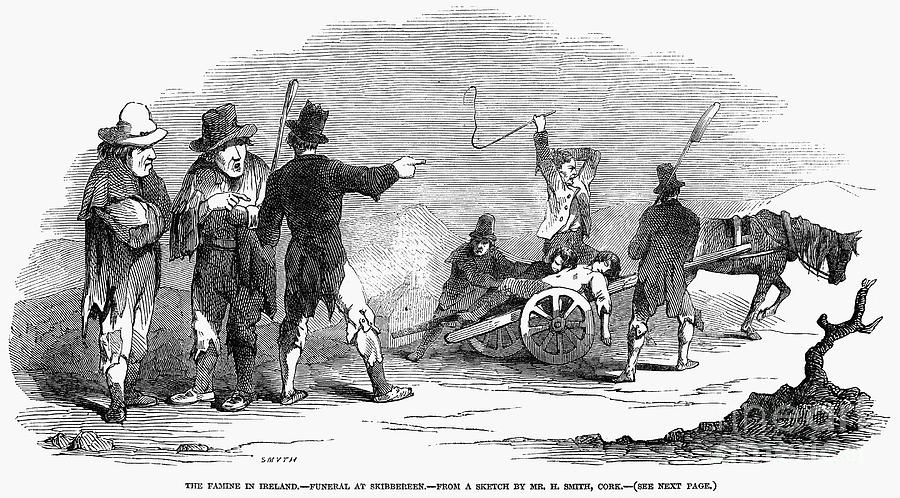
The Brave Soldiers From Erin Why The Irish Fought With Great Success During The American Civil War: Part 4 Culture of the Irish


Engraving Titled The Famine In Ireland-Funeral At Skibbreen_From A Sketch By Mr. H Smith (1847)

Engraving Titled The Famine In Ireland-Funeral At Skibbreen From A Sketch By Mr. H Smith (1847)

Life in nineteenth century Ireland was challenging at best. The Irish faced death, on an almost daily bases. An anonymous poet wrote of this dreadful time in Ireland saying, “God sent a course upon the land because her sons were slaves; The rich earth brought forth rottenness, and gardens became graves; The green crops withered in the field, all blackened by the curse, And Wedding gay and dance gave way to coffin and hearse.” (1) In order to survive the Irish had to become accustomed to this dreadful way of life.

After emigrating from Ireland the Irish would be faced with the notion of death during the Civil War. Death would be common place during the four year conflict 750,000 men would die. (2) By comparison in five years 1,500,000 Irishmen and women would perish in the famine in Ireland. (3) In looking at these numbers one can only imagine that an Irish soldier who fled Ireland due to the famine had an overwhelming and powerful understanding of life and death upon entering Civil War service. This is not to say that the Irish took death lightly. However, they did become desensitized to it, thus making them more comfortable with the idea of dying.
The Irish’s ability to be at peace with the idea of death transformed itself into battlefield heroics. This idea can be seen in the actions of Brevet Brigadier General Thomas Smyth. Smyth immigrated to the United States at age twenty during the height of the famine, during the Civil War Smyth enlisted as a major in the 1st Delaware Infantry. He had gallant actions and a tendency to lead from the front with a disregard for his own life and safety. Captain Conyngham said this about him, “With the coolness and judgment of the scientific officer he combined a bravery almost amounting to rashness. He generally rode in front of his own picket lines along the outer posts, to make sure that all was right.” (4)

Brigadier General Thomas Smyth

Brigadier General Thomas Smyth

It was these qualities that gained him a promotion to the commander of his regiment. It was in this capacity that then Colonel Smyth found himself at Gettysburg, where on the third day of the battle he was severely wounded. The wound did not keep Smyth out of action for long though, as he returned to action with the rank of Brigadier General. Smyth again led from the front; however, this would be his undoing as he was shot in the neck while leading his men near Farmville, Virginia. (5) One can only surmise that Smyth’s fearlessness came from a different understanding of what it means to die, an understanding learned by seeing so much death as a youth back in Ireland.

The Irish in America whether being born in Ireland or in the United States always had a piece of the old country with them in their hearts and minds. The Irish had to develop coping mechanisms in order to survive their everyday struggles. Their coping skills came directly from their culture. Three of the most notorious traits the Irish are known for are their humor, drinking and love of a good fight. These characteristics served the Irish participants in the American Civil War well as they faced new hardships in their life as soldiers.

Irish humor can cover a rage from sarcastic wit to bawdy and over the top. This is as true today, as it was during the American Civil War. The Irish are known for using their humor to defuse tense emotional situations. One such occasion during the war was when the Irish of the 13th Louisiana were marching off amongst a sea of crying mothers and sweethearts. One of the men remarked, “I wish I had a gurl to cry for me but the devil a wun cares I go or stay.” Another member of the regiment was heard to reply, “I’m glad I’ve no wun. If I get kilt me people will never know what become of me, and I’ll only have a monument in the Company books, Killed in battle, Mike Morrisy and that’s not my thrue name, at that.” (6) After this statement the members of the 13th Louisiana, within earshot, must have had a good laugh and their tensions and anxieties relived, even if but for a mere moment.

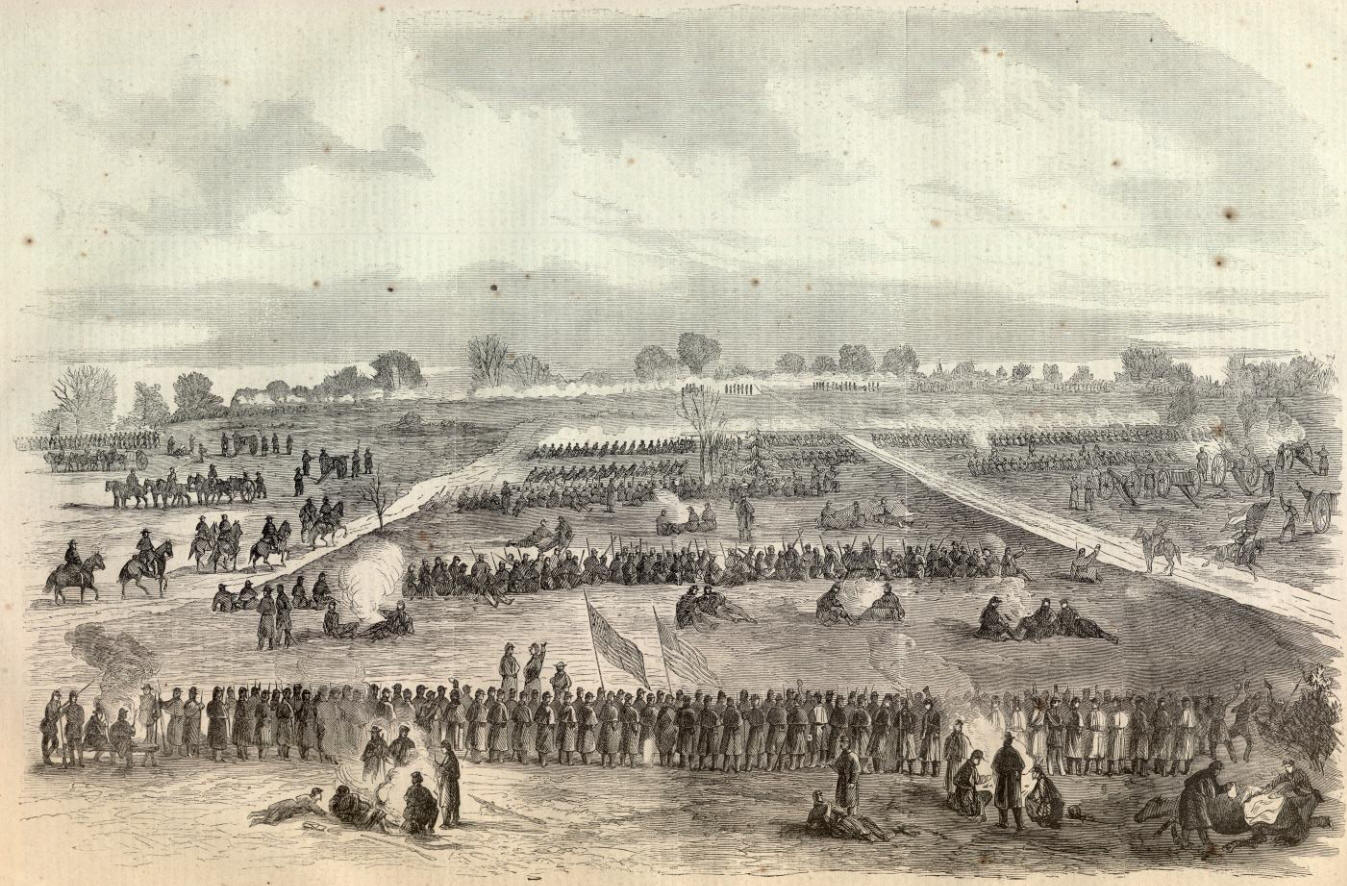
The Irish units were also notorious for their hijinks, which were merely a way to cope with stress of battle. One example of this was when the town of Gettysburg turned out to defy the rebel occupation. An Irishmen named John Donnally of the 8th Alabama “Emerald Guard” looked into the crowed and saw a dapper gentleman, with a fine hat, standing along the route. Donnally broke ranks and snuck up behind the gentleman and placed his bullet riddled cap upon the dandy’s head, taking the expensive hat for himself. This resulted in tremendous laughter from them men of the 8th Alabama, as well as other confederates on the march. (7) This was another stressful and possibly volatile situation defused by Irish wit. These shenanigans were not just contained to off the battlefield. During the Battle of Murfreesboro an Irish Confederate soldier lay wounded on the field. He was searching for help to the rear, when he spotted a federal soldier running in that direction. The Confederate soldier took the yank hostage and rode him back to the rear whistling The Girl I left Behind Me, a popular cavalry tune of the era. (8) This episode shows just how the Irish used humor to stay calm while under fire, an attribute that would serve them well throughout the conflict.

The Battle Of Murfreesboro, Tennessee Sketched By Mr. Henrr R. Hubner For Harper's Weekly Febuary 14th 1863

The Battle Of Murfreesboro, Tennessee Sketched By Mr. Henry R. Hubner For Harper’s Weekly February 14th 1863

Having men with an Irish sense of humor could also be a nice distraction from the long days. Captain Conyngham writes about Andrew Lawler, an officer in the 28th Massachusetts Volunteer Infantry, during one of their long forced marches. Conyngham says, “He was beloved by all; possessed of an ardent, hopeful temperament which no hardship; however sever could dampen, he was the life of the bivouac; while his rollicking humor and endless jokes often shortened the weary march.” (9) As anyone who was in the armed forces would know, having a man like that to lessen ones burden also helps keep a mass of men moving. The Irish regiments during the American Civil War were full of such men.

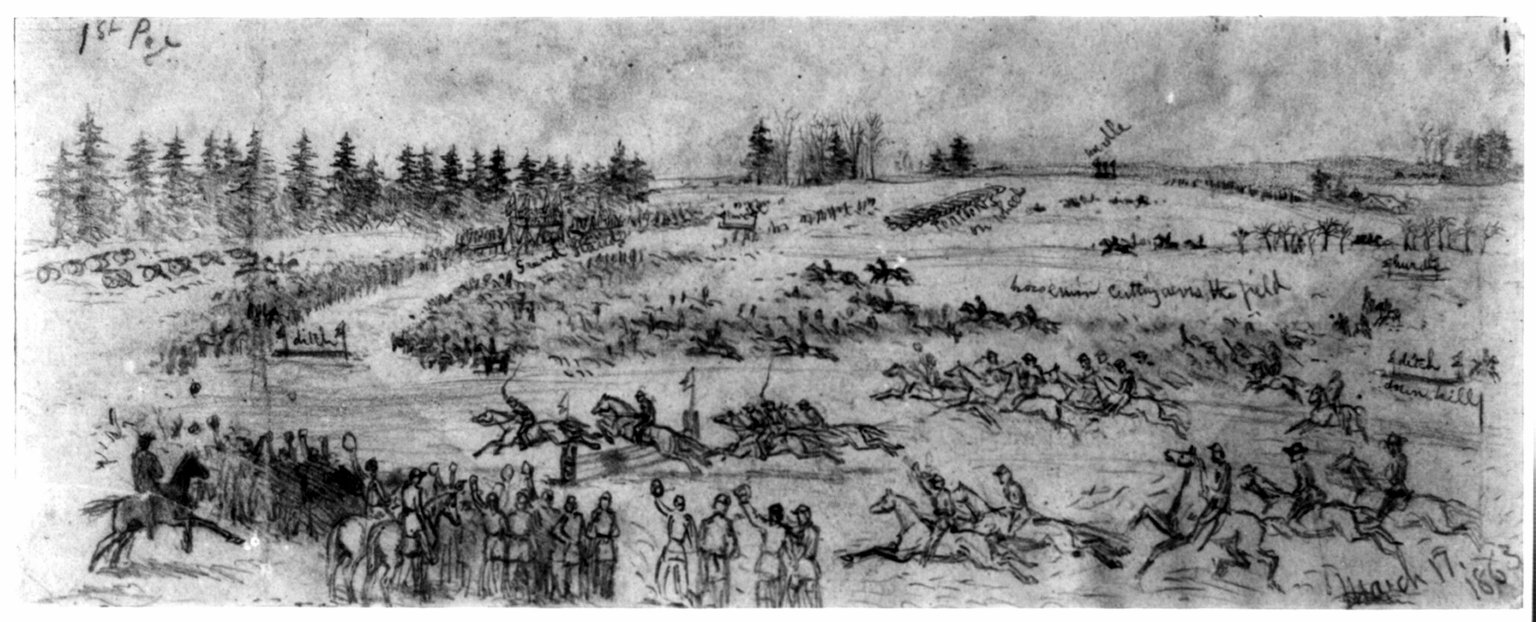
Drinking by itself is not a healthy way to deal with stress. However, the Irish have developed it into an art form full of music, good cheer, and lively conversation. This can be seen by the Saint Patrick’s Day Celebration the Irish soldiers had in 1863. The festivities consisted of athletic competitions, that including a steeple chase with the finest horses in the Brigade, and a liquor requisition that consisted of “eight buckets of champagne, ten gallons of rum, and twenty two of whisky,”. (10)  This break was well earned, as the Irish Brigade was previously involved in some of the hardest fighting the Army of the Potomac had engaged in. This celebration also gave the men a bonding experience, bringing them together in a way that many other regiments did not have. This experience may also have been the difference in the Brigades performance at the Battle of Chancellorsville. Although it was a Confederate victory, it could have been a much bigger blow to the Union. Conyngham writes of the Brigades actions while defending a Federal battery, saying, “Here the remnant of the Irish Brigade for it numbered only about five hundred and twenty men going into action did good service to the Union; for had the rebels seized the battery and turned it upon our army a regular panic might have ensued, for at the same time several regiments on the right and left were giving way.” (11) From this quote one can gather that the Irish Brigade fought as a tenacious unit, brought together through war as well as uniquely Irish celebrations off the battlefield.

St. Patrick's Day in the army--The steeple chase By Edwin,  Forbes Sketched March 17th 1863

St. Patrick’s Day in the army–The steeple chase By Edwin, Forbes Sketched March 17th 1863

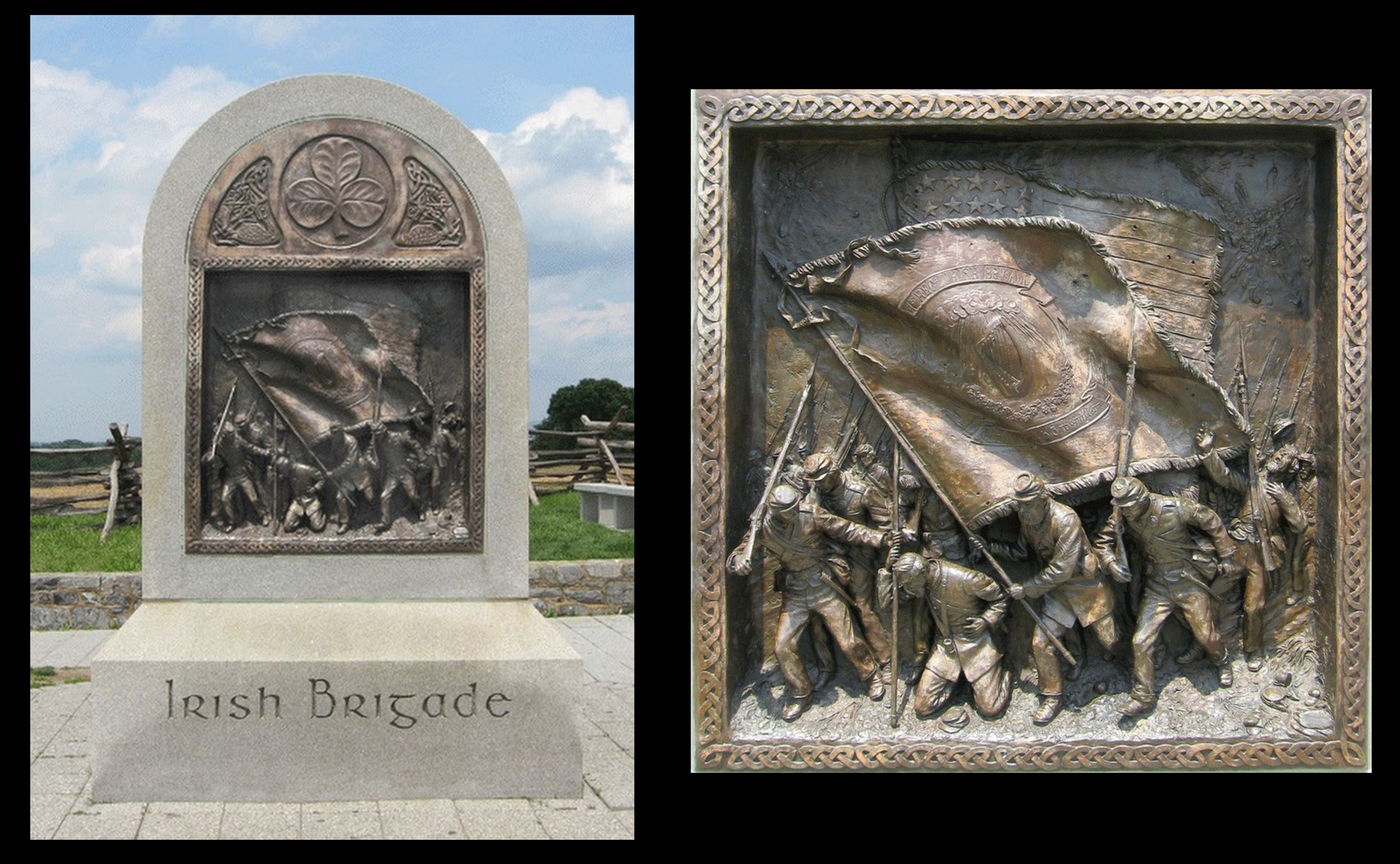
Irish Brigade Monument At

Irish Brigade Monument At Antietam

It is also known that the Irish love a good fight. This can be seen in the fact that a half million Irishmen left their homeland between 1585 and 1818 to fight for France and Spain, these men are known as the “Wild Geese.” (12) Therefore, when the American Civil War broke out, it naturally attracted Irishmen to sign up and enter the row. This fighting spirit transferred to the battlefield as well. An illustration of this can be seen in an account regarding Corporal Jack T. McBride of the 45th Mississippi. During an attack of his position he was slashed in the face by a federal officers sword. Without missing a step, McBride attacked the Yankee and threw him to the ground, pounding upon his head until he had to be physically removed and shackled by other Union officers. McBride taunted every Union soldier he encountered on his was to prison camp. He even challenged a Yankee officer to a boxing match, McBride got knocked out as a result of this challenge. However, throughout this one can see that his fighting Irish spirit never wavered. (13) The essence of the fighting Irish can also be seen during the Battle of Antietam. “The green flag was completely riddled, and it appeared certain death to anyone to bear it, for eight color-bearers had already fallen. The last had fallen, and the Irish green lay trailing in the dust. Meagher cried out ‘Boys, raise the colors, and follow me!’ Captain James McGee, of the Sixty-ninth, rushed forward, and crying, ‘I’ll follow you!’ seized the flag. As he raised it, a bullet cut the standard in two in his hand; and, as he again stooped down, another bullet tore through his cap. Still, he jumped up, waved the flag, shook it at the rebels, and cheered on the troops, almost miraculously escaping.” (14) This charge was successful, as it drove the Confederates back and forced them to retire from the field. The steadfast Irish pugnaciousness had won the day once more.

The American Civil War was a turning point in the history of the Irish American. Their devotion, bravery and sacrifices, both north and south, gave a new dignity and admiration to America’s Irish population. Not only did the Irish became widely accepted and well-respected, they also became a vital part of America. A journalist of the period is quoted as saying, “There are several kinds of power working at the fabric of the American republic water power, steam power and Irish power, the last works hardest of all.” (15) As for why the Irish made such fierce and bold fighters this is due to the four factors mentioned in this work: religion, acceptance, Irish Nationalism, and the Irish culture. It is the combination of all four that set the Irish apart, making them a superior fighting force that any army would be pleased to have on their side. A Confederate commander of an Irish regiment, when asked what ethnic group of soldiers he preferred, said:

“I would have Irish soldiers in preference to any others; and I tell you why. First, they have more dash, more élan than any other troops that I know of; then they are more cheerful and enduring nothing can depress them. Next, they are more cleanly. The Irishman never failed to wash himself and his clothes. Not only were they cheerful, but they were submissive to discipline when once broken in and where they had good officers that was easily done; but once they had confidence in their officers, their attachment to them was unbounded. And confidence was established the moment they saw their general in the fight with them…. They required strict discipline: but they always admitted the justice of their punishment when they believed their commander was impartial; and they never were sullen, or bore malice. There was one great element of strength in these men—they were volunteers, every man of them. Many could have been excused on the ground of their not being American citizens, as not more than one-third of them had a right to vote at the time; but they joined of their own free will—no Irishman was conscripted. I repeat, if I had to take from one to 10,000 men to make a reputation with, I’d take the same men as I had in the war—Irishmen from the city, the levees, the river, the railroads, the canals, or from ditching and fencing on the plantations. They make the finest soldiers that ever shouldered a musket.’ And this was the testimony of one of the fiercest fighters of the war.” (15)

This quote sums up the Irish service in the American Civil War; the general would choose the Irish to fight for the Confederates due to the combination of the four attributes discussed in this work. The Irish fought in every engagement during the American Civil War. Their valor was matched by none and their deeds are still legendary to this day.

Notes;

1) O’Riordan, Tomás. Ireland, 1815-70 : Emancipation, Famine and Religion. (Dublin ;Portland, OR: Four Courts Press, 2011.) 58

2) Gugliotta, Gary. New Estimate Raises Civil War Death Toll. April 2, 2012. http://www.nytimes.com/2012/04/03/science/civil-war-toll-up-by-20-percent-in-new-estimate.html?pagewanted=all&_r=0 (accessed November 24, 2013).

3) O’Riordan, Tomás. Ireland, 1815-70 : Emancipation, Famine and Religion 61

4) Conyngham, The Irish Brigade and It’s Campaigns. 542

5) Collins. Famine to Freedom The Irish in the American Civil War. 211

6) O’Brian. The Irish Americans In the Confederate Army. 28

7) Ibid

8) Ibid, 29

9) Conyngham, The Irish Brigade and It’s Campaigns. 588

10) Ibid, 373

11) Ibid, 400

12) McLaughlin, Mark. The Wild Geese : The Irish brigades of France and Spain. (Oxford, UK : Osprey Publishing, 1980.) 3

13) O’Brian. The Irish Americans In the Confederate Army. 27

14) Conyngham, The Irish Brigade and It’s Campaigns. 305-306

15) O’Brian. The Irish Americans In the Confederate Army. 3