Private James Daniel Moore: A Journey from Rural Roots to the Battlefield

As I strolled through the serene grounds of Oakwood Cemetery in Gastonia, North Carolina, I couldn’t help but pause at the grave of Private James Daniel Moore, whose epitaph seemed to beckon me to delve deeper. Born to the hardworking farming couple of Carroll and Sarah Moore on January 5, 1846 [1], in the rural expanse of Caldwell County, young James, affectionately known as “Jimmie,” [2] had a modest upbringing and limited formal education. However, he more than made up for what he lacked in academic pursuits with his exceptional proficiency in the art of farming, honed through years of toiling alongside his parents in the fields.

Private James Daniel Moore’s grave at Oakwood Cemetery in Gastonia, North Carolina. Photo by @firefightinirish

Jimmie’s boyhood days were a tapestry of joyous outdoor adventures as he reveled in the simple pleasures of swimming, hunting, and fishing, immersing himself in the beauty of nature surrounding his family’s homestead. However the tranquility of his youth was soon shattered by the ominous rumblings of the American Civil War. This conflict would abruptly curtail his carefree pastimes and thrust him into the harsh realities of the battlefield. On July 15, 1861[3], the young Jimmie, driven by a sense of duty and patriotism, enlisted and was mustered into the “F” Company of the 26th North Carolina regiment as a private. He then embarked on a journey that would test his mettle and indelibly shape the course of his life.

Image of Private Moore in uniform provided by American Civil War Forums. “Confederate Veteran James Daniel Moore of Caldwell County, NC : Civil War Remembrances | Other Soldiers, Politicians, & Men.” Accessed June 29, 2024. https://civilwartalk.com/threads/confederate-veteran-james-daniel-moore-of-caldwell-county-nc-civil-war-remembrances.123810/.

Amid the chaos and carnage of the Seven Days Battles, Private Moore stood his ground, his youthful resilience and unwavering resolve on full display. At the pivotal Battle of Gettysburg, where the 26th North Carolina played a crucial role, Jimmie’s bravery and sacrifice would be etched into the annals of history. As part of the Color Guard on the first day’s fight, he found himself among the 85 [4] men wounded, his body bearing the scars of the relentless struggle, a testament to his unwavering dedication to the cause he had sworn to defend. He recounted his story in an 1897 interview for the “The Morning Post” (of Raleigh, NC.):

“I was wounded at the top of the hill (Cemetery Ridge) from which the last line of the enemy had been driven. At that time there was only three of us left, and I was congratulating myself that I was safe, when I was knocked insensible (senseless) by a piece of a shell striking me on the neck, and at the same time a ball passed through my leg.” [5]

He would lay there in the hot July sun for hours, losing blood and suffering from thirst before being rescued by his comrades.

Colonel Henry King Burgwyn Jr. leads the 26th North Carolina at the battle of Gettysburg, July 1, 1863. By Don Troiani.

Moore would recover in the hospital before being sent home on a furlough. While at home, he had to “fight off “bushwhackers,” northern sympathizers, who “prowled like wolves around those loyal valley homes, ready whenever they could rush in to kill and rob the unprotected.[6] He would return to the 26th in time to join them for the Battle of the Wilderness. Here, he was with Lieutenant Colonel Jones when Jones was mortally wounded. Private Moore attended to Lieutenant-Colonel Jones and watched him draw his last breath. Due to the pain of his leg wound, Private Moore was declared unfit for infantry duty and was transferred to Company D, 1st North Carolina Cavalry. He joined them near Petersburg in September 1864.[7]

A friend and fellow member of the 1st wrote:

he (Pvt. Moore) came to the regiment splendidly mounted on a beautiful dark mare, and from that time till the close of the war was with the regiment in the various cavalry battles and skirmishes in which it was engaged, including, among others, Boisseau’s farm. Gravelly Run, Wilson’s farm, Hampton’s cattle raid, and Bellfield.” With this cavalry troop, he served as General Wade Hampton’s courier until the close of the war, doing his full part in the exploits by which Hampton’s cavalry won imperishable fame for Southern arms.[8]

After the war, Moore moved to Winamac, Indiana, to avoid further trouble with the bushwhackers. Here, he would be employed as a store clerk, and he believes he met the man who shot him at Gettysburg.

One evening, while talking to several Union veterans in the store, one, whose name was Hayes, remarked that he was in the Battle of Gettysburg, and from his account of himself and his location and command, I satisfied myself that he was with the troops we fought at Gettysburg on the first day.” [9]

Image of Moore as an older man. from Parker, Hershel. “My Cousin the Author, James Daniel Moore–Female Soldier in Civil War.” My Cousin the Author, James Daniel Moore–Female Soldier in Civil War. Accessed June 29, 2024. https://fragmentsfromawritingdesk.blogspot.com/2016/04/my-cousin-author-james-daniel-moore.html.

They would remain friends during Moore’s time in Indiana. Moore would move back home to North Carolina in February of 1868[10]. Once at home, he would reconnect with Martha Lewis, they would marry on September 25th, 1870; [11] together, they would have eight children. Moore worked for his brother-in-law in Dallas, North Carolina, then moved to Gastonia to establish a cotton mill. He would become the secretary and treasurer of the Modena Cotton Mills. Moore would become one of the most successful businessmen in the county. He would die on August 6, 1905[12], after suffering from a brief illness. Businesses across the county closed, and hundreds attended his funeral. He was laid to rest at Oakwood Cemetery; his epitaph reads,

And I Heard A Voice From Heaven Saying Unto Me, Write Blessed Are The Dead Which Die In The Lord From Henceforth: Yea, Saith The Spirit, That They May Rest From Their Labours; And Their Works Do Follow Them.” [13]

Grave of Private James Daniel Moore. By @firefightinirish

[1] “James Daniel Moore: Free Download, Borrow, and Streaming,” Internet Archive (Gastonia, N.C.: Martha J. Moore, January 1, 1970), https://archive.org/details/jamesdanielmoore00gast/page/n5/mode/2up, Pg. 21.

[2] Ibid. Pg. 15

[3] James Daniel Moore Soldier History. “Historical Data Systems, Inc”, 2024. https://www.civilwardata.com/active/hdsquery.dll?SoldierHistory?C&156013.

[4] ccwinslow394, “James Daniel Moore, Company F 26th NC : The First Day At Gettysburg,” NC Civil War History Center of Fayetteville, March 6, 2019, https://nccivilwarcenter.org/james-daniel-moore-company-f-26th-nc-the-first-day-at-gettysburg/.

[5] Ibid

[6] “James Daniel Moore: Free Download, Borrow, and Streaming,” Internet Archive (Gastonia, N.C.: Martha J. Moore, January 1, 1970), https://archive.org/details/jamesdanielmoore00gast/page/n5/mode/2up, Pg.16.

[7] ccwinslow394, “James Daniel Moore, Company F 26th NC: The First Day At Gettysburg,” NC Civil War History Center of Fayetteville, March 6, 2019, https://nccivilwarcenter.org/james-daniel-moore-company-f-26th-nc-the-first-day-at-gettysburg/.

[8] “James Daniel Moore: Free Download, Borrow, and Streaming,” Internet Archive (Gastonia, N.C.: Martha J. Moore, January 1, 1970), https://archive.org/details/jamesdanielmoore00gast/page/n5/mode/2up, Pg. 16.

[9] ccwinslow394, “James Daniel Moore, Company F 26th NC: The First Day At Gettysburg,” NC Civil War History Center of Fayetteville, March 6, 2019, https://nccivilwarcenter.org/james-daniel-moore-company-f-26th-nc-the-first-day-at-gettysburg/.

[10] Ibid

[11] Ibid. Pg. 26

[12] Ibid.

[13] Ibid. Pg. 61

From Firefighter to Soldier: The Journey of Captain Alfred A. Donalds

During an adventure at Green-Wood Cemetery in Brooklyn, I discovered the grave of Captain Alfred A. Donalds. He was born to David and Susan Donalds in Columbia County, New York, around 1835[1].  Captain Donalds was listed as a ship carpenter during the 1860 census. He was also the foreman of East River Engine Co. 17 part of The Fire Department of New York.

Torchlight Procession of the New York Firemen – from original sketch, The Illustrated London News, January 23, 1858, page 93. From The Rona and Martin Schneider Collection of Late 19th and Early 20th Century American Fine Art Prints
Small folio hand-colored lithograph published by George Whiting of New York in 1861, titled “Col. Emer Ellsworth, (of the New York Zouaves).” From The American Military Heritage Museum Of North Carolina

Soon after the outbreak of the American Civil War, Col. Elmer Ellsworth put out the following call:

I want the New York firemen, for there are no more effective men in the country, and none with whom I can do so much. They are sleeping on a volcano at Washington, and I want men who are ready at any moment to plunge into the thickest of the fight.”[2]  

On April 20th, 1861, Donalds answered that call, enlisting as a 1st Sergeant. He mustered into “I” Co. NY 11th Infantry (First Fire Zouaves) a few weeks later. On April 29th, 1861, Under the command of Col. Elmer Ellsworth, then Sgt. Donalds and the 11th New York infantry left for Washington, D.C.

The Departure of Ellsworth’s Zouaves escorted by the New York fire Dept. Illus. in: Frank Leslie’s Illustrated Newspaper, 1861 May 11, p. 404

  In Washington, the regiment showcased their unique Zouave characteristics and effectiveness as firefighters when a severe fire erupted close to Willard’s hotel. Col. Ellsworth took up the task. Upon receiving the order, ten men from each company quickly hurried to the engine house, forced the door open, and swiftly arrived at the scene with the firefighting equipment. They were soon joined by most of their fellow soldiers, with Col. Ellsworth taking charge and, after strenuous effort, successfully extinguishing the flames. General Mansfield publicly thanked them for their assistance, and the citizens enthusiastically cheered for them.  J. Frank Kernan’s book Reminiscences of the Old Fire Laddies and Volunteer Fire Departments of New York and Brooklyn describes one of the most heroic scenes of the incident.

It was necessary to get the hose to the roof of the hotel, but the ladders were not long enough While in dilemma, Mr. Alfred Smith, one of the Zouaves…suggested that if his comrades would hold him suspended, by the legs he would reach down to the man on the ladder below and make a coupling of the hose Corporal Keese and a companion grasped the daring Smith by the feet and held head downward he made a connection to the butt. The water was then turned on, and Willard’s was saved.”[3]

Waud, Alfred R. , Artist. Gallant conduct of Ellsworth’s Zouaves, in their successful endeavor to save Willard’s Hotel, Washington / sketch by A. Waud Washington D.C, 1861. Photograph. https://www.loc.gov/item/2006677587/.

  On May 24th, 1861, Sgt. Donalds and the 11th New York boarded boats. They arrived in Alexandria and seized control of the dock and the city. At this point, Colonel Ellsworth

Currier & Ives. Death of Col. Ellsworth After hauling down the rebel flag, at the taking of Alexandria, Va., May 24th/ / Brownell ; Jackson. United States, ca. 1861. N.Y.: Pub. by Currier & Ives. Photograph. https://www.loc.gov/item/2001696141/.

proceeded to the top of the Marshall House, removing the secession flag that had been flying there for several days. While descending the stairs with the flag, he was shot in the chest by a rebel named Jackson and died immediately. Private Brownell of Co. A quickly shot the assassin. The death of their faithful leader shook the regiment; however, they continued.

On June 21st, 1861, during the battle of First Bull Run, Sgt. Donalds and the 11th regiment effectively engaged in close combat with the renowned Black Horse cavalry. The rallying cry of “Ellsworth! Remember Ellsworth!”[4] accompanied each engagement, resulting in the fall of enemy horsemen. Amidst the chaos and fervor of battle, each soldier fought independently as the tumultuous conflict drowned out the officers’ commands.  After failing to gain ground with their cavalry, the opposing forces unleashed their elite infantry and favored “Louisiana Zouaves” in overwhelming numbers upon the regiment. The opposing new force was pushed back three times, and only after two hours of fighting did it finally give up the ground. Before the 11th retired from the field, they ran to help other units in trouble. One of those units was the famed 69th N.Y.S.M.

“New York’s Bravest” . The 69th New York and the 11th New York (1st Fire Zouaves) defend the 69th’s Green Irish flag at the Battle of First Manassas. By Don Troiani Historical Artist

The 69th were beaten back, and both their flag and a high-ranking officer had been captured. Men of the 11th, led by Captain John Wildey, rushed in to help the beleaguered 69th. This is an account of what transpired:

 “At the fight at Bull Run, when the flag of the glorious Sixty-ninth Regiment was wrested from them by a superior force of the enemy, John Wildey rushed forward at the head of his brave men, and after a bloody contest, in which he killed two men,–one a rebel officer, whose sword he took from him as a trophy,–recaptured the flag, and after marching four miles he restored it to the gallant corps from whom it had been taken.[5] 

During this engagement, the 11th  suffered twenty-four fatalities and forty-six injuries, and fifty-two soldiers went missing, with many of them being captured as prisoners.[6]

On August 1st, 1862, Donalds was discharged for promotion. He was commissioned into “F” Co. NY 73rd Infantry (Second Fire Zouaves) the same day[7]. Captain Donalds and the 73rd were involved in the following engagements: The Siege of Yorktown, The Battle of Williamsburg, and The Battle of Fair Oaks. After the battle of Fair Oaks, Commander of the 73rd NY, William R. Brewster, recognized him and other captains for their aid “…in urging forward the men when exposed to a galling fire and obliged to advance through a thick entanglement of brush and felled timber. Most of my men were shot while climbing over felled trees.[8]

The 73rd and Captain Donald were also heavily engaged during the Seven Days Battles. After the battle of Malvern Hill, General Daniel Sickles wrote,

 I must especially commend the admirable conduct of Captain Alfred A. Donalds in commanding Fourth Excelsior. He was not assisted by a single officer above the rank of lieutenant, and of these, only four were on duty. Notwithstanding every embarrassment, the fragment of his brave command was most effectively and gallantly led by him throughout the day.[9].

Currier & Ives. The battle of Malvern Hill, Va. July 1st. , 1861. [New York: Currier & Ives, ?] Photograph. https://www.loc.gov/item/90709064/.

Brigadier General Joseph Hooker mentioned Donalds after the fight at Harrison’s Landing. He commended Captain Donalds for his admirable service, acknowledging that his “heroic conduct was conspicuous throughout the day.”[10]

On August 27th, 1862, Captain Donalds was killed in action as acting commander of the 73rd New York during a skirmish at Kettle Run near Bristoe Station, VA. On September 8th of that same year, in his field report from Fort Lyon, Virginia, Brigadier General Nelson Taylor of the United States Army saluted Captain Donalds by saying,

“In closing this report, I shall avail myself of the opportunity to express my admiration of the gallant conduct on the field of the officers and men who so nobly followed the fortunes of the brigade during the time which this report covers, particularly to the lamented Captain Alfred A. Donalds, of the Fourth Excelsior Regiment, who fell early in the action at Bristoe Station.…”[11]  

The captain’s mortal remains were retrieved from Washington, D.C., and returned to New York. Here, Chief Engineer John Decker of the Fire Department of New York ordered to “call out the Department to attend the funeral. The various companies will wear their respective badges of mourning, the Chief and Assistants act as marshals, and the fire alarm bells will be tolled during the solemnities.” [12]

The Fire Department of New York passed the following resolution on the day of his funeral:

“Whereas It is with feelings of pain and regret we have heard of the death of our late brother, associate, and member, Captain Alfred A. Donalds of the Second Regiment Fire Zouaves, who fell while gallantly and nobly fighting in the cause of the Union; therefore, be it Resolved, That in the death of Captain Alfred A. Donalds, the country has lost the services of a brave and efficient officer, the Department an esteemed and faithful member, and his associates a true and devoted friend. Resolved, that we deeply deplore the death of our late friend and companion and beg to leave to tender our heartfelt sympathies to his relatives, recommending them for consolation to the mercy of Him who doeth all things for the best.” [13]

The commanding officer of the 73rd New York Infantry, Col. William R. Brewster, wrote the following letter to the Foreman of Engine Company No. 17:

“This week, the remains of the late Capt. Donalds of your company wounded at the battle of Bristol will be sent to New York for appropriate burial. Capt. Donalds had, by his gallant conduct in action, his courage and zeal, conspicuous among so many brave comrades, attracted the attention of his brigade and division Commanders and had been frequently noticed in their official reports in the most flattering terms.

During a long period of sickness and imprisonment under which I suffered, completely unfitting me for any service in the field, the command of my regiment devolved upon Capt. Donalds, and, by his close attention to the arduous duties required of a commanding officer through the Peninsular campaign and cheerfulness of disposition under the most trying circumstances, he had endeared himself to all. By the death of Capt. Donalds, the service loses a brave and gallant officer, while to myself, the loss is that of a true and tried friend upon whom I could at all times rely

The regiment which I have the honor to command was raised under the auspices of the Fire Department of the City of New York and composed almost entirely of members of that Organization. The courage they have shown in the many bloody contests which, as a portion of the celebrated Excelsior Brigade and Hooker’s (now Sickles’) Division, silences the clamor of those who say that firemen do not make good soldiers.The battle of Bristol, in which Capt. Donalds fell, was of short duration, but one of the most severely contested during the present war. The regiment went into action with but ninety men and eight officers, and in one hour and ten minutes, forty-eight men and five officers lay killed upon the field. It was while urging the reinforcements, both by voice and example, that Capt. Donalds fell, mortally wounded. The name of Capt. Alfred A. Donalds should always be held in fond remembrance, not only by all your company but by every member of the Fire Department of New York. So long as the memory of her brave soldiers is cherished by a grateful people, so long will Capt. Donalds be remembered with gratitude and affection While we mourn his untimely death, let us never forget that he fell while nobly defending his country’s flag, with his back to his friends and his face to the foe. I am, Sir, Very respectfully yours,


WM. R. BREWSTER,

Colonel Commanding Fourth Regiment. [14]

Photo of Captain Donalds grave next to the 73rd New York Monument at Gettysburg. Photo by @firefightinirish

Captain Donalds was interred with full military and firematic services at Green Wood cemetery on November 23rd, 1862.

Captain Alfred A. Donalds, a prominent figure, in the Fire Department of New York demonstrated exceptional bravery and leadership during the American Civil War. His legacy lives on through his gallant actions on the battlefield, where he ultimately sacrificed his life in service to his country.


[1] “1850 United States Federal Census for Alfred Donalds.” Ancestry. Accessed June 18, 2024. https://www.ancestry.com/imageviewer/collections/8054/images/4196779-00372?pId=11569853.

[2] About.com, Col. Elmer Ellsworth Became a Legend and Martyr Early in the Civil War [online version available at http://history1800s.about.com/od/civilwar/ss/Death-of-Elmer-Ellsworth_2.htm.%5D

[3] Kernan, J. Frank. Reminiscences of the old fire laddies and volunteer fire departments of New York and Brooklyn: Together with a complete history of paid departments of both cities. New York, NY: M. Crane, 1885.

[4] “New York State Military Museum and Veterans Research Center.” 11th New York Infantry Regiment’s Civil War Historical Sketch :: New York State Military Museum and Veterans Research Center. Accessed June 19, 2024. https://museum.dmna.ny.gov/unit-history/infantry/11th-infantry-regiment/historical-sketch.

[5] The New York Herald. (New York, NY), Jul. 27, 1861. https://www.loc.gov/item/sn83030313/1861-07-27/ed-1/.

[6] New York State Military Museum and Veterans Research Center.” 11th New York Infantry Regiment’s Civil War Historical Sketch :: New York State Military Museum and Veterans Research Center. Accessed June 19, 2024. https://museum.dmna.ny.gov/unit-history/infantry/11th-infantry-regiment/historical-sketch.

[7] Gwmain. “Civil War Biographies: Deuschle-Dunbar – Green-Wood.” Green-Wood Cemetery, June 15, 2024. https://www.green-wood.com/2015/civil-war-biographies-deuschle-dunbar/.

[8] Ibid

[9] Ibid

[10] Ibid

[11] Ibid

[12] “The Funeral of Capt. Donalds.” New York Times. November 23, 1862, Vol. XII No. 3484 edition.

[13] Ibid

[14] Ibid

A Southern Tale Of Love and War.

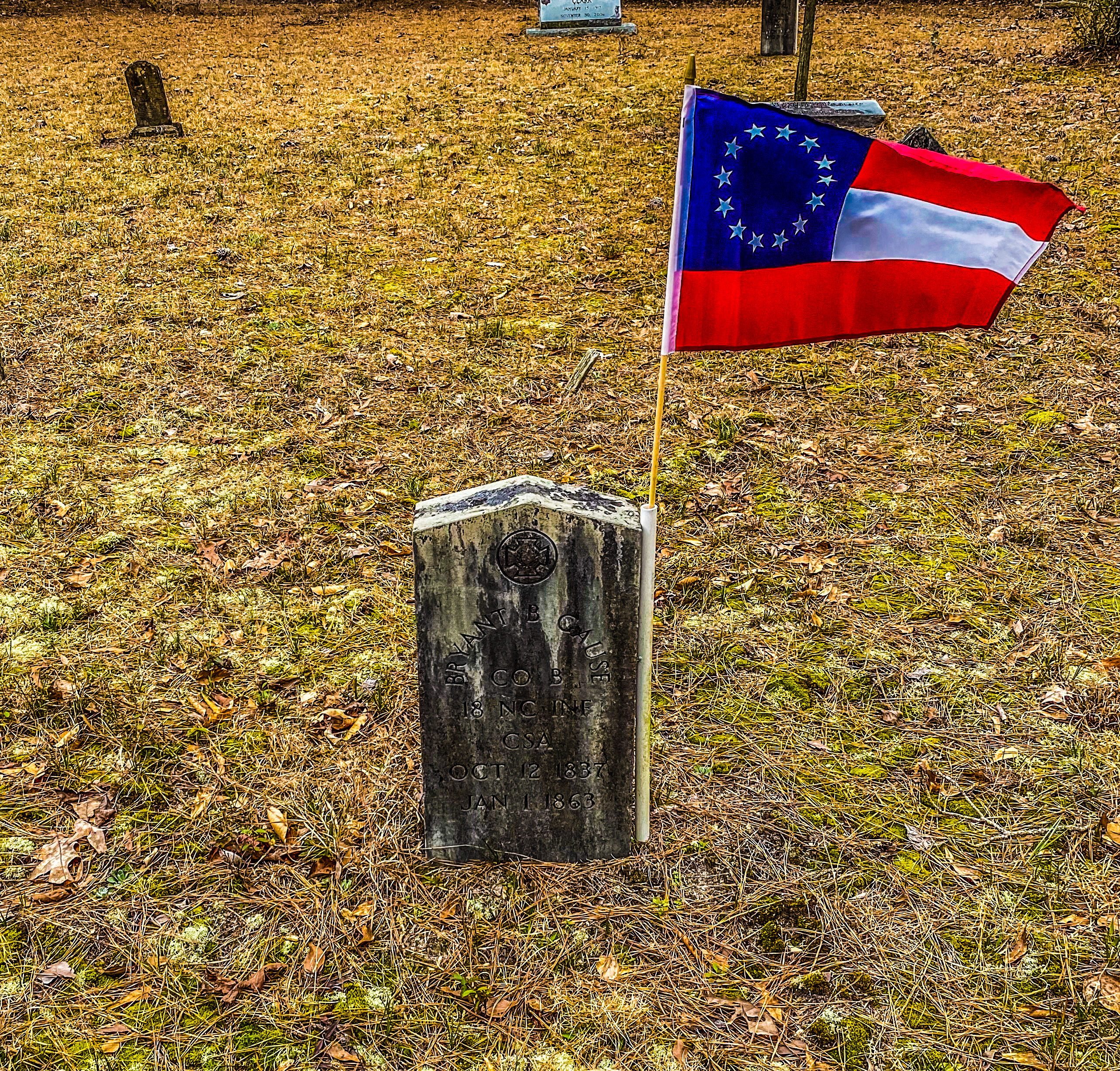
My recent adventures took me to Clarkton North Carolina. Here I stumbled upon Benevolence Cemetery, and the grave of Private Bryant B Gause. He was born in Bladen County North Carolina, to Henry Taylor and Lucy Ann Gause[1], on October 12th, 1837, [2] He was listed as being five feet ten inches tall, with blue eyes, dark hair, and a dark complexion.[3] Before the outbreak of the American Civil War Pvt. Gause was a farmer. He would meet Lucy Matilda Thompson. They would marry shortly before the hostilities began. Gause would enlist on May 3rd, 1861, at Elizabethtown North Carolina.[4] He was mustered into “B” Co. NC 18th Infantry the same day.[5] Not wanting to leave her husband and being 6 feet tall, 165 lbs., physically strong and an expert with the rifle herself[6], she…. “cut her thick hair close, took up seams in one of Bryant’s suits, oiled her squirrel musket, and boarded a train for Virginia as ‘Pvt. Bill Thompson”[7] 

She fought side by side with her husband and the 18th at First Manassas, and was wounded when… “an iron (shell) scrap tore open her scalp from forehead to crown (later protected by a silver plate).””[8] She was discovered as a woman but begged to be sent back to her husband’s side. Her request was approved, and she was with her husband during the Seven Days where he was wounded at Frayser’s Farm.[9] They would also be engaged at the Battles of Antietam and Fredericksburg. Sadly, during the Battle of Fredericksburg Pvt. Gause was seriously wounded[10]. He was taken to a hospital in Scottsville, VA. Where he would die from his injuries on January 1st, 1863.[11]

Battle of Fredericksburg, created by Currier and Ives, Library of Congress

His wife” Pvt. Bill Thompson” was not by his side when he passed, as she was in the advanced stages of pregnancy and was home to give birth to their daughter Mary Caroline Gause.[12] Pvt. Gause’s body would be escorted home by his wife ending her service as well.

Grave of Private Bryant B Gause at Benevolence Cemetery in Clarkton North Carolina. Photo by @firefightinirish.

He would be interred at Benevolence Cemetery in Clarkton North Carolina where he now rests. Lucy Matilda Thompson Gause AKA Pvt. Bill Thompson would go back to a more traditional role post war weaving and working the fields. She would eventually settle in Savannah, Georgia. Here she would meet an Irishman who served in the Union Navy by the name of Joseph Patrick Kenney. [13] They would have six children. Lucy would die on June 22, 1925, at the age of 83. She is buried at the Meeks Cemetery in Nicholls, Georgia.[14]


[1] Gloria Cash, “Gill Family Tree,” Ancestry, accessed April 21, 2021, https://www.ancestry.com/family-tree/person/tree/153633896/person/102030276353/facts.

[2] “Page 1 Headstone Applications, 1925-1963.” Fold3. Accessed April 21, 2021. https://www.fold3.com/image/320518210.

[3] “Page 31 Civil War Service Records (CMSR) – Confederate – North Carolina,” Fold3, accessed April 21, 2021, https://www.fold3.com/image/37632252

[4] “Page 31 Civil War Service Records (CMSR) – Confederate – North Carolina,” Fold3, accessed April 21, 2021, https://www.fold3.com/image/37632252

[5] “Bryant B. Gause,” American Civil War Research Database (Historical Data Systems, Inc.), accessed April 21, 2021, http://www.civilwardata.com/active/hdsquery.dll?SoldierHistory?C&181744.

[6] “Florida 7th VF Bulletin,” Ancestry, accessed April 21, 2021, https://www.ancestry.com/mediaui-viewer/tree/1034196/person/6003737475/media/8a687238-5116-41c0-83db-19d1689cb275?_phsrc=ZhY340&_phstart=successSource.

[7] Mauriel Joslyn, Confederate Women (Gretna, LA: Pelican, 2005), Pg. 67.

[8] Mauriel Joslyn, Confederate Women (Gretna, LA: Pelican, 2005), Pg. 67.

[9] “Bryant B. Gause,” American Civil War Research Database (Historical Data Systems, Inc.), accessed April 21, 2021, http://www.civilwardata.com/active/hdsquery.dll?SoldierHistory?C&181744.

[10] “Page 31 Civil War Service Records (CMSR) – Confederate – North Carolina,” Fold3, accessed April 21, 2021, https://www.fold3.com/image/37632252.

[11] Ibid

[12] DeAnne Blanton and Lauren M. Cook, They Fought like Demons: Women Soldiers in the American Civil War (Stroud: Sutton, 2005), Pg. 59.

[13] “Florida 7th VF Bulletin,” Ancestry, accessed April 21, 2021, https://www.ancestry.com/mediaui-viewer/tree/1034196/person/6003737475/media/8a687238-5116-41c0-83db-19d1689cb275?_phsrc=ZhY340&_phstart=successSource.

[14] Ibid

A soldier’s story at Forest hill Cemetery Morganton North Carolina.

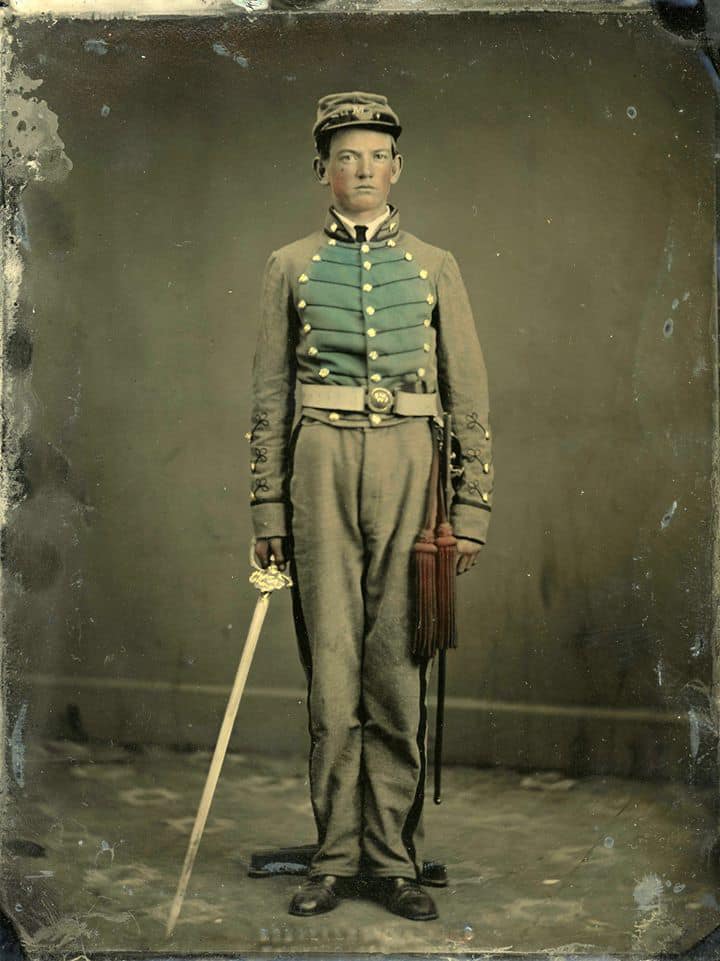
On my way back from Asheville I made a quick stop in Morganton. Here I paid respects to Lieut. John Caldwell. He was born in 1845 at Morganton, North Carolina to Tod & Minerva Caldwell. John grew up and worked on his family farm. In 1861 John who was known as “Jack”, was a Cadet at the Hillsboro Military Academy.[1] His father was a Unionist, but John went against his father’s wishes and chose to join his friends and defend his state. In July of 1861 John Was a member of the 6th North Carolina Volunteers stationed in Staunton Virginia.[2] By December of 1861, Caldwell was serving as a Drill Instructor for the state of North Carolina in a training camp at Asheville.[3]  He continued in this capacity through 1862, until most of the volunteer regiments had organized and marched off. On May 5th, 1863, John Caldwell was mustered into “E” Co. 33rd North Carolina Infantry as a Private.[4]

1/4 plate tintype of Lieut. John Caldwell Courtesy of the Brem Family Collection.

He would be immediately promoted to Lieut. in order to replace the 33rd’s loses from the Battle of Chancellorsville.[5]  Upon hearing of Young Johns promotion his father sent him a letter containing some wise fatherly advice… “Don’t be tyrannical or overbearing toward your men. Be kind and obliging to everyone no matter how low or humble his position may be, and if you get into battle be like a man and a true soldier. Be kind and merciful to your enemies if any should be placed in your power. It is a badge of true courage and of a gentlemanly Christian spirit to show mercy and kindness to your enemies and it may in the fortunes of war happen that you may need the friendship of those you are fighting against. Observe vigorously the golden rule, “to do unto others as you would have them do unto you.” Oh what would I not give if this cruel and unnatural war was ended and you and your army and in honor return home to your friends.”[6]            

Lieut. Caldwell led his men during the march into Pennsylvania, he and his men were shelled along the way, and performed picket duty. They would reach Gettysburg on July 1st at around 15:30 they “on the right of the Division in the final and successful movement against the Union forces on Seminary Ridge held back Union Cavalry which threatened the flank and had a sharp conflict at the stone wall on Seminary Ridge just south of Fairfield Road.”[7]  On the second day the 33rd was involved in some heavy skirmishing. “our line of battle was not engaged but there was a very strong picket fighting in front of us and as it was the turn of his company to go out on skirmish he (John Caldwell) was skirmishing all day and was not relived until about sundown. He took his skirmishers out in gallant style and during the day lost two of his company killed and several wounded.”[8]  On the third day Lieut. Caldwell and the 33rd took part in the Pickett–Pettigrew–Trimble Charge, as part of Longstreet’s assault. During the assault Lieut. Caldwell and Lieut. Wilson Lucas were ordered by General Pender to command 75 men and take a farm lane. Lieut. Wilson Lucas writes of this action saying…. 

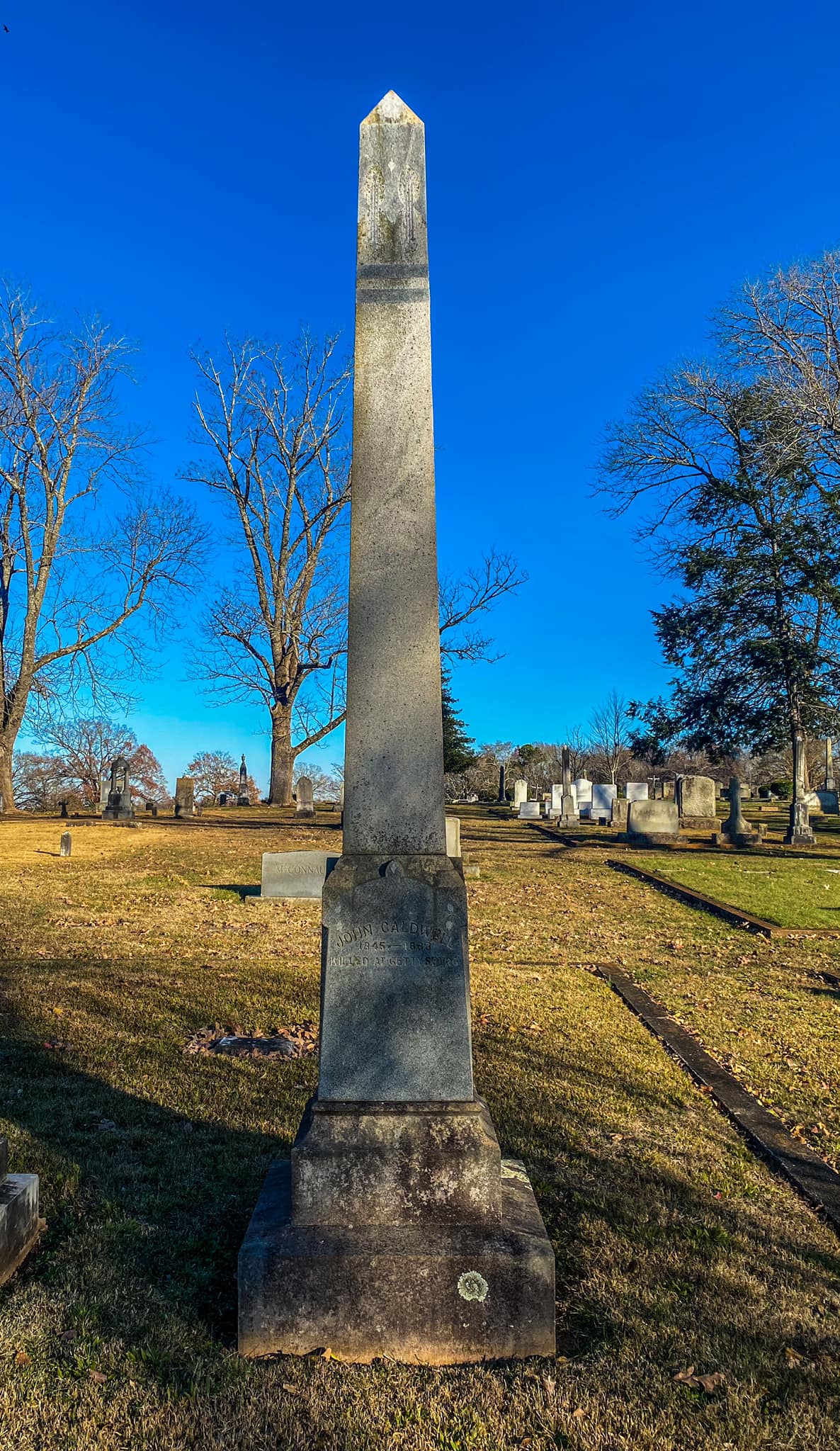
Gravestone of Lieut. John Caldwell 33rd North Carolina Infantry at Forest hill Cemetery Morganton North Carolina Photo By @firefightinirish

“We formed the men in line, I commanded the right and Lieut. Caldwell the left. We had to charge through an open field, with no protection whatever. … When we got within two hundred yards of the Federals, we charged with a yell, and they stood their ground until we were within ten steps of the road, then a part of them ran, but 26 surrendered. And the very last time they fired upon us, which was not more than twelve or fourteen feet from them, they shot Lieut. Caldwell in the left breast. I did not see him fall. As soon as we were in the road one of the men told me Lieut. Caldwell was killed. I went at once to the left and found him, lying partly on his back and side … I called two men, and we placed him on his back and spread his oil cloth over him. He was warm and bleeding very freely when I got to him. I could not send him out to the regiment, for it was such an exposed placed the Federal skirmishers would have killed a man before he could get a hundred yards, as we were lying close to each other.”[9] 

Currier & Ives. The battle of Gettysburg, Pa. July 3d. United States, 1863. [New York: Published by Currier & Ives, ?] Photograph. https://www.loc.gov/item/90709061/.

Lieut. Caldwell’s commanding officer Col. Avery in letter to John’s father wrote “You may have the satisfaction to know that he fell where we would all wish to fall (if it be God will) with his face to the enemy.’[10] Lieut. John Caldwell’s body was buried on Seminary Ridge that night “near “two honey-pod trees … not far from an old two-story house.”[11] Even with the reports of Lieut. Caldwell falling before the enemy, his father refused to believe his son was killed.

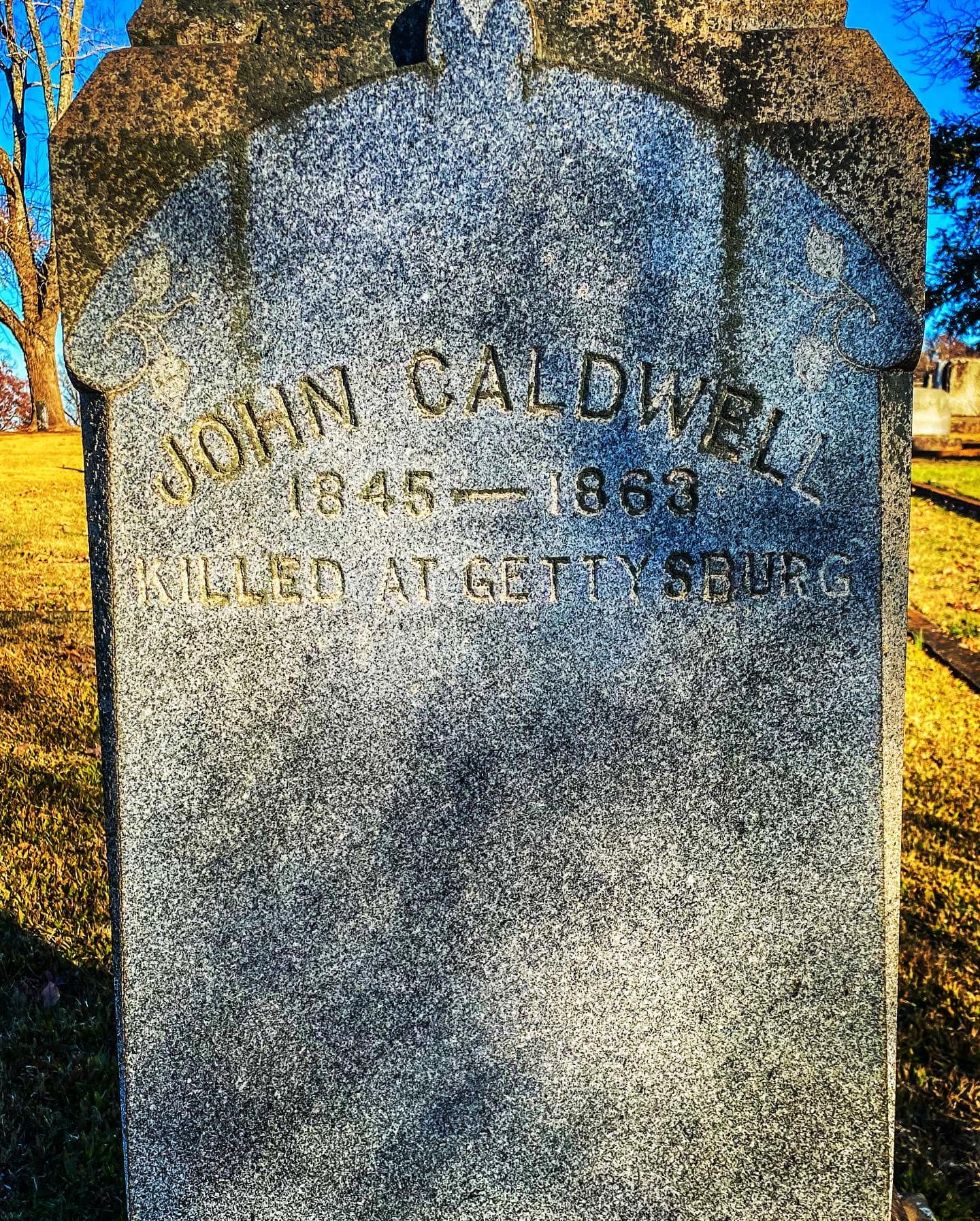
Inscription on Lieut. John Caldwell’s grave at Forest hill Cemetery Morganton North Carolina. Photo By @firefightinirish

It was not until Tod R, Caldwell was governor of North Carolina, that he found out his son’s fate. It was told to him by Lieut. Wilson Lucas who was then a state legislature. It was said that the Governor “locked himself in his room and was all day in tears”.[12] Gov. Caldwell kept this secret from his wife for 14 years, she found out when Lieut. Caldwell’s bloodied commission to Lieut. Was sent home by a New Yorker who had found it on the Battlefield. Lieut. Caldwell’s body would be returned to North Carolina and reinterned at Forest Hill Cemetery in Morganton.  Let us never forget this young man’s sacrifice for his state and his country.   


[1] “Tod Robinson Caldwell Papers, 1801-1890.,” UNC University Libraries, accessed November 28, 2021, https://finding-aids.lib.unc.edu/00128/#folder_5#1.  Scan 12

[2] Ibid, Scan 14

[3] Ibid, Scan 25

[4] “Page 2 Civil War Service Records (CMSR) – Confederate – North Carolina,” Fold3, accessed November 29, 2021, https://www.fold3.com/image/45066577.

[5] Ibid

[6] Christopher M. Watford, The Civil War in North Carolina: Soldiers’ and Civilians’ Letters and Diaries, 1861-1865 (Jefferson, North California: McFarland & Company, Inc., Publishers, 2009). Pg. 278

[7] “History of the 33rd North Carolina Infantry Regiment in the Civil War,” The Civil War in the East, May 17, 2021, https://civilwarintheeast.com/confederate-regiments/north-carolina/33rd-north-carolina-infantry-regiment/.

[8] Don Ernsberger, Also for Glory: The Pettigrew-Trimble Charge at Gettysburg July 3, 1863 (United States: Xlibris Corp, 2008). Pg. 57

[9] Michael C. Hardy, General Lee’s Immortals: The Battles and Campaigns of the Branch-Lane Brigade in the Army of Northern Virginia, 1861-1865 (El Dorado Hills, CA: Savas Beatie LLC, 2018). Pg. 330

[10] Biff Hollingsworth, “18 July 1863: ‘You May Have the Satisfaction to Know That He Fell Where We Would All Wish to Fall (If It Be God Will) with His Face to the Enemy.”: Civil War Day by Day,” 18 July 1863: “You may have the satisfaction to know that he fell where we would all wish to fall (if it be God will) with his face to the enemy.” | Civil War Day by Day, accessed November 29, 2021, https://web.lib.unc.edu/civilwar/index.php/2013/07/18/18-july-1863-you-may-have-the-satisfaction-to-know-that-he-fell-where-we-would-all-wish-to-fall-if-it-be-god-will-with-his-face-to-the-enemy/.

[11] Michael C. Hardy, General Lee’s Immortals: The Battles and Campaigns of the Branch-Lane Brigade in the Army of Northern Virginia, 1861-1865 (El Dorado Hills, CA: Savas Beatie LLC, 2018). Pg. 350

[12] John Hartwell, “Lt. John Caldwell, 33rd North Carolina, Pender’s Brigade,” Civil War Talk, n.d., https://civilwartalk.com/threads/lt-john-caldwell-33rd-north-carolina-penders-brigade.135030/?amp=1.