From Firefighter to Soldier: The Journey of Captain Alfred A. Donalds

During an adventure at Green-Wood Cemetery in Brooklyn, I discovered the grave of Captain Alfred A. Donalds. He was born to David and Susan Donalds in Columbia County, New York, around 1835[1].  Captain Donalds was listed as a ship carpenter during the 1860 census. He was also the foreman of East River Engine Co. 17 part of The Fire Department of New York.

Torchlight Procession of the New York Firemen – from original sketch, The Illustrated London News, January 23, 1858, page 93. From The Rona and Martin Schneider Collection of Late 19th and Early 20th Century American Fine Art Prints
Small folio hand-colored lithograph published by George Whiting of New York in 1861, titled “Col. Emer Ellsworth, (of the New York Zouaves).” From The American Military Heritage Museum Of North Carolina

Soon after the outbreak of the American Civil War, Col. Elmer Ellsworth put out the following call:

I want the New York firemen, for there are no more effective men in the country, and none with whom I can do so much. They are sleeping on a volcano at Washington, and I want men who are ready at any moment to plunge into the thickest of the fight.”[2]  

On April 20th, 1861, Donalds answered that call, enlisting as a 1st Sergeant. He mustered into “I” Co. NY 11th Infantry (First Fire Zouaves) a few weeks later. On April 29th, 1861, Under the command of Col. Elmer Ellsworth, then Sgt. Donalds and the 11th New York infantry left for Washington, D.C.

The Departure of Ellsworth’s Zouaves escorted by the New York fire Dept. Illus. in: Frank Leslie’s Illustrated Newspaper, 1861 May 11, p. 404

  In Washington, the regiment showcased their unique Zouave characteristics and effectiveness as firefighters when a severe fire erupted close to Willard’s hotel. Col. Ellsworth took up the task. Upon receiving the order, ten men from each company quickly hurried to the engine house, forced the door open, and swiftly arrived at the scene with the firefighting equipment. They were soon joined by most of their fellow soldiers, with Col. Ellsworth taking charge and, after strenuous effort, successfully extinguishing the flames. General Mansfield publicly thanked them for their assistance, and the citizens enthusiastically cheered for them.  J. Frank Kernan’s book Reminiscences of the Old Fire Laddies and Volunteer Fire Departments of New York and Brooklyn describes one of the most heroic scenes of the incident.

It was necessary to get the hose to the roof of the hotel, but the ladders were not long enough While in dilemma, Mr. Alfred Smith, one of the Zouaves…suggested that if his comrades would hold him suspended, by the legs he would reach down to the man on the ladder below and make a coupling of the hose Corporal Keese and a companion grasped the daring Smith by the feet and held head downward he made a connection to the butt. The water was then turned on, and Willard’s was saved.”[3]

Waud, Alfred R. , Artist. Gallant conduct of Ellsworth’s Zouaves, in their successful endeavor to save Willard’s Hotel, Washington / sketch by A. Waud Washington D.C, 1861. Photograph. https://www.loc.gov/item/2006677587/.

  On May 24th, 1861, Sgt. Donalds and the 11th New York boarded boats. They arrived in Alexandria and seized control of the dock and the city. At this point, Colonel Ellsworth

Currier & Ives. Death of Col. Ellsworth After hauling down the rebel flag, at the taking of Alexandria, Va., May 24th/ / Brownell ; Jackson. United States, ca. 1861. N.Y.: Pub. by Currier & Ives. Photograph. https://www.loc.gov/item/2001696141/.

proceeded to the top of the Marshall House, removing the secession flag that had been flying there for several days. While descending the stairs with the flag, he was shot in the chest by a rebel named Jackson and died immediately. Private Brownell of Co. A quickly shot the assassin. The death of their faithful leader shook the regiment; however, they continued.

On June 21st, 1861, during the battle of First Bull Run, Sgt. Donalds and the 11th regiment effectively engaged in close combat with the renowned Black Horse cavalry. The rallying cry of “Ellsworth! Remember Ellsworth!”[4] accompanied each engagement, resulting in the fall of enemy horsemen. Amidst the chaos and fervor of battle, each soldier fought independently as the tumultuous conflict drowned out the officers’ commands.  After failing to gain ground with their cavalry, the opposing forces unleashed their elite infantry and favored “Louisiana Zouaves” in overwhelming numbers upon the regiment. The opposing new force was pushed back three times, and only after two hours of fighting did it finally give up the ground. Before the 11th retired from the field, they ran to help other units in trouble. One of those units was the famed 69th N.Y.S.M.

“New York’s Bravest” . The 69th New York and the 11th New York (1st Fire Zouaves) defend the 69th’s Green Irish flag at the Battle of First Manassas. By Don Troiani Historical Artist

The 69th were beaten back, and both their flag and a high-ranking officer had been captured. Men of the 11th, led by Captain John Wildey, rushed in to help the beleaguered 69th. This is an account of what transpired:

 “At the fight at Bull Run, when the flag of the glorious Sixty-ninth Regiment was wrested from them by a superior force of the enemy, John Wildey rushed forward at the head of his brave men, and after a bloody contest, in which he killed two men,–one a rebel officer, whose sword he took from him as a trophy,–recaptured the flag, and after marching four miles he restored it to the gallant corps from whom it had been taken.[5] 

During this engagement, the 11th  suffered twenty-four fatalities and forty-six injuries, and fifty-two soldiers went missing, with many of them being captured as prisoners.[6]

On August 1st, 1862, Donalds was discharged for promotion. He was commissioned into “F” Co. NY 73rd Infantry (Second Fire Zouaves) the same day[7]. Captain Donalds and the 73rd were involved in the following engagements: The Siege of Yorktown, The Battle of Williamsburg, and The Battle of Fair Oaks. After the battle of Fair Oaks, Commander of the 73rd NY, William R. Brewster, recognized him and other captains for their aid “…in urging forward the men when exposed to a galling fire and obliged to advance through a thick entanglement of brush and felled timber. Most of my men were shot while climbing over felled trees.[8]

The 73rd and Captain Donald were also heavily engaged during the Seven Days Battles. After the battle of Malvern Hill, General Daniel Sickles wrote,

 I must especially commend the admirable conduct of Captain Alfred A. Donalds in commanding Fourth Excelsior. He was not assisted by a single officer above the rank of lieutenant, and of these, only four were on duty. Notwithstanding every embarrassment, the fragment of his brave command was most effectively and gallantly led by him throughout the day.[9].

Currier & Ives. The battle of Malvern Hill, Va. July 1st. , 1861. [New York: Currier & Ives, ?] Photograph. https://www.loc.gov/item/90709064/.

Brigadier General Joseph Hooker mentioned Donalds after the fight at Harrison’s Landing. He commended Captain Donalds for his admirable service, acknowledging that his “heroic conduct was conspicuous throughout the day.”[10]

On August 27th, 1862, Captain Donalds was killed in action as acting commander of the 73rd New York during a skirmish at Kettle Run near Bristoe Station, VA. On September 8th of that same year, in his field report from Fort Lyon, Virginia, Brigadier General Nelson Taylor of the United States Army saluted Captain Donalds by saying,

“In closing this report, I shall avail myself of the opportunity to express my admiration of the gallant conduct on the field of the officers and men who so nobly followed the fortunes of the brigade during the time which this report covers, particularly to the lamented Captain Alfred A. Donalds, of the Fourth Excelsior Regiment, who fell early in the action at Bristoe Station.…”[11]  

The captain’s mortal remains were retrieved from Washington, D.C., and returned to New York. Here, Chief Engineer John Decker of the Fire Department of New York ordered to “call out the Department to attend the funeral. The various companies will wear their respective badges of mourning, the Chief and Assistants act as marshals, and the fire alarm bells will be tolled during the solemnities.” [12]

The Fire Department of New York passed the following resolution on the day of his funeral:

“Whereas It is with feelings of pain and regret we have heard of the death of our late brother, associate, and member, Captain Alfred A. Donalds of the Second Regiment Fire Zouaves, who fell while gallantly and nobly fighting in the cause of the Union; therefore, be it Resolved, That in the death of Captain Alfred A. Donalds, the country has lost the services of a brave and efficient officer, the Department an esteemed and faithful member, and his associates a true and devoted friend. Resolved, that we deeply deplore the death of our late friend and companion and beg to leave to tender our heartfelt sympathies to his relatives, recommending them for consolation to the mercy of Him who doeth all things for the best.” [13]

The commanding officer of the 73rd New York Infantry, Col. William R. Brewster, wrote the following letter to the Foreman of Engine Company No. 17:

“This week, the remains of the late Capt. Donalds of your company wounded at the battle of Bristol will be sent to New York for appropriate burial. Capt. Donalds had, by his gallant conduct in action, his courage and zeal, conspicuous among so many brave comrades, attracted the attention of his brigade and division Commanders and had been frequently noticed in their official reports in the most flattering terms.

During a long period of sickness and imprisonment under which I suffered, completely unfitting me for any service in the field, the command of my regiment devolved upon Capt. Donalds, and, by his close attention to the arduous duties required of a commanding officer through the Peninsular campaign and cheerfulness of disposition under the most trying circumstances, he had endeared himself to all. By the death of Capt. Donalds, the service loses a brave and gallant officer, while to myself, the loss is that of a true and tried friend upon whom I could at all times rely

The regiment which I have the honor to command was raised under the auspices of the Fire Department of the City of New York and composed almost entirely of members of that Organization. The courage they have shown in the many bloody contests which, as a portion of the celebrated Excelsior Brigade and Hooker’s (now Sickles’) Division, silences the clamor of those who say that firemen do not make good soldiers.The battle of Bristol, in which Capt. Donalds fell, was of short duration, but one of the most severely contested during the present war. The regiment went into action with but ninety men and eight officers, and in one hour and ten minutes, forty-eight men and five officers lay killed upon the field. It was while urging the reinforcements, both by voice and example, that Capt. Donalds fell, mortally wounded. The name of Capt. Alfred A. Donalds should always be held in fond remembrance, not only by all your company but by every member of the Fire Department of New York. So long as the memory of her brave soldiers is cherished by a grateful people, so long will Capt. Donalds be remembered with gratitude and affection While we mourn his untimely death, let us never forget that he fell while nobly defending his country’s flag, with his back to his friends and his face to the foe. I am, Sir, Very respectfully yours,


WM. R. BREWSTER,

Colonel Commanding Fourth Regiment. [14]

Photo of Captain Donalds grave next to the 73rd New York Monument at Gettysburg. Photo by @firefightinirish

Captain Donalds was interred with full military and firematic services at Green Wood cemetery on November 23rd, 1862.

Captain Alfred A. Donalds, a prominent figure, in the Fire Department of New York demonstrated exceptional bravery and leadership during the American Civil War. His legacy lives on through his gallant actions on the battlefield, where he ultimately sacrificed his life in service to his country.


[1] “1850 United States Federal Census for Alfred Donalds.” Ancestry. Accessed June 18, 2024. https://www.ancestry.com/imageviewer/collections/8054/images/4196779-00372?pId=11569853.

[2] About.com, Col. Elmer Ellsworth Became a Legend and Martyr Early in the Civil War [online version available at http://history1800s.about.com/od/civilwar/ss/Death-of-Elmer-Ellsworth_2.htm.%5D

[3] Kernan, J. Frank. Reminiscences of the old fire laddies and volunteer fire departments of New York and Brooklyn: Together with a complete history of paid departments of both cities. New York, NY: M. Crane, 1885.

[4] “New York State Military Museum and Veterans Research Center.” 11th New York Infantry Regiment’s Civil War Historical Sketch :: New York State Military Museum and Veterans Research Center. Accessed June 19, 2024. https://museum.dmna.ny.gov/unit-history/infantry/11th-infantry-regiment/historical-sketch.

[5] The New York Herald. (New York, NY), Jul. 27, 1861. https://www.loc.gov/item/sn83030313/1861-07-27/ed-1/.

[6] New York State Military Museum and Veterans Research Center.” 11th New York Infantry Regiment’s Civil War Historical Sketch :: New York State Military Museum and Veterans Research Center. Accessed June 19, 2024. https://museum.dmna.ny.gov/unit-history/infantry/11th-infantry-regiment/historical-sketch.

[7] Gwmain. “Civil War Biographies: Deuschle-Dunbar – Green-Wood.” Green-Wood Cemetery, June 15, 2024. https://www.green-wood.com/2015/civil-war-biographies-deuschle-dunbar/.

[8] Ibid

[9] Ibid

[10] Ibid

[11] Ibid

[12] “The Funeral of Capt. Donalds.” New York Times. November 23, 1862, Vol. XII No. 3484 edition.

[13] Ibid

[14] Ibid
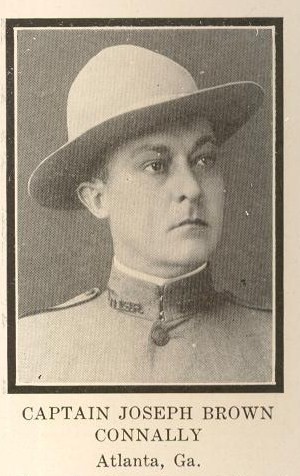
Captain Joseph Brown Connally: A True All American

On my recent stop in Atlanta, I took a trip over to Oakland Cemetery. Initially established as Atlanta Cemetery in 1850 and renamed Oakland Cemetery in 1872, this landmark is a hidden treasure located near the heart of Downtown Atlanta. Historic Oakland Cemetery is rich in history, and stories. One such story is that of Captain Joseph Brown Connally.

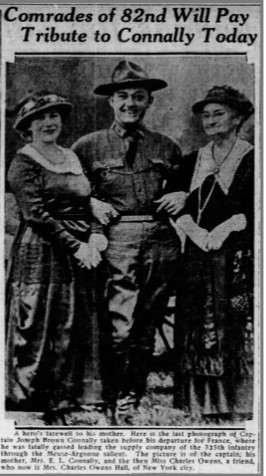
Photo from The Atlanta Constitution

He was born in Atlanta Georgia on December 17th, 1875. His Parents were Dr. Elisha Connally, and Mary Virginia Brown. Captain Connally’s maternal grandfather was former Georgia Governor Joseph Emerson Brown. Young J.B Connally would attend the finest schools before being accepted to The University of Georgia. He would graduate from there and become an Insurance Clerk, eventually Connally would help form the first car insurance agency in Atlanta.[1] Connally would enlist in the army during America’s first call for volunteers.[2] He would receive his officers training at Fort McPherson and be commissioned into the 82nd Division. Capt. Connally was assigned to the 325th Infantry on September 2nd 1917[3], then sent to Camp Gordon to train his men. Capt. Connally was put in charge of 325th’s supply company. He and his men left for Europe aboard the S.S. Karmala on April 18th, 1918.[4] 

Last photo of Capt. Connally. His mother is on the right and his friend Miss, Charles Owens is on his left. Photo from: The Atlanta Constitution, September 27, 1930.

They were sent to the Toul sector, then became engaged during the Battle of Saint-Mihiel, and The Meuse–Argonne offensive. On October 10th, 1918, during the Meuse–Argonne offensive, Capt. Connally was hit with gas. An article in the Atlantic Constitution describes the scene of his gassing, “Far above the noise of battle are heard the groans of the wounded and the wails of the dying. Over the outstretched forms of many of their comrades the 325th pushes on. When the smoke clears away Joe Brown Connally is one of those on the ground his lungs filled with deadly Poisonous gas.”[5] One of his men stated that “Captain Connally should have two medals of honor.” [6] He then reported that Capt. Connally could barely stand and kept directing and calming his men while refusing medical treatment. It was reported that Connally said when urged to go to the hospital “My boys need me: if I go there will be no one to take care of them and if I leave here before we are relieved it will be to my own funeral.” [7] Capt. Connally would be sent to a field hospital to convalesce before heading stateside aboard the S.S. Sierra on May 9th, 1919.[8]

Sadly Connally would not ever recover fully from the gas attack. He would die on August 26th, 1920, at Lawson General Hospital. His cause of death was listed as “valvular heart disease with mitral insufficiency “[9]secondary to the lasting effects of the gas.

Funeral of Capt. Connally at Second Baptist Church. Photo From: The Atlanta Constitution, September 27th 1930.

In 1922 the Connally family established the “Joe Brown Connally Scholarship in Georgia History, this scholarship is still awarded to this day.  Plaques honor Capt. Connally at Georgia Baptist Hospital, The University of George, and The Capital City Club.

At the Capital City Club plaque dedication, a friend said of Capt. Connally “As for his life at this club, it was he who showed us that the Volstead act could not kill the joy of the club, He showed Us that the roses on women’s cheeks bloom just as red after the act as before it, and taught us that Coca-Cola has a spice and can supplant champagne and that there is not really so great a gulf from Budweiser to Bevo.

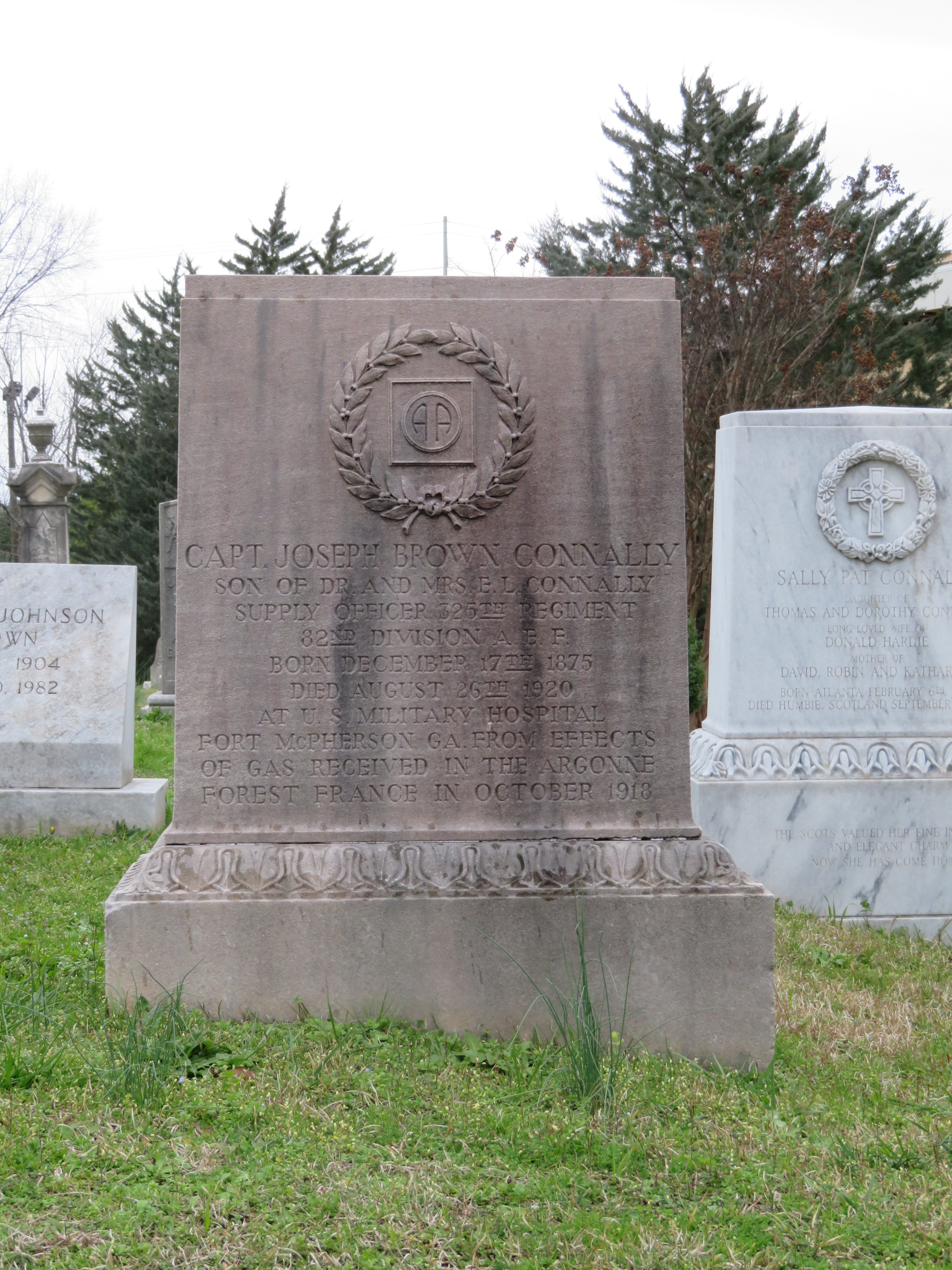
Grave of Captain Joseph Brown Connally at Oakland Cemetery. Photo Credit: @firefightinirish.

Those who knew him could never forget him and the great spirit he possessed. He was a prince of good fellows, and for cheer, unselfishness, and courage he had no superior.”[10]  Let us never forget Capt. Connally’s sacrifice, he truly was an All American…


[1] Galloway, Tammy Harden. The Inman Family: an Atlanta Family from Reconstruction to World War I. Macon, Ga: Mercer Univ. Press, 2002. Pg. 66-67

[2] “Tablet Unveiled To Honor Memory Of Capt. Connally.” The Atlanta Constitution, November 12, 1921.

[3] “Georgia, World War I Service Cards, 1917-1919 for Joseph Brown Connally.” Ancestry.com. Accessed February 29, 2020. https://tinyurl.com/qqjaun8.

[4] “Page 149 US Army WWI Transport Service, Passenger Lists.” Fold3. Accessed February 29, 2020. https://www.fold3.com/image/604138259.

[5] “Smile of Fallen Warrior Not Forgotten by Soldier Companions Who Fought Beside Him .” The Atlanta Constitution, September 27, 1930.

[6] “Captain Connally Given High Praise By Fellow Officer.” The Atlanta Constitution, December 8th, 1930.

[7] Ibid.

[8] “Page 434 US Army WWI Transport Service, Passenger Lists.” Fold3. Accessed February 29, 2020. https://www.fold3.com/image/604339436.

[9] “Georgia, Deaths Index, 1914-1940 for Joseph B. Connally.” Ancestry. Accessed February 29, 2020. https://tinyurl.com/rh7a6xb.

[10] “Tablet Unveiled To Honor Memory Of Capt. Connally.” The Atlanta Constitution, November 12, 1921.

A Civil War Image Speaks: The story of Captain Garrett Brady and the 2nd New Jersey Infantry

Every artifact has a story. This Carte de visite of Captain Garrett Brady, of the 2nd New Jersey Infantry is no different. Brady was born in Ballykilageer, Wicklow, Ireland on March 9th, 1836.[1] His parents were Bryan Brady and Lucy Graham. He would live in Ireland, working on the family farm till 1860. That is the year when he boarded the Prinz Albert in Galway enroute to America. Brady would arrive in New York City on April 16th of that year. [2]  By June of 1860 he would be living in Newark New Jersey working as a Morroco Dresser.[3]

Shortly after the bombardment of Fort Sumter Brady would answer the call, enlisting on May 27th, 1861. He would be commissioned as a 1st Lieutenant, in “C” Co. 2nd New Jersey Volunteer Infantry that same day.[4] Brady and the 2nd N.J.V.I were held in reserve at Bull Run, before heading to Washington D.C to support its defense. 1st Lieutenant Brady was promoted to Captain during The Seven days before Richmond. He would fight at Second Battle of Bull Run, and the Battle of South Mountain, where he and his regiment…

Carte de visite of Captain Garrett Brady 2nd New Jersey Infantry. The American Military Heritage Museum Of North Carolina

“Advanced from the fields north and west of Burkittsville, charged up the mountain, carried this point, and followed the enemy to the west foot of the mountain.”[5]

A few days later Brady would be involved in The Battle of Antietam. Here he and the second…

“Arrived upon the field from Crampton’s Pass about noon, and was formed for a charge upon the Confederate line just North of the Dunkard Church. The order for the charge was countermanded, and the brigade took position across this road, in support of the 6rh Corps Artillery, the right of the brigade in woods North of the road, the left in the open field South, where it remained, under artillery fire, until the morning of the 19th.”[6]

The next engagements Captain Brady would be involved in were the Battles Fredericksburg, Gettysburg, and the battle of the Wilderness. During the heat of the fight at the Wilderness the Confederates mounted a large attack…

“The attack spread east into the New Jersey Brigade and south toward the right flank of Morris’ brigade. It caught the 2nd New Jersey at its coffee fires. The veterans leaped to their feet and fell in across the paths of the retreating soldiers. “Back! Back! You cowards,” the Jerseymen shouted at the refugees who were breaking through their ranks. Captain Garrett Brady (Company C) drew his sword and vainly tried slapping frightened soldiers back into the ranks. Sedgwick dismounted, sword in one hand, stood on a log near the Culpeper Mine Road, and screamed, “For God’s sake, hold it.”[7]

Currier & Ives. The battle of the Wilderness Va. May 5th & 6th. Virginia, 1864. [New York: Pubd. by Currier & Ives, ?] Photograph. https://www.loc.gov/item/9071491

On May 12th, 1864, during The Battle of Spotsylvania Court House, Captain Brady lead Company “C” in the assault on the Salient, “Bloody Angle”. Here he was wounded in the thigh and taken prisoner. He was imprisoned at Camp Oglethorpe, Camp Sorghum, and the infamous Libby Prison before being released. Captain Brady would be discharged on January 1st, 1865.[8]

L. Prang & Co. Battle of Spottsylvania sic / Thulstrup. Virginia Spotsylvania, 1887. [Boston: L. Prang & Co] Photograph. https://www.loc.gov/item/90712278/.

After the war Brady returned to Newark and resumed his career as a Morocco Manufacture. According to the 1870 United States Federal Census Brady was married to Mary A Brady. They had four children, James, Joseph, John, and Mary.

Brady died on July 18th, 1886, from “Chronic Phthisis Pulmonalis”.[9] He is interred at Holy Sepulcher Cemetery East Orange, Essex County, New Jersey.


[1] “Ireland, Catholic Parish Registers, 1655-1915,” Ancestry, accessed June 11, 2022, https://www.ancestry.com/discoveryui-content/view/7206245:61039?ssrc=pt&tid=83040556&pid=202067016551.

[2] “New York, U.S., Arriving Passenger and Crew Lists (Including Castle Garden and Ellis Island), 1820-1957,” Ancestry, accessed June 11, 2022, https://tinyurl.com/534n88b3.

[3] “1860 United States Federal Census for Garrett Brady,” Ancestry, accessed June 11, 2022, https://www.ancestry.com/discoveryui-content/view/54161188:7667?ssrc=pt&tid=83040556&pid=202067016551.

[4] “Garrett Brady,” American Civil War Research Database, accessed June 12, 2022, http://www.civilwardata.com/active/index.html.

[5] “2nd New Jersey Volunteer Infantry Regiment,” The Civil War in the East, May 23, 2019, https://civilwarintheeast.com/us-regiments-batteries/new-jersey/2nd-new-jersey/.

[6] Ibid

[7] John M. Priest, in Victory without Triumph: The Wilderness, May 6th & 7th, 1864 (Shippensburg, PA: White Mane Pub. Co., 1996), pp. 201-202.

[8] “Garrett Brady,” American Civil War Research Database, accessed June 12, 2022, http://www.civilwardata.com/active/index.html.

[9] “1886 Garrett Brady, Newark NJ, Death Certificate,” Ancestry, accessed June 13, 2022, https://tinyurl.com/2bp35x8t.

A Letter Speaks

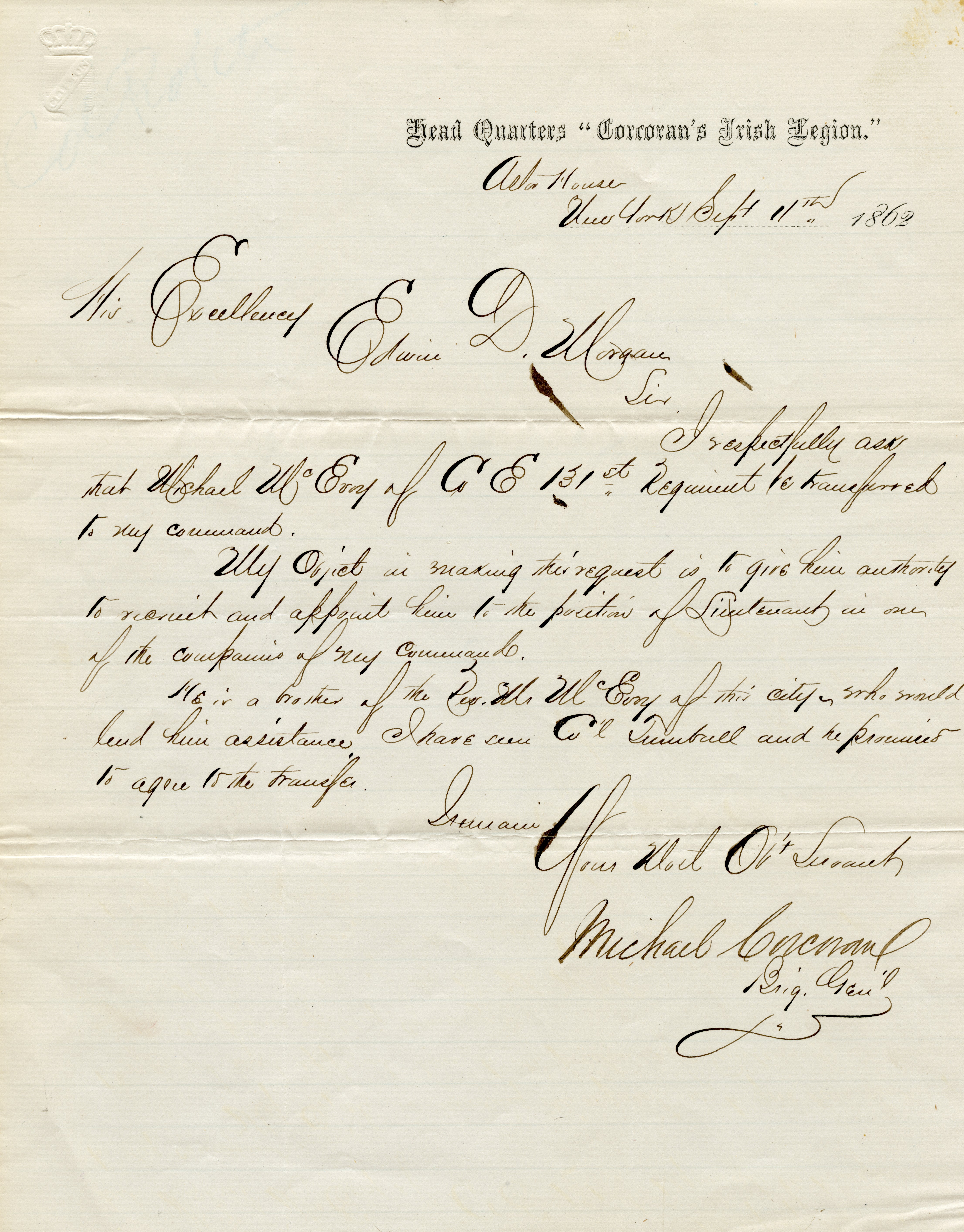
A letter to some is just a piece of paper with words on it. However when one digs deep they can find a hidden story. This letter is written and signed by Brigadier General Michael Corcoran. The letter’s recipient is then Governor of New York Edwin D. Morgan. In this post I am not going to just focus on the “big names” associated with the piece (We can all use Google for that). There is also the interesting tail of Michael McEvoy of Company E, 131st New York. So without further adieu may I present the The letter it reads……

“Sir,

I respectfully ask that Michael McEvoy of Company E, 131st Regiment be transferred to my command.

My object in making this request is to give him authority to recruit and appoint him to the position of Lieutenant in one of the companies of my command.

He is a brother of the Provost Marshal McEvoy of this city, who would lend his assistance. I have seen Colonel Turnbull and he promised to agree to the transfer.

I remain,

Your Most Obedient Servant,

Michael Corcoran

Brigadier General” [1]

Corcoran Letter, provided by The American Military Heritage Museum Of North Carolina
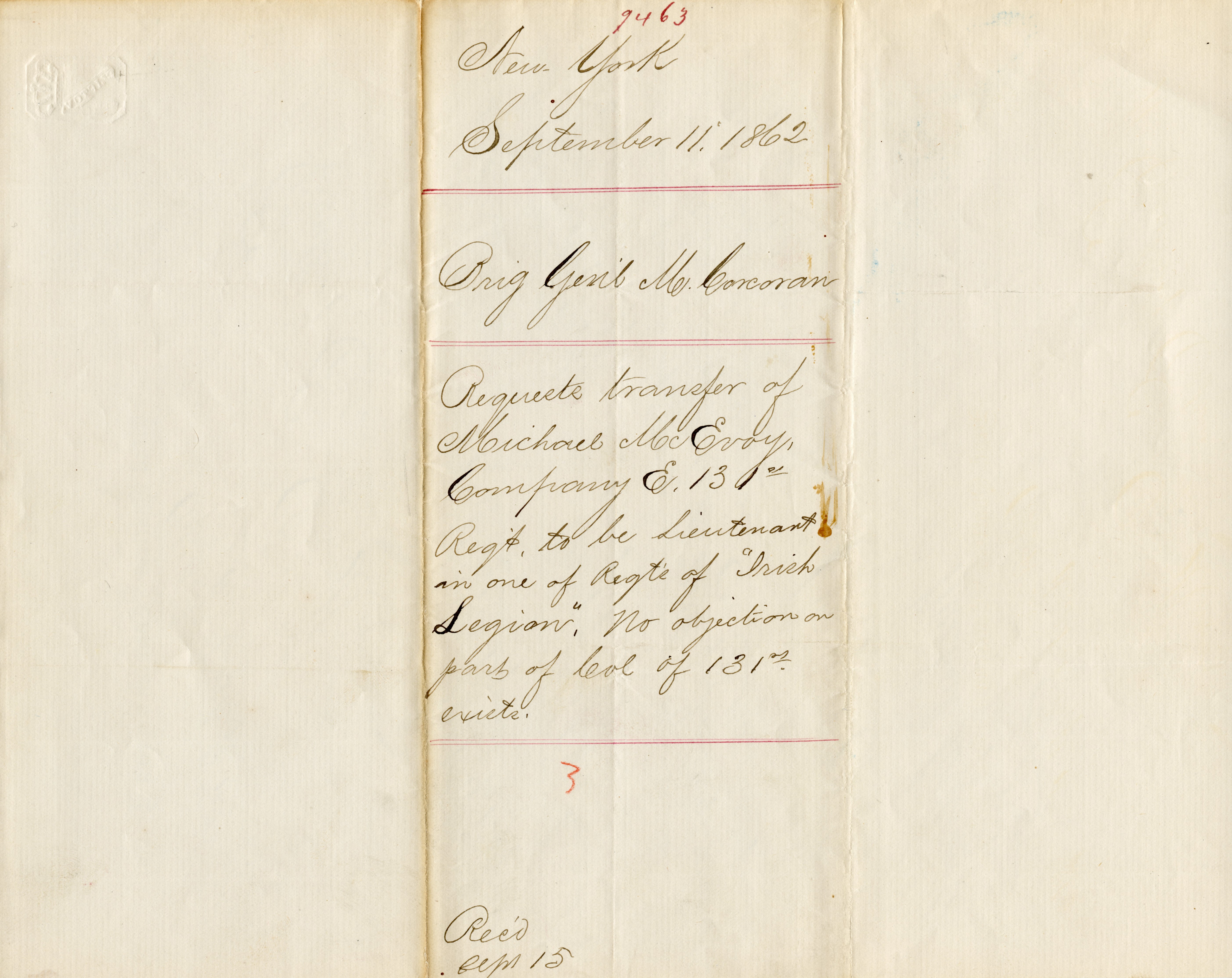
Back of the Corcoran Letter, provided by The American Military Heritage Museum Of North Carolina

Michael McEvoy was born in Ireland around 1828[2]. He was described as five feet nine inches tall, with blue eyes, light hair, and a light complexion.[3] McEvoy would immigrate to America prior to 1850. He was listed on the 1850 United States Federal Census as being a farmer, and married to Cath McEvoy, they had one child James.[4] McEvoy was employed as a Teamster, at the time of his enlistment in the Union army on August 13th, 1862.[5]

. He would be mustered into “E” Co 131st infantry as a private on September 6th.[6] Per General Corcoran’s request McEvoy would be transferred to “D” Co. 170th New York on September 19th, 1862.[7] He would be mustered in as a private on October 7th, 1862. Private McEvoy would participate in the battle of Deserted House. He would later be granted leave on March 21st, 1863, McEvoy would never return to service[8]. Private McEvoy would be listed as a deserter from camp at Suffolk Virginia on April 3rd, 1863.[9] That is where his trail ends for now.

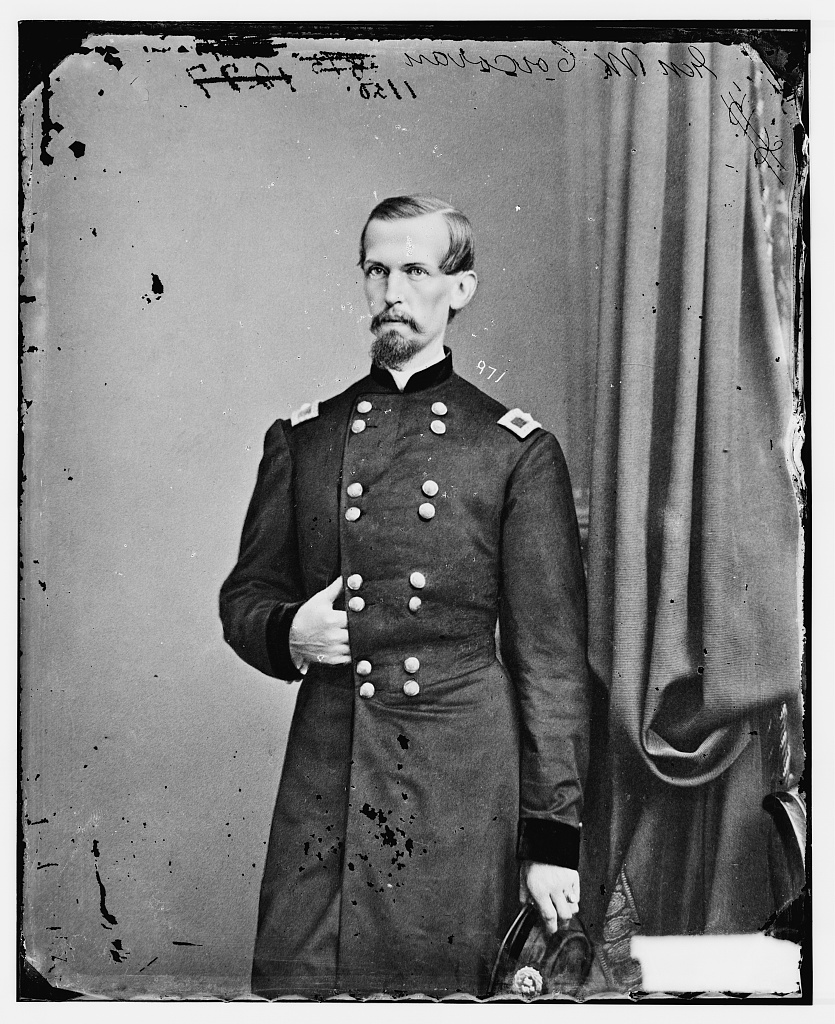
Michael Corcoran was born in Carrowkeel, county Sligo Ireland. He was a member of the Irish Nationalist Guerrilla force known as the Ribbonman. His ties to this group were eventually discovered in 1849, so he immigrated to New York City in order to avoid capture.[10] To gain a position in society Corcoran joined the 69th New York State Militia as a private. He would advance rapidly due to, “his military passion and his previous knowledge of military tactics were a great advantage to him.”[11] Corcoran moved up in rank and became a Colonel.  It was in this capacity that Corcoran became a hero to the Irish Nationalist, as well as the overall Irish immigrant population of New York. When he chose not to parade the 69th  in front of the Prince of Whales upon the Princes visit, saying that “as an Irishman he could not consistently parade Irish-born citizens in honor of the son of a sovereign, under whose rule Ireland was left a desert and her best sons exiled or banished.”[12] His action resulted in a court-martial. However, it was overturned due to the need of good officers to fight in the Civil War.


General Michael Corcoran, U.S.A. United States, None. [Between 1860 and 1865] Photograph. https://www.loc.gov/item/2018667330/.

Corcoran resumed his rank in the 69th New York and was present at that Battle of First Manassas, where he was captured. Corcoran spoke of this later by saying, “I did not surrender until I found myself after having successfully taken my regiment off the field, left with only seven men and surrounded by the enemy.”[13] Corcoran was eventually exchanged over a year later, and was received back with acclaim. He was given the rank of Brigadier General and put in command of his own troops, known as Corcoran’s “Irish Legion.” The first battle of the Legion took place during the Battle of Deserted House Virginia. Although not one of the biggest battles of the war, Corcoran demonstrated calmness under fire and his men showed how they admired Corcoran by following his every commanded under intense battle conditions. Sadly this would be Corcoran’s last major battle as he was killed later that year when he fell from his horse. Even though Corcoran’s life was cut short his legend and the Prince of Wales incident continued to inspire men, especially those of his Legion who were fighting for their adopted homes as well as Irish pride.

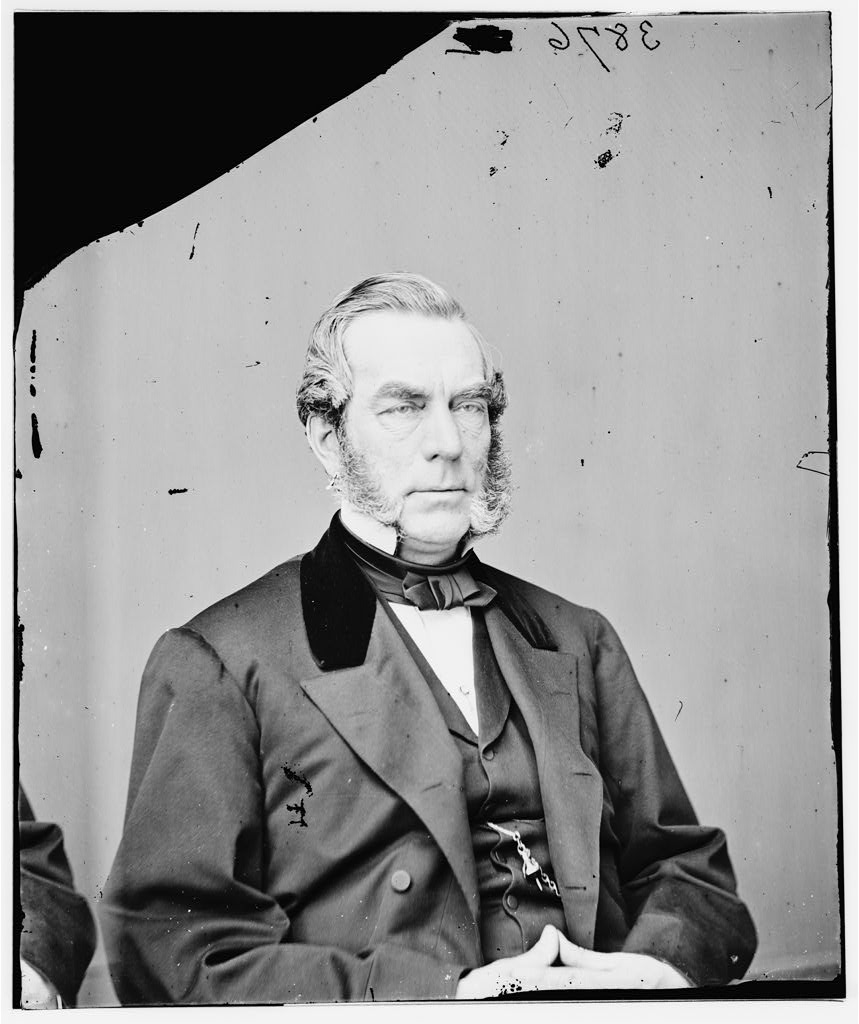
The National Governors Association has written this about Gov. Edwin D. Morgan.

“EDWIN D. MORGAN, the twenty-third governor of New York, was born in Washington, Massachusetts on February 8, 1811. His education was attained at the Bacon Academy in Colchester, Connecticut, where his family moved to in 1822. Morgan established a successful business career, with holdings in the banking and brokerage industries. He first entered politics in Connecticut, serving as a member of the Hartford city council, a position he held in 1832. After moving to New York, he served as alderman of New York City in 1849; was a member of the New York State Senate from 1850 to 1851; and served as the state immigration commissioner from 1855 to 1858. He also chaired the Republican National Committee from 1856 to 1864. Morgan next secured the Republican gubernatorial nomination, and was elected governor by a popular vote on November 2, 1858.

Edwin D. Morgan
. United States, None. [Between 1860 and 1870] Photograph. https://www.loc.gov/item/2018669639/.

He was reelected to a second term in 1860. During his tenure, the state’s canal system was advanced; Vassar College was founded; and volunteers were raised and equipped for service in the Civil War. Morgan also served as major general of volunteers during the war, as well as serving as the commander for the Department of New York. After leaving the governorship, Morgan was elected to the U.S. Senate, an office he held from 1863 to 1869. From 1872 to 1876 he chaired the Republican National Committee; and in 1881 he turned down an appointment to serve as U.S. secretary of treasury. Governor Edwin D. Morgan passed away on February 14, 1883, and was buried in the Cedar Hill Cemetery in Hartford, Connecticut.” [14]

Although these three men are from completely different backgrounds, their stories intersect in this one document. Historical stories are everywhere, you just need to dig under the surface to find them.


[1] Corcoran, Michael. Letter to Gov. Edwin D, Morgan. “Brigadier General Michael Corcoran Request For Michael McEvoy.” New York, New York: Astor House, September 11, 1862.

[2] “Page 1 New York Civil War Muster Roll Abstracts McEvoy, Michael.” Fold3. Accessed December 31, 2022. https://www.fold3.com/image/315981459.

[3] Ibid

[4] “Michael McEvoy in the 1850 United States Federal Census.” Ancestry. Accessed December 31, 2022. https://www.ancestry.com/discoveryui-content/view/7008512:8054?tid=&pid=&queryId=6a9bb6ca9453a20b805c27f011dfac83&_phsrc=csG312&_phstart=successSource.

[5] Page 1 New York Civil War Muster Roll Abstracts McEvoy, Michael.” Fold3. Accessed December 31, 2022. https://www.fold3.com/image/315981459

[6] Ibid

[7] “Page 1 New York Civil War Muster Roll Abstracts Michael McEvoy.” Fold3. Accessed December 31, 2022. https://www.fold3.com/image/316135643.

[8] Ibid

[9] Ibid

[10] Pritchard, Russ A. The Irish Brigade : a Pictorial History of the Famed Civil War Fighters. (Philadelphia,

[11] Conyngham, The Irish Brigade and It’s Campaigns , 537

[12] Ibid 

[13] Ibid, 538

[13] Shiels, Damian. Irish in the American Civil War Exploring Irish involvement in the American Civil War . March 18, 2012. http://irishamericancivilwar.com/2012/03/18/baptism-of-fire-the-corcoran-legion-at-deserted-house-virginia-30th-january-1863/ (accessed 11 20, 2013).

[14] Sobel, Robert, and John Raimo. “Edwin Denison Morgan.” National Governors Association. Accessed November 3, 2023. https://www.nga.org/governor/edwin-denison-morgan/.