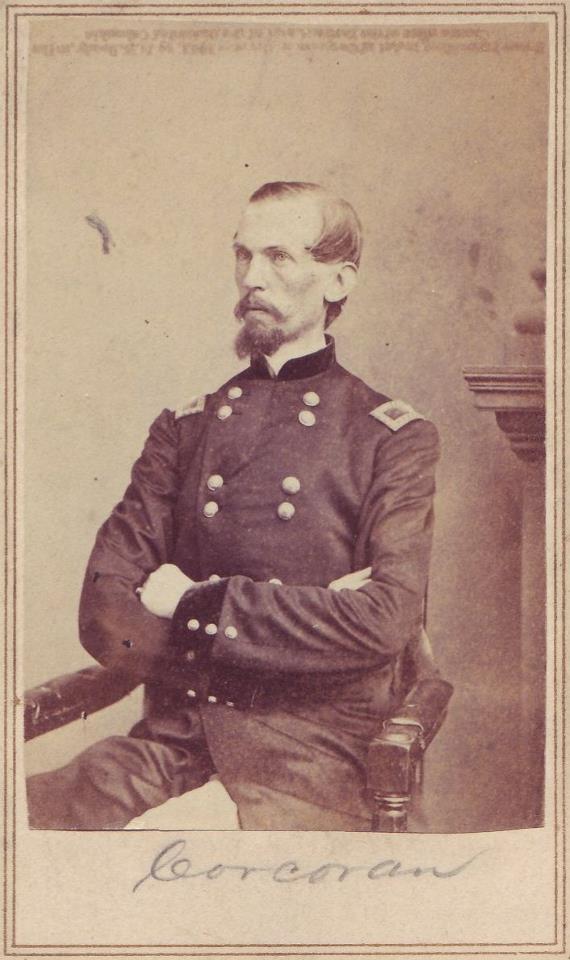
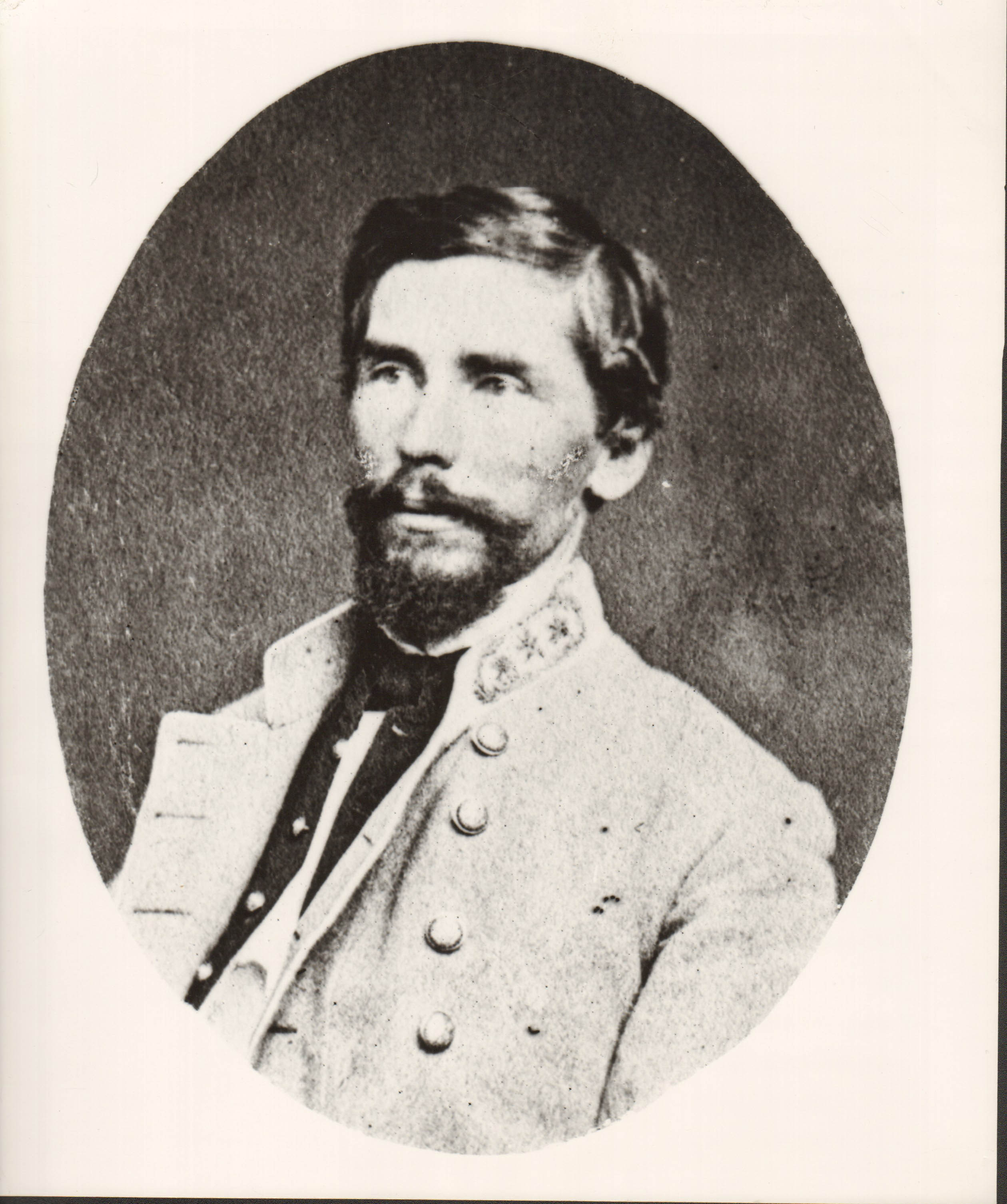
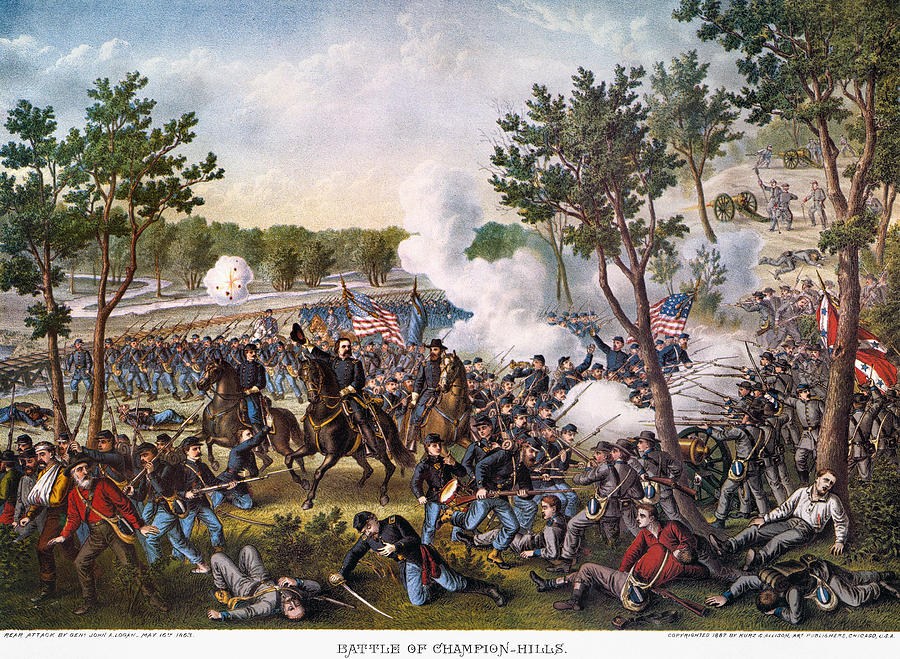
The Extraordinary Journey of Lieutenant Eugene Brady: From the Emerald Isle to the Heart of Philadelphia

Have you ever wondered about the personal stories behind those sepia-toned photographs of Civil War soldiers? Today, I want to share a story that touched my heart, one that brings to life the courage, sacrifice, and humanity of those who fought in America’s bloodiest conflict. In my hands lies a weathered letter, written by First Lieutenant Eugene Brady of the 116th Pennsylvania. The creases in the letter are witness to countless readings. Like thousands before him, Brady left the emerald shores of Ireland, seeking a new life in America. Instead, he found a nation torn apart by war and a calling that would ultimately lead to his destiny. Brady wasn’t just another officer in the famed Irish Brigade; he was a father, a husband, and a leader who earned the unwavering loyalty of his men. As I unfold this remarkable story of his final days, culminating in a fateful charge that would mark him as one of the last heroes of the Irish Brigade to fall in battle, we’ll discover how one immigrant’s journey became intertwined with America’s destiny.
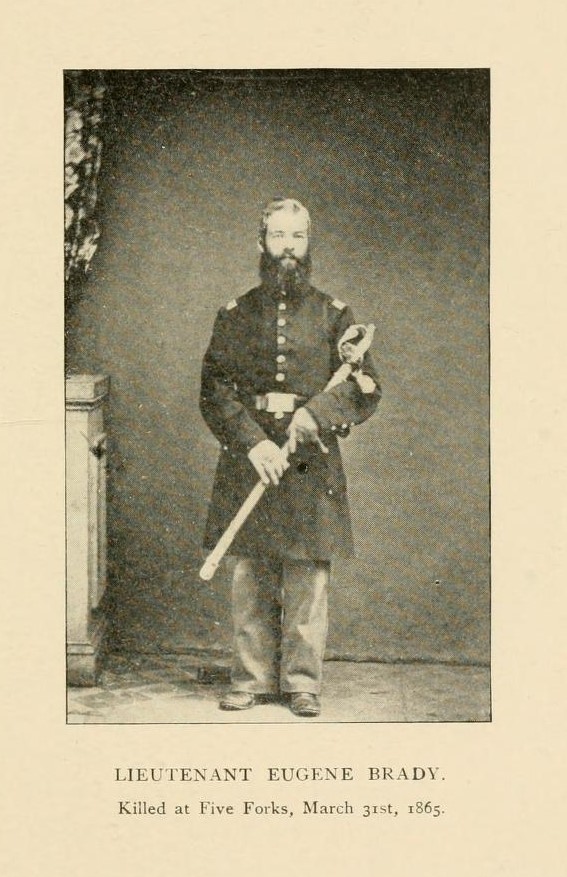
Mulholland, St. Clair A. The Story of the 116th Regiment: Pennsylvania Volunteers in the War of Rebellion: The Record of a Gallant Command. 1st ed. Philadelphia, United States of America: F. McManus, Jr. & Co., 1903. Pg. 377

Brady was born in Ireland circa 1830[1]. Eugene Brady immigrated to the United States to escape the Great Famine. He settled in Philadelphia, Pennsylvania, where he met Mary Fery. They married on October 18, 1855[2]and their Union resulted in four children. According to the 1860 United States Federal Census, Brady was employed as a police officer.

By the summer of 1862, Brady had shifted to a career as a painter, and the nation was embroiled in war. Brady responded to the call to arms, and enlisted on June 11, 1862[3]. He was mustered in as a corporal in Company “K” 116th Pennsylvania Infantry on August 15th, 1862[4]

Corporal Brady and the 116th Pennsylvania Infantry embarked on their journey from their home state to Washington, D.C., on August 31. They were marching toward the heart of the conflict. By September 7, they had reached Rockville, Maryland, and then advanced to Fairfax Courthouse. As October arrived, they advanced to Harper’s Ferry, West Virginia, where they officially joined the legendary Irish Brigade as part of the 2nd Brigade, 1st Division, 2nd Army Corps of the Army of the Potomac. From late October through mid-November, Brady and his comrades pressed through the rugged terrain of Loudoun Valley before settling at Falmouth, Virginia. There, they braved the elements and prepared for the battles ahead, camping until mid-December, and unknowingly standing on the precipice of the brutal engagement that awaited them, the Battle of Fredericksburg. Corporal Brady and 116th Pennsylvania had not previously engaged in a significant battle; Fredericksburg would be a brutal initiation. With the Union’s assault losing momentum, the 116th and the remainder of the Division were directed into the fray.
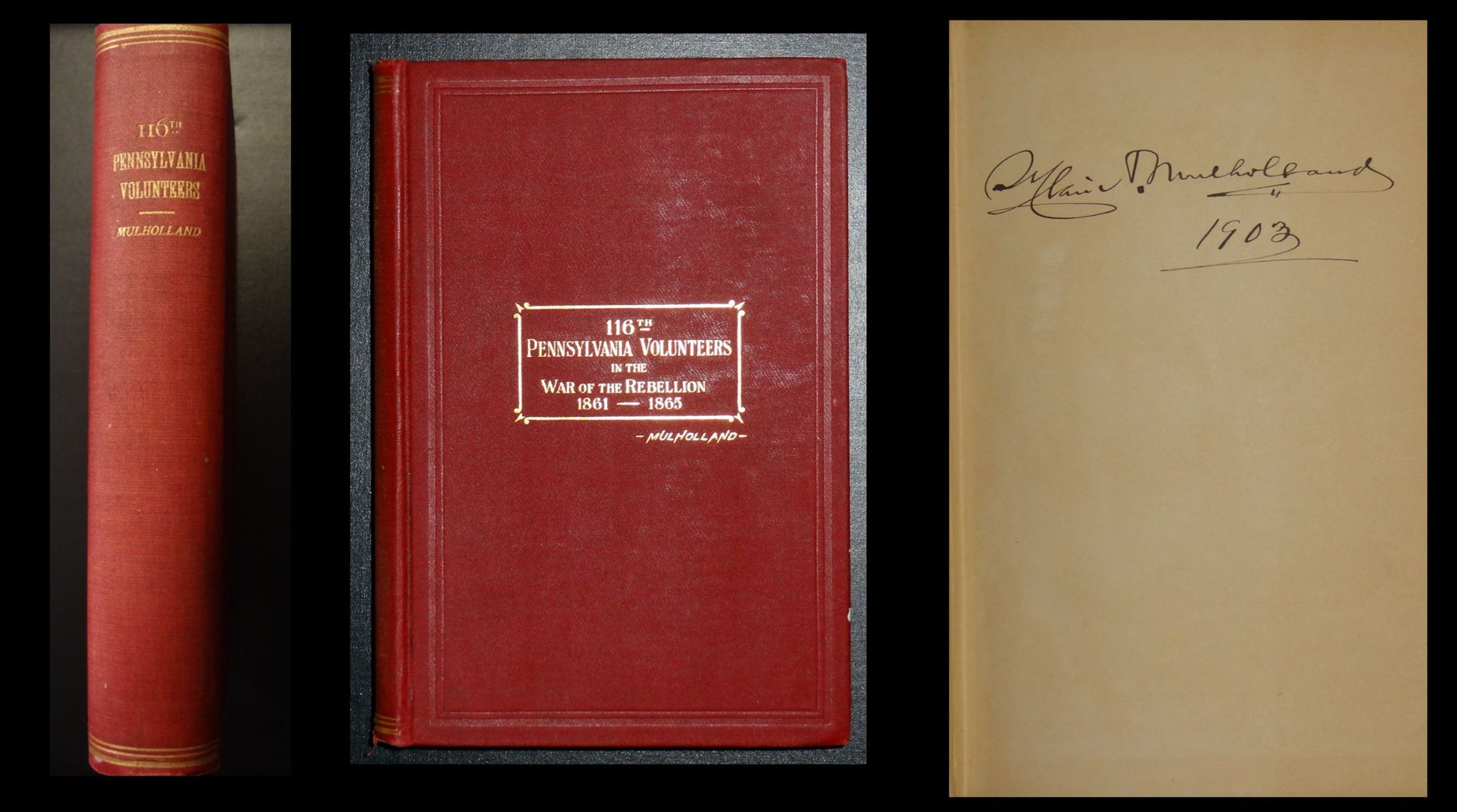
An image of a signed first edition of The Story of the 116th Regiment: Pennsylvania Volunteers in the War of Rebellion by Colonel St. Clair Augustine Mulholland, generously shared by the American Military Heritage Museum of North Carolina.

 All the soldiers adorned a sprig of green boxwood in their caps to signify their membership in Meagher’s Irish Brigade. In his book, The Story of the 116th Regiment: Pennsylvania Volunteers in the War of Rebellion, Colonel St. Clair Augustine Mulholland details the march into Fredericksburg the day before they engaged in the battle.

It was a cold, clear day, and when the Regiment filed over the bluffs and began descending the abrupt bank to cross the pontoons into the town, the crash of two hundred guns filled the valley of the Rappahannock with sound and smoke. The color-bearers of the Irish Brigade shook to the breeze their torn and shattered standards:

“That old green flag, that Irish flag, it is but now a tattered rag, but India’s store of precious ore Hath not a gem worth that old flag.”

The Fourteenth Brooklyn (” Beecher’s Pets “) gave the brigade a cheer, and the band of Hawkin’s Zouaves struck up ” Garry Owen ” as it passed. Not so pleasant was the reception of the professional embalmers who, alive to business, thrust their cards into the hands of the men as they went along, said cards being suggestive of an early trip home, nicely boxed up and delivered to loving friends by express, sweet as a nut and in perfect preservation, etc., etc.”[5]

On the morning of December 13, 1862, after a failed attack led by Union General Meade, Corporal Brady and the men of the 116th were called to arms and lined up for battle. These men heard the roar of battle in the distance and watched their wounded comrades march to the rear.

The wounded went past in great numbers, and the appearance of the dripping blood was not calculated to enthuse the men or cheer them for the first important battle. A German soldier, sitting in a barrow with his legs dangling over the side, was wheeled past. His foot had been shot off, and the blood was flowing from the stump. The man was quietly smoking, and when the barrow would tip to one side, he would remove the pipe from his lips and call out to the comrade who was pushing: “Ach, make right”! It seemed ludicrous, and some of the men smiled, but the sight was too much for one boy in the Regiment, William Dehaven, who sank in the street in a dead faint……..so the Regiment stood — under arms, listening to the sounds of the fight on the left and waiting patiently for their turn to share in the strife, while General Thomas Francis Meagher, mounted and surrounded by his staff, addressed each Regiment of his (the Irish) brigade in burning, eloquent words, beseeching the men to uphold in the coming struggle the military prestige and glory of their native land.”[6]

The men of the 116th were sent forward through a deserted city. Soldiers conversed in hushed whispers as exploding shells rained down, causing devastating damage. The first shell severely injured the Colonel, decapitated a Sergeant, and claimed the lives of three others in the 116th. One shell hit the 88th New York, putting 18 soldiers out of action. Despite this devastation, the Regiment continued marching in columns of four, but the bridge they needed to cross had been destroyed. The shells continued to fall, accompanied by Minie balls intertwining with their screeches.
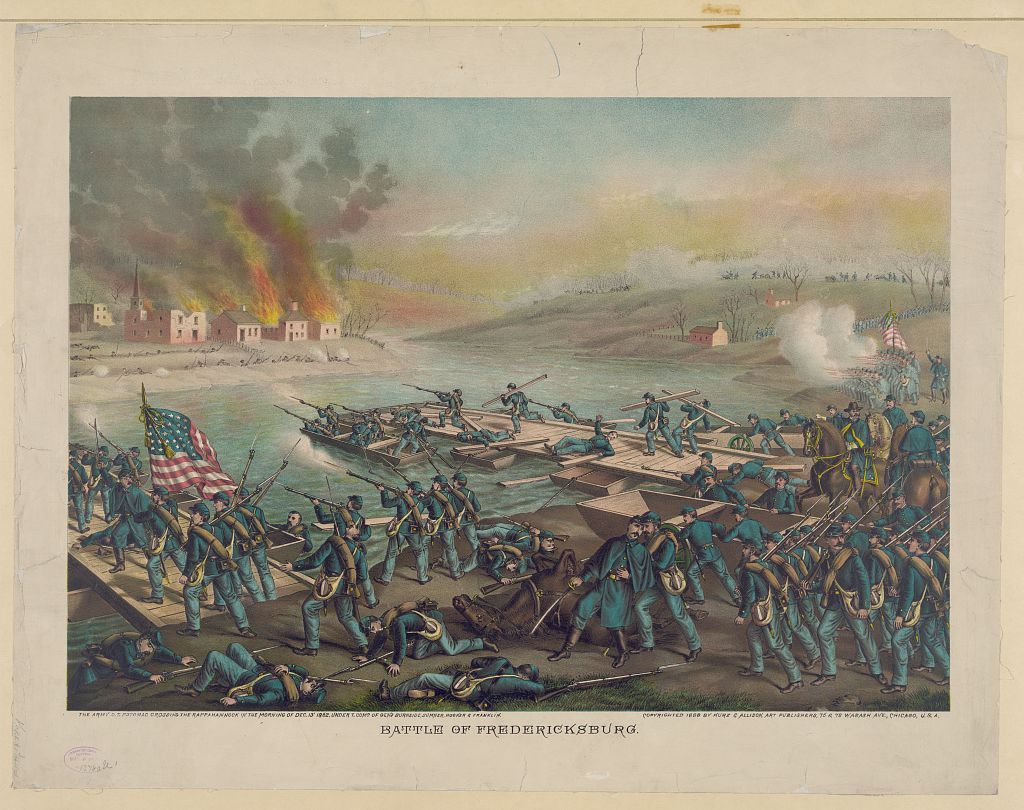
Kurz & Allison. Battle of Fredericksburg–the Army o.t. Potomac crossing the Rappahannock in the morning of Dec. 13′ , under t. comd. of Gen’s Burnside, Sumner, Hooker & Franklin. Virginia Fredericksburg, ca. 1888. Photograph. https://www.loc.gov/item/91482051/.

The men faced a challenging situation as they stepped over the broken bridge, stepping on the shattered timbers, while some men plunged into the freezing water. The shells continued to fall, and an officer fell into the stream, mortally wounded. After crossing the stream, a sharp rise in the ground hid the Regiment from the enemy, allowing them to prepare for the column of attack led by the brigade front.

“Then the advance was sounded. The order of the regimental commanders rang out clear on the cold December air, ” Right shoulder, shift arms, Battalion forward, guide centre, march “. The long lines of bayonets glittered in the bright sunlight. No friendly fog hid the Union line from the foe, and as it advanced up the slope, it came in full view of the Army of Northern Virginia. The noonday sun glittered and shone bright on the frozen ground, and all their batteries opened upon the advancing lines. The line of the enemy could be traced by the fringe of blue smoke that quickly appeared along the base of the hills. The men marched into an arc of fire. And what a reception awaited them! Fire in front, on the right and left. Shells came directly and obliquely and dropped down from above. Shells enfiladed the lines, burst in front, in rear, above and behind, shells everywhere. A torrent of shells; a blizzard of shot, shell and fire. The lines passed on steadily. The gaps made were quickly closed. The colors often kissed the ground but were quickly snatched from dead hands and held aloft again by others, who soon in their turn bit the dust. The regimental commanders marched out far in advance of their commands, and they too fell rapidly, but others ran to take their places. Officers and men fell in rapid succession.[7]

Through this hellish fire, the 116th Pennsylvania, as part of the Irish Brigade, got within thirty yards of the stone wall that was the stronghold of the Confederate position. All the Irish Brigade’s field and staff officers were wounded. The brigade began pouring fire into the Confederate line. One of their color sergeants, waving the flag on the crest, was struck by five balls in succession, piercing the colors and breaking the flagstaff. The command began falling back. The men of the 116th and the rest of the Irish Brigade who were able to move hurried to the rear. Those who were immobilized stayed on the field, many of them for days after the fight. When the fight began, the Regiment marched on the field with 17 commissioned officers and 230 enlisted men. As a result of the battle, 12 officers were wounded, and 77 men were killed, wounded, or missing.[8] This was Corporal Eugene Brady’s first action; he had seen a true baptism by fire. Due to the number of men lost in the Regiment, they were forced to consolidate into a battalion of four companies. Corporal Brady was then promoted to Sergeant and transferred to “D” Company on January 26, 1863.[9]  

            Sergeant Brady and the 116th would set up a winter camp at Falmouth, Virginia. They stayed there until the end of April. Receiving instructions to go toward Chancellorsville, the Regiment then moved out and marched until they reached a swamp, where they set up camp for the night. Col. St. Clair Augustine Mulholland describes the accommodations in his memoir.

“The regimental line ran through a swamp that skirted the edge of a dark wood. The darkness became dense. The ankle-deep ooze made lying down impossible and standing up most inconvenient, so’ fallen trees as roosting places were in great demand, some sitting and trying to balance themselves on a ragged tree stump with feet drawn up to avoid the wet. Watersnakes crawled around in great numbers, frogs croaked, and hundreds of whip-poor-wills filled the trees and made the long night more dismal by their melancholy calling.”[10]

The following day, May 1, the Regiment was positioned with the right, flanking the plank road that extends from Fredericksburg to Chancellorsville and the left, flanking the river. They waited all day for an assault that never came while listening to the distant crash of war. The next day, they were moved to fill a gap on the right flank; here again, they heard the roar of battle as they fixed fortifications and turned all the local structures into blockhouses. Brigadier General Thomas Francis Meagher visited the line in the afternoon to encourage his men. A little later, an officer rushed to the commander to report on the enemy’s progress. Just then, a startled deer fled through the battlefield just before Confederate General Stonewall Jackson’s 26,000 men launched a surprise attack on the Union Army’s right side. The musket fire intensified, and Union soldiers, particularly from the Eleventh Corps, began to panic and retreat in confusion. Some got caught in the abatis (defensive obstacles), while others frantically tried to flee. However, Brady and the 116th Pennsylvania and others in the Irish brigade remained steadfast, blocking and reorganizing the fleeing soldiers.

As dusk fell, the gunfire intensified, and the brigade officers worked to restore order, redirecting troops and preparing for action. A final burst of musketry rang out as night fell, followed by an eerie silence.

Around midmorning on May 3, the 116th received orders to advance toward Chancellorsville House and join the rest of the Division. At the time, part of the Division was already engaged in battle, pushing back the Confederate forces. Once again, Eugene Brady and the men of the 116th marched toward the sound of gunfire, passing streams of the dead and dying as they made their way to their position on the battlefield. Describing the harrowing scene, Colonel St. Clair Augustine Mulholland later wrote.
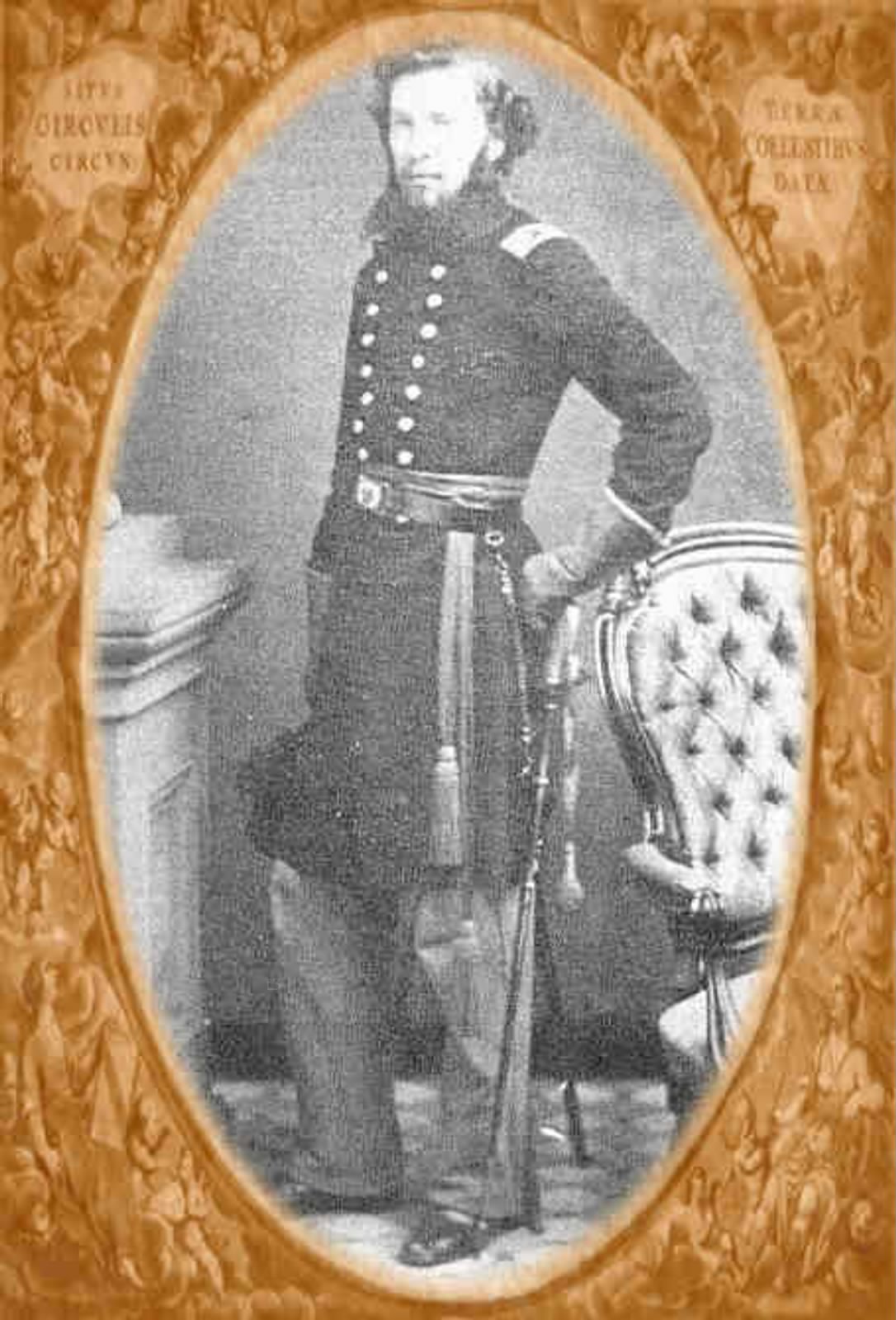
Mulholland in uniform during the Civil War. (Florentius, “St. Clair Augustin Mulholland ~ Irishman. Philadelphian. Artist. Civil War Hero.Catholic.,”n.d., https://gloriaromanorum.blogspot.com/2024/07/st-clair-augustin-mulholland-irishman.html.)

“As it passed along, the evidence of the struggle soon became manifest. Streams of wounded men flowed to the rear. Men with torn faces, split heads, smashed arms, wounded men assisting their more badly hurt comrades, stretchers bearing to the rear men whose limbs were crushed and mangled, and others who had no limbs at all. Four soldiers carried on two muskets, which they held in form of a litter, the body of their Lieutenant Colonel who had just been killed. The body hung over the muskets, the head and feet limp and dangling, the blood dripping from a ghastly wound — a terrible sight indeed. Wounded men lay all through the woods, and here and there, a dead man rested against a tree, where, in getting back, he had paused to rest and breathed his last. Shells screamed through the trees and, as the Regiment approached the front, the whir of the canister and shrapnel was heard, and musket balls whistled past, but the men in the ranks passed on quietly and cheerfully, many of them exchanging repartee.”[11]

Upon reaching their objective, the men of the 116th quickly took cover along the forest’s edge, pressing themselves to the ground to evade the relentless shell fire. Soon after, Brady and his troops prepared for a desperate stand, determined to repel the enemy while securing a new defensive line. To reinforce their position, the Union commander ordered the Fifth Maine Battery to deploy near the Chancellorsville House, readying for the impending assault. The Battery commander and his men quickly set up their five cannons in an orchard, opening fire on the advancing Confederates. However, the exposed position made them an immediate target for thirty enemy guns. The battlefield became a scene of chaos and destruction, with shells tearing through men, horses, and equipment. The Battery Commander was mortally wounded, followed by the Lieutenant, who was killed moments after taking command. Once filled with blooming apple trees, the orchard was transformed into a fiery, blood-soaked battleground.
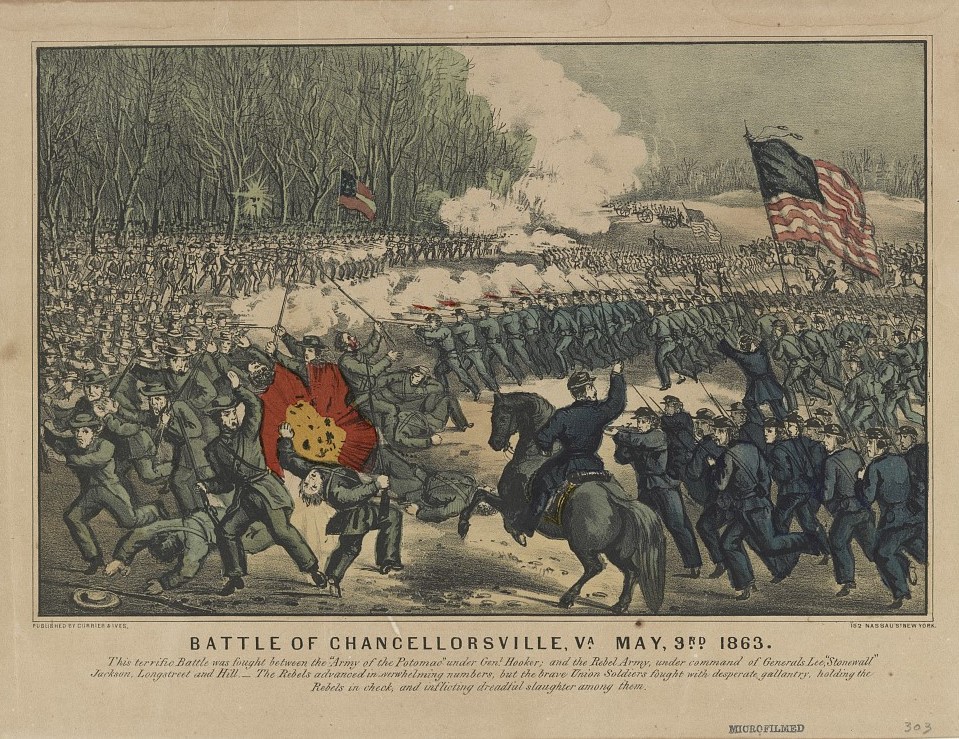
Currier & Ives. Battle of Chancellorsville, Va. May, 3rd. Virginia United States Chancellorsville, 1863. [New York: Published by Currier & Ives, 152 Nassau St. New York, ?] Photograph. https://www.loc.gov/item/90709046/.

Amidst the chaos of battle, an orderly was decapitated by a shell but remained upright on his horse fifty feet before collapsing[12], while another fell with fatal wounds. Soldiers of the 116th suffered gruesome injuries, yet many remained remarkably composed. One such soldier nonchalantly lit his pipe with the burning fuse of an enemy shell while others exchanged jokes, seemingly unfazed by the chaos around them. Within twenty minutes, most of the battery’s guns had fallen silent, nearly all the caissons lay in ruins, and wounded soldiers were strewn across the battlefield.[13] Smoke soon billowed from the Chancellorsville House, now engulfed in flames despite sheltering wounded soldiers and the resident family. Some soldiers of the Union’s Second Delaware bravely rushed to save as many injured as possible, carrying them to safety beneath the trees. As the mansion burned, the women of the household fled onto the porch, where a Union colonel gallantly stepped forward to escort her to safety.

As the battle raged and Union forces withdrew, the 116th was ordered to retrieve the abandoned guns of the Maine Battery. A group of one hundred men from the 116th rushed to grab the field pieces. As a squad struggled to move one of the guns, a shell exploded in their midst, killing two soldiers, wounding several others, and knocking everyone to the ground.[14] Undeterred, the men quickly got back on their feet, laughing off the blast, and resumed their efforts, successfully hauling the gun away. A Sergeant from the 116th spotted an abandoned caisson and was determined to save it. Realizing he was alone and unable to haul it away, he made a quick decision to destroy it instead. “Standing, [he] wished to take it off also, but the men were gone, and, as he could not haul it off alone, he concluded to destroy it; so striking a match, he lit a newspaper, threw it in, jumped back, and the chest blew up. By some miracle, the brave boy remained uninjured himself.”[15]

With the guns secured, the Regiment went down the road as Confederate forces advanced, taking control of Chancellorsville. Brady, along with the 116th, was the last to leave the battlefield. Upon emerging from the woods near the Bullock House, the regiment was met by General Sickles, who, “rising in his stirrups, called for three cheers ‘for the Regiment that saved the guns’”[16] filling the exhausted soldiers with a sense of pride and accomplishment.

            As the Union army withdrew to its defensive line, the Battle of Chancellorsville ended with only a brief skirmish. Although large-scale fighting ceased, Confederate sharpshooters remained active, making any movement dangerous. Eventually, the Union forces, defeated, began their retreat across the river. Through the night, they moved silently under the cover of darkness as the wind howled through the trees and occasional gunfire echoed in the distance. With no time to retrieve the wounded or bury the dead, fallen soldiers remained on the battlefield as the Union army withdrew. Most had crossed the swollen river by dawn, with the 116th among the last to retreat. As the Union pickets rushed to the bridge, Confederate forces attempted to cut them off, but they escaped just in time. Once across, the pontoons were severed, and a Confederate battery fired a few final shots as the last Union troops disappeared, bringing the Chancellorsville campaign to an end.

Sergeant Brady and the 116th underwent relentless drills, reviews, and inspections as May progressed, achieving peak discipline and proficiency, particularly in bayonet exercises and skirmishing. Life in the camp was nonstop, from reveille to taps, making picket duty along the serene river the most coveted assignment. Unlike the harsh winter months, when soldiers endured freezing temperatures without fires, May brought warmth and beauty, with daisies and buttercups lining the riverbanks. Standing watch for two hours, followed by four hours of rest, was far preferable to the constant demands of camp life, where drills and inspections left little time for respite.

With the 116th Regiment, Brady embarked on a grueling march that began on June 14, enduring extreme heat, exhaustion, and treacherous conditions as they moved through Virginia and into Maryland. Along the way, they faced hardships such as limited water, stifling dust, and even an unsettling encounter with a mass of snakes during a nighttime swim. They passed historic battlefields, including Bull Run, and faced Confederate resistance at Haymarket. Despite the exhausting pace, the soldiers found moments of relief, particularly in Frederick, Maryland, where they enjoyed fresh food and the comforts of the city. The Regiment then pushed forward, crossing into Pennsylvania with renewed spirits and covering an incredible 34 miles in one day. By July 1, they reached the outskirts of Gettysburg and prepared for the battle that would soon unfold.

As the afternoon sun hung low on July 2nd, orders were given for the Irish Brigade to advance into battle. But before they marched into the chaos of Gettysburg, the soldiers took part in one of the most profound and solemn moments ever witnessed on an American battlefield.

Father William Corby, the brigade’s chaplain, stood atop a large rock before Brady and the assembled men of the 116th, who stood in silent formation, awaiting their fate. Knowing the bloodshed that lay ahead, Father Corby offered them general absolution, a sacred rite rarely seen outside of European battlefields. With heads bowed and knees in the dirt, the soldiers received his blessing as he extended his hand over them, his voice carrying the ancient Latin words of forgiveness:

“Dominus noster Jesus Christus vos absolvat…”[17]

The moment was breathtaking. Even as the roar of cannon fire and the rattle of musketry echoed from the distant Peach Orchard and Little Round Top, an eerie stillness fell over the brigade. Nearby, a general and his officers watched in silent reverence. The absolution was not just a prayer; it was a farewell. Dressed in their uniforms, these men were already clad in their burial shrouds. Within the hour, many of them would fall, their final act on earth a whispered prayer beneath the Pennsylvania sky.
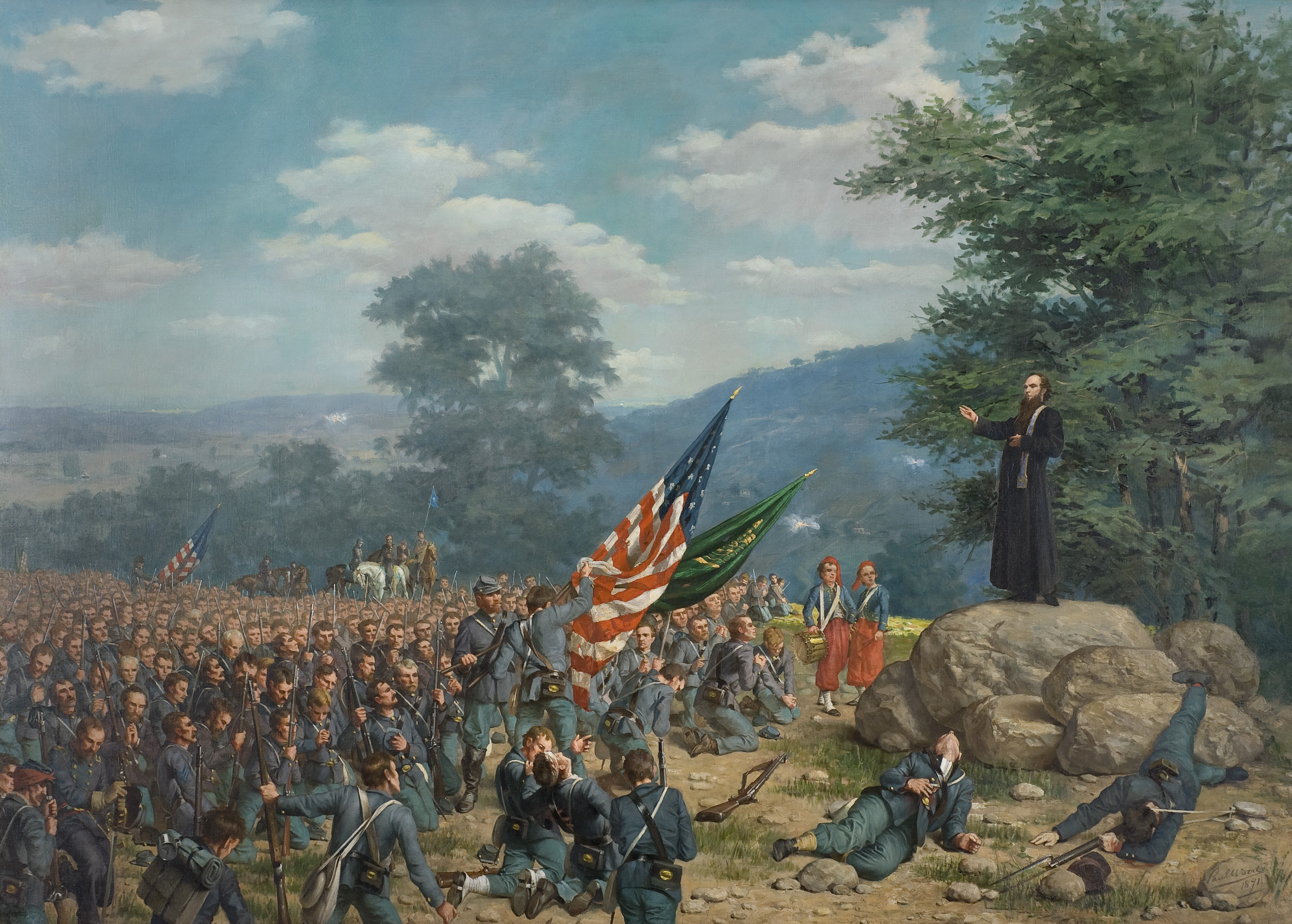
Paul Henry Wood (American, 1872-1892), Absolution Under Fire, 1891, oil on canvas, 72 x 102 inches. Gift of the artist, Collection of the Raclin Murphy Museum of Art, University of Notre Dame, 1976.057

Soon after this moment of peace, the Regiment advanced along the ground where other men had bravely fought and fallen, pushing beyond their last position to engage the enemy. With one Union General mortally wounded and his men forced to withdraw after a valiant struggle, the Irish brigade surged forward to renew the assault. Positioned at their extreme right flank, the 116th played a crucial role in anchoring the line as the battle raged.

Brady and the regiment advanced with disciplined precision, navigating the rugged terrain of boulders and trees. They held their formation despite the challenging landscape. Nearing the crest, they encountered the enemy and were met with a volley of fire—fortunately, aimed too high to inflict significant damage. Undeterred, the men surged forward, engaging in brutal close combat. “The men of the Regiment went in at a ‘right shoulder shift’ and, although the ground was covered with huge boulders, interspersed with forest trees, hilly and rough, the alignment was well preserved and, as it neared the crest, met the enemy and received a volley.[18].” Officers drew their revolvers, and fierce hand-to-hand fighting ensued. A sergeant standing tall and fearless in the fray was tragically struck down by a bullet to the brain. However, the Confederates, exhausted and overwhelmed, ultimately surrendered and were sent to the rear as prisoners of war.
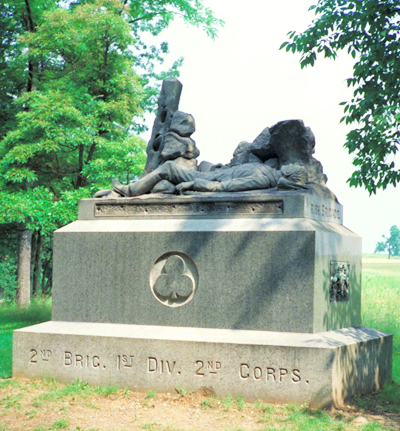
Monument to the 116th Pennsylvania Infantry at Gettysburg (The Battle of Gettysburg. “Monument to the 116th Pennsylvania Infantry Regiment at Gettysburg,” January 10 2020. https://gettysburg.stonesentinels.com/union-monuments/pennsylvania/pennsylvania-infantry/116th-pennsylvania/.)

The 116th halted where their monument now stands. Here, they unexpectedly encountered Confederate forces at the crest of a hill. The Confederates fired too quickly, causing most of their shots to miss, while the Regiment’s return fire was devastating, leaving the enemy’s position covered in their dead. The Regiment then observed Confederate forces preparing another attack, and as orders were given to retreat, they withdrew in good order toward Little Round Top. Some soldiers from the 116th regiment were captured. The retreat through a wheat field was chaotic and deadly, with several men missing or killed. The Regiment eventually reformed near Cemetery Ridge, where it held its position as night fell over the battlefield. One of the men wounded during the day’s action was Sergeant Eugene Brady.

After the battle, as Sergeant Brady was recovering from his wound, he received a well-earned promotion to First Lieutenant on November 21, 1863[19]. He would rejoin the 116th shortly after, ready to return to the fight.  

On November 25th, First Lieutenant Brady and the 116th Regiment left camp and entered the Mine Run campaign. After crossing the Rapidan at Germania Ford, they fortified positions at Robertson’s Tavern but saw no immediate combat. On November 27, they took their position in the woods near Mine Run. On November 28, amidst heavy rain, the Regiment moved closer to the front, preparing for an attack. The Union planned to turn the Confederate right flank. That night, 16,000 troops, including the 116th, marched through rugged terrain. By sundown on the 29th, the Union forces reached their position. The 116th engaged the enemy, pushing them into their entrenchments, but darkness halted further action.

That night was bitterly cold, with soaked and exhausted soldiers suffering immensely; more lives were lost to exposure than in some battles. As dawn broke, the men braced for battle, but no order to attack came, leaving them in a state of tense anticipation.

Nearly the entire 116th Regiment was assigned to the skirmish line during the Battle of Mine Run, leaving only a small guard with the colors. During the fight, Brady and the men of the 116th captured many Confederate prisoners. The captured men were primarily young men from North Carolina, who were poorly clothed and equipped; some even seemed relieved to be taken prisoner.

The 116th camped and reorganized over the next few months. On May 1, 1864, a fierce storm swept through the camp at Brandy Station, toppling tents and wrecking winter quarters. Soldiers scrambled to make repairs, but orders came to move before the work was complete. Then, on May 2, an eerie calm settled over the army; there were no drills, reviews, or duties. It was a moment of quiet before the storm as the soldiers braced for the campaign ahead.

As night fell on May 3, Brady and the 116th silently broke camp, leaving fires burning to deceive the enemy. Moving stealthily through dense forests, they crossed the Rapidan at Ely’s Ford. By noon on May 4, they reached the ruins of the Chancellorsville House, where they massed. Pickets were posted, artillery positioned, and arms stacked; every soldier was accounted for as they prepared for the battles to come.

On the afternoon of May 5, Brady and the 116th found themselves in a nearly impenetrable wilderness, surrounded by dense woods that concealed the enemy. Though they could not see their foes, the eerie sound of whistling bullets cutting through the trees betrayed their presence.

In hushed preparation, Brady and his men readied for battle. Advancing in formation proved nearly impossible, as the thick underbrush obscured visibility, even within their ranks. Yet, despite the chaos of the terrain, the men pressed on into the unknown, bracing for the clash ahead. As the leading regiment pushed forward, it collided with the enemy after advancing just three hundred yards. A sudden eruption of musket fire shattered the silence; the brutal campaign of 1864 had begun. The battlefield lay just beyond the remnants of abandoned gold mines, where decaying timbers from old cabins lay scattered and deep mining shafts punctuated the dense wilderness.

The battlefield became a scene of chaos and carnage as First Lieutenant Brady and the Regiment pressed forward through the thick smoke and relentless gunfire. Bullets tore through the dense underbrush, cutting down men in their ranks, yet the soldiers pushed on with unwavering determination. Even amid the horror, the camaraderie and dark humor of the troops shone through, as captured in this account:

The crash of musketry filled the woods; the smoke lingered and clung to the trees and underbrush and obscured everything. Men fell on every side, but still, the Regiment passed steadily on. One by one, the boys fell—some to rise no more, others badly wounded—but not a groan or complaint, and a broad smile passed along the line when Sergeant John Cassidy of Company E, finding fault because when shot through the lungs, he had to walk off without assistance, someone said to him: “Why, Cassidy, there’s a man with all of his head blown off, and he is not making half as much fuss as you are!”[20]

Soon after the opening salvo, the 116th Regiment was temporarily detached from the Irish Brigade to support another Brigade. As Brady and the 116th marched back to rejoin their unit at dusk, they noticed a critical gap in the battle line. Without waiting for orders, they swiftly moved in to fill the breach, providing essential reinforcement at a pivotal moment. Their quick thinking and decisive action were crucial in stabilizing the line.
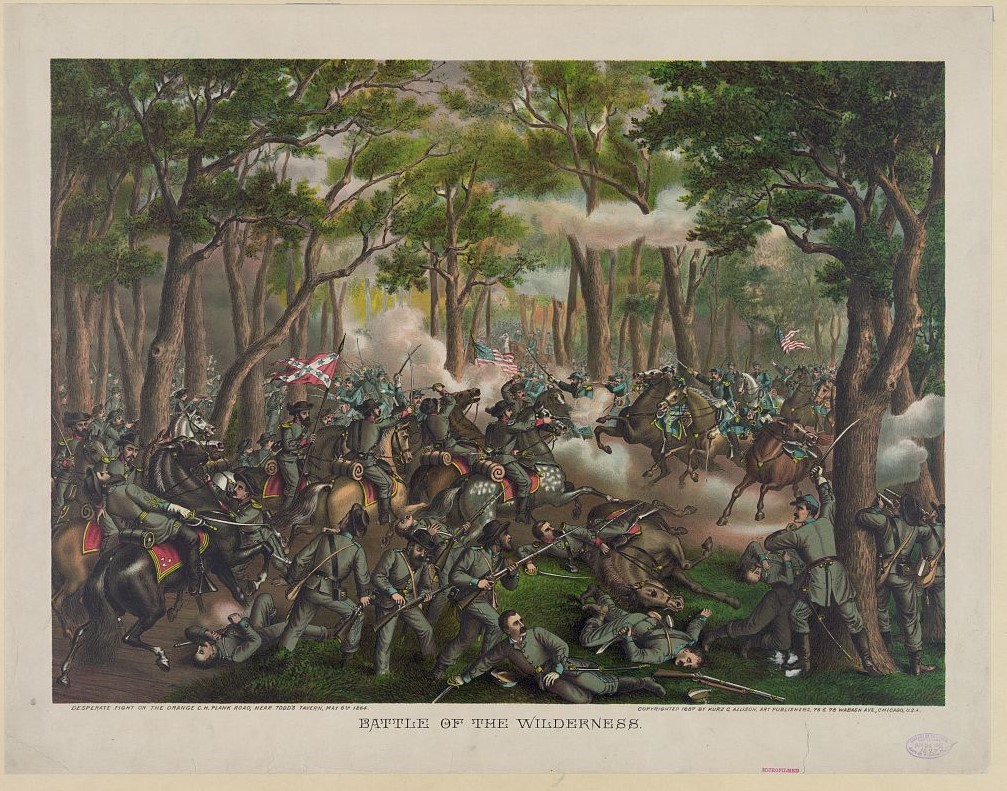
Kurz & Allison. Battle of the Wilderness–Desperate fight on the Orange C.H. Plank Road, near Todd’s Tavern, May 6th. Virginia, ca. 1887. Photograph. https://www.loc.gov/item/91721585/.

As the Confederate forces advanced toward the opening in the battle line, the 116th Regiment, with their disciplined ranks, stopped the enemy in its tracks. After a brief exchange of gunfire, the Confederates withdrew just as another Union regiment arrived with resounding cheers to reinforce the position. As darkness fell, Brady and the exhausted soldiers, hungry and worn from battle, lay down to sleep without supper. Throughout the night, stretcher-bearers carried the wounded to the rear, and with the first light of morning, the line withdrew once more.

This fight would be forever known as The Battle of the Wilderness.

The following day, First Lieutenant Brady and his Regiment held their position along the road while the rest of the Union Army advanced into the woods. Initially, they heard the cheers of their advancing troops, but by noon, the tide turned, and the wounded began pouring back, signaling a Union setback. The enemy launched an attack in the evening, and a fierce firefight ensued. As the battle raged, the Regiment faced relentless enemy fire and an unexpected, terrifying new threat: flames engulfing the battlefield. The intense heat and thick smoke turned the fight into a nightmarish scene, yet the soldiers stood their ground with unwavering determination:

“The wind fanned the flames, and soon, the whole line in front of the Regiment was in a blaze. The smoke rolled back in clouds; the flames leaped ten and fifteen feet high, rolled back, and scorched the men until the heat became unbearable, the musket balls the while whistling and screaming through the smoke and fire. A scene of terror and wild dismay, but no man in the ranks of the Regiment moved an inch. Right in the smoke and fire, they stood and sent back the deadly volleys until the enemy gave up the effort and fell back and disappeared into the depths of that sad forest where thousands lay dead and dying.”[21]

The horror of the moment was only heightened when the fire spread to the surrounding trees and brush, consuming the very ground on which so many had fought and fallen. The full extent of the tragedy remained unknown, as many wounded soldiers were trapped in the blaze, their fate left to the mercy of the flames. Yet, in the face of such devastation, acts of bravery emerged. Volunteers, led by a Lieutenant, rushed into the inferno to save as many as possible, exemplifying the selflessness and heroism that defined these soldiers in the darkest times. The enemy’s final assault on the evening of May 6 effectively ended the Battle of the Wilderness. With the 116th, Brady held their position along the road throughout the night and the following day, engaging only in sporadic picket fire and dodging occasional artillery exchanges.  

            Brady, with the 116th, remained engaged in battle throughout May 8th-10th, 1864, as they maneuvered across the Po River in an attempt to turn the Confederate flank. Initially tasked with capturing a wagon train, the operation evolved into a more significant strategic movement. As Union forces crossed the river, Confederate troops quickly fortified their positions, making an assault infeasible. After a series of skirmishes and near captures, including two of their officers accidentally wandering into enemy lines, the order was given to withdraw. However, as the troops fell back, they were attacked by Confederate forces, resulting in fierce combat amid a burning forest. Despite being surrounded by flames and heavy enemy fire, the 116th held its ground until the last moment before retreating across the final remaining bridge. Tragically, thirty men were left behind, trapped in the blaze. As darkness fell, exhausted but determined, the Regiment rallied once more for another counterattack, bringing what would be known as the Battle of the Po to a close.

            On May 11, after a day of picket firing, Brady and the soldiers of the 116th endured a cold, rainy evening with weak fires that barely provided warmth. The harsh wind and pervasive smoke made the conditions nearly unbearable. They managed to boil coffee, but they could not cook a proper meal. Exhausted and soaked, the men settled in for a restless sleep. However, they quickly roused themselves as orders came in around 9 p.m. to march immediately.

 At 10 p.m., First Lieutenant Brady and the Regiment were sent on a grueling night march through dense woods, torrential rain, and muddy terrain toward Spottsylvania, with orders to attack at daylight. After midnight, the Regiment arrived at the designated area, forming a double column despite the heavy fog and lingering darkness. An hour later, as the attack began, a Confederate volley killed a high-ranking officer, but the Union soldiers pressed on, launching a surprise assault on the enemy’s works. Brady and the 116th were among the first to breach the enemy defenses, with their regimental colors leading the way, as individual soldiers engaged one-on-one across the contested ground. In the ensuing chaotic combat, the attackers overwhelmed the Confederate defenses, capturing colors, artillery, officers, and thousands of prisoners, thus securing a decisive victory despite the disarray and confusion of battle. The following excerpt vividly illustrates the fierce and personal nature of the combat experienced by the 116th Regiment during the assault :

“Lieutenant Fraley, of Company F, ran a Confederate color-bearer through with his sword; a Confederate shot one of the men when almost within touch of his musket, then threw down his piece and called out, ‘I surrender,’ but Dan Crawford, of Company K, shot him dead; Billy Hager, of the same company, ran into a group of half a dozen and demanded their surrender, saying ‘Throw down your arms, quick now, or I’ll stick my bayonet into you,’ and they obeyed. Henry J. Bell, known as ‘Blinky Bell,’ leaped over the works and yelled, ‘Look out, throw down your arms; we run this machine now.’ A large number of the men of the Regiment ran forward and took possession of a battery of brass pieces and, turning them around, got ready to open on any force that might appear. “[22]

This passage captures the raw brutality of the fighting, the individual acts of valor, and the quick thinking that contributed to the Regiment’s overall success in battle.

            The 116th fought in brutal, close-quarters combat on May 12, 1864, during the battle of Spottsylvania Court House, one of the bloodiest days of the war. Scattered along the captured works, they regrouped into squads to face relentless, all-day Confederate assaults that continued into the night. Despite drenching rain, intense hand-to-hand fighting erupted over a mile of trench, with soldiers exchanging musket fire and bayonet attacks. The battle was so fierce that the dead piled up on both sides, and bodies had to be repeatedly cleared from the trenches to make room for the living. Trees were torn apart during the battle, and one large tree fell, injuring some men. The continuous fighting on May 12 left the 116th Regiment scattered after their early charge, preventing them from regrouping immediately. When the fighting finally ceased at midnight and the Confederates retreated, amid a chilling rain, the Union forces took possession of the bloody field.
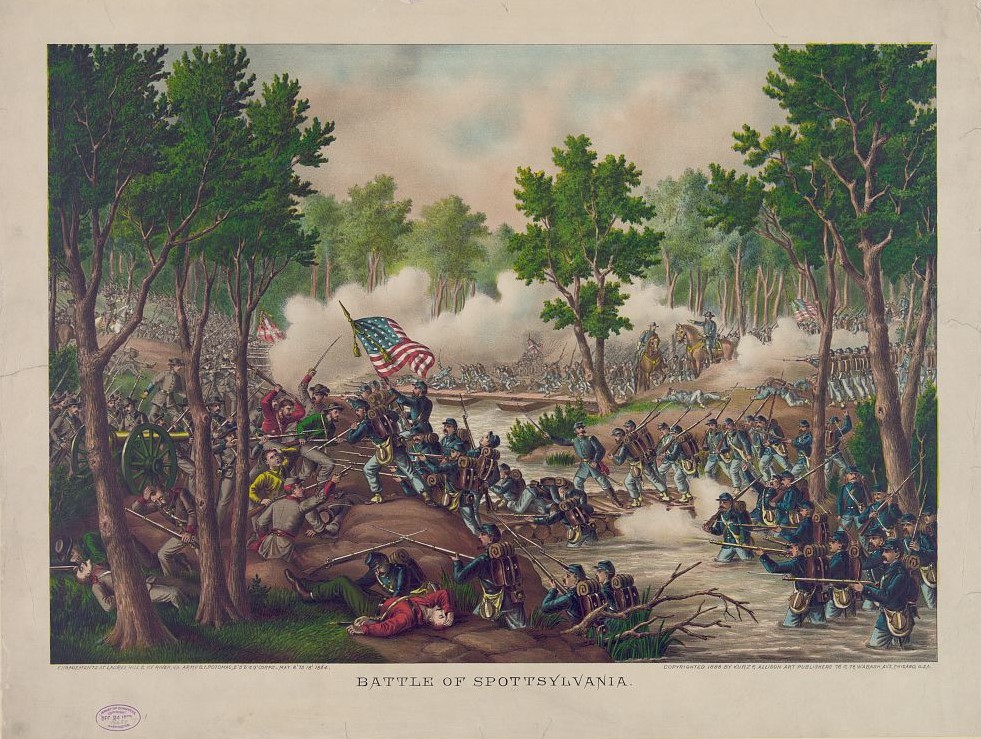
Kurz & Allison. Battle of Spottsylvania–Engagements at Laurel Hill & NY River, Va… May 8 to 18
. Virginia, ca. 1888. Photograph. https://www.loc.gov/item/91721595/.

At dawn on May 13, the 116th reassembled the companies and discovered that many brave soldiers had perished during the long, bloody day. Soon, both armies’ exhausted troops finally fell asleep among the dead.

Brady and the 116th would endure continuous marching and skirmishing for the next eleven days, facing enemy fire nearly daily. After a grueling night march on June 1, the Regiment finally settled outside Cold Harbor.
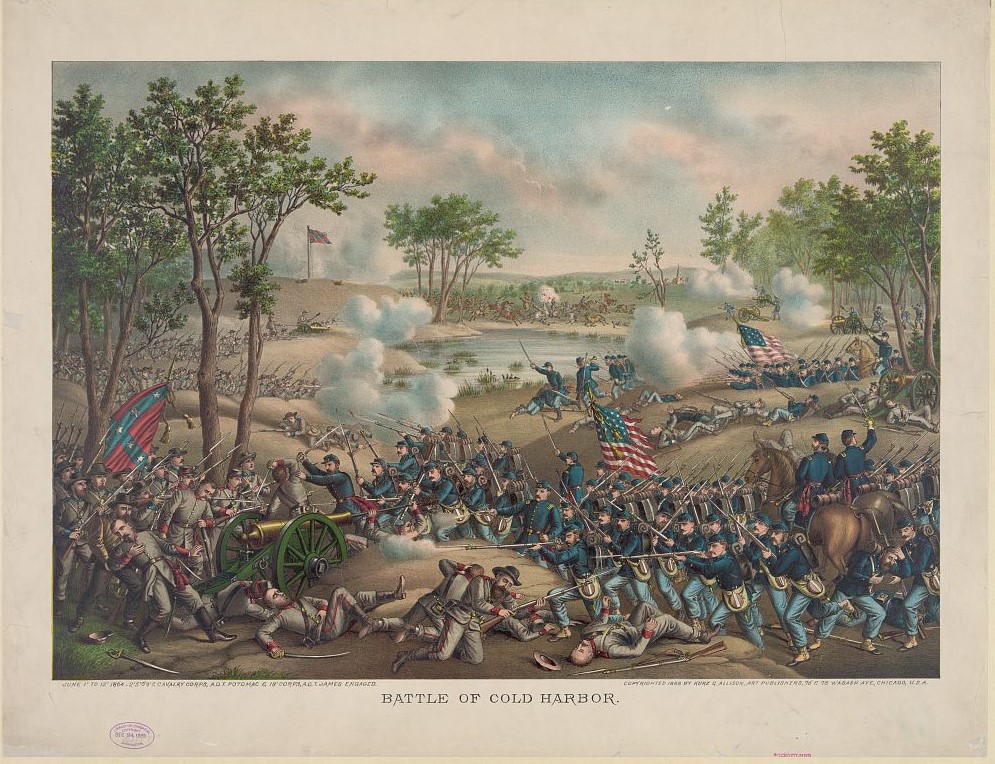
The Battle of Cold Harbor began at 4:30 a.m. with an advance by the Union. The Union troops were met with a devastating Confederate fire, causing heavy losses. Despite the intense resistance, they managed to drive the Confederates from a sunken road and capture 300 prisoners, a battle flag, and artillery.[23].

However, the initial success quickly turned into a disastrous defeat as Confederate reinforcements forced the Union troops to retreat under relentless musketry and artillery fire.

Brady and the 116th were ordered to take cover in a ravine but later had to withdraw under heavy fire, suffering significant casualties while retreating uphill without shelter. Despite the chaos, officers showed bravery in regrouping the troops under fire. The entire battle lasted less than an hour but was one of the bloodiest of the war, with massive Union losses. During the Battle of Cold Harbor, the 116th suffered heavy casualties, losing seventy men and officers who were either killed or wounded.[24]

Brady and the regiment remained stationed at Cold Harbor until the night of June 12, enduring continuous hardship without rest, day or night. There was never a moment of peace from the 3 p.m. roll call until nightfall. The Regiment frequently provided significant picket details, with no relief from the skirmish line until after dark the following night. Soldiers had to find cover and dig makeshift shelters as the opposing lines were incredibly close—sometimes just a few feet apart. In one instance, surprised by his mistake, a Confederate lieutenant unknowingly walked into the 116th’s position and was captured.

On the evening of June 12, the army quietly withdrew from Cold Harbor and began moving left, with the Regiment marching throughout the night.

Lieutenant Brady and the 116th were under fire for nineteen out of thirty-one days, engaging in battles across multiple locations, including the Wilderness, Spottsylvania, North Anna, and Cold Harbor. They faced relentless combat, resulting in over two hundred killed and wounded. This number does not include Company B, which was stationed at division headquarters as provost guard, nor those sent to the rear due to illness, many of whom succumbed to disease from the harsh conditions of constant fighting and exposure.

On the evening of June 13, upon reaching the north bank of the James River, the 116th immediately began digging defensive works despite their exhaustion. Once the fortifications were completed, they were finally able to rest. The following day, June 14, the Union began crossing to the south side of the river, but due to limited transportation, Brady and the regiment could not cross until the evening.

On the afternoon of June 16, the 116th launched an assault on heavily fortified Confederate positions, despite the enemy having reinforced their defenses the night before. The attack was met with intense artillery and musket fire as they advanced over broken ground. Maintaining their formation under heavy fire, the troops charged through abatis and over the enemy’s works before securing the position, engaging in fierce hand-to-hand combat with bayonets. The victory resulted in capturing several Redans, artillery, and prisoners. The 116th suffered heavy losses; 46 enlisted men were killed, wounded, or missing.[25]

Between June 17 and June 21, Brady and the Regiment were heavily engaged in assaults on enemy positions near Petersburg. On June 17, they advanced with near-perfect alignment but suffered heavy losses upon encountering enemy earthworks. The following day, another assault on enemy lines resulted in a bloody repulse, marking the shift to siege warfare.

On June 19, Brady and the Regiment remained under arms, repelling a night attack. They were placed in reserve the next day but remained in heavy combat conditions. On June 21, after a promised rest, they moved toward Reams Station, engaged in a skirmish, and fortified their position. However, a gap in the lines allowed a Confederate cavalry raid, disrupting the support units.

During June and July, the siege of Petersburg intensified, with Union and Confederate forces relying heavily on trench warfare and artillery. Brady and the 116th rapidly constructed redoubts, siege batteries, and defensive structures while introducing devastating mortar fire that surprised the Confederates. However, the Confederates quickly adapted, building bomb-proof shelters and launching their mortar attacks.

            The mortar barrages were especially deadly, as multiple shells were fired simultaneously, making it nearly impossible to avoid them. Soldiers on the picket lines and reserves suffered heavy casualties, and even those in supposedly secure camps were at risk. The unpredictability of the mortar fire made it a particularly demoralizing aspect of the siege, as soldiers were uncertain whether they would survive the night. Both sides endured significant losses, making the siege an exhausting and terrifying ordeal.

            On the afternoon of July 26, the 116th, along with Lieutenant Brady, departed from camp and marched toward Point of Rocks. Crossing the Appomattox River on a pontoon bridge after dark, the Regiment continued its march through the night. Despite the darkness and warm conditions, small fires helped guide the way. By early morning on July 27, Lieutenant Brady and the 116th reached the James River and crossed on pontoons, massing in the woods until daylight. At first light, the 116th advanced. As the Regiment advanced across the open plain, it encountered heavy enemy fire but managed to reach the Confederate works with minimal losses. The intensity of the enemy’s fire was mitigated by the support of Union gunboats, which launched massive hundred-pound shells over the soldiers’ heads and into the enemy’s fortifications. The sheer power of these shells was awe-inspiring as they exploded with immense force, shredding massive trees and wreaking havoc within the enemy’s lines.

            On the night of July 29, under the cover of darkness, Brady and the Regiment began its march back to Petersburg, arriving just in time to witness what would be known as the Battle of the Crater. This disastrous failure resulted in the loss of many Union soldiers. After returning to camp, the Regiment was granted a much-needed two-week rest. However, picket duty remained constant, and casualties on the outer lines continued to occur regularly.

During the Regiment’s brief rest period near Stephensburg in early August 1864, Lieutenant Eugene Brady wrote a heartfelt letter to his wife. His words reflect the temporary lull in battle and the uncertainty that still loomed over the soldiers. He describes the Regiment’s orders being issued and then suddenly revoked, the quiet yet tense atmosphere along the picket line, and his concerns about missing enlistment papers. Despite the hardships of war, his letter conveys a deep sense of devotion to his family, gratitude for their well-being, and the ever-present possibility of movement or renewed combat. Below is his letter in full:
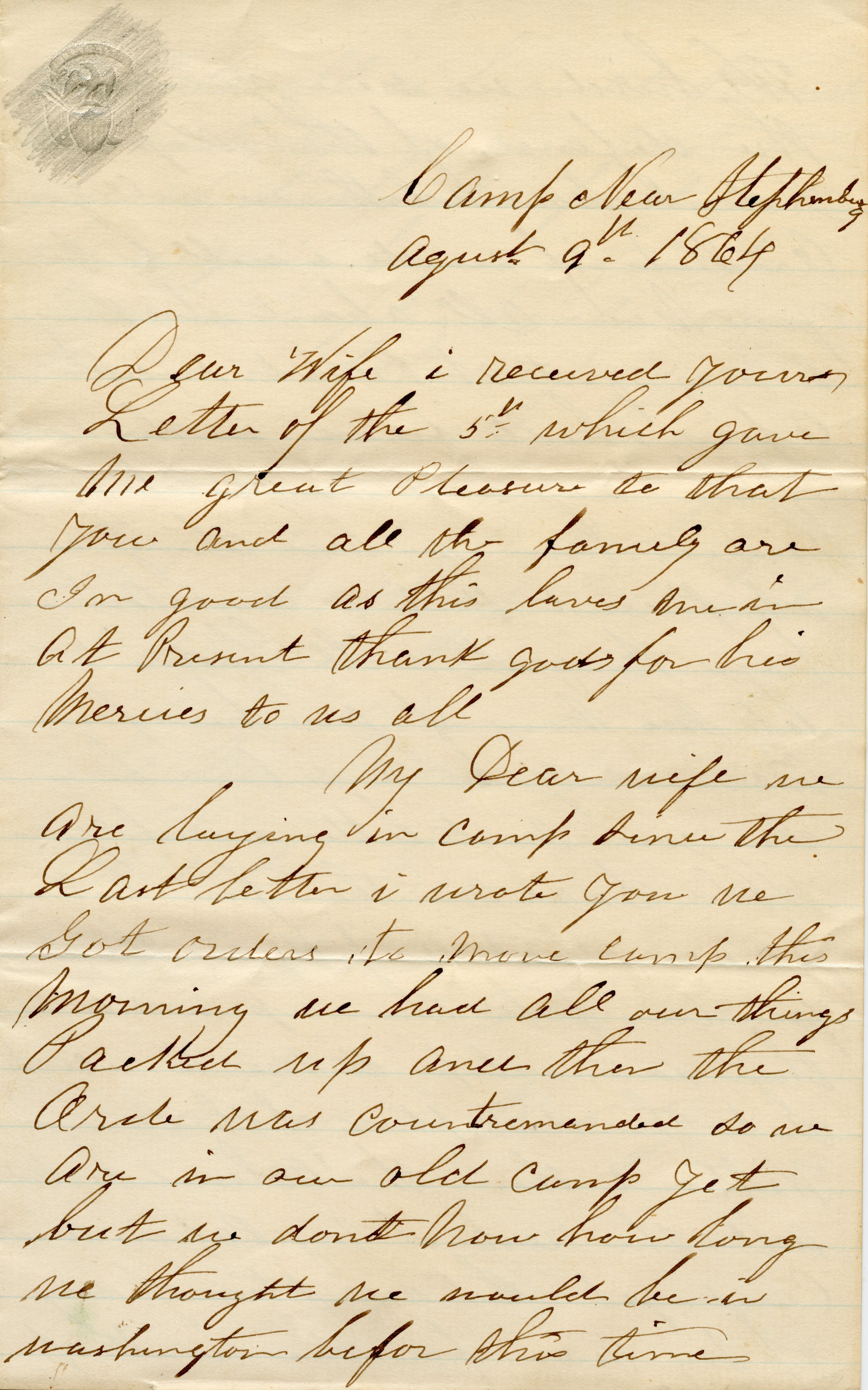
Letter composed by Lieutenant Eugene Brady, 116th Pennsylvania, and generously shared by the American Military Heritage Museum of North Carolina.

Camp near Stephensburg

August 9th, 1864

Dear Wife,

           I received your letter of the 5th which gave me great pleasure seeing that you and all the family are in good, as this leaves me in at present. Thank God for his mercies to us all. My dear wife, we are laying in camp since the last letter I wrote you. We got orders to move camp this morning. We had all our things packed up, and then the order was countermanded. So, we are in our old camp yet. But we don’t know how long. We thought we would be in Washington before this time. We heard we were going to the defenses of that department. I don’t know whether we will go or not. If we do, I will let you know all about it. Things are very quiet at present, except a few shells fired in the course of the day and night along the picket line. We don’t have any things at present. But I don’t know how long it will last. Let me know if you heard from Bernard yet and how he is. In your next letter, I wish you would send me their enlistment papers that I left in the drawer.

You can fold them up and send them in an envelope to me as I can’t get the description of the men. Without them, the Colonel lost all the rest of my papers and can’t get the description of any of my men for the want of them. The Colonel is here at present. He only came on a visit to see us. He looks first rate. He is going home again tomorrow. Captain Newlin is in command of the Regiment yet. I send you all my love and best respects. Give respects to all my inquiring friends. This is all I have to say at present. So, no more at present. But I remain your affectionate husband,

                                 Eugene Brady[26]
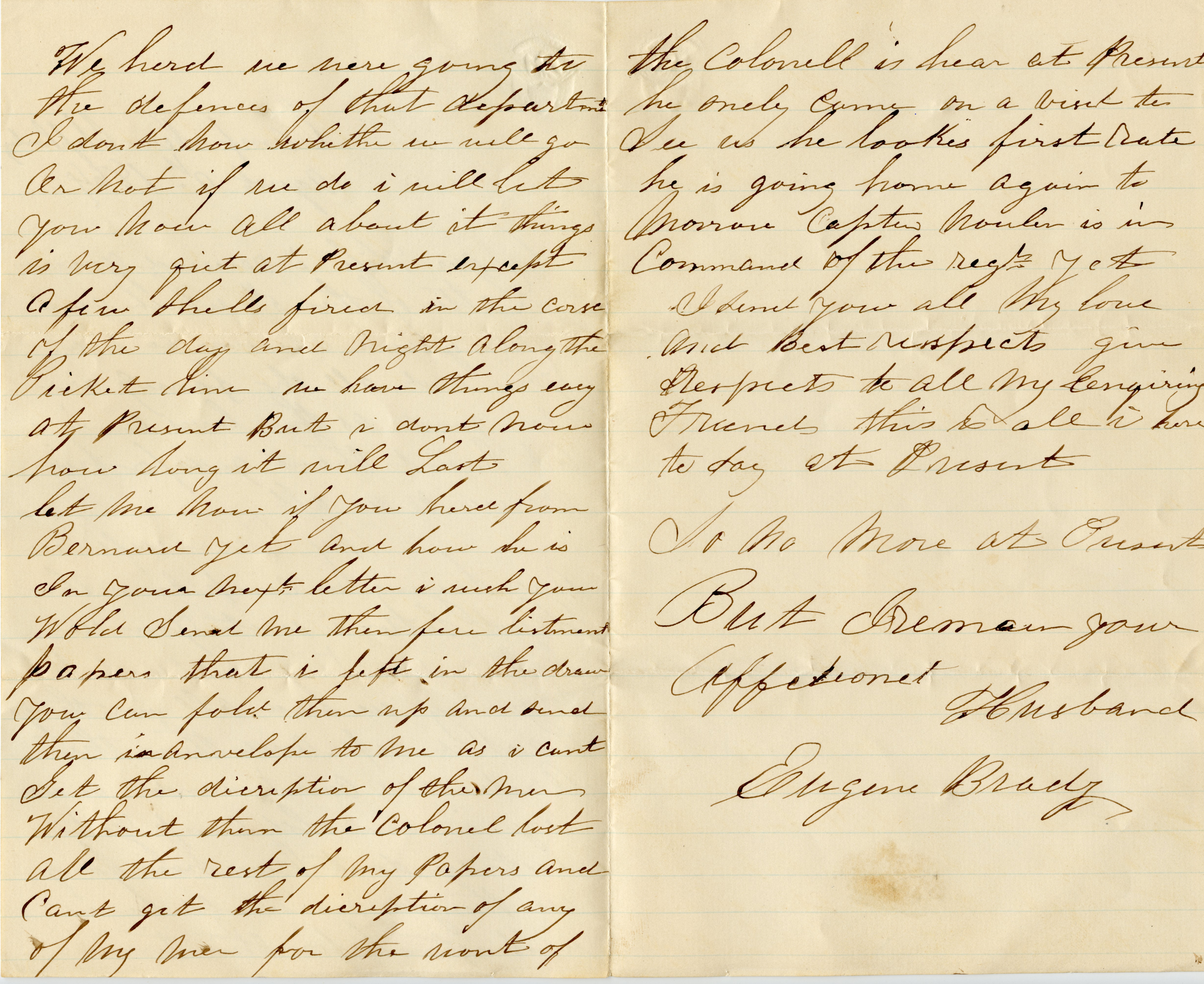
Letter composed by Lieutenant Eugene Brady, 116th Pennsylvania, and generously shared by the American Military Heritage Museum of North Carolina

On August 12, the respite came to an end. Brady and the 116th began embarking on steamers at City Point, and the soldiers, believing they were headed to Washington, were filled with excitement and joy. However, their hopes were dashed by midnight when they learned they were heading to Deep Bottom for battle instead of Washington. The mood quickly shifted from one of happiness to one of disappointment. The following day, August 14, they faced extreme heat while marching, digging trenches, and participating in an unsuccessful assault at Fussell’s Mill. That evening, they boarded the steamers again, and despite the earlier suffering, their spirits lifted as they sang songs and felt camaraderie under the stars.

The heat and hardships of the day were remembered as some of the most intense things the soldiers had ever experienced.

On August 15, the Union forces spent the day in picket fighting and trenching, searching for the enemy’s left, but no significant progress was made. On the 16th, the Union cavalry advanced towards Richmond but was forced to retreat after driving the Confederate cavalry back. On August 17, there was heavy skirmishing along the line of the 116th, with casualties on both sides. The armies declared a truce for two hours to remove the dead and wounded. In the afternoon, the Confederates launched an attack, but the Union forces successfully counterattacked, driving them back. Brady and the 116th played a key role in flanking the enemy.

On August 19th and 20th, only light picket firing was done, and the 116th prepared for a withdrawal from Deep Bottom. The march back to Petersburg on the night of the 20th was a miserable experience, marked by heavy rain, thunder, lightning, and treacherous roads, as the picket line was relentlessly exposed to the storm’s fury. After the grueling Deep Bottom campaign, the exhausted troops expected rest but were immediately ordered to work on entrenchments, pushing many to their physical limits. They then endured a forced march in pouring rain to the Gurley House on the Weldon Railroad, collapsing in the mud upon arrival. On August 22nd and 23rd, Lieutenant Brady, with the 116th, helped destroy sections of the Weldon Railroad, bending rails over fires made from railroad ties. Though physically taxing, the soldiers preferred the work over building fortifications under enemy fire. By the evening of the 23rd, they reached Reams Station and took a position in the entrenchments.

The Battle of Reams Station on August 25, 1864, saw Lieutenant Brady with the 116th defending hastily constructed fortifications against a fierce Confederate assault. Early in the day, Confederate forces advanced, pushing back Union pickets and taking up positions in the surrounding woods. Attempts to reclaim the ground failed, resulting in close-quarters combat and heavy losses. Lieutenant Brady’s letter mentions Captain Garrett Nowlen, whose leadership and bravery left a lasting impression on the men of his Regiment. Nowlen’s heroism was vividly captured during the Battle of Reams Station, where he made the ultimate sacrifice:

“Captain Garrett Nowlen, then in command of the Regiment, stood up in front, waving his sword and cheering on the men. At that moment, a ball pierced his heart. For an instant, he was motionless, then turning quickly to where the men of his own company were in line, he looked towards them and waved his hand: — ‘Good-bye, boys, good-bye — good-bye.’ He was falling when he repeated the last words, and when he struck the ground, he was dead.”[27]
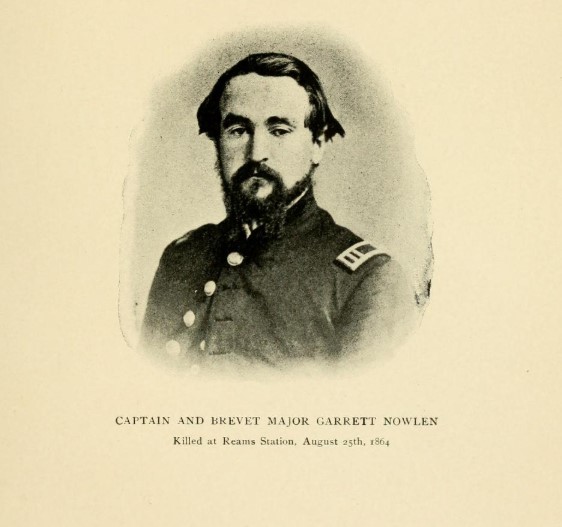
Mulholland, St. Clair A. The Story of the 116th Regiment: Pennsylvania Volunteers in the War of Rebellion: The Record of a Gallant Command. 1st ed. Philadelphia, United States of America: F. McManus, Jr. & Co., 1903. Pg. 300

In the afternoon, Confederate forces launched a massive assault, overwhelming parts of the Union line. Brady, with the 116th, fought valiantly. They held their ground until they were forced to retreat under a devastating enfilading fire. As darkness fell, both sides withdrew, marking the battle as a costly defeat for the Union.  

After Reams Station, the Regiment spent weeks in reserve, facing constant enemy fire. They moved to the front line in September, enduring two months of relentless trench warfare. The siege of Petersburg saw constant skirmishes between pickets, often escalating into more extensive engagements involving entire brigades and divisions. Nights were especially tense, with gunfire erupting at the slightest sound and sometimes lasting for hours, even when no enemy movement occurred. Soldiers grew accustomed to the noise, sleeping soundly despite the relentless firing. The danger remained ever-present, as numerous lives were claimed each night, with bodies retrieved by dawn and quickly forgotten as life in the trenches carried on.  

One cold, quiet night on the picket line outside of Petersburg, Lieutenant Brady entertained his men with a ghost story that revealed his flair for storytelling and the warmth and camaraderie he shared with them. His tale wasn’t of eerie shadows or haunting figures but of a “real Christian ghost.”

“You all remember that on Saturday evening. May 2, at Chancellorsville, the fight was pretty hot for a while, and a good many of our people dropped in the woods on the right of our line. Well, it is of one of them that I will tell you. There was an old lady living at that time in the little village of Hokendauqua, on the Lehigh River, who had a son in the Eleventh Corps. On Sunday morning, May 3, the old lady crossed the river to Catasauqua, a village just opposite to where she lived, and called upon the pastor of a church, with whom she was acquainted. She told him that her son was home and walking around the streets, but he would not speak to her.
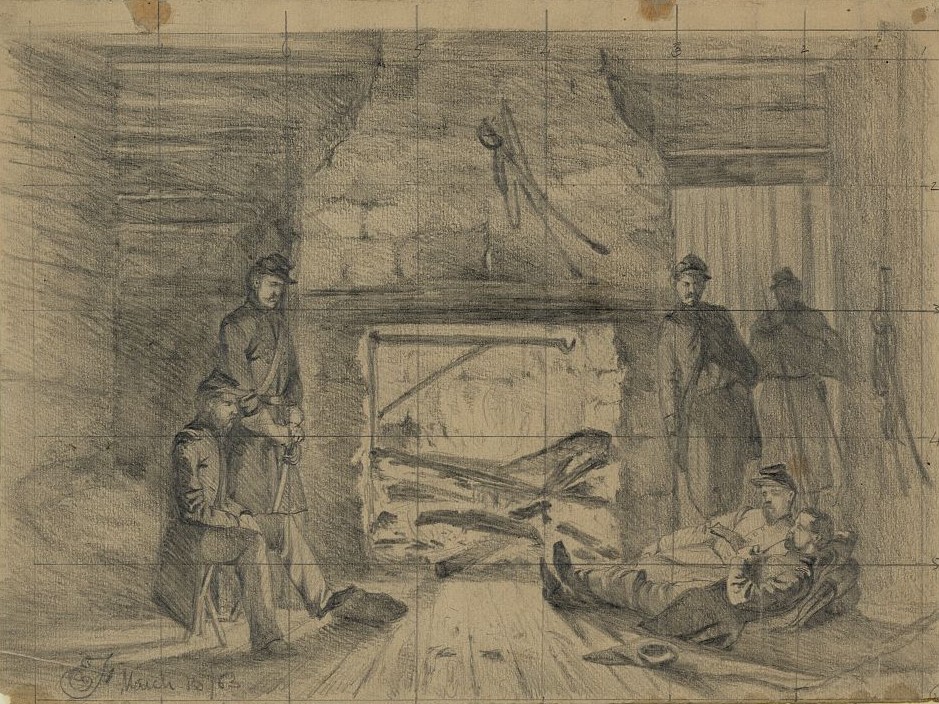
Forbes, Edwin, Artist. On picket–Officers’ quarters in log house / EF. Falmouth Virginia United States, 1863. Photograph. https://www.loc.gov/item/2004661920/

‘Last evening (Saturday), ‘ said she, ‘I was washing out some things, the door was open, and who should walk in but my son John. I did not expect him, and I was so astonished for a moment, I did not realize his presence, then quickly drying my hands on my apron, I ran towards him. Would you believe it, he never offered to come towards me but, giving me such a sad, strange look, and without uttering a word, he turned and walked up the stairs. As soon as I could come to my senses, I ran after him, but he was gone. The window was open, and he must have climbed down the trellis-work that the grapevine clings to and so left the house. I lay awake all night thinking and expecting him to come back, but daylight came, and no John. I got the breakfast and started out to hunt him up, and as I was walking along the street, I saw my son just in front of me. I ran to catch up, but he turned a corner, and when I reached there, he was gone. I dare say he went into one of the neighbor’s houses, but which one I could not find out. Now, sir, you can see that my son is evidently angry at something and will not speak to me. Won’t you come over to Hockendaqua to see him, and find out what is the matter ‘? The reverend gentleman, pitying the poor woman, returned with her to her home, hoping to find her boy and have mother and son reconciled. He hunted everywhere through the village but could learn nothing of the soldier. No one had seen him but his mother. On Tuesday morning, May 5, a letter came saying that the boy had been killed on Saturday evening, just at the time that he walked in to see his mother. Gentlemen, that is a true story of a Christian soldier in full uniform and in broad daylight, and no sad-eyed Hindoo prowling around at midnight, dressed in white,”[28]

Lieutenant Brady’s devotion to his men went beyond morale-boosting stories and camaraderie; it was a commitment that extended to the battlefield itself. During a tense moment in the siege of Petersburg, he proved this again when he spotted young William J. Curley, the drummer boy of Company E, wandering dangerously into the open, unaware that he was in the enemy’s sights as he searched for his company.

“Lieutenant Brady, of Company D, seeing his danger, called to him to jump into one of the rifle pits. Before he had time to do so, however, a Johnny let go and sent a ball through the head of Curley’s drum.”[29]

Shortly after this harrowing incident, the Army granted Lieutenant Brady leave to return home and care for his pregnant wife, Mary. His departure was a brief respite from the relentless dangers of the front lines, allowing him a moment of solace with his family before duty called him back to the Regiment. Mary gave birth to their fourth child, Cecilia, on December 12, 1864.[30] Before returning to the front, Lieutenant Brady seemed to have a premonition of his fate. Upon the expiration of his short furlough, just a few months before his death, he bid his friends goodbye with solemn certainty, telling them that he would not see them again.  

In late March 1865, the war’s final campaign began with relentless marching and combat. On March 28, Lieutenant Brady and the 116th withdrew from Petersburg and advanced leftward, crossing Hatcher’s Run. Fighting erupted near Dabney’s Mill despite torrential rain that flooded the terrain. By March 30, Lieutenant Brady and the Regiment faced continuous fire from all sides, leaving no time for rest, food, or sleep. Even attempts to make coffee were thwarted by enemy fire. The Regiment suffered significant losses before linking up with additional Union forces as the intense battle continued.

The battles on March 31 and April 1 were brutal, with the 116th Regiment fighting valiantly but suffering devastating losses. On March 31st, during a skirmish near Five Forks, Lieutenant Eugene Brady, a courageous and respected officer, lost his life. The Regiment’s casualties were heavy, and many of the dead remained where they fell, making the full extent of the losses unknown. During the battle, General Lee personally led the Confederate forces, launching a fierce attack that initially broke the Union line. However, the Union, with the help of the 116th, counterattacked with remarkable force, driving back the Confederate brigades, capturing prisoners and a flag, and restoring the Union lines.

Lieutenant Eugene Brady met his end in an act of fearless leadership that day while leading a small group of men in a daring assault on an enemy rifle pit. Brady’s courage and sacrifice in that moment embodied the unwavering resolve of the Regiment in the war’s final, brutal days.
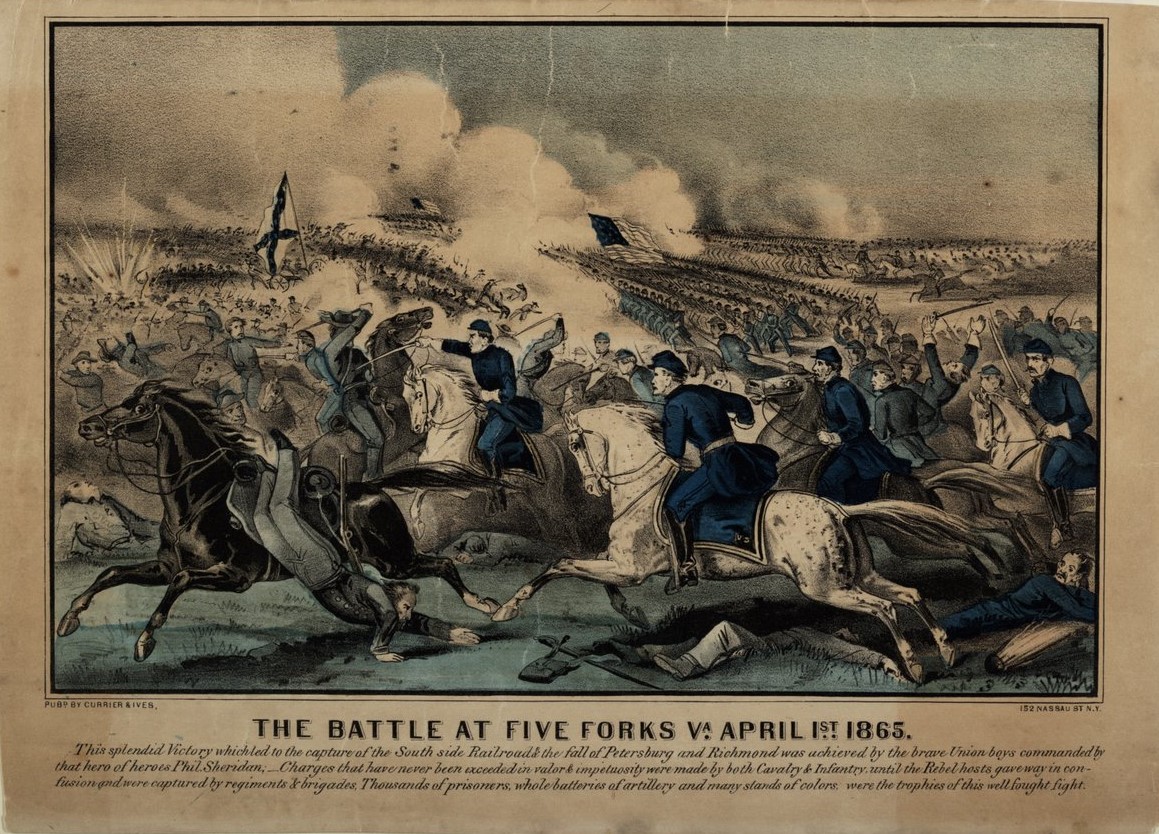
“Battle of Five Forks Va. April 1st 1865, c.1865.” MeisterDrucke, n.d. https://www.meisterdrucke.ie/fine-art-prints/N.-and-Ives,-J.M.-Currier/165974/Battle-of-Five-Forks-Va.-April-1st-1865,-c.1865.html.

 Sergeant Edward S. Kline later recounted the harrowing experience, saying,

“I remember distinctly, after wading across a creek, that the enemy had some rifle pits on a hill in a field, and Lieutenant Brady said, ‘Let us go for that pit.

‘Together with four or five other men, I joined him, and we succeeded in gaining possession of the pit, but the enemy soon had a flank fire on us. I think I was the only survivor. Lieutenant Brady was killed first. He made some remark about a Confederate color-bearer shaking his flag at us from behind a tree some hundred yards distant when he was hit right in the forehead. He fell against me and died instantly.”[31]

With the rest of the men likely lost, Kline barely escaped, carrying Brady’s shoulder straps and memorandum book to prevent them from falling into enemy hands. Later, when the Union forces pushed forward, Kline returned with a detail to recover Brady’s body, ensuring he was placed in the care of the regimental surgeon, Dr. Wm. B. Hartman. Lieutenant Brady’s remains were transported to Philadelphia, where he was laid to rest in Old Cathedral Cemetery.
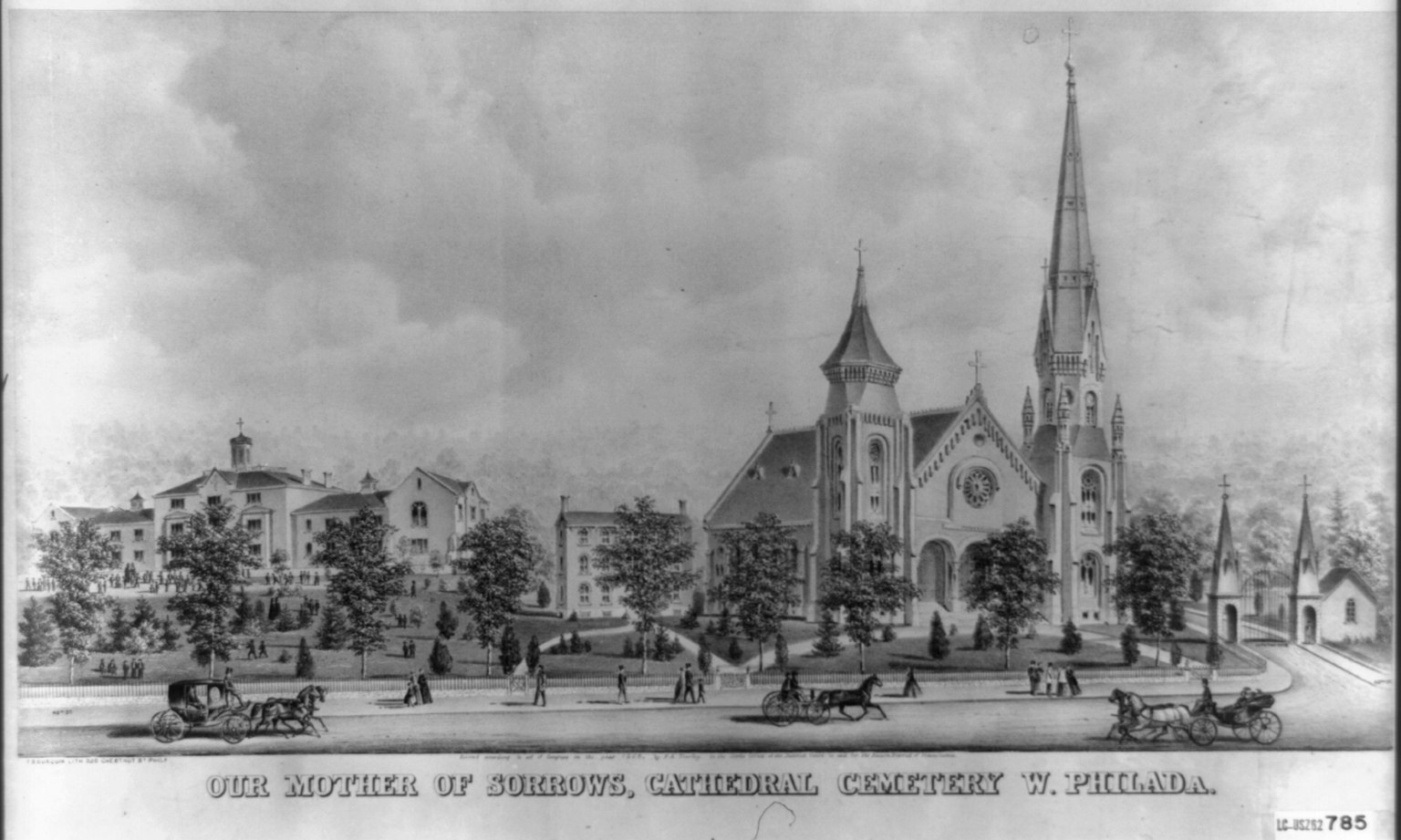
Our Mother of Sorrows, Cathedral Cemetery W. Philada. , . [No Date Recorded on Shelflist Card] Photograph. https://www.loc.gov/item/2003680654/.

After Lieutenant Brady’s tragic death, his wife, Mary, was left to navigate an uncertain future, raising their four children without her husband’s support. On April 24, 1865[32], she applied for a widow’s pension, which she eventually received at a rate of $17 per month, equivalent to approximately $331 today[33]. Mary worked as a domestic servant to make ends meet, persevering through hardship to provide for her family. Mary lived until 1913, passing away from nephritis.[34]. Mary’s son later sought government assistance to cover her funeral expenses, which totaled $307, but the request was denied, as her estate was deemed sufficient to bear the cost.

As we remember First Lieutenant Eugene Brady, we see more than just a name in history; we glimpse a life marked by courage, devotion, and sacrifice. From his humble beginnings on the Emerald Isle to the brutal battlefields of the Civil War, Brady’s story echoes the resilience of countless immigrants who risked everything for a cause greater than themselves. Brady’s unwavering courage and sacrifice, as well as his loyalty to his men and his family, even in the face of certain death, speak volumes about the strength of the human spirit. Let us honor his memory and the sacrifices of all soldiers by working toward a future where peace triumphs over war.


[1] “Eugene Brady in the 1860 United States Federal Census.” Ancestry, 2009. https://www.ancestry.com/search/collections/7667/records/4518410?tid=&pid=&queryId=44e3a92f-caee-4119-9ad5-0198226eea4c&_phsrc=JHJ1157&_phstart=successSource.

[2] “Page 5 – US, Civil War ‘Widows’ Pensions’, 1861-1910.” Fold3, 2008. https://www.fold3.com/image/271287394/brady-eugene-page-5-us-civil-war-widows-pensions-1861-1910.

[3] “Pennsylvania, U.S., Civil War Muster Rolls, 1860-1869.” Ancestry®, 2015. https://www.ancestry.com/search/collections/9040/records/19699?tid=&pid=&queryId=2ba0a779-d445-4b3d-8fd4-b83751451d16&_phsrc=JHJ1175&_phstart=successSource.

[4] Ibid

[5] Mulholland, St. Clair A. The Story of the 116th Regiment: Pennsylvania Volunteers in the War of Rebellion: The Record of a Gallant Command. 1st ed. Philadelphia, United States of America: F. McManus, Jr. & Co., 1903. Pg’s 35-36

[6] Ibid Pg’s 43-44

[7] Ibid. Pg. 47

[8] “230 Series I Volume XXI- Serial 31 – Fredericksburg,” n.d., https://www.civilwar.com/battles/927-official-record/series/volume/campaign/fredericksburg/177626-230-series-i-volume-xxi-serial-31-fredericksburg.html.

[9] “Page 1 – US, Pennsylvania Veterans Card Files, 1775-1916,” Fold3, n.d., https://www.fold3.com/image/712041844/brady-eugene-page-1-us-pennsylvania-veterans-card-files-1775-1916.

[10] Mulholland, St. Clair A. The Story of the 116th Regiment: Pennsylvania Volunteers in the War of Rebellion: The Record of a Gallant Command. 1st ed. Philadelphia, United States of America: F. McManus, Jr. & Co., 1903. Pg. 93

[11] Ibid, Pg’s 96-97

[12] Ibid Pg. 99

[13] Ibid

[14] Ibid Pg. 100

[15] Ibid Pg’s 100-101

[16] Ibid 101

[17] Ibid. Pg. 372

[18] Ibid. Pg. 125

[19] “Civil War Data,” n.d. https://www.civilwardata.com/personnel/usa/925912.

[20]Ibid, Pg. 186

[21] Ibid, Pg’s 189-190

[22] Ibid Pg. 210

[23] Ibid Pg. 255

[24] Ibid Pg. 256

[25] Ibid Pg. 269

[26] Brady, Eugene. Letter to Mary Brady. August 9, 1864. Camp Near Stephensburg. In possession of The American Military Heritage Museum Of North Carolina

[27] Mulholland, St. Clair A. The Story of the 116th Regiment: Pennsylvania Volunteers in the War of Rebellion: The Record of a Gallant Command. 1st ed. Philadelphia, United States of America: F. McManus, Jr. & Co., 1903. Pg. 294

[28] Ibid Pg. 314-16

[29] Ibid Pg. 318

[30] Fold3. “Page 2 – “US, Civil War Pensions, 1861-1910,” n.d. https://www.fold3.com/image/271287391/brady-eugene-page-2-us-civil-war-widows-pensions-1861-1910.

[31] Mulholland, St. Clair A. The Story of the 116th Regiment: Pennsylvania Volunteers in the War of Rebellion: The Record of a Gallant Command. 1st ed. Philadelphia, United States of America: F. McManus, Jr. & Co., 1903. Pg. 337

[32] Fold3. “Brady, Eugene – Fold3 – US, Civil War &Quot;Widows’ Pensions&Quot;, 1861-1910,” n.d. https://www.fold3.com/file/271287390.

[33] “Inflation Rate Between 1865-2025 | Inflation Calculator,” n.d. https://www.in2013dollars.com/us/inflation/1865?amount=17.

[34] “Mary C Brady in the Pennsylvania, U.S., Death Certificates, 1906-1971
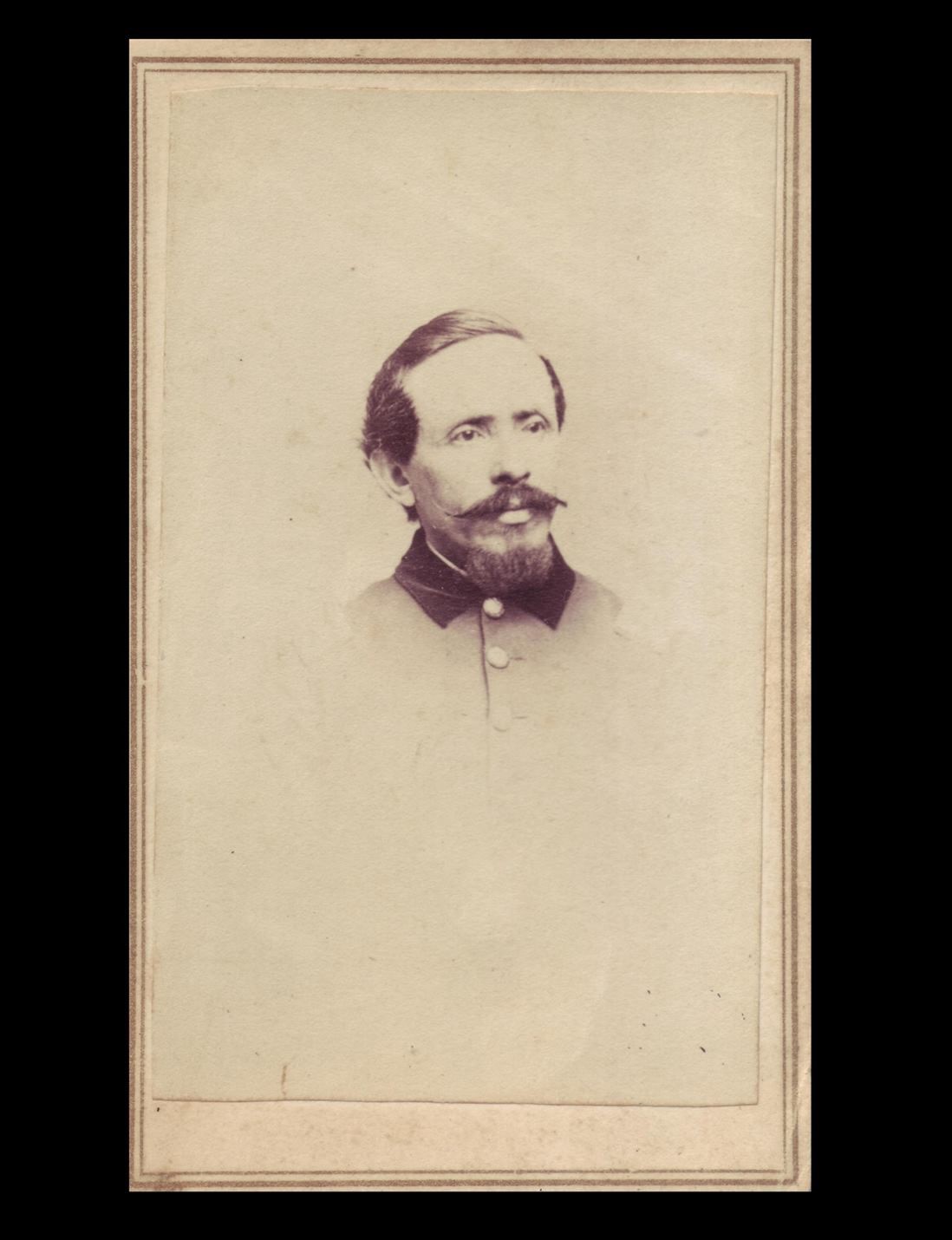
n.d., https://www.ancestry.com/search/collections/5164/records/346405?tid=&pid=&queryId=1c0060d4-9c70-47bf-94bc-e91aecaaf262&_phsrc=JHJ1196&_phstart=successSource.

From County Cork to Civil War Valor: The Story of Captain Michael Doran

In the annals of American Civil War history, the contributions of Irish regiments are both profound and poignant. Among those who served with distinction was Captain Michael Doran, a man whose journey through three of the significant Irish regiments—the 37th New York “Irish Rifles,” the 69th New York Company K “Irish Zouaves,” and the illustrious 155th New York “Corcoran’s Irish Legion”—weaves a tale of valor, camaraderie, and the harsh realities of war. From his initial enlistment in 1861 amid controversy to his gallant but perilous charge at the Battle of Cold Harbor, Doran’s story is an emblem of the courage and resilience of countless soldiers. Join us as we delve into the remarkable life of Captain Michael Doran, exploring the challenges he faced, the battles he fought, and the indelible mark he left on the legacy of the Irish in the American Civil War.

Carte de visite of Capt. Michael Doran signed on the reverse: “Very respectfully yours, Michael Doran Capt. 155th Regt. NY Vols. It has a backmark from G.T. Lape, 130 Chatham Street, NY. (Courtesy Of The American Military Heritage Museum Of North Carolina)

Michal Doran was born in County Cork, Ireland, sometime around 1826[1].Doran immigrated to the United States before 1850 and worked as a tanner in Hurley, New York.[2] Doran joined the Army in 1857 and was assigned to the ordnance department. When he enlisted, The Army described him as five feet six inches tall, with grey eyes, brown hair, and a dark complexion.[3] On May 11, 1861, the secretary of war ordered his discharge.[4] Michael Doran enlisted in the 37th New York “Irish Rifles” four days later. Due to his prior service, they promoted Doran to Captain of “C” Company on July 7, 1861.[5]  

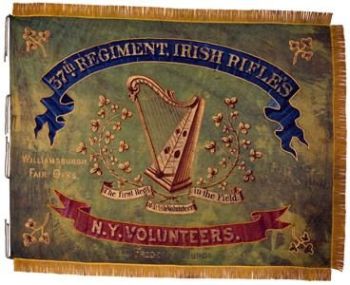
According to reports, the 37th New York Volunteer Infantry received this green silk Regimental Color from the City of New York in February 1863. It was carried at Chancellorsville, Virginia, from May 1–3, 1863, and it has traditional Irish iconography painted on both sides. The regiment’s 1862 campaigns and status as “The first Regt. of Irish Volunteers in the Field” are commemorated by painted battle honors on the flag.(Retrieved From “37th Regiment NY Volunteer Infantry | Regimental Color | Civil War :: New York State Military Museum and Veterans Research Center,” 2025.)

                On July 23rd, Capt. Doran and the 37th New York left to help defend Washington, DC. By August, Doran’s company became attached to Hunter’s Brigade, Division of the Potomac. In October, they served with Richardson’s Brigade, Heintzelman’s Division, Army of the Potomac. In this capacity, they would conduct reconnaissance at Pohick Church and Occoquan. On November 4th, Captain Doran would submit false payrolls, leading to his dismissal. An issue of the New York Times reported the incident on September 2, 1861.

At the request of Gov. Morgan, Col. McCunn remains in temporary command of the New York Thirty-seventh, though his resignation was accepted by the authorities. Five of the ten Captains of the Thirty-seventh are now on trial before a court-martial, presided over by Col. Green, of the Fifteenth Massachusetts Volunteers. They are Capts. Reardon, Company A; Doran, Company C; Cavanaugh, Company E; McHugh, and Michael Murphy. They are charged with making out false payrolls, by which pay has been received for from ten to twenty-two more men than they had in their respective commands. In three cases, the evidence has been closed with but a meager defense to the charges. Witnesses from the ranks have testified that at the command of their officers, they had answered to false names. Col. McCunn is charged with purging the regiment of such offenders.”[6]

Doran later enlisted on May 26, 1862,[7] In New York City, New York. On the same day, they commissioned him as a Second Lieutenant in the “K” company of the 69th New York State Militia, also known as the Irish Zouaves.

Second Lieutenant Doran and the 69th New York State Militia, under the command of Colonel James Bagley, were once more assigned to Washington; they departed the state on May 29, 1862, and provided support for the defenses of Washington until being mustered out on September 3, 1862, in New York City

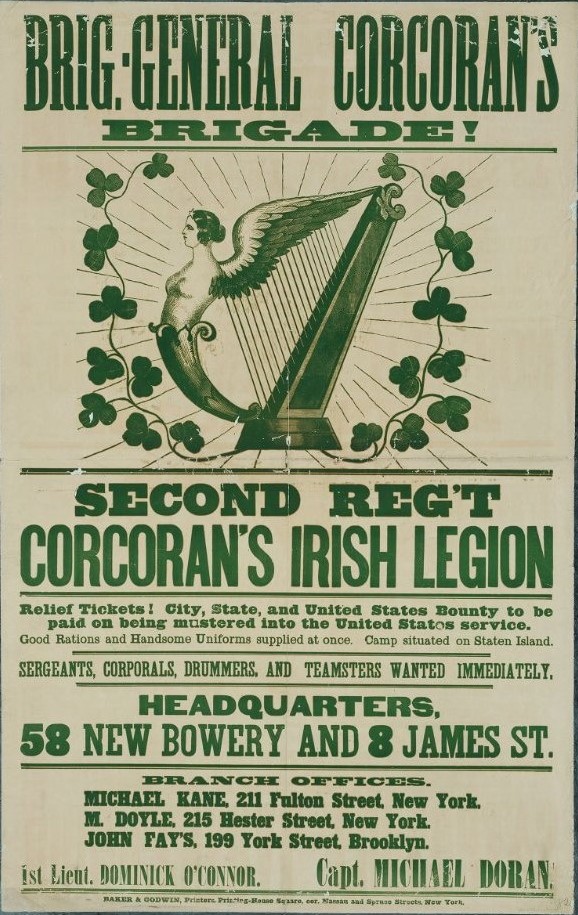
Union enlistment poster for the 155th New York. Note the mention of Captain Doran on the lower right. (Retrieved from Lunchcountersitin, “An Irish American View of the Colored Soldier.”)

Doran would enlist again on September 8th, 1862. “B” Company 155th New York Infantry Corcoran’s Irish Legion commissioned him a Captain on November 18th, 1862.[8]   Captain Doran and the 155th New York fought at Deserted House, The Siege of Suffolk, Dix’s Peninsula Campaign, Sangster’s Station, Spotsylvania Court House, North Anna River, Totopotomoy, and Cold Harbor, where Captain Doran led a courageous yet reckless charge against a Confederate stronghold. This event is noted in “Cold Harbor: Grant and Lee, May 26-June 3, 1864,” by Gordon C. Rhea.

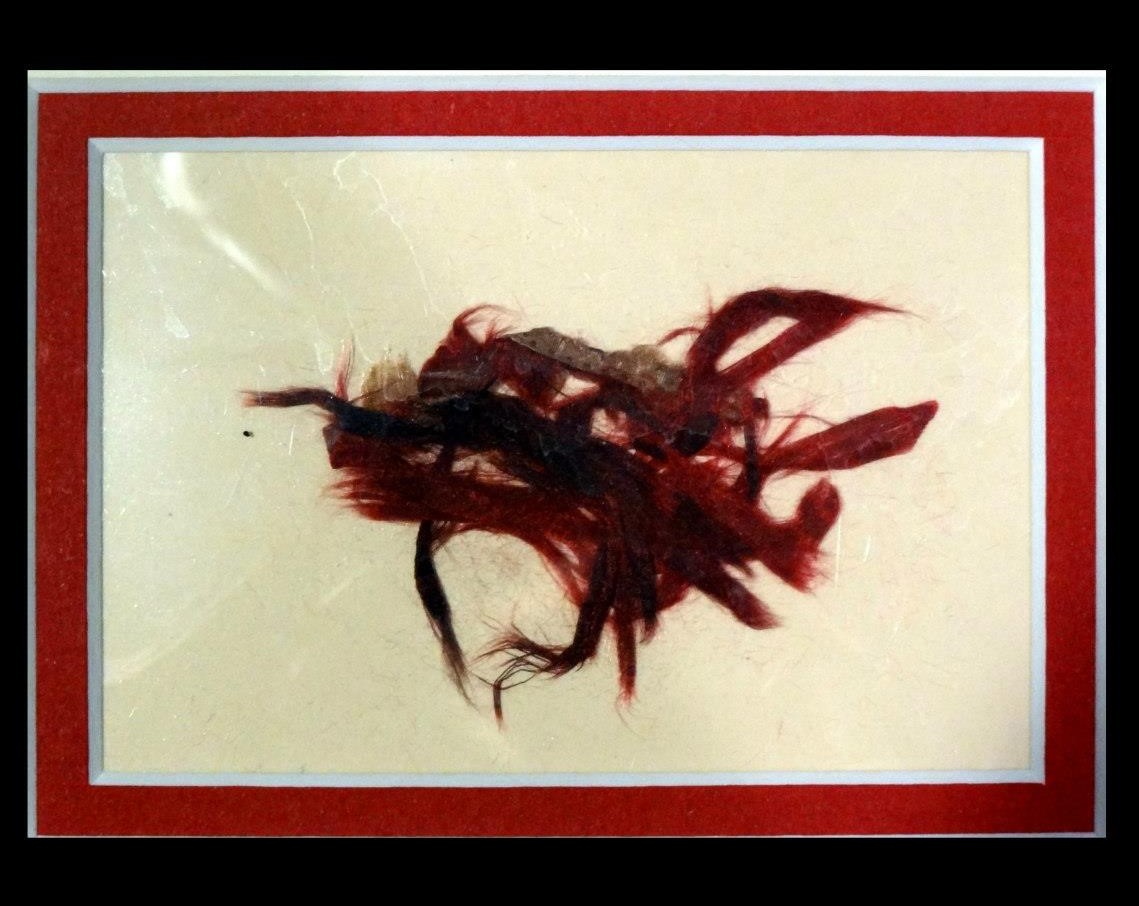
Sliver of the flag from the 155th NY Infantry Corcoran’s Irish Legion. It was part of the effects that belonged to Captain Joseph F. Eustace, a member of the 155th who distinguished himself at the battle of Hatcher’s run. (Courtesy of The American Military Heritage Museum Of North Carolina)

Tyler’s remaining regiments had advanced simultaneously with the 8th New York Heavy Artillery. The 155th and 182nd New York, next to Bates’s battalion, ended up in the same morass as the Heavies to their right. Captain Michael Doran, commanding the 155th New York, dressed the regiment behind the protective cover of a ridge and sent it forward. Cresting a small rise, the New Yorkers came into sight of the main rebel line about 150 yards away. “Balls commenced literally to mow us down,” the 155th’s adjutant, 1st Lieutenant John Russell Winterbotham, wrote home the next day. Doran’s soldiers found themselves under devastating fire in front of a muddy ravine carved by a feeder to Boatswain Creek. “There was a marsh in front of our regiment,” a man in the 155th reported, “and I doubt if we could have reached the enemy works even if they had not been there to oppose us.” Soldiers attempted to return fire, reported Winterbotham, but “they were no match for the entrenched rebels, and the supports failed to come up but they would not fly but stood like heroes” The 155th took devastating casualties some 130 men, about half the soldiers who made the charge but was unable to advance. Realizing the hopelessness of his situation, after thirty minutes of fruitlessly trading fire with the Confederates from a distance of only 50 yards, Captain Doran pulled his regiment’s remnants back behind a slight ridge 150 yards from the rebel line, where the troops began digging. The 182nd New York, on Doran’s left, also dropped behind the ridge, losing 94 soldiers in the process. “We felt it was murder, not war,” Private Newell Smith of the 155th New York reported. “or that at best a very serious mistake had been made.” Adjutant Winterbotham concluded likewise: “The idea of our charging the enemy’s line with the number we had was preposterous.”[9]

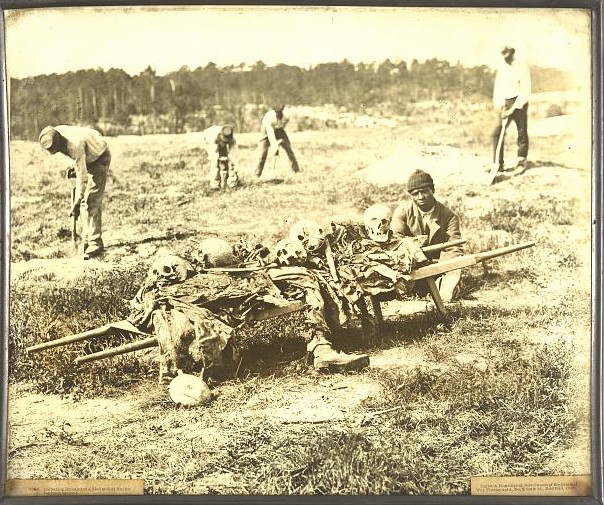
Taylor & Huntington, Reekie, John, photographer. Collecting remains of killed at Cold Harbor for re-internment. United States Virginia Cold Harbor, 1865. Photograph. https://www.loc.gov/item/2013645963/.

Captain Doran would lead his company until his discharge for disability on February 16, 1865. The Army gave him the rank of Major on November 17, 1864. However, the 155th never mustered Captain Doran into that rank.[10]

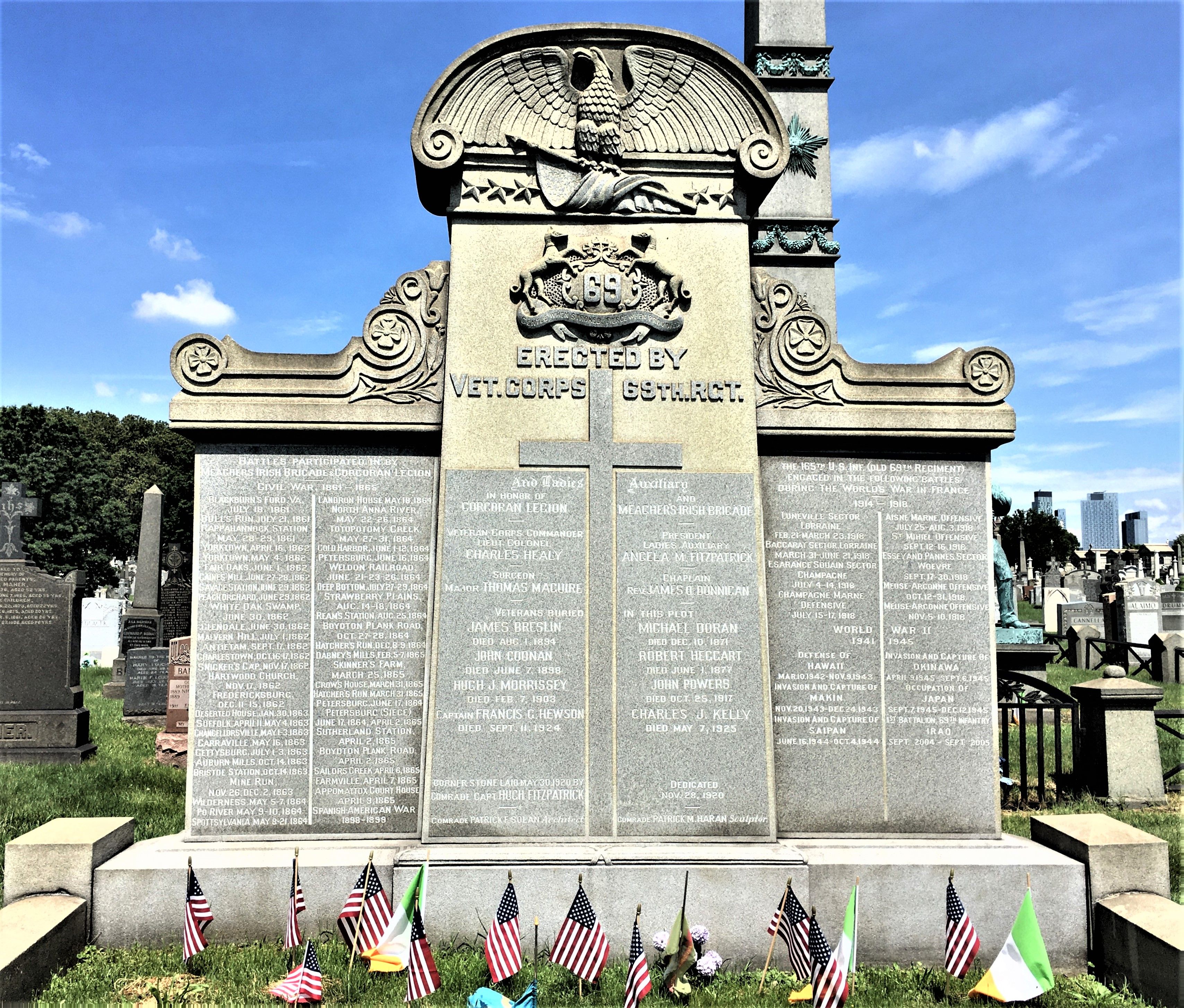
After the war, Doran was very active in The Society of The Army of The Potomac. He attended many of their reunions till his death from heart disease on October 27th, 1890[11]. Surviving members of the 155th New York interred his remains at Calvary Cemetery in Queens in the Irish Fighting 69th Monument plot. The Monument commemorates the Civil War service of two brigades that grew out of the old 69th N.Y.S.M, the Irish Brigade and Corcoran’s Legion, of which the 155th New York was a part.

Photo of The Irish Fighting 69th Monument plot at Calvary Cemetery in Queens (Photo By Inis Fada on 10 June 2021)

                Captain Michael Doran’s military service during the American Civil War exemplifies the bravery and dedication of Irish regiments as he navigated significant battles and challenges while leaving a lasting legacy within the Irish community. His journey from enlistment to leadership in multiple regiments highlights the profound impact of immigrant soldiers on the war’s history.


[1] “U.S., Army, Register of Enlistments, 1798-1914 1855 Jan – 1857 Sep A-Z,” Ancestry.com, 2007, accessed January 28, 2025, https://tinyurl.com/ypyavp8c.

[2] “Michael Doran in the 1850 United States Federal Census,” Ancestry.com, 2009, accessed January 28, 2025, https://tinyurl.com/mrxhxzd6.

[3] “U.S., Army, Register of Enlistments, 1798-1914 1855 Jan – 1857 Sep A-Z,” Ancestry.com, 2007, accessed January 28, 2025, https://tinyurl.com/ypyavp8c.

[4] Ibid

[5] “Page 1 – US, New York Civil War Muster Roll Abstracts, 1861-1900,” Fold3, n.d., https://www.fold3.com/image/316116418/doran-michael-page-1-us-new-york-civil-war-muster-roll-abstracts-1861-1900.

[6] 37th Regiment, New York Volunteers Civil War Newspaper Clippings; retrieved from http://dmna.ny.gov/…/civil/infantry/37thInf/37thInfCWN.htm

[7] “Soldier History Michael Doran,” Historical Data Systems, Inc, 2025, accessed January 29, 2025, https://www.civilwardata.com/personnel/usa/1865371.

[8] “US, New York Civil War Muster Roll Abstracts, 1861-1900,” Fold3, 2014, accessed January 29, 2025, https://www.fold3.com/image/316181601/doran-michael-page-1-us-new-york-civil-war-muster-roll-abstracts-1861-1900.

[9]  Rhea, Gordon C. Cold Harbor: Grant and Lee, May 26-June 3, 1864. Baton Rouge: Louisiana State University Press, 2002. Pg. 521 

[10] “US, New York Civil War Muster Roll Abstracts, 1861-1900,” Fold3, 2014, accessed January 29, 2025, https://www.fold3.com/image/316181601/doran-michael-page-1-us-new-york-civil-war-muster-roll-abstracts-1861-1900.

[11] “Michael Doran in the New York, New York, U.S., Index to Death Certificates, 1862-1948,” Ancestry.com, 2020, accessed January 31, 2025, https://tinyurl.com/ycjtrk6b.

The Battle of Gettysburg: A fight the South was destined to lose

In July 1863, the peaceful town of Gettysburg, Pennsylvania enjoyed a beautiful day, with little excitement in the town. The residents went about their business in a calm and friendly manner, content with their way of life. However, their tranquility was shattered when a fierce battle erupted, which later became known as the Battle of Gettysburg. This three-day conflict was a significant event in American history, playing a crucial role in shaping the identity and future of the nation.

This battle has become the focus of historians, both amateur and professional. Every major decision made during the Battle of Gettysburg has been scrutinized. Blame for the Southern loss has been passed on to Generals Robert E. Lee, George Pickett, and James Ewell Brown Stuart.

General’s Robert E. Lee, George Pickett, & James Ewell Brown Stuart. Pictures from the Library Of Congress

This leads us to the question – did the Confederates have a chance of winning this battle? They most certainly did not.  The South was destined to lose the battle before those three days in July took place. This was due to the following reasons: overconfidence, the loss of critical leadership, the lack of available fighting men, the deficiency of an industrial complex, southern culture itself, and the fact that the Union forces, especially those from Pennsylvania who were defending their land for the first time during the American Civil War.

 To demonstrate the above points concerning the Confederate’s chance of winning the Battle of Gettysburg, one has to start at the beginning of the war. On April 12, 1861, Confederate guns fired on Fort Sumter in Charleston, South Carolina, signaling the beginning of the American Civil War. This was the first in a series of Southern victories, each one bolstering their confidence. During the Battle of Fredericksburg on December 13, 1862, in Virginia, the Union Army made a grand charge at the stone wall upon Marye’s Heights, only to suffer 12,600 casualties, whereas the Confederates suffered only 5,000.[1]

Currier & Ives. Battle of Fredericksburg, Va. Dec 13th United States, 1862. [New York: Currier & Ives] Photograph. https://www.loc.gov/item/90709058/.

Then, at the Battle of Chancellorsville during the spring of 1863, another 17,000 Union soldiers fell. Forcing Abraham Lincoln to say, “My God My God, What Will The Country Say.”[2]   Riding on the moral boosts of those two victories, Confederate General Lee felt his army was unstoppable and encouraged an invasion of the North. However, high morale is a double-edged sword. Military historian Lieutenant-Colonel Sir John Baynes speaks of the importance of a soldier’s morale in his work Morale – A Study of Men and Courage. He says,

“At its highest peak, it is seen as an individual’s readiness to accept his fate willingly even to the point of death, and to refuse all roads that lead to safety at the price of conscience.”[3]  

Baynes’s statement speaks to the foolhardiness that overconfident men in battle have. This was shown time and time again by the Southern forces during the Battle of Gettysburg.  

One example of Southern overconfidence occurred on July 1, 1863, by Company B of the 26th North Carolina. They were led by Colonel Henry King Burgwyn Jr., a promising young officer and a graduate of the Virginia Military Institute.  The 26th was in a desperate fight on McPherson’s Ridge, where they performed repeated charges against the Union forces, which held the high ground. Out of 800 men reported before the day’s fight, only 216 remained; one of the fallen was Colonel Buygwyn himself. [4] Third Colonel John Randolph Lane of the 26th North Carolina later wrote of Buygwyn’s death and the charge, describing it as,

“At this time the colors have been cut down ten times, the color guard, all killed and wounded….The gallant Burgwyn leaps forward, takes them up (the colors), and again the line moves forward; at that instant, he falls with a bullet through both lungs.” [5]

Colonel Henry King Burgwyn Jr. leads the 26th North Carolina at the battle of Gettysburg, July 1, 1863. By Don Troiani.

The reckless repeated attacks on well-fortified high ground had cost the southern forces one of their boldest and most promising leaders.

Another example of Southern overconfidence occurred on July 2, 1863. After studying the Federal’s position, the Confederate commanders had a briefing to discuss their future actions at Gettysburg. Feeling his army was unstoppable, General Lee thought this was the time and place to destroy the Federal Army. However, General James Longstreet strongly disagreed and advised General Lee to march south and pick better ground to fight to force an attack. General Lee disregarded Longstreet’s objections and ordered him to attack the left side of the Federal position on Cemetery Ridge and Culp’s Hill.  One of the reasons these hills were so important was that artillery could be placed upon them, thus increasing its range. This can be illustrated using the battle at Cemetery Hill.

O’Sullivan, Timothy H, photographer. View of Gettysburg from Cemetery Hill
. Pennsylvania Gettysburg United States, None. [Photographed 1863, july, printed between 1880 and 1889] Photograph. https://www.loc.gov/item/2014646001/.

Atop the heights of Cemetery Hill, three batteries could be placed to provide a clear view of any force coming from the north or the east. Cemetery Hill had an elevation of 150 feet, which made it the ideal height for firing shots at troops approaching from as far away as six hundred feet. [6] 

This had devastating effects on the Confederate forces that tried to attack those heights. These guns commanded the field for all three days of the battle. Major Robert Stiles of the Virginia Light Artillery described the destruction of his artillery by the guns of Cemetery Hill on the second day of the fight by stating:

“Never, before or after, did I see fifteen or twenty guns in such a condition of wreck and destruction as this battalion was. It had been hurled back, as it were, by the very weight and impact of metal from the position it had occupied on the crest of the little ridge, into a saucer-shaped depression behind it, and such a scene as it presented.” [7]

Battle of Gettysburg: Charge of the Confederates on Cemetery Hill, Thursday evening, July 2, 1863. Orton, C. (2013, July 2). Cemetery Hill | The Saturday Evening Post. The Saturday Evening Post. https://www.saturdayeveningpost.com/2013/07/where-the-civil-war-was-won/charge-on-cemetary-hill/
Richard Ewell Library of Congress

Confederate General Richard Stoddert Ewell’s decision to make a late attack on Cemetery Hill with his whole force indicates Southern overconfidence. This attack, with about 3,500 men, was repulsed by the heavily fortified position, and the Southern force suffered substantial casualties.[8]  

Perhaps the most famous example of the audaciousness of the Southern command at Gettysburg is that of the Pickett, Pettigrew, and Trimble assault on July 3, 1863. After the first two days of fighting at Gettysburg, General Lee decided that his best option was to mass his force and attack the center of the Union line with fresh troops from General Pickett’s division. This attack would entail a 592-yard march under direct enemy fire across open ground.  Lee felt his army of northern Virginia was up to the task because he thought they were invincible.[9] After an hour of an artillery barrage, 13,000 Confederate troops stepped out of the woods to begin what would be the last charge for many of them.[10] First Lieutenant John T. James of Company D, 11th Virginia, wrote about his experience in this action. He said:

After terrible loss to the regiment, brigade, and division, we reached and actually captured the breastworks. Some of them had taken possession of the cannon when we saw the enemy advancing heavy reinforcements. We looked back for ours, but in vain; we were compelled to fall back and had again to run as targets to their balls. Oh, it was hard, too hard to be compelled to give way for the want of men after having fought as hard as we had that day. The unwounded…soon got back to the place where we started from. We gained nothing but glory and lost our bravest men.” [11] 

Forbes, Edwin, Artist. Pickett’s charge from a position on the enemy’s line looking toward the Union lines, Zeigler’s grove on the left, a clump of trees on the right / Edwin Forbes. Pennsylvania Gettysburg United States, None. [Between 1865 and 1895] Photograph. https://www.loc.gov/item/2004661944/.

The aftermath of this charge was devastating. Two of the three brigade commanders in Pickett’s division were killed, and the third was severely wounded. In addition, only half of the men who participated in the charge returned to the Confederate lines. [12] This tactical decision by General Lee, based on his men’s high morale and almost unblemished battle record, was beyond disastrous for the Confederate Army and the Confederate States as a whole.

Another aspect that led to the defeat of the Confederate forces during the Battle of Gettysburg was the loss of crucial leadership before the battle. None was more important than the death of Thomas Jonathan “Stonewall” Jackson. Jackson was born in Virginia in 1824. As a teenager, he was appointed to the United States Military Academy at West Point, where he graduated in 1846. Jackson was then sent to Mexico, where he was involved in the Mexican-American War. He was brevetted twice for “good conduct” during the battles of Churubusco and Chapultepec. [13]  After the war, Jackson became a professor of Philosophy and Artillery at the Virginia Military Institute.

Thomas Jonathan Jackson is a full-length portrait on horseback, facing left, holding up a hat in his right hand. , ca. 1913. Photograph. https://www.loc.gov/item/92514006/.

 At the American Civil War outbreak, Jackson was appointed to Brigade Commander. During the first battle of Bull Run, the Confederate forces began to break, except General Jackson’s Brigade. When trying to rally his men, Confederate General Bernard E. Bee saw Jackson calmly upon his horse amongst the fray of battle and said, “See there, Jackson, standing like a stonewall, rally on the Virginians!”[14] This is how General Jackson earned the name “Stonewall.” His bravery in the face of danger turned the tide of battle, making it a Confederate victory.  Jackson’s subsequent success was during the First Battle of Winchester on May 25, 1862. Using unique tactics, he deployed 5,000 men to delay and distract a much larger force. Author Walton Rawls describes Jacksons actions during this campaign as such,

“Silent as a sphinx, brave as a lion, his unexpected disappearances, and mysterious descents upon the enemy at its weakest points inspired something akin to terror in the breast of the federal soldier.”[15]

These tactics resulted in an overwhelming victory for the Confederate Army at Winchester. Repeatedly, Jackson successfully guided his troops to triumph. At Cedar Run, Jackson drove the Federal Army back with force, and later, in 1862, Jackson captured Harper’s Ferry with 13,000 men and 70 cannons.[16]

In 1863, during the Wilderness Campaign, General Jackson was out scouting the area at dusk when he came upon a picket made up of General William Dorsey Pender’s North Carolinians. He was mistaken for the enemy and shot three times in the left arm, resulting in its amputation.

Above, artist Mark Churms captures the moment the night of May 2, 1863 during the Battle of Chancellorsville when Lt. Gen. Thomas J. “Stonewall” Jackson below was felled by a volley fired by his own men, members of the 26th North Carolina of Lane’s Brigade of A. P. Hill’s Division.

Upon hearing the news, General Lee remarked, “He has lost his left arm, but I have lost my right arm.” [17] These wounds led to General Jackson catching pneumonia, which he succumbed to on May 10, 1863. It was less than three months before the Battle of Gettysburg.[18] 

As one can see, General Jackson was a valued commander who General Lee highly trusted. General James Longstreet replaced Jackson. Like Jackson, he graduated from the United States Military Academy at West Point and was brevetted during the Mexican War.[19] However, that is where their similarities end. Whereas Jackson was a more aggressive commander, Longstreet tended to err on the side of caution, as seen during the Battle of Gettysburg. At Gettysburg, General Longstreet insisted that the Confederate force leave after the first day and regroup before heading to Washington. However, General Lee wanted to keep up the fight and take on the Union forces while they had them in their sights.

Longstreet at Gettysburg, July 2. , ca. 1900. Photograph. https://www.loc.gov/item/2002699823/.

Lee hoped to strike what he thought would be one final blow and end the war.  This point of contention was hotly discussed between the two commanders and is still debated today. Another big question historians ask is, what, if anything, would Jackson have done differently if still alive? Perhaps he would have deployed the same maneuvers he did at Winchester and used his brigade to strike the Union army at will, striking fear into them and thus avoiding the fated meeting on the fields of Pennsylvania. Or if they did meet at Gettysburg, would Jackson and Lee devise a joint plan that would have destroyed the Union and ended the war? We will never know the answer to that question.

Another general who was a severe loss to the Confederacy before the Battle of Gettysburg was Brigadier-General George Burgwyn Anderson. Anderson was a North Carolina native and graduated 10th in his class at The United States Military Academy at West Point in 1852. After graduation, he had a successful career as a Cavalry officer. He resigned his commission in 1861 to serve the Confederate States of America.[20] Anderson’s most prominent and boldest display of leadership took place during the Battle of Williamsburg, Virginia, in 1862, where

Brigadier General George B. Anderson Library of Congress via National Park Service

“out of 520 rank and file which the regiment carried into action, 462 were killed or wounded, and out of 27 commissioned officers, all but one were killed or wounded. This was not a foredoomed forlorn hope or a charge of a ‘Light Brigade,’ but surpassed any such recorded in history, both in loss and achievement, for they went in to win and did win. During this fight, Colonel Anderson seized the colors of the Twenty-seventh Georgia and dashed forward, leading the charge. Though his men, cheering wildly as they followed, losing scores at every step, their courage was irresistible, and Anderson planted the colors on the stubbornly defended breastworks. This was witnessed by President Davis, who at once promoted Anderson to brigadier-general.”[21]  

As this quote shows, Brigadier-General Anderson was a brave and inspirational leader to his men. However, this was not his only attribute which benefited the Confederacy. During the Seven Days Battle in the summer of 1862, “He was conspicuous for skill in detecting the weak points of the enemy and boldness and persistence in attack.”[22]  Later, in 1862, Brigadier-General Anderson led another bold charge during the battle of Malvern Hill, where he was wounded. During the Battle of South Mountain in the fall of 1862, his division was outnumbered and held off half of General McClellan’s Union force.[23] A few days later, during the Battle of Sharpsburg, also known as The Battle of Antietam, Anderson again gallantly led his men in a charge at what was to be known as the “Bloody Lane.” He was wounded in the ankle and died of infection a month later in Raleigh, North Carolina.[24]

 Anderson Mortuary Monument at Antietam, Photo by @firefightinirish

Upon his death, Brigadier-General Anderson was replaced by Major-General Stephen Dodson Ramseur. Ramseur was also a United States Military Academy graduate at West Point. However, he was only 14th in his class. [25] The Battle of Fredericksburg, in December of 1862, was General Ramseur’s first chance at commanding his new brigade. He did so with success. He was also victorious in the spring of 1863 at the Battle of Chancellorsville. Before The Battle of Gettysburg, these were the only two battles in which he served as a Brigade Commander. Thus making him one of the least experienced officers in the field.

On July 1, 1863, the first day of the Battle of Gettysburg, Brigadier General Ramseur’s brigade successfully pushed back the Union line before the Federals completely routed the Confederate forces. When reviewing July 2 in his after-action report, Ramseur said:

“Remained in line of battle all day, with very heavy skirmishing in front. At dark, I received an order from Major-General Rodes to move by the right flank until Brigadier-General Doles’ troops cleared the town and then to advance in line of battle on the enemy’s position on the Cemetery Hill. I was told that the remaining brigades of the division would be governed by my movements. I obeyed this order until within 200 yards of the enemy’s position, where batteries were discovered in position to pour upon our lines direct, cross, and enfilade fires. Two lines of infantry behind stone walls and breastworks were supporting these batteries. The strength and position of the enemy’s batteries and their supports induced me to halt and confer with General Doles, and, with him, to make representation of the character of the enemy’s position, and ask further instruction. In answer, received an order to retire quietly to a deep road some 300 yards in the rear and be in readiness to attack at daylight; withdrew accordingly.” [26]  

Major General Stephen Dodson Ramseur. The North Carolina Collection Photographic Archives (NCCPA); Folder 3779: Ramseur, Stephen Dodson (1837-1864): Scan 1

This over-cautiousness would not have been shown by his predecessor, Brigadier General Anderson, who, as mentioned before, had an eye for finding the weakness in the enemy and exploiting it to his advantage and ultimate victory. Ramseur’s lack of skill, knowledge, and ambition cost his brigade dearly on the third day of battle at Gettysburg. Ramseur wrote in his after-action report,  about July 3rd saying,

remained in line all day, with severe and damaging skirmishing in front, exposed to the artillery of the enemy and our own short-range guns, by the careless use or imperfect ammunition of which I lost seven men killed and wounded. Withdrew at night and formed line of battle near Gettysburg, where we remained on July 4.[27]

Not only did this cost Brigadier General Ramseur’s brigade the lack of gaining the high ground, but it also cost the Confederate Army. This is because the high ground commanded the field by being able to pour fire down at the enemy from a long range. The loss of Brigadier General Anderson at Antietam proved costly at the time as well as months later at Gettysburg.

Confederate General Nathan Bedford Forrest once said, “The key to victory is to get there first with the most.”[28] The southern forces had little issue with the former. However, the latter part of General Forrest’s statement was nearly impossible for the South, since they had less than one-third of the available manpower of the North.[29] This issue would get worse as the war went on. The southern forces would lose 2,000 men killed and another 9,000 wounded at Antietam. [30] At Fredericksburg, a Confederate victory resulted in about 5,000 Southern casualties.[31] At Chancellorsville, they lost 13,000 killed, wounded, and missing again in what is to be considered a Confederate victory.[32]

Confederate dead behind stone wall. The 6th. Maine Inf. penetrated the Confederate lines at this point. Fredericksburg, VA, 1863. (National Archives Identifier 524930)

The Union also suffered heavy losses in all of these battles, but the difference was they could replace them. This was because the northern states were more populated. The Northern states were also receiving a continuous influx of immigrants from Europe, who were provided with weapons a uniform, and instructed to participate in the fighting for their adopted nation. 

Before the Battle of Gettysburg, the Union had greater numbers of troops compared to the Confederate forces. Approximately 95,000 men made up the Union’s troop strength, while the Confederacy had just 67,000 soldiers present on the battlefield. [33]  During the first two days at Gettysburg, the numbers for the Confederacy would diminish even more. During the fight for Cemetery Hill, on the first day, the 26th, North Carolina alone lost 549 out of its 843 men.[34] After the engagement at Little Round Top on the second day, the Confederate forces lost 1,200 men as opposed to only 500 Union troops.[35] During the fight for the Wheatfield, an Ohio regiment reported that the Confederate bodies were stacked so high and thick they could not avoid trampling upon them in their pursuit of the retreating Louisiana Tigers.[36] All of these examples are losses that the Confederacy could not afford.

General Lee opted to concentrate his forces and launch an attack on the Union line in the middle, partly as a result of numerous Confederate losses. This conclusion would result in the infamous Pickett, Pettigrew, and Trimble charge on the third day of Gettysburg. General Lee would outnumber the Union by massing his forces and having 13,000 men attack 7,000.[37] Lee didn’t fully comprehend the strength of the entrenched force with heavily fortified positions, similar to his own force at Fredericksburg on Marye’s Heights. That led to the Union line being cut down during that engagement. The Pickett,Pettigrew, Trimble assault had the same result, with Pickett’s division loosening forty percent of its strength. The Confederate army also lost many commanders, including Generals Armistead, Garnett, and Kemper.[38]

After this disastrous maneuver, General Lee told Major General Pickett, “You and your man have covered yourself with glory.” Pickett replied, “Not all the glory in the world, General Lee can atone for the widows and orphans this day has made.”[39] This response to Lee by Pickett shows the waste of misutilized manpower that resulted from this decision, an operation based on General Lee’s use of the available forces. Lee went into the battle with the numbers working against him.

Harper’s Weekly Sept. 21, 1861 illustration of musket making at Springfield Armory.

The southern states not only had a shortage of able-bodied men for combat but also lacked the industrial capability of the North. Unlike the northern states, which had numerous factories like the Springfield Armory, the South struggled to produce arms and munitions. The northern states produced 32 times more firearms than the southern states. This is to say that the North produced 3,200 firearms for every 100 made in the South.[40]  This was a problem for the southern states because it forced them to obtain many of their armaments from outside the country. Any loss of munitions or a means to produce them was disastrous to the Confederacy’s efforts.   

The effects of lack of munitions can be seen during the Battle of Gettysburg. During the artillery barrage that took place before the Pickett, Pettigrew, and Trimble assault on July 3, 1863, one hundred and forty-three guns opened fire in an effort to soften the Union line. The intended effect however was not achieved by the aforementioned actions. Several weeks earlier, the Richmond arsenal, a major producer of fuses for cannon projectiles, had exploded and been obliterated. As a result, the Confederacy had to resort to using untested fuses with longer burn times from Charleston, South Carolina. These fuses led to the artillery pieces overshooting the Union line, resulting in less damage and compelling the courageous Southern soldiers to march into inevitable doom and eternal glory.[41]

Ruins of arsenal, Richmond, Virginia Gardner, Alexander, photographer. Ruins of arsenal, Richmond, Virginia / Alex. Gardner, photographer. Richmond United States Virginia, ca. 1866. [1863 April printed later] Photograph. https://www.loc.gov/item/2002713098/.

War materials were not the only thing lacking in the Southern ranks. They also missed the comforts of home, such as buttons for their uniforms and cotton to repair them. Additionally, they missed spices, food items, and fresh water. The North had sutlers who followed them around and provided them with all sorts of provisions, and the South did not. Instead, the Confederate troops could purchase these items or find them in the towns they came upon in their invasion of the North.[42]

The Gettysburg campaign exacerbated the South’s need for such items. The long forced marches drew them further away from their limited supply train. These maneuvers made by the Confederate Army were an exercise in misery, as they marched 30 miles or so a day with pounds of equipment, including their packs, blanket roll, and weapons. A soldier describes the men after such a march as “footsore, weary, supperless, and half-sick…. {They} lay down in their wet clothes and grimy condition to sustain the same ordeal tomorrow.”[43]  As a result, the town of Gettysburg looked like an oasis for the men and their commanders. This is one of the reasons the town was chosen to be occupied. Perhaps if the Southern forces had been better supplied, they may have made it to Washington D.C. and avoided the battle of Gettysburg altogether.

Another aspect that negatively affected the Southern forces during the Battle of Gettysburg was their own culture. In his work, Organizational Culture and Leadership, Professor Edgar Henry Schein defines culture as “A here and now dynamic and phenomenon and coercive background that influences us in multiple ways.”[44]  One aspect of Southern culture that influenced them was the idea of aristocratic chivalry created by slave-owning. Many Southerners believed they were descended from the Cavaliers of old. Professor of history Rollin G. Osterweis describes this belief in his work, Romanticism and Nationalism in the Old South. He states,

Prince Rupert of the Rhine is frequently regarded as a quintessential Cavalier  Portrait of Prince Rupert, Count Palatine (1619-1682) by Sir Anthony van Dyck

“Persons belonging to the blood and race of the reigning family recognized as Cavaliers directly descended from the Norman-Barrons of William the Conqueror, a race distinguished in its earliest history for its warlike and fearless character, a race in all times since renowned for its gallantry, chivalry, honor, gentleness, and intellect…The Southern people came from that race.”[45] 

General James Ewell Brown Stuart, also known as JEB, fully embraced this philosophy. In 1854, he graduated from the United States Military Academy at West Point. He had a successful career as an Indian fighter. As a member of a U.S. Military detachment, he also accompanied General Lee in halting John Brown’s raid on the arsenal at Harpers Ferry. His daring, cavalier attitude and thirst for adventure, coupled with his heroic actions in battle and composure under fire, earned him the admiration of his men. [46]

The crucial role of cavalry in the American Civil War encompassed not only serving as a swift strike force capable of altering the course of battle, but also as scouts with the ability to ride undetected around the enemy, tally troop numbers, and provide intelligence on enemy movements. An infantry commander would be left in a perilous situation without this vital service, rendering them blind to the battlefield. General Lee relied on this intelligence very much. American historian Douglas Southall Freeman says, “Lee’s strategy was built, in large part, on his….intelligence reports…facilitated more by Stuart and Stuarts’ scouts than anything else.”[47]  

On June 22, 1863, General Lee issued orders to General Stuart, stating that he was to guard General Ewell’s right flank, “keep him informed of all enemy movements, and, if possible, ride across the Potomac to go east or west of the Blue Ridge Mountains.”[48]General Stuart saw these orders as an opportunity to head northward on a search for glory, rather than just crossing the Potomac as instructed. His bold and cavalier attitude, as well as his desire for combat action, fueled his decision. During Stuart’s raid, General Lee had no contact with him, leaving Lee unaware of General Hooker’s Federal forces’ movements and troop numbers. This lack of communication also left Lee in the dark during the initial day of the Battle at Gettysburg on July 1, 1863. When the Confederate forces first met the Union Army, Lee thought this was just a small detachment of Union forces.  He fought them with uncertainty by not fully committing his entire force, which at the time outnumbered his enemy. He told General Longstreet, “Without Stuart, I do not know what to do.”[49] Perhaps, if Lee was more confident and had his numbers verified by Stuart’s Cavalry, he would have brought up all his force and pushed the Federals back on that first day. This may have changed the result of the battle.

Furthermore, the lack of reconnaissance hurt Confederate General Heath as he marched blindly into an ensnarement perpetrated by Union General Buford on the first day of battle. Health kept pushing men up front, thinking that Buford would engage them and retreat.

Major General Henry Heth (Left) Major General John Buford (Right) Library Of Congress

However, the famed Union Iron Brigade came up and laid waste to the Confederate troops, who suffered heavy casualties that they could not afford.[50] General Stuart arrived at Gettysburg mid afternoon on July 2nd with a few captured wagons to show for his poor decision.[51] By then, it was too late; the Union had the high ground, and the Battle of Gettysburg was all but lost for the Confederacy.

Their defeat at Gettysburg was also influenced by Southern culture through their tendency to use indirect language and their preference for politeness when giving orders. The New Encyclopedia of Southern Culture: Volume 5: Language describes this phenomenon by saying,

“A slightly different dimension of politeness is the degree to which one communicates in a ‘direct’ fashion. Southerners are notoriously indirect, a classic negative politeness strategy. Such indirectness can appear in the overall interaction structure, as in the time spent before getting to the main business of a conversation. A negative politeness strategy is probably most clearly demonstrated as “indirect speech acts.”[52]  

This failure to communicate can be seen in General Lee’s orders to General Ewell to take Cemetery Hill “if practicable.” [53] This ambiguous order left General Ewell to decide what to do. In the end, Ewell chose not to take the hill, leaving it open for the Union to occupy and thus setting them up on the high ground for the rest of the battle. Perhaps the outcome would have been different if General Lee had been more direct and had ordered Ewell to take the hill instead of being polite. As one can see, the very core of the Southern soldier and their culture affected the battle in a way that hurt their cause and resulted in defeat.

Before Lee invaded the North, the Confederate forces had enjoyed the benefit of fighting in their backyard and defending their land; this gave them a home-field advantage that had many benefits, none more important than a strong sense of pride and urgency to defend what was theirs. Southern Politician John Slidell wrote of this benefit, saying,

We shall have the enormous advantage of fighting on our territory and for our very existence . . . All the world over, are not one million men defending themselves at home against invasion stronger in a mere military point of view than five million [invading] a foreign country?”[54]

During the Battle of Gettysburg, their advantage was lost, and the North gained it as the situation was reversed. Historian Bell Irvin Wiley, in his work The Life of Billy Yank: The Common Soldier of the Union, quotes a Union surgeon who noticed this dramatic shift in the Federal’s fighting spirit:

“Our men are three times as enthusiastic as they have been in Virginia, The idea that Pennsylvania is invaded and that we are fighting on our own soil, proper, influences them strongly. They are more determined than I have ever before seen them.”[55]

Colonel Roy Stone’s brigade of around 1,300 Pennsylvanians provides the best illustration of the Federals defending their homes, particularly with their actions in and around McPherson Woods on the initial day of the battle.[56] In his report, he writes about how his brigade faced overwhelming odds and held the Confederate forces at bay, saying,

“No language can do justice to the conduct of my officers and men on the bloody” first day; “to the coolness with which they watched and awaited, under a fierce storm of shot and shell, the approach of the enemy’s overwhelming masses; their ready obedience to orders, and the prompt and perfect execution, under fire, of all the tactics of the battle-field; to the fierceness of their repeated attacks, on to the desperate tenacity of their resistance. They fought as if each man felt that upon his own arm hung the fate of the day and the nation.”[57]  

In holding their position, the men of Stone’s brigade suffered a considerable loss as 853 men were killed, wounded, or missing, but they were willing to give their last full measure because their blood would be spilled on the soil of their native state.[58] This action held the Confederates in check, keeping them from attaining the high ground that would be so crucial to the Union’s success during the second day of battle and the entire Battle of Gettysburg,  

The Battle of Gettysburg cost the Confederacy deeply. After the three-day engagement, they had lost 24,000 men. This was about one-third of the troop strength Lee’s Army of Northern Virginia brought into battle,[59] An irrecoverable loss that led to their inevitable end. After the battle, General Lee spoke to his generals, saying that it was all his fault. However, this was not the case, as the mistakes and circumstances before the battle led to their defeat.  Their overconfidence led to imprudent decisions and needless casualties. Crucial leadership’s absence led to commanders lacking experience, causing them to hesitate. General Longstreet’s lack of trust from General Lee resulted in his alternate plan falling on deaf ears. The lack of available fighting men caused Lee to perform a mass charge with most of his available forces on what he thought was the weakest point of the Union line. This resulted in a desperate charge, costing him almost his entire army.

O’Sullivan, Timothy H, photographer. Gettysburg, Pa. Confederate dead gathered for burial at the southwestern edge of the Rose woods, July 5. Gettysburg United States Pennsylvania, 1863. [July 5] Photograph. https://www.loc.gov/item/2018666308/.

The South’s lack of an industrial complex caused them to use inferior munitions and adopt a forage strategy, making Gettysburg an attractive place to stage and regroup.

Lastly the South was influenced by southern culture. The concept of the Cavalier was deeply embedded, resulting in their top cavalry leader, James Ewell Brown Stuart, participating in a raid for his own benefit, which resulted in General Lee being deprived of intelligence reports.Furthermore, this culture was based on polite speech, leading to misinterpreted orders, which left the Southern forces vulnerable on the second day of battle. For these reasons, the South lost the Battle of Gettysburg and, ultimately, the war.

What started as a lovely day in July 1863 in the small town of Gettysburg, Pennsylvania, ended up as three days that fulfilled the fate of the South and changed the nation.


[1] McPherson, James. Ordeal By Fire: The Civil War and Reconstruction. New York: McGraw-Hill, 1992. 303

[2]Ibid, 321

[3] Baynes, John Christopher. Morale : a Study of Men and Courage. Garden City N.Y: Avery, 1988. 87

[4] Wilson, Clyde Norman. The Most Promising Young Man of the South : James Johnston Pettigrew and His Men at Gettysburg. Abilene, Tex.: McWhiney Foundation Press, 1998. 63

[5] Davis, Archie K. Boy Colonel of the Confederacy : the Life and Times of Henry King Burgwyn, Jr. Chapel Hill: University of North Carolina Press, 1985. 329

[6] Guelzo, Allen C. Gettysburg : the Last Invasion. First ed. New York: Alfred A. Knopf, 2013. ?

[7] Stiles, Robert. Four Years Under Marse Robert. 3d ed., 8th thousand. New York: Neale, 1904., 34

[8] Nofi, Albert A. The Gettysburg Campaign, June-July 1863. 3rd ed. Conshocken, PA: Combined Books, 1997. 136

[9] Rollins, David and Shultz, Richard. Measuring Pickett’s Charge. n.d. http://www.gdg.org/Gettysburg%20Magazine/measure.html (accessed 04 26, 2014).

[10] McPherson, James. Ordeal By Fire: The Civil War and Reconstruction. New York: McGraw-Hill, 1992. 327

[11] Georg, Kathleen R. Nothing but Glory : Pickett’s Division at Gettysburg. Hightstown, NJ : Longstreet House, 1987. 149

[12] McPherson, James. Ordeal By Fire: The Civil War and Reconstruction. New York: McGraw-Hill, 1992. 329

[13] Rawls, Walton. Great Civil War Heroes and Their Battles. New York, NY: Abberville Press, 2011. 226

[14] Ibid,  227

[15] Ibid, 227

[16] Ibid. 228

[17] Carlisle, Rodney P & Kirchberger, Joe H. Civil War and Reconstruction. New York, NY : Facts on File , 2008. 380

[18] Rawls, Walton. Great Civil War Heroes and Their Battles. New York, NY: Abberville Press, 2011. 229

[19] Ibid, 245

[20] Evans, Clement A. Confederate Military History, a library of Confederate States Military History: Volume 4, North Carolina Atlanta, GA: Confederate Publishing Company, 1899.  289

[21] Ibid, 290

[22] Ibid

[23] Ibid

[24] Pippen, Craig. George B. Anderson Bio-Sketch. 2013. http://www.ncscv.org/george-burgwyn-anderson (accessed 05 02, 2014).

[25] Evans, Clement A. Confederate Military History, a library of Confederate States Military History: Volume 4, North Carolina Atlanta, GA: Confederate Publishing Company, 1899. 341

[26] Ramseur, S.D. Report of Brig. Gen. S. D. Ramseur, C. S. Army, commanding brigade. http://www.civilwarhome.com/ramseurgettysburgor.htm (accessed 5/ 3/ 14)

[27] Ibid

[28] Alexander, Bevin. How Great Generals Win . New York, NY: W. W. Norton & Company, 2002. 23

[29] McPherson, James. Ordeal By Fire: The Civil War and Reconstruction. New York: McGraw-Hill, 1992. 171
[30] Ibid, 286

[31] Ibid, 303

[32] Ibid, 321
[33] Guelzo, Allen C. Gettysburg. New York: Alfred A. Knoph, 2013. 160

[34] Ibid, 196

[35] Cross, David F. “Battle of Gettysburg: Fighting at Little Round Top.” America’s Civil War Magazine, July 1999: retrieved from http://www.historynet.com/little-round-top#tabs-13685314-0-0. 5/3/14

[36] Thackery, David T. A Light and Uncertain Hold: A History of the Sixty-Sixth Ohio Volunteer Infantry. Kent, Ohio : Kent State Univ Press, 1999.62

[37] Hess, Earl J. Pickett’s Charge: The Last Attack at Gettysburg. Chapel Hill, NC : The University of North Carolina Press, 2011. 222

[38] Smith, Carl. Gettysburg 1863 high tide of the confederacy. Westport, CT: Osprey Publishing, 2004. 104

[39] Guelzo, Allen C. Gettysburg. New York: Alfred A. Knoph, 2013. 428-29

[40] Arrington, Benjamin T. Industry and Economy during the Civil War. 4 26, 2014. http://www.nps.gov/resources/story.htm?id=251 (accessed 5 4, 2014).

[41] Oester, Dave. Ghosts of Gettysburg: Walking on Hallowed Ground. Lincoln, Nebraska: iUniverse, Inc, 2007. 77

[42] Coddington, Edwin. The Gettysburg Campaign A Study in Command. New York, NY: Simon & Schuster, 1979. 159

[43] Ibid, 79

[44] Schein, Edgar H. Organizational Culture and Leadership. San Francisco, CA: John Wiley & Sons, 2010. 3

[45] McPherson, James. Ordeal By Fire: The Civil War and Reconstruction. New York: McGraw-Hill, 1992. 53

[46] Robinson, Warren C. Jeb Stuart and the Confederate Defeat at Gettysburg. Lincoln, NE: The University of Nebraska, 2007. 34-36

[47] Robinson, Warren C. Jeb Stuart and the Confederate Defeat at Gettysburg. Lincoln, NE: The University of Nebraska, 2007. 39

[48] Ibid, 51

[49] Ibid, 120

[50] Robinson, Warren C. Jeb Stuart and the Confederate Defeat at Gettysburg. Lincoln, NE: The University of Nebraska, 2007. 124

[51] Ibid, 130

[52] Montgomery, Michael & Johnson, Ellen. The New Encyclopedia of Southern Culture: Volume 5: Language. Chapel Hill, NC : The University of North Carolina Press , 2007. 172

[53] Cole, Phillip M. Command and Communication Frictions in the Gettysburg Campaign. Orrtanna, PA: Colecraft Industries , 2006. 69

[54] McPherson, James. Ordeal By Fire: The Civil War and Reconstruction. New York: McGraw-Hill, 1992. 187

[55] Wiley, Bell Irvin. The Life of Billy Yank: The Common Soldier of the Union. Baton Rouge, LA : Louisiana State University Press, 2008. 283

[56] Vanderslice, John M. Gettysburg, then and now, the field of American valor; where and how the regiments fought, and the troops they encountered; an account of the battle, giving movements, positions, and losses of the commands engaged;. Philadelphia, PA: G. W. Dillingham co, 1897. 57

[57] Stone, Roy Col. “Report of Col. Roy Stone, One hundred and forty-ninth Pennsylvania Infantry, commanding Second Brigade.” Gettysburg Order of Battle. 1863. http://www.civilwarhome.com/stonegettysburgor.htm (accessed 5 17, 2014).

[58] Vanderslice, John M. Gettysburg, then and now, the field of American valor; where and how the regiments fought, and the troops they encountered; an account of the battle, giving movements, positions, and losses of the commands engaged;. Philadelphia, PA: G. W. Dillingham co, 1897. 57

[59] McPherson, James. Ordeal By Fire: The Civil War and Reconstruction. New York: McGraw-Hill, 1992. 329

Private James Daniel Moore: A Journey from Rural Roots to the Battlefield

As I strolled through the serene grounds of Oakwood Cemetery in Gastonia, North Carolina, I couldn’t help but pause at the grave of Private James Daniel Moore, whose epitaph seemed to beckon me to delve deeper. Born to the hardworking farming couple of Carroll and Sarah Moore on January 5, 1846 [1], in the rural expanse of Caldwell County, young James, affectionately known as “Jimmie,” [2] had a modest upbringing and limited formal education. However, he more than made up for what he lacked in academic pursuits with his exceptional proficiency in the art of farming, honed through years of toiling alongside his parents in the fields.

Private James Daniel Moore’s grave at Oakwood Cemetery in Gastonia, North Carolina. Photo by @firefightinirish

Jimmie’s boyhood days were a tapestry of joyous outdoor adventures as he reveled in the simple pleasures of swimming, hunting, and fishing, immersing himself in the beauty of nature surrounding his family’s homestead. However the tranquility of his youth was soon shattered by the ominous rumblings of the American Civil War. This conflict would abruptly curtail his carefree pastimes and thrust him into the harsh realities of the battlefield. On July 15, 1861[3], the young Jimmie, driven by a sense of duty and patriotism, enlisted and was mustered into the “F” Company of the 26th North Carolina regiment as a private. He then embarked on a journey that would test his mettle and indelibly shape the course of his life.

Image of Private Moore in uniform provided by American Civil War Forums. “Confederate Veteran James Daniel Moore of Caldwell County, NC : Civil War Remembrances | Other Soldiers, Politicians, & Men.” Accessed June 29, 2024. https://civilwartalk.com/threads/confederate-veteran-james-daniel-moore-of-caldwell-county-nc-civil-war-remembrances.123810/.

Amid the chaos and carnage of the Seven Days Battles, Private Moore stood his ground, his youthful resilience and unwavering resolve on full display. At the pivotal Battle of Gettysburg, where the 26th North Carolina played a crucial role, Jimmie’s bravery and sacrifice would be etched into the annals of history. As part of the Color Guard on the first day’s fight, he found himself among the 85 [4] men wounded, his body bearing the scars of the relentless struggle, a testament to his unwavering dedication to the cause he had sworn to defend. He recounted his story in an 1897 interview for the “The Morning Post” (of Raleigh, NC.):

“I was wounded at the top of the hill (Cemetery Ridge) from which the last line of the enemy had been driven. At that time there was only three of us left, and I was congratulating myself that I was safe, when I was knocked insensible (senseless) by a piece of a shell striking me on the neck, and at the same time a ball passed through my leg.” [5]

He would lay there in the hot July sun for hours, losing blood and suffering from thirst before being rescued by his comrades.

Colonel Henry King Burgwyn Jr. leads the 26th North Carolina at the battle of Gettysburg, July 1, 1863. By Don Troiani.

Moore would recover in the hospital before being sent home on a furlough. While at home, he had to “fight off “bushwhackers,” northern sympathizers, who “prowled like wolves around those loyal valley homes, ready whenever they could rush in to kill and rob the unprotected.[6] He would return to the 26th in time to join them for the Battle of the Wilderness. Here, he was with Lieutenant Colonel Jones when Jones was mortally wounded. Private Moore attended to Lieutenant-Colonel Jones and watched him draw his last breath. Due to the pain of his leg wound, Private Moore was declared unfit for infantry duty and was transferred to Company D, 1st North Carolina Cavalry. He joined them near Petersburg in September 1864.[7]

A friend and fellow member of the 1st wrote:

he (Pvt. Moore) came to the regiment splendidly mounted on a beautiful dark mare, and from that time till the close of the war was with the regiment in the various cavalry battles and skirmishes in which it was engaged, including, among others, Boisseau’s farm. Gravelly Run, Wilson’s farm, Hampton’s cattle raid, and Bellfield.” With this cavalry troop, he served as General Wade Hampton’s courier until the close of the war, doing his full part in the exploits by which Hampton’s cavalry won imperishable fame for Southern arms.[8]

After the war, Moore moved to Winamac, Indiana, to avoid further trouble with the bushwhackers. Here, he would be employed as a store clerk, and he believes he met the man who shot him at Gettysburg.

One evening, while talking to several Union veterans in the store, one, whose name was Hayes, remarked that he was in the Battle of Gettysburg, and from his account of himself and his location and command, I satisfied myself that he was with the troops we fought at Gettysburg on the first day.” [9]

Image of Moore as an older man. from Parker, Hershel. “My Cousin the Author, James Daniel Moore–Female Soldier in Civil War.” My Cousin the Author, James Daniel Moore–Female Soldier in Civil War. Accessed June 29, 2024. https://fragmentsfromawritingdesk.blogspot.com/2016/04/my-cousin-author-james-daniel-moore.html.

They would remain friends during Moore’s time in Indiana. Moore would move back home to North Carolina in February of 1868[10]. Once at home, he would reconnect with Martha Lewis, they would marry on September 25th, 1870; [11] together, they would have eight children. Moore worked for his brother-in-law in Dallas, North Carolina, then moved to Gastonia to establish a cotton mill. He would become the secretary and treasurer of the Modena Cotton Mills. Moore would become one of the most successful businessmen in the county. He would die on August 6, 1905[12], after suffering from a brief illness. Businesses across the county closed, and hundreds attended his funeral. He was laid to rest at Oakwood Cemetery; his epitaph reads,

And I Heard A Voice From Heaven Saying Unto Me, Write Blessed Are The Dead Which Die In The Lord From Henceforth: Yea, Saith The Spirit, That They May Rest From Their Labours; And Their Works Do Follow Them.” [13]

Grave of Private James Daniel Moore. By @firefightinirish

[1] “James Daniel Moore: Free Download, Borrow, and Streaming,” Internet Archive (Gastonia, N.C.: Martha J. Moore, January 1, 1970), https://archive.org/details/jamesdanielmoore00gast/page/n5/mode/2up, Pg. 21.

[2] Ibid. Pg. 15

[3] James Daniel Moore Soldier History. “Historical Data Systems, Inc”, 2024. https://www.civilwardata.com/active/hdsquery.dll?SoldierHistory?C&156013.

[4] ccwinslow394, “James Daniel Moore, Company F 26th NC : The First Day At Gettysburg,” NC Civil War History Center of Fayetteville, March 6, 2019, https://nccivilwarcenter.org/james-daniel-moore-company-f-26th-nc-the-first-day-at-gettysburg/.

[5] Ibid

[6] “James Daniel Moore: Free Download, Borrow, and Streaming,” Internet Archive (Gastonia, N.C.: Martha J. Moore, January 1, 1970), https://archive.org/details/jamesdanielmoore00gast/page/n5/mode/2up, Pg.16.

[7] ccwinslow394, “James Daniel Moore, Company F 26th NC: The First Day At Gettysburg,” NC Civil War History Center of Fayetteville, March 6, 2019, https://nccivilwarcenter.org/james-daniel-moore-company-f-26th-nc-the-first-day-at-gettysburg/.

[8] “James Daniel Moore: Free Download, Borrow, and Streaming,” Internet Archive (Gastonia, N.C.: Martha J. Moore, January 1, 1970), https://archive.org/details/jamesdanielmoore00gast/page/n5/mode/2up, Pg. 16.

[9] ccwinslow394, “James Daniel Moore, Company F 26th NC: The First Day At Gettysburg,” NC Civil War History Center of Fayetteville, March 6, 2019, https://nccivilwarcenter.org/james-daniel-moore-company-f-26th-nc-the-first-day-at-gettysburg/.

[10] Ibid

[11] Ibid. Pg. 26

[12] Ibid.

[13] Ibid. Pg. 61

Captain Joseph Kerin: An Inspiring Tale of Irish American Valor

Captain Joseph Kerin was born in County Claire Ireland around 1822. He was described as five feet seven inches tall with, brown hair, blue eyes and a fair complexion.[1]

Carte de visite of Captain Joseph Kerin. Courtesy of  The American Military Heritage Museum Of North Carolina

Kerin was employed as a laborer; and living in New York at the time of his enlistment. He was mustered into Company B, 2nd U.S. Dragoons on January 3rd, 1853.[2]   The next month Kerin joined the company in Texas. He would serve with the company during its involvement with the Border War in Kansas, as well as going with them on the Mormon expedition to Utah in 1857.[3]  

                Before the outbreak of the American Civil War, Kerin would serve in the General Mounted Service at Carlisle Barracks, Pennsylvania. He would eventually be promoted to first sergeant, and serve as drill instructor. Kerin was Later appointed a second lieutenant, of the 6th U.S. Cavalry on October 26, 1861.[4]  He was assigned to “H” Company a month later. He accompanied them to the Peninsula in March 1862.[5] During the siege of Yorktown then second lieutenant Kerin captured a Confederate Captain during a charge of the enemies works.[6]

Kurz & Allison. Battle of Williamsburg–Gen. Hancock’s charge, May 5, . Union Gen. McClellan … Conf. Gen. J.E. Johnston
. Williamsburg Virginia, ca. 1893. Photograph. https://www.loc.gov/item/91482054/.


During the battle of Williamsburg Kerin “behaved with such fearlessness and gallantry as to call forth a special report to the brigade commander.”[7]  He also commanded two platoons in successful missions to destroy bridges over the South Anna River.

                Kerin later served as an acting assistant general for the brigade of regular cavalry. He assisted in the pursuit of Stuart during Stuart’s first ride around the Army of the Potomac. Kerin also acted in this capacity during the first three days of the Seven Days Battles.[8]              

Kerin would command “H” Co. from September 1862 to April 1863.[9] During this time he would be engaged in the Maryland Campaign. He would see action at Sugarloaf Mountain, Antietam, and Charlestown, as well as pursuing General Stuart a second time. Kerin was promoted to Provost Marshall of the Cavalry Division, Army of the Potomac.

Gardner, Alexander, photographer. Antietam, Md. A cavalry orderly
. United States Maryland Antietam, 1862. October. Photograph. https://www.loc.gov/item/2018666258/.

He would serve in this position during action at Philomont, Unionville, Upperville, Barbour’s Crossroads, Amissville, and the battle of Fredericksburg.[10]  

Kerin would be promoted to first lieutenant, 6th Cavalry on December 23, 1862.[11] He would rejoin his regiment in that capacity  in March 1863.[12] First lieutenant Kerin would be with his regiment during the Stoneman Raid. He would be taken prisoner during the Battle of Brady Station, “while gallantly assisting him (the commanding officer) to reform the command after the charge.”[13]

Forbes, Edwin, Artist. Cavalry charge near Brandy Station, Va
. United States Virginia Brandy Station, 1864. Photograph. https://www.loc.gov/item/2004661456/.

Kerin would spend the rest of the war in confederate prisons. He would be sent to Libby prison where he would escape via a tunnel, but would be recaptured.[14] He was then moved to Macon George, before being moved again to Charleston South Carolina. It was during this move Kerin tried to escape by jumping from a moving train, however he was recaptured. Kerin would try and escape again while imprisoned at Colombia only to be recaptured by dogs.[15] He would remain a prisoner till his exchange in March 1865.[16]

“In the Libby prison sadly.” By John Ross Dix
. Image. https://www.loc.gov/item/amss-hc00009d/.

                After the war Kerin would serve as a mustering officer before returning to Texas and being promoted to Captain in July 1866.[17] Captain Kerin would serve as a recruiting officer in command of the Permanent Troop at the Carlisle Barracks. He even served as Treasurer and an Instructor of Tactics.[18]

Kerin would later serve with his regiment at Fort Richardson, Texas before being put in charge of the Shreveport Arsenal and grounds, until November 1869.[19] Captain Kerin would retire from the army on June 28, 1878.[20]

He would move to the Chestnut Hill section of Philadelphia, where he would die on September 24, 1890.[21]

Captain Joseph Kerin would be buried with full military honors provided by the George G. Meade post of the G.A.R, at Laurel Hill cemetery in Philadelphia.[22]


[1] “U.S. Army, Register of Enlistments, 1798-1914.” Ancestry.com. Accessed January 25, 2020. https://tinyurl.com/uxqvoyu.

[2] Ibid

[3] Dccaughey. “Fiddler’s Green: Joseph Kerin.” Regular Cavalry in the Civil War, April 8, 2008. https://regularcavalryincivilwar.wordpress.com/2008/04/08/fiddlers-green-joseph-kerin/.

[4] Ibid

[5] Ibid

[6] Carter, General William Harding. From Yorktown to Santiago with the Sixth u. s. Cavalry. Baltimore, MD: The Lord Baltimore Press, 1900. Pg. 26

[7] Ibid, Pg. 32

[8] Dccaughey. “Fiddler’s Green: Joseph Kerin.” Regular Cavalry in the Civil War, April 8, 2008. https://regularcavalryincivilwar.wordpress.com/2008/04/08/fiddlers-green-joseph-kerin/.

[9] Ibid

[10] Ibid

[11] Ibid

[12] Ibid

[13] Carter, General William Harding. From Yorktown to Santiago with the Sixth u. s. Cavalry. Baltimore, MD: The Lord Baltimore Press, 1900. Pg. 85

[14] Caughey, Donald C., and Jimmy J. Jones. The 6th United States Cavalry in the Civil War: A History and Roster. Jefferson , NC: McFarland & Company Incorporated, 2013.

[15] Ibid

[16] Ibid

[17] Dccaughey. “Fiddler’s Green: Joseph Kerin.” Regular Cavalry in the Civil War, April 8, 2008. https://regularcavalryincivilwar.wordpress.com/2008/04/08/fiddlers-green-joseph-kerin/.

[18] Ibid

[19] Ibid

[20] Ibid

[21] Ibid

[22] The Internal Revenue Record and Customs Journal. Vol. 37. P. V. Van Wyck and Company, 1891.

The Inspiring Story of Henry F. Warner, North Carolina Hero & Medal of Honor Recipient.

I took a trip to Troy North Carolina earlier in the week. Why Troy you ask? Answer; It is the final resting place of Corporal Henry F. Warner; this is his story.

Henry was born to Earnest and Minnie Warner on August 23rd, 1923 in Troy North Carolina.[1] Sadly, Henry’s father would be a homicide victim when Warner was only five.[2] Henry would attend the local schools, and took a job as a machine operator in the Troy Textile Mill after graduation. He entered the army on January 11th, 1943.[3]

Photo of Corporal Henry F. Warner From: https://www.cmohs.org/recipients/henry-f-warner

Corporal Warner was listed on his draft card as being six feet tall, 135 pounds, with red hair, and a light complexion. He would be assigned as a 57mm anti tank gunner with the 2nd battalion of 26th Infantry regiment, in the 1st Division (The Big Red One).[4] He would accompany them during the D-day landings, as well as fighting through France and Belgium. 

On December 16th, 1944, the German army launched a large offensive into Belgium known as “Battle of the Bulge”.   By the 20th of December the allies were practically surrounded and under constant attack, the 26th Infantry was no exception. Early that morning 20 German tanks broke through their line with almost complete surprise due to a dense fog.[5], this is when Corporal Henry Warner sprung into action.  Staff Sergeant Stanley Oldenski, witnessed Warner’s actions and describes them as such,

Soldiers of the Big Red One enter snowy Butgenbach, Belgium, From: https://warfarehistorynetwork.com/article/from-omaha-beach-to-victory/

Two (tanks) headed straight toward Corporal Warner’s position, firing tank cannon and machineguns, He answered the fire and his first round hit the lead tank and set it afire. Four more shots set it afire and destroyed it. “The second tank was firing and coming right at him, but he carefully placed four rounds into it and silenced its cannon and machineguns, “‘then he saw the third Mark V was bearing down on him he didn’t seem to pay any attention. He was working at the breach lock of his weapon and didn’t stop trying to make it work until the tank was within five yards of him. “Then, jumping to the side of the gun pit, he fired his pistol at the tank as it came on and the tank commander fired back with a pistol. Corporal Warner kept firing until the German tank commander threw up his hands and slumped over the side of the tank. The tank retreated. “On the following day, the Jerries threw in a very heavy barrage and again the tanks broke through the battalion line and started machinegunning our riflemen in an attempt to drive them out of their foxholes so the German riflemen could break through. A German Mark IV appeared in front of Corporal Warner’s position and he fired, setting the motor on fire. But its machineguns got off a burst that killed Corporal Warner.”[6]

For his actions those two days Corporal Warner was posthumously awarded the Medal of Honor. The decoration was presented to his mother by General John T. Kennedy in a ceremony at Fort Bragg on July 6th, 1945.[7]

General John T. Kennedy presenting the Medal of Honor during a ceremony at Fort Bragg on July 6th, 1945. . https://www.facebook.com/photo/?fbid=3984364528254729&set=a.466699133354637

His official citation reads; “Serving as 57-mm. antitank gunner with the 2d Battalion, he was a major factor in stopping enemy tanks during heavy attacks against the battalion position near Dom Butgenbach, Belgium, on 20-21 December 1944. In the first attack, launched in the early morning of the 20th, enemy tanks succeeded in penetrating parts of the line. Cpl. Warner, disregarding the concentrated cannon and machine gun fire from 2 tanks bearing down on him, and ignoring the imminent danger of being overrun by the infantry moving under tank cover, destroyed the first tank and scored a direct and deadly hit upon the second. A third tank approached to within 5 yards of his position while he was attempting to clear a jammed breach lock. Jumping from his gun pit, he engaged in a pistol duel with the tank commander standing in the turret, killing him and forcing the tank to withdraw.

Grave of Corporal Henry F. Warner at Southside Cemetery in Troy North Carolina. Photo By @firefightinirish

Following a day and night during which our forces were subjected to constant shelling, mortar barrages, and numerous unsuccessful infantry attacks, the enemy struck in great force on the early morning of the 21st. Seeing a Mark IV tank looming out of the mist and heading toward his position, Cpl. Warner scored a direct hit.

Grave of Corporal Henry F. Warner at Southside Cemetery in Troy North Carolina. Photo By @firefightinirish

Disregarding his injuries, he endeavored to finish the loading and again fire at the tank whose motor was now aflame, when a second machine gun burst killed him. Cpl. Warner’s gallantry and intrepidity at the risk of life above and beyond the call of duty contributed materially to the successful defense against the enemy attacks.”[8]

Corporal Warner’s body was repatriated in November of 1947,[9] and he was interred at Southside Cemetery in Troy North Carolina. He was survived by his mother, brother, and sister.[10]

Grave of Corporal Henry F. Warner at Southside Cemetery in Troy, North Carolina. Photo By @firefightinirish


[1] “Henry Fred Warner U.S. WWII Draft Cards Young Men, 1940-1947.” Search. Accessed December 29, 2019. https://tinyurl.com/rh8lrgq.

[2] “North Carolina, Deaths, 1906-1930 Earnest Coll Warner.” Search. Accessed December 29, 2019. https://tinyurl.com/r3tm78e.

[3] “U.S., War Department, Press Releases and Related Records, 1942-1945 Box 14: B 951 – C 270.” Ancestry.com. Accessed December 29, 2019. https://search.ancestry.com/search/db.aspx?dbid=3026. Pg. 3

[4] Ibid

[5] Ibid, Pg. 1 & 2

[6] Ibid

[7] “MOTHER RECEIVES MEDAL OF HONOR AWARDED HER SON.” Asheville Citizen-Times, July 7, 1945.

[8] “CPL Henry F. Warner.” First Division Museum. Accessed December 29, 2019. https://www.fdmuseum.org/about-the-1st-infantry-division/medal-of-honor-recipients/cpl-henry-f-warner/.

[9] “Carolinas War Dead To Arrive This Week.” The Charlotte Observer , November 23, 1947.

[10] “Henry F Werner in the 1940 Census: Ancestry.” Ancestry.com. Accessed December 29, 2019. https://tinyurl.com/u53ot2h.

A Letter Speaks

A letter to some is just a piece of paper with words on it. However when one digs deep they can find a hidden story. This letter is written and signed by Brigadier General Michael Corcoran. The letter’s recipient is then Governor of New York Edwin D. Morgan. In this post I am not going to just focus on the “big names” associated with the piece (We can all use Google for that). There is also the interesting tail of Michael McEvoy of Company E, 131st New York. So without further adieu may I present the The letter it reads……

“Sir,

I respectfully ask that Michael McEvoy of Company E, 131st Regiment be transferred to my command.

My object in making this request is to give him authority to recruit and appoint him to the position of Lieutenant in one of the companies of my command.

He is a brother of the Provost Marshal McEvoy of this city, who would lend his assistance. I have seen Colonel Turnbull and he promised to agree to the transfer.

I remain,

Your Most Obedient Servant,

Michael Corcoran

Brigadier General” [1]

Corcoran Letter, provided by The American Military Heritage Museum Of North Carolina
Back of the Corcoran Letter, provided by The American Military Heritage Museum Of North Carolina

Michael McEvoy was born in Ireland around 1828[2]. He was described as five feet nine inches tall, with blue eyes, light hair, and a light complexion.[3] McEvoy would immigrate to America prior to 1850. He was listed on the 1850 United States Federal Census as being a farmer, and married to Cath McEvoy, they had one child James.[4] McEvoy was employed as a Teamster, at the time of his enlistment in the Union army on August 13th, 1862.[5]

. He would be mustered into “E” Co 131st infantry as a private on September 6th.[6] Per General Corcoran’s request McEvoy would be transferred to “D” Co. 170th New York on September 19th, 1862.[7] He would be mustered in as a private on October 7th, 1862. Private McEvoy would participate in the battle of Deserted House. He would later be granted leave on March 21st, 1863, McEvoy would never return to service[8]. Private McEvoy would be listed as a deserter from camp at Suffolk Virginia on April 3rd, 1863.[9] That is where his trail ends for now.

Michael Corcoran was born in Carrowkeel, county Sligo Ireland. He was a member of the Irish Nationalist Guerrilla force known as the Ribbonman. His ties to this group were eventually discovered in 1849, so he immigrated to New York City in order to avoid capture.[10] To gain a position in society Corcoran joined the 69th New York State Militia as a private. He would advance rapidly due to, “his military passion and his previous knowledge of military tactics were a great advantage to him.”[11] Corcoran moved up in rank and became a Colonel.  It was in this capacity that Corcoran became a hero to the Irish Nationalist, as well as the overall Irish immigrant population of New York. When he chose not to parade the 69th  in front of the Prince of Whales upon the Princes visit, saying that “as an Irishman he could not consistently parade Irish-born citizens in honor of the son of a sovereign, under whose rule Ireland was left a desert and her best sons exiled or banished.”[12] His action resulted in a court-martial. However, it was overturned due to the need of good officers to fight in the Civil War.


General Michael Corcoran, U.S.A. United States, None. [Between 1860 and 1865] Photograph. https://www.loc.gov/item/2018667330/.

Corcoran resumed his rank in the 69th New York and was present at that Battle of First Manassas, where he was captured. Corcoran spoke of this later by saying, “I did not surrender until I found myself after having successfully taken my regiment off the field, left with only seven men and surrounded by the enemy.”[13] Corcoran was eventually exchanged over a year later, and was received back with acclaim. He was given the rank of Brigadier General and put in command of his own troops, known as Corcoran’s “Irish Legion.” The first battle of the Legion took place during the Battle of Deserted House Virginia. Although not one of the biggest battles of the war, Corcoran demonstrated calmness under fire and his men showed how they admired Corcoran by following his every commanded under intense battle conditions. Sadly this would be Corcoran’s last major battle as he was killed later that year when he fell from his horse. Even though Corcoran’s life was cut short his legend and the Prince of Wales incident continued to inspire men, especially those of his Legion who were fighting for their adopted homes as well as Irish pride.

The National Governors Association has written this about Gov. Edwin D. Morgan.

“EDWIN D. MORGAN, the twenty-third governor of New York, was born in Washington, Massachusetts on February 8, 1811. His education was attained at the Bacon Academy in Colchester, Connecticut, where his family moved to in 1822. Morgan established a successful business career, with holdings in the banking and brokerage industries. He first entered politics in Connecticut, serving as a member of the Hartford city council, a position he held in 1832. After moving to New York, he served as alderman of New York City in 1849; was a member of the New York State Senate from 1850 to 1851; and served as the state immigration commissioner from 1855 to 1858. He also chaired the Republican National Committee from 1856 to 1864. Morgan next secured the Republican gubernatorial nomination, and was elected governor by a popular vote on November 2, 1858.

Edwin D. Morgan
. United States, None. [Between 1860 and 1870] Photograph. https://www.loc.gov/item/2018669639/.

He was reelected to a second term in 1860. During his tenure, the state’s canal system was advanced; Vassar College was founded; and volunteers were raised and equipped for service in the Civil War. Morgan also served as major general of volunteers during the war, as well as serving as the commander for the Department of New York. After leaving the governorship, Morgan was elected to the U.S. Senate, an office he held from 1863 to 1869. From 1872 to 1876 he chaired the Republican National Committee; and in 1881 he turned down an appointment to serve as U.S. secretary of treasury. Governor Edwin D. Morgan passed away on February 14, 1883, and was buried in the Cedar Hill Cemetery in Hartford, Connecticut.” [14]

Although these three men are from completely different backgrounds, their stories intersect in this one document. Historical stories are everywhere, you just need to dig under the surface to find them.


[1] Corcoran, Michael. Letter to Gov. Edwin D, Morgan. “Brigadier General Michael Corcoran Request For Michael McEvoy.” New York, New York: Astor House, September 11, 1862.

[2] “Page 1 New York Civil War Muster Roll Abstracts McEvoy, Michael.” Fold3. Accessed December 31, 2022. https://www.fold3.com/image/315981459.

[3] Ibid

[4] “Michael McEvoy in the 1850 United States Federal Census.” Ancestry. Accessed December 31, 2022. https://www.ancestry.com/discoveryui-content/view/7008512:8054?tid=&pid=&queryId=6a9bb6ca9453a20b805c27f011dfac83&_phsrc=csG312&_phstart=successSource.

[5] Page 1 New York Civil War Muster Roll Abstracts McEvoy, Michael.” Fold3. Accessed December 31, 2022. https://www.fold3.com/image/315981459

[6] Ibid

[7] “Page 1 New York Civil War Muster Roll Abstracts Michael McEvoy.” Fold3. Accessed December 31, 2022. https://www.fold3.com/image/316135643.

[8] Ibid

[9] Ibid

[10] Pritchard, Russ A. The Irish Brigade : a Pictorial History of the Famed Civil War Fighters. (Philadelphia,

[11] Conyngham, The Irish Brigade and It’s Campaigns , 537

[12] Ibid 

[13] Ibid, 538

[13] Shiels, Damian. Irish in the American Civil War Exploring Irish involvement in the American Civil War . March 18, 2012. http://irishamericancivilwar.com/2012/03/18/baptism-of-fire-the-corcoran-legion-at-deserted-house-virginia-30th-january-1863/ (accessed 11 20, 2013).

[14] Sobel, Robert, and John Raimo. “Edwin Denison Morgan.” National Governors Association. Accessed November 3, 2023. https://www.nga.org/governor/edwin-denison-morgan/.

John J. “Black Jack” Pershing: the Man that Made the World Safe for Democracy


Pershing at General Headquarters in Chaumont, France, October 1918

Pershing at General Headquarters in Chaumont, France, October 1918

On April 6, 1917 the United States entered into World War One; a war that had been raging on in Europe for three years already. America sent two million men overseas under the command of Major General John J. Pershing. Even though Pershing had some battle experience that made him a qualified commander, he was not the Army’s first choice. With the sudden death of General Frederick Funston, Pershing was chosen to lead the men into war. Pershing would soon show the world he was actually the right choice due to his skills as a leader, statesman and military tactical expert.

Pershing was born on September 13, 1860 in Laclede, Missouri and experienced war at an early age. By 1861 the Civil War had consumed the United States. The town of Laclede was constantly harassed by Southern Raiders who attacked local businesses. One of these businesses was owned by Perishing’s father. On June 18, 1863 a young Pershing accompanied his father to the store that morning and at four in the afternoon they were sacked by Raiders. Perishing’s father locked the safe and grabbed young John and his shotgun as they fled the store; this was the

Young Pershing

Young Pershing

General’s first taste of war.[1] Although no one in the family was hurt, the raiders took $3,000 and the lives of several of the towns citizens before a train full of Union Soldiers came to their rescue.[2]

After working a series of jobs with varied success Pershing saw an opportunity to better himself by attending West Point. After a rough testing process Pershing was admitted in 1882. [3] It was during his time at West Point that Pershing first established himself as a leader and was made Captain of the Corps of Cadets. It was during this role that he established his policy on discipline. Pershing stated “If the men of that class have a high regard for discipline and frown upon unbecoming behavior, the other classes follow the example; if there is a laxity in the First Class, or if they are complaining or carless in dress, such faults are reflected in the classes below.” [4] In 1886 Pershing graduated West Point, although not the top of his class academically. His actions as Captain set him apart from the rest of his class and made him a rising star in the United States Army. It was due to his class standing that Pershing was given the opportunity to select his assignment. Seeking glory and adventure, the twenty-six year old Pershing chose the cavalry.

Cadet Pershing at West Point

Cadet Pershing at West Point

The next few years were a time of growth and development for Pershing. Pershing first official assignment was at Fort Bayard in New Mexico as part of a unit that was trying to fight the last of the Apache Indian Tribe in the southwest. Pershing was out on many patrols but never had an opportunity to engage any members of the tribe. Over the next few years Pershing moved from post to post and learned how to lead men in harsh conditions, mostly climate related situations than actual combat. Pershing soon grew tired of roaming the plains and decided to apply for the position of Commander of Cadets at the University of Nebraska. This was a job Pershing excelled at. In just a few years he turned a floundering program into the winners of the National Drill Competition. After his term at the University of Nebraska Pershing was assigned to the Tenth Cavalry; an African American unit of the now famous Buffalo Soldiers.

It was with the Tenth Calvary that Pershing’s life and career would make a drastic shift. Pershing took his command of the Tenth Cavalry very earnestly and during this time of racial tension Pershing found his new job challenging. He soon discovered though that if he gave his men the respect they deserved, they would perform their tasks with extreme diligence. Lieutenant Perishing led the Tenth in rounding up Cree Indians. This was not an easy task as he had to forge through the mountains and his men were fighting outs of small pox. Due to his success Pershing caught the eye of the Commander of the Army, General Nelson Miles. This is when Perishing’s military career began to take off. He was assigned to General Miles staff and from there became an assistant instructor at West Point.

During his time as an instructor at West Point Pershing drove his cadets hard. Biographer Gene Smith state in his book on Pershing that “To his charges he seemed a heartless martinet, rigid, unforgiving, always ready to pounce on the slightest departure from perfect performance, someone seeming ever ready indeed anxious to mark down demerits.” [5] As a result of his hard driving attitude and Perishing’s association with the Tenth Cavalry the cadets nicknamed him “Nigger Jack.” [6] This name would later become Black Jack in public media. His now famous moniker was at first a term of derision and disrespect.

10-cav-san-juanPershing finally got to put his leadership skills into play during combat when the Spanish American War broke out in 1898. Pershing was not enjoying his teaching role and wanted to help on the front lines. The only problem was that he was not allowed to be called into the field due to a military decree that prevented instructors at West Point from doing so. Pershing had to call in every favor he had owed to him and stated he would take any post. Due to his connections, Pershing was finally allowed to leave West Point and was reassigned to the Tenth Cavalry as their captain. Pershing and the Tenth arrived in Cuba ready to fight. Unfortunately for Pershing he did not see any action when the war began. Instead, he was being assigned to various missions, such as picking up Cuban insurgents to help the American cause. Perishing’s first taste of hostile combat came during the Battle of San Juan Hill when the poorly equipped Tenth marched through the most harsh and unforgiving terrain only to be met by the heavily armed and entrenched Spanish. Pershing called it “A veritable hail of shot and shell”. [7] The Americans were out gunned since their weapons were no match for the Spanish. The Tenth took heavy fire and casualties. At one point one of the squadrons from the Tenth got separated from the rest of the unit, so Pershing set out to find them in the midst of the fight. Pershing ran across General Joseph Wheeler just as a shell exploded between the two of them. This incident made an impression on Pershing as he then decided that a fighting general should always be at the front. [8] Another thing that made a lasting impression on Pershing was the courage of the black troops. Pershing later wrote in a memo, “We officers of the Tenth Cavalry could have taken our black heroes in our arms.”[9]

The years following the Spanish American War contained a combination of combat, office work and personal tragedy. Pershing was assigned to a series of desk jobs in Washington DC before being sent to the Philippines in 1889. While there he used military tact and diplomacy to help settle a dispute between the United States and the local tribe. Pershing was again assigned back to Washington and held a desk job for several years. In 1914, he was sent to El Paso, Texas to lead troops for a possible excursion into Mexico. Pershing decided to leave his wife and children behind; a decision he would regret the rest of his life. In 1915 the Pershing house burned down killing his wife and three daughters, the only survivor was his son.[10] This forever changed Pershing. The once vibrant and sometimes even jovial man turned into a cold and withdrawn soul saddled with grief.

On March 14, 1916 Pershing got the orders to go into Mexico for the purpose of hunting down Poncho Villa. Villa had been raiding American

Pershing and staff in Mexico, Pershing 4th from left. Pershings aide, Capt George S. Patton 5th from left.

Pershing and staff in Mexico, Pershing 4th from left. Pershings aide, Capt George S. Patton 5th from left.

towns along the Mexican border and his men were murdering American citizens and stealing their positions. The Mexican expedition proved to be a failure overall as Villa was never captured. However, for Pershing it became a great proving ground as it tested his skills of leadership over such a force and its supply lines. This expedition also proved to be America’s first use of mechanized warfare. By exhibiting this force Pershing saw its potential for future wars. It was also on this expedition that Pershing met a young and eager lieutenant named George S. Patton. Pershing saw a lot of himself in the young officer and soon took him under his wing, which would later be beneficial during World War One.

In 1917 when the United States finally felt they had no choice but to enter the war that was happing in Europe, Pershing was station at Fort Sam Houston in Texas. In the preceding years the United States was desperately trying to stay out of the war that was embroiling Europe. However, after the sinking of the RMS Lusitania as sea, which killed one hundred and twenty eight Americans,[11] and the Publication of the Zimmerman Telegram, in which Germany promised American territory to Mexico, the U.S. entered the war. Pershing was fearful he would be passed over for a command to be a part of the action. He wrote the Secretary of War, Newton Baker, saying “My life has been spent as a soldier, much of it on campaign, so that I am now fully prepared for the duties of this hour.” [12] His plea worked as Pershing was assigned to command the first division in France. However, no decision was made on who would command the entire American Expeditionary Force (AEF). This decision was up to Baker; whom had eliminated candidates due to health reasons and age. Eventually he was left with two individuals: General Leonard Wood and Pershing. Pershing was finally selected due to the fact that he had led a large force before and Wood lacked discretion when speaking in public.

Major General Pershing now had the overwhelming task of putting together an army that was in shambles. Due to years of isolationism the United States Army was nothing but a paper tiger, full of outdated weapons and only a handful of soldiers. After Pershing selected his staff he set off to Europe with the AEF. They had only 550 guns, which was enough ammunition to last through a nine hour firefight, and 55 airplanes, most of which were outdated.[13] During the trip over to Europe Pershing had a staff meeting in which it was decided that 1,000,000 American soldiers were needed to win the war.[14] Pershing arrived in Great Britain to much fan fair and was the highlighted guest at many parties and political gatherings. However, this was not Perishing’s idea of war. He knew that there was work to be done and resented the public spectacle.

During the next few months Pershing was overworked and kept long hours trying to get his men ready for combat. Fourteen thousand young men mustered in front of Pershing on the June 26, 1917 the first of the American forces arrived. The General was unimpressed as he found them to be undisciplined and unkempt. Pershing was also disappointed in the commanders of the First Division, so in order to better fit his ideals he made some changes in the command structure. By October 1917 Perishing felt they were ready to be rotated into the fight.[15] Unfortunately, the Germans learned of the green American troops being transferred and launched an attack first. Although this attack was large in scale and a defeat for the Allies, the American casualties were light with only three Americans killed. When Pershing heard the news he openly wept. [16]

General Pershing In France Leading the American Expeditionary Force (AEF)

General Pershing In France Leading the American Expeditionary Force (AEF)

As the American entered the war it was a devastating time for the Allies. The Allies were losing men by the thousands and America had not yet raised the number of troops to be effective. During their early months of involvement, Pershing only had 175,000 men in Europe, mostly in non-combat related jobs.[17] With the losses suffered by the other Allied forces, France and Britain called for the amalgamation of all forces and to use the American forces as replacements in other units. Pershing was dead set against this idea because he felt it would demoralize the American troops. He also felt distrust for the foreign commanders and feeling did not want American blood spilled because of their incompetence. By the end of 1917 Pershing was still working on the logistics of gathering his force and was playing politics with the French, British and the United States War Department. The American forces still had not seen much action on the front.

It took till the summer of 1918 before Pershing felt comfortable enough with his numbers to issue an order creating the American First Army. This army was then sent into the fray at St. Mihiel, France and prepared for battle. At this time French Marshal Ferdinand Foch made one more push for the amalgamation of French and American forces. Perishing angrily replied, “Here on the very day that you turn over a sector the American army and almost on the eve of an offensive you ask me to reduce my operation so you can take away several of my divisions and assigning them to the French… This virtually destroys the American army that we have been trying for so long.” [18] Foch left the office angered and the issue was dropped for the last time.

During the fall of 1918 the United States army finally entered into the action. Their first major combat action was when they went into the battle

American charge against the St.-Mihiel salient (one doughboy has just taken a hit from German fire)

American charge against the St.-Mihiel salient
(one doughboy has just taken a hit from German fire)

of St. Mihiel. The American forces started off with an artillery barrage and then set forth with a push that went further than their objectives expected them too. The American force took 16,000 prisoners and 450 enemy guns.[19] This was the first major victory for the AEF. This success allowed Pershing to authorize what would be known as the Meuse-Argonne Offensive. Pershing wrote, “Our dogged offensive was wearing down the enemy, who continued desperately to throw his best troops against us, thus weakening his line in front of ours Allies and making their advance less difficult,” when discussing this American success.[20] This push eventually resulted in the depletion of German forces and by the 8th of November Pershing received word that the hostilities would be ending soon. Finally on the 11th of November, 1918 the war ended with the signing of the Treaty of Versailles. This Allied victory was set in motion due to the AEF and Perishing’s leadership.

eterans of World War I parade down 5th Avenue in New York City on Sept. 10, 1919. The parade was held to honor General John J. Pershing and an estimated 25,000 soldiers from the American Expeditionary Force, almost one year after the official end to the war.

eterans of World War I parade down 5th Avenue in New York City on Sept. 10, 1919. The parade was held to honor General John J. Pershing and an estimated 25,000 soldiers from the American Expeditionary Force, almost one year after the official end to the war.

Pershing returned home to a hero’s welcome. Parades were held in Philadelphia and New York in which Pershing faced cheering crowds and adoring children. At one point a little girl handed him some flowers and Pershing broke down; one would only assume it was due to the loss of his own daughters. After that all visits with children had to be screened. Pershing was elevated to Army Chief of Staff before retiring in 1924 because of his age. The Cleveland Plain Dealer wrote about the loss of Pershing to the Army and said “His retirement is a loss to the country; and there is no doubt that when the public becomes acquainted with the circumstances of his retirement, especially the sharp reduction in his pay, it will demand tardy justice for him. Pershing has never stooped to the more obvious devices to obtain popularity; and this fact has strengthened his hold on the country.” [21] After retiring, Pershing gave speeches from time to time; but mostly kept to himself and what was left of his family. Over the years his appearances grew less and less as the General got weaker and finally passed quietly in his sleep in 1948. General Pershing

Carrying the casket of General John J. Pershing to the gravesite at Arlington National Cemetery

Carrying the casket of General John J. Pershing to the gravesite at Arlington National Cemetery

made a lasting impact on those he commanded and befriended over the years. Nothing compared though to the impact the death of his wife and children left on Pershing. Their deaths turned Perishing into the cold, calculated leader that crafted an army and won the First World War


Bibliography

Delgado, James P. Silent Killers: Submarines and Underwater Warfare. Osprey Publishing, 2011.

Lacey, Jim. Pershing. New York: Palgrave Macmillan, 2008.

Palmer, Frederick. John J. Pershing General of th Armies. Harrisburg: The Military Service Publishing Company, 1948.

Perry, John. Pershing Commander of The Great War. Nashville: Thomas Nelson , 2011.

Pershing, John J. My Experienced in the First World War. New York: Da Capo Press, 1931.

Smith, Gene. Until The Last Trumpet Sounds The Life of General of The Armies John J. Pershing. New York: John Wiley & Sons, Inc., 1998.

Times, The Army. The Yanks Are Coming. New York: G.P. Putnam’s Sons, 1960.

Vandiver, Frank E. Black Jack The Life and Times of John J. Pershing. College Station : Texas A&M University Press, 1977.

Weir, William. The Encyclopeda of African American Military History. Prometheus Books: Amherst, 2004.


[1] Lacey, Pg. 7

[2] Lacey, Pg. 8

[3] Lacey, Pg. 10

[4] Vandiver, Pg. 41

[5] Smith, Pg. 48

[6] Smith, Pg. 49

[7] Perry, Pg. 41

[8] Perry, Pg. 42

[9] Weir, Pg. 231

[10] Palmer, Pg. 67

[11] Delgado, Pg. 150

[12] Lacey, Pg. 88

[13] Times, Pg. 59

[14] Vandiver, Pg., 700

[15] Lacey, Pg. 127

[16] Lacey, Pg. 128

[17] Lacey, Pg. 130

[18] Lacey, Pg. 152

[19] Pershing, Pg. 270

[20] Times, Pg. 118

[21] Times, Pg.159

Brigadier General William “Billy” Mitchell A Hero Ahead Of His Time

Brigadier General Billy Mitchell, United States Army Air Service

Brigadier General Billy Mitchell, United States Army Air Service

Brigadier General William “Billy” Mitchell was a born leader and a military visionary. He made numerous contributions to the United States and its use of air power. Even though his career ended in disgrace, Brigadier General Billy Mitchell’s ideas were ahead of his time. Mitchell personally saw the power of the air force in World War I. Stating, in 1918, “The day has passed when armies on the ground or navies on the sea can be the arbiter of a nation’s destiny in war. The main power of defense and the power of initiative against an enemy has passed to the air.” (1) Mitchell would spend the rest of his military career trying to prove this statement true by conducting tests and writing theory’s that are still used to this day.

William “Billy “Mitchell was born December 29th 1879 into a family of wealth and privilege. This gave him the advantage of a good education, as well as giving him opportunities not afforded to the average individual. These opportunities included travel. As a child, Mitchell’s father, 1st lieutenant John L. Mitchell who fought with the 24th Wisconsin Infantry Regiment during the American Civil War, would take young Billy to Waterloo and other battle sites around the world. There Billy was told of the gallant deeds and heroism that took place at these battle sites. Mitchell’s sister Ruth stated, “Willie could see the old battles going on as if they were unfolding before his eyes.” (2) In 1898 the United States was on the verge of conflict in Cuba. It was at this time, based on his background, that a youthful Billy Mitchell would sign up for service seeking adventure, thus beginning his twenty-eight year military career.

Billie Mitchell's Father John L. Mitchel

Billie Mitchell’s Father John L. Mitchel

Mitchell was sent to Florida with the First Wisconsin Volunteers. Within a week he made the rank of Second Lieutenant, becoming the youngest officer in service at just eighteen years of age. (3) During this campaign, Mitchell did not see any action. This frustrated him, he remarked to his father, “Here I have been since the war without any foreign service to speak of and have not been in any engagements as of yet. How would you have felt in the Civil War if you had been out of the way somewhere?” (4) In 1899 there was an insurrection in the Philippines and on November 1st of that year, Mitchell arrived there under the command of General Arthur Macarthur to help put down the insurgency. This would give Billy his wish to see combat and he did so as a member of the Signal Corps. It was the job of the Signal Corps to travel with the infantry and sometimes ahead of them to lay down wires to establish telegraph communications. This put Mitchell in the thick of the fighting. He related one particularly dangerous operation in Mabalang to his sister Ruth saying, “I got our line into the rebel trenches ahead of the troops. The insurrectionists ran, blowing up a big railroad bridge. We had a pretty good scrap there. As they retreated along the railroad track they were not more 300 yards away from us in columns of fours; but there was not a single company of our troops insight of them. I thought I could bring somebody down with my pistol, they looked so near, but I had to use my carbine.” (5) By the end of the Philippine insurrection Mitchell’s signalmen had broken up several rebel bands and captured seventy insurgent flags, furthermore Mitchell was promoted to the rank of Captain for his efforts. (6)

Mitchell in Alaska with the Signal Corps

Mitchell in Alaska with the Signal Corps

Mitchell decided to make the Army his career and spent time in Alaska with the Signal Corps engineering communications between isolated outposts and the United States as well as Canada, again with much success. After this he was assigned to Fort Leavenworth known back then as the “intellectual center of the army.” (7) It was there in 1906 that Mitchell first discovered the importance that the air would play in future warfare. He introduced his findings in a presentation given to the Signal Corps School entitled “The Signal Corps with Divisional Cavalry and Notes on Wireless Telegraphy, Searchlights and Military Ballooning.” (8) In this presentation, Mitchell spoke of dirigibles saying they may “Cruise at will over a battlefield, carrying messages out of a besieged fortress or sail alone above a beleaguered place, immune from the action of men on the earth’s surface.” (9) In the same article, Mitchell went on to say, “By towing another balloon, loaded with explosives, several hundred pounds of guncotton could be dropped from the balloon which it is towing in the midst of an enemy’s fortifications.” (10) These ideas were groundbreaking. As the awareness in the use of air combat was in its infancy, Mitchell saw its potential by concluding his work with this statement. “Conflicts, no doubt, will be carried on in the future in the air” (11)
Mitchell took a staff position in Washington DC where he stayed in till 1916 when due to his frustration at the lack of promotion and a desire to see field service he joined the Armies Aviation Squadron. In this capacity, Mitchell was promoted to Major and assigned to bolster military aviation training. He took part in the training getting fifteen hours of flight time while taking thirty-six flights. (12) Although Mitchell did not earn his wings with this training, he was considered one of America’s top aviation experts. It was due to this fact that on March 19th 1917 then Lieutenant Colonel Mitchell was sent to France as an aeronautical observer. By the time he arrived, the United States had declared war on Germany beginning American involvement in the First World War.

While Mitchell was in France, he was amazed to see the advancements the French had made in military aircraft. He remarked, “I had been able to flounder around with the animated kites that we called airplanes in the United States, but when I laid my hand to the greyhounds of the air they had in Europe, which went twice as fast as ours, it was an entirely different matter.” (13) It was this experience that started to display to Mitchell the full potential of modern air power. He immediately petitioned the United States Army to manufacture or purchase these new advanced aircraft, but he was rebuffed on multiple occasions making Mitchell most frustrated. Another experience that opened Mitchell’s eyes was when he was caught in an air raid noticing “…another series of strong explosions, then the machine gun and anti-aircraft fire. The whole town was, of course, in darkness and everyone had taken to the vaces or vaulted wine cellars inside of houses.” (14) This had a profound effect on Mitchell as he now could see the effect of air power on the morale of the enemy, as well as the reach that such power can have as to make a quick strike from a distance in a short amount of time. An additional event that facilitated Mitchell understanding about the future of air power was a reconnaissance flight that he took with a French pilot over the German lines. Mitchell wrote that he could gain a better picture of the troop formations by air then on the ground. He said, “A very significant thing to me was that we could cross the lines of these contending armies in a few minutes in our airplane, whereas the armies had been locked in the struggle, immovable, powerless to advance for three years…” (15) The combination of these revelations made Mitchell even more fervent in his requests for more support from the United States Army to strengthen and improve their air capabilities. He was looked at by those in Washington as someone of little value when it came to his grasp of aviation, where as he was considered an expert in France. Mitchell would later use his relationship with French premier Alexandre Ribot to coax him to send a message to Washington DC restating Mitchell’s plan, under the guise that it was Ribot’s, requesting twenty thousand planes and forty thousand mechanics. These numbers were much more than the United States could spare, however it awoke the bureaucrats in the American capital and started the process that would eventually lead to a massive aerial force three times the size of the French. (16)

Although this was a victory for Mitchell, his problems with getting the United States aviation capabilities up to date were just starting. The arrival of General John “Black Jack” Pershing added a whole new set of challenges for Mitchell, who felt, “General Pershing himself thought aviation was full of dynamite and pussyfooted just when we needed the most action.” (17) These two strong characters, Mitchell and Pershing, would have many heated discussions on the role of air power and who would command it. Mitchell was tired of having to go through

Billy Mitchell and General Pershing

Billy Mitchell and General Pershing

Washington for all of his requests and wanted one man to be the head of aviation, where Pershing did not see the need for this, feeling that aviation was just a whim. The discussions got so heated between the two that Pershing threatened to send Mitchell back to the states. Mitchell however was not intimidated and became unrelenting in this matter. So as to not have to make due on his threat, Pershing seeing the value of Mitchell, appointed Major General William Kenly as Chief of the Air Service in the fall of 1917 in order to calm Mitchell down and to keep peace. (18)
At this time, Mitchell was known as a bit of a highflier, racing around in his Mercedes and entertaining several up and coming flyers and dignitaries. On one occasion, Mitchell’s Mercedes broke down on a small French road when an Army driver stopped to help him. The driver ended up being able to fix the car due to the fact that he was a racing driver back in America. The driver wanted to be in the Air Service and Mitchell helped make that happen. The driver’s name was Eddie Rickenbacker, America’s first Ace Flyer and one of Mitchell’s greatest contributions to the Air Service. (19)

However, Mitchell’s life was still not all parties and leisure. There was still plenty of work to be done and arguments to be made. A new advisory rose to challenge Mitchell in the form of American Brigadier General Benny Foulois, who was put in command of the United States Air Service. Foulois was an experienced aviator who had no time for Mitchell’s brashness saying Mitchell had an “extremely childish attitude”, and was “mentally unfit for further field service”. (20) This posed yet another issue for Pershing who again saw the value of Mitchell not only as a tactician but also as a liaison to the French. So in order to mediate the situation, Pershing sent Mitchell to the front, and made him commander of all aviation forces there. This was where Mitchell shined the most.

Mitchell about to fly an air mission during the First World War

Mitchell about to fly an air mission during the First World War

Mitchell, much like his friend future General George S. Patton Jr., always led from the front and in Mitchell’s case this meant flying missions. One such mission took place when the French and American Armies were being squeezed by the Germans in an attempt to out flank them and head into Paris. A plan was devised to use a combined British and American squadron to patrol the sky. Straightaway, Mitchell saw only disaster for this proposal and made a counter suggestion to fly a reconnaissance mission. This offer was accepted and Mitchell decided to fly the mission himself. He took off after a quick few hours of sleep and headed toward the enemy. Mitchell discovered thousands of Germans marching in columns towards a series of bridges. He quickly turned his aircraft in the direction of the closet allied air field touched down and found the commander spreading the word to start an aerial attack on the bridges. A secondary aerial attack on the German supply base at Fere-en-Tardenois was also suggested by Mitchel and approved by command. Mitchell’s vision saw that this plan, if successful, would turn the German Army around and trap them, thus destroying any chance they had for victory. (21) The action that took place was intense and resulted in the first allied success in the air. Although this success was limited, it started to turn the tide of the war. For his brave reconnaissance flight, Mitchell was awarded the Distinguished Service Cross. (22)

Mitchell’s next large scale maneuver was the largest aerial operation of the war consisting of fifteen hundred aircraft, this assault was known as the St. Mihiel offensive. Between September 12th and 16th , the Americans where in total command of the air making thirty three hundred flights into enemy territory racking up four thousand hours of flight time firing thirty thousand rounds of ammunition, making more than one thousand separate bomb attacks using seventy five tons of munitions. This operation resulted in the destruction of sixty enemy planes and twelve enemy balloons, all of this during bad weather. (23)

The First World War established the career of Billy Mitchell; he entered France as a Lieutenant Colonel and was now leaving a Brigadier General with a reputation for having extraordinary leadership and being perhaps the most experienced airmen in the service of the United States Army. On November 11th 1919, the armistice ending the First World War was signed. Before returning to the United States, Mitchell went to London to discuss air strategy with the Chief of the British Air Staff, General Hugh Trenchard. The focus of this discussion was on air independence, concentrating on the theory that the aviation wing of the Army should be a separate service all together. Mitchell was a propionate of this theory and after the talks upon his return to the United States it became one of his major goals. (24)

Left: Sir Huge Trench Right:  Major General William Hann

Left: Sir Huge Trench Right: Major General William Hann

Mitchell’s constant speeches and writings to the Army War Department concerning a separate aviation service and the possibility of air attack from across the globe, made him very unpopular. He was also making enemies amongst members of the Army who were not flyers by questioning their authority on matters of air combat. He had a large quarrel with General William G. Hann, who was a very well established commander at the time. Mitchel insisted that air power alone could win a war and that infantry was a thing of the past. Hann, an infantry commander, took offence and the argument ended in a great deal of destine between both men, Mitchel wrote about the situation saying, “it impressed on me more than ever that, under the control of the army, it will be impossible to develop an air service.” (25) Mitchell’s challengers were not only in the army, he was developing enemies in the navy as well, due to two factors; the aforementioned separate aviation service, as well as a tight military budget. A battle erupted between the Navy and Mitchell over these issues.

The Navy went so far as to send then Assistant Secretary of the Navy Franklin Delano Roosevelt out on a speaking tour to campaign against the idea of a separate air wing claiming it was ill conceived and would take money away from the navy, making them weaker and a strong navy was essential to keep America safe. (26) Mitchell long felt that the navy was almost obsolete and vulnerable to air attack saying in his book Winged Defense The Development and Possibilities of Modern Air Power –Economic and Military “From a military standpoint, the airmen have to study the effect that air power has on navies and what their future will be. They know that within the radius of air power’s activities, it can completely destroy any surface vessels or war ships. They know that in the last war, surface ships, battleships, cruisers and other sea craft took comparatively little active part.” (27)
mitchell.6Mitchell’s ideas were put to the test in a series of experiments conducted by both the Army and the Navy on the bombing of ships from the air. Multiple vessels were used. One of the vessels used in this series of experiments was the captured German battleship Ostfriesland. The navy had the first chance at destroying the mighty craft, but only succeeded in damaging her. Then Mitchell’s army squadron flew in and obliterated the German warship, sinking her in minutes. Mitchell described the scene this way, “When a death blow has been dealt by a bomb to a vessel, there is no mistaking it. Water can be seen to come up under both sides of the ship and she trembles all over…In a minute the Osterfriesland was on her side in two minutes she was sliding down by the stern; in three minutes she was bottom-side up, looking like a gigantic whale, in a minute or more only her tip showed above water.” (28)

Although this proved Mitchell’s theory that air power can defeat sea power, his fight to gain funding and a separate aviation service went on to no avail and resulted in his demotion from Assistant Chief of the Air Service. He reverted to his permanent rank of Colonel and was transferred to San Antonio, Texas, as air officer to a ground forces corps. (29) This is where he heard the news about the tragedies of the Shenandoah as well as the ill-fated attempt to fly from San Pablo Bay to Hawaii. Both incidents happened within

1925: Caught in a squall over southeastern Ohio, the Navy dirigible USS Shenandoah breaks up and crashes into a field, killing 14 of the 43 men aboard.

1925: Caught in a squall over southeastern Ohio, the Navy dirigible USS Shenandoah breaks up and crashes into a field, killing 14 of the 43 men aboard.

days of one another and were put on by the navy as well publicized attempts to show naval air superiority they ended in failure and death. The Secretary of the Navy not wanting to admit any wrongdoing issued a statement, “The failure of the Hawaiian flight and the Shenandoah disaster we have come to the conclusion that the Atlantic and the Pacific are still our best defenses. We have nothing to fear from enemy aircraft that is not on this continent.” (30) This enraged Mitchell as it was a slap in the face to everything he stood for and was warning against, therefore he felt compelled to make this statement, about the incidents; to the press, “My opinion is as follows: These accidents are the result of the

incompetency, the criminal negligence, and the almost treasonable administration of our national defense by the Navy and War Departments.” (31) Mitchell was court marshaled and charged with “Conduct to the prejudice of good order and military discipline and in a way to bring discredit upon military service” (32) Mitchell left for Washington DC and was placed under arrest a few days after his arrival. The court-martial record has one million four hundred thousand words and consists of seven large volumes, but in all of those words there was not enough to help Mitchell out of this predicament. (33) By Special order 248 on October 20Th 1925 Mitchell was found guilty and received what was considered a light sentence due to his heroic service in the First World War. The sentence consisted of a suspension of rank and command, plus forfeiture of pay for five years. Mitchell retired from the service one year later in disgrace. (34) The next ten years Mitchell spent time with his family and traveled around the country discussing air power still as feisty as he was during his many campaigns before Congress. He died of heart failure in 1936 a man ahead of his time but looked

The Court Martial of Billy Mitchell

The Court Martial of Billy Mitchell

upon then as an agitator and a crackpot.
Billy Mitchell is now revered by many and his doctrine has become the bases for the American Air Force which is now a separate branch of service something Mitchell fought so hard for but would never see in his life. He is a true war hero and a visionary whose grandiose ideas were way ahead of his time ending his career in disgrace. He was a man who never faltered from his beliefs, making him one of the greatest military leaders in the history of the United States of America.
1) Jones, Johnny R. William “Billy” Mitchell’s Air Power. Honolulu: University Press of the Pacific, 2004 Pg. 3

2) Davis, Burke. The Billy Mitchell Affair. New York: Random House, 1967. Pg. 15

3) Davis, Pg. 17

4) Ibid

5) Mitchell, Ruth. My Brother Bill. New York: Harcourt, Brace And Company, 1953. Pg. 49

6) Davis, Pg.’s 18-19

7) Hurley, Alfred F. Billy Mitchell, Crusader for Air Power. New ed. Bloomington: Indiana University Press, 1975. Pg. 10

8) Ibid, Pg. 11

9) Ibid,

10) Ibid,

11) Ibid,

12) Ibid, Pg. 21

13) Davis, Pg. 29

14) Schwarzer, William. The Lion Killers Billy Mitchell and the Birth of Strategic Bombing. Mt. Holly: Aerial Perspective, 2003. Pg. 20

15) Davis, Pg. 30

16) Ibid, Pg. 32

17) Ibid, Pg. 35

18) Ibid, Pg. 35

19) Ibid, Pg. 36

20) Ibid

21) Levine, Isaac Don. Mitchell Pioneer of Air Power. New York: Duell, Sloan and Pearce, 1943. Pg.’s 120-121

22) Ibid, Pg. 127

23) Ibid, Pg.’s 132-135

24) Cook, James. Billy Mitchell. Boulder: Lynne Reinner Publishing, 2002. Pg. 107

25) Cooke, Pg. 114

26) Ibid, Pg. 115

27) Mitchell, William. Winged Defense The Development and Possibilities of Modern Air Power, Economic and Military. New York: G.P. Putman’s Sons, 1925. Pg. 99

28) Ibid, Pg. 72

29) Burlingame, Roger. General Billy Mitchell Champion of Air Defense. New York: McGraw-Hill , 1952.Pg. 141

30) Ibid, Pg. 148

31) Mitchell, Pg. 301

32) Cooke, Pg. 180

33) Gaureau, Emile, and Cohen, Lester. Billly Mitchell Founder of Our Air Force and Prophet Without Honor. New York: E.P. Dutton & Co , 1942.Pg. 135

34) Cooke, Pg. 217

The Brave Soldiers From Erin Why The Irish Fought With Great Success During The American Civil War: Part 3 Irish Nationalism

Nationalism by definition is: loving ones country and wanting to be governed by ones own people. During the second part of the nineteenth century, there was an increased progression of nationalistic feeling in Ireland. Due to this feeling there was a rise in physical force revolutionary groups, the largest organized group being the Fenians. Even though the Fenians started out in Ireland, they also established roots in America, by recruiting large numbers of the new Irish immigrant population. This was easily done due to the fact that the new Irish blamed the English for having to leave their homes in the old country. (1) The Fenian movment was at the height of popularity when the American Civil War broke out. So their ranks decided that fighting in this war would boost the movement as well as being great practice for the eventual uprising in Ireland. Even those who had no intention of going back to Ireland felt a connection to the Fenian movement and were swayed by it. Not to mention, many of the commanders of the Irish ethnic regiments were respected Fenians. These commanders were great motivators for the Irish fighting in the war, since many would follow them simply because of their allegiance to Ireland. This unique Irish quality was yet another reason these brave soldiers from Erin were such fierce fighters.

The Fenians' progress (1865), cover.

The Fenians’ progress (1865), cover.

One such commander was John O’Mahony, one of the Fenian movement founders,  O’Mahony was born in Ireland in 1816. In 1848 he took part in the failed Ballingarry rebellion and escaped to France. From there he made his way to the United States in 1854. Upon arrival he joined many groups to advance the cause of Irish freedom, one of which was the 69th New York, where he rose to the rank of colonel. During the American Civil War O’Mahony’s rank was mostly political, as he traveled around the nation speaking about the Fenian cause. However, he had a change of heart and felt fighting would help the Fenians cause even more. Therefore, he founded the Phoenix Brigade. At the time the Brigade was founded it was not endorsed as a State of New York military force. However, it was eventually merged into a formal State of New York militia force, designated as the 99th New York State Militia. This made it an Irish Republican military unit subsidized by an independent state. This unit would soon be activated to fight against the Confederate States. O’Mahoney also planned to use them after the war to invade Canada and strike a blow to the English on foreign soil. (2)

Carte de visite of John Francis O'Mahony; From The Collection of The American Military Heritage Museum Of North Carolina

Carte de visite of John Francis O’Mahony; From The Collection of The American Military Heritage Museum Of North Carolina

One of the most respected Fenians who inspired the Irish with his ferocious Irish nationalism was Thomas F. Meagher. Meagher succeeded in getting himself into difficulties on both sides of the Atlantic. Born in County Waterford, Ireland and opposed to British rule, he joined the Young Irelanders movement, which was a branch of the Fenians. Meagher quickly rose to a position of power do to his great oratory skills. His most famous speech was the “Sword Speech” given in Dublin on July 28, 1846, (3) this solidified his power and he was given the moniker “Meagher of the Sword.” Meagher’s prestige in the movement made him an ideal candidate for a diplomatic mission to France, which resulted in him bringing back a flag that would eventually become the Irish Tri-Color, the National flag of Ireland today. (4)  Meagher like O’Mahony was involved in the failed uprising of the Young Irelanders at Ballingarry, County Tipperary. He was captured, tried, convicted and sentenced to be exiled to Tasmania. (5) Meagher made a daring escape from his penal colony and landed in America as a hero to the Irish population. He picked up where he left off as an orator for the Irish cause. It was of no surprise that when the American Civil War came about Meagher used his status to raise an Irish Zouave company in 1861 and joined the Union army himself.

1861 Currier Ives entitled Captain. Thomas Francis Meagher. Zouave Corps Of The 'Sixty-Ninth'. Meagher appears in his zouave uniform of the 69th New York Vols

1861 Currier Ives entitled Captain. Thomas Francis Meagher. Zouave Corps Of The ‘Sixty-Ninth’. Meagher appears in his zouave uniform of the 69th New York Vols

He served as the commanding officer of that company and eventually rose to the rank of Brigadier General in the Irish Brigade. Due to his popularity, gained by his actions back in Ireland, his men would fight hard for him. One example of this was at the Battle of Bull Run. The Brigade moved to the right and initially pushed back the enemy. The Confederate forces, with the timely aid of reinforcements, stopped the advancement of the Irish Brigade and began to move the Union forces back. The Irish of the 69th New York would not go down that easily. They rallied and charged multiple times under heavy artillery fire, only to be stopped. During this portion of the battle, General Meagher had his horse shot out from under him. He immediately jumped up, waved his sword, and exclaimed, “Boys! Look at that flag, remember Ireland and Fontenoy”. (a battle during the War of the Austrian Succession in which the Irish Brigade of France achieved victory against an English adversary) (6) With his nationalist battle cry ringing in their ears, the Brigade made one final push and sustained substantial casualties. One of these casualties was Lieutenant Colonel Haggerty, a native of Ireland, who was styled by Captain Conyngham “as fine a specimen of a Celt as Ireland could produce.” (7) Haggerty was just one of many men who perished valiantly that day. After the battle the Commander of the Union Army, General Irving McDowell, who watched the charge, rode up to the 69th and personally thanked them. Meagher lead the Irish Brigade in every battle up till and including the Battle of Fredericksburg. After this battle a war weary Meagher resigned his commission and was reassigned to other duties. (8)

Gallant Charge of The Sixty Ninth Regiment New York State Militia Upon A Rebel Battery At The Battle of Bull Run. Published in Harper's Weekly August 10th 1861

Gallant Charge of The Sixty Ninth Regiment New York State Militia Upon A Rebel Battery At The Battle of Bull Run. Published in Harper’s Weekly August 10th 1861

Although Meagher’s military service with the Irish Brigade did not last the duration of the war, his leadership and inspiration magnificently guided the Brigade through many of its hardest battles.
Another Irish Nationalist who had a positive effect on the fighting spirit of the Irish in the American Civil War was Michael Corcoran. Corcoran was born in Carrowkeel, county Sligo Ireland and was a member of the Irish Nationalist Guerrilla force known as the Ribbonman. His ties to this group were eventually discovered in 1849 so he immigrated to New York City in order to avoid capture. (9) To gain a position in society he joined the 69th New York State Militia as a private. This would not last as “his military passion and his previous knowledge of military tactics were a great advantage to him.” (10) Corcoran moved up in rank and became a Colonel. It was in this capacity that Corcoran became a hero to the Irish Nationalist, as well as the overall Irish immigrant population of New York. He chose not to parade his men in front of the Prince of Whales upon his visit, saying that “as an Irishman he could not consistently parade Irish-born citizens in honor of the son of a sovereign, under whose rule Ireland was left a desert and her best sons exiled or banished.” (11) His action resulted in a court-martial. However, it was overturned due to the need of good officers to fight in the Civil War. Corcoran resumed his rank in the 69th New York and was present at that Battle of First Manassas, where he was captured. Corcoran spoke of this later by saying, “I did not surrender until I found myself after having successfully taken my regiment off the field, left with only seven men and surrounded by the enemy.” (12) Corcoran was eventually exchanged over a year later, and was received back with acclaim. He was given the rank of Brigadier General and put in command of his own troops, known as Corcoran’s “Irish Legion.” The first battle of the Legion took place during the Battle of Deserted House Virginia. Although not one of the biggest battles of the war, Corcoran demonstrated calmness under fire and his men showed how they admired Corcoran by following his every commanded under intense battle conditions.

Carte de visite of Michael Corcoran From The Collection of The American Military Heritage Museum Of North Carolina

Carte de visite of Michael Corcoran From The Collection of The American Military Heritage Museum Of North Carolina

(13) Sadly this would be Corcoran’s last major battle as he was killed later that year when he fell from his horse. Even though Corcoran’s life was cut short his legend and the Prince of Wales incident continued to inspire men, especially those of his Legion who were fighting for Uncle Sam as well as Irish pride.
The Union was not the only beneficiary of Irish Nationalist leadership due to the fact that many of the Irish in the south felt the situation in America mirrored the situation in Ireland with Great Britain. They felt an aggressive big government had taken on the smaller independent state, and that was something they could support fighting against, one such leader was  Patrick Ronayne Cleburne. Cleburne was born in the late 1820s to a middle class Irish Protestant family in County Cork, Ireland. He had an ambition to be an apothecary but he failed the entrance exam for the medical school. So for economic reasons he joined the British army even though he believed it to be “a symbol for tyranny.” (14) Cleburne’s time in the army was served in a unit that preformed civil duties in famine stricken Ireland. By 1849 the famine finally caught up to him and his family, so he and his sister immigrated to America. (15) Cleburne eventually settled in Arkansas where he joined many social clubs, including a Militia Company called the Yell Rifles, and was soon elected captain. (16) When the American Civil War broke out Cleburne was in charge of the Yell’s and marched them off to war. Soon his military prowess was noticed by Confederate commander William J. Hardee and he was promoted to Brigade Commander. (17) Cleburne served with distinction, most notably his stand at Ringgold Gap where his 4,000 men held off the superior numbers of General Hooker’s Union troops. (18)

During the battle, Cleburne personally took command of his battery units and waited for the Federal forces to get within a short distance. He kept his men calm till the enemy was in the precise position for their guns to inflict the most damage. Cleburne then shouted, “NOW!! Lieutenant, give it to em!” (19) The canister shot devastated the Union line and drove them back. For this act Commander Cleburne received a Congressional Citation from the Confederate Congress, and earned the nickname “Stonewall of the west.” (20) In November of 1864 Cleburne met his fate during the battle of Franklin, Tennessee. During the battle Cleburne had two horses shot out from under him then continued on foot drew his sword and charged head strong toward the Federal lines. As he urged his men forward and got within paces of the Union breastworks he was shot through the heart. (21)

Major general Patrick Ronayne Cleburne

Major general Patrick Ronayne Cleburne

Cleburne died a hero’s death for his adopted land. However, after reading his words one can easily make the assumption that in his mind he gave his last full measure for Ireland as well. This can be seen in Cleburne’s Proposal to Arm Slaves. In this letter to Confederate commanders he writes, “As between the loss of independence and the loss of slavery, we assume that every patriot will freely give up the latter — give up the negro slave rather than be a slave himself. If we are correct in this assumption it only remains to show how this great national sacrifice is, in all human probabilities, to change the current of success and sweep the invader from our country.” (22) From this quote one can easily infer that Cleburne saw the parallels between the South’s struggle in the American Civil War and Irelands fight against English oppression. He was like other southern Irishmen inspiring to join the war effort with a fervent passion to vanquish their northern aggressors.
The Irishmen who felt the similarities between the south and Irish Nationalist fought with great vigor against the Federals, and stated their desire to subjugate their oppressive foe, when they chose the names for their regiments. A unit in the 1st Missouri Brigade evoked the name of the bold Robert Emmet, and Irish rebel and patriot, when they chose to be called Emmet Guards. (23) The Emmet Guards distinguished themselves at the Battle of Champion Hill, Mississippi. The action of the battle was described as such, “With flags flying and the rebel yell erupting from their mouths. The Missouri Confederates advanced, driving the bluecoats back, recapturing lost batteries, and gaining much ground. Bitter hand to hand fighting swirled over the rough terrain, among the magnolias, deep gullies, and dense woodlands of Champion Hill.” (24) The Irish from Missouri almost split the Union line in two before Federal reinforcements arrived and drove the rebels back. The Irishmen of the Emmet Guards did their namesake proud but suffered heavily for their effort. (25)

Battle of Champion Hill By Kurz & Allison published in 1887

Battle of Champion Hill By Kurz & Allison published in 1887

Another southern battalion born out of Irish Nationalism was part of the 1st Virginia and named the Montgomery Guards, after the Irish born American Revolutionary war hero General Richard Montgomery. (26) Additionally, this unit has another strong tie to Irish patriotism and national pride. William Henry Mitchel, the son of John C. Mitchel Senior, an exiled Irish revolutionary and leader of the Young Irelander movement, served in its ranks. John C. Mitchel instilled the ideas of Irish nationalism into his son and explained how Irelands struggle was almost identical to that of the south. (27) Young William took those ideas into battle with him at Gettysburg. William was elected to be the color barer of the 1st Virginia and led them into what would be forever remembered as Pickett’s Charge. He was severely wounded and about to be escorted to the rear but refused in order to advance the standard of his regiment with a sense of Irish pride. He was struck again and this time the wound was mortal. Upon hearing of the news John C. Mitchel reflected, “He could not have died in better company nor, as I think, in a better cause.” (28) The Irishmen of the 1st Virginia fought that day “not only with pride in the centuries long Irish revolutionary heritage and the legacy of their Irish rebel forefathers but also in the rich traditions of their regiment as well.” (29)
The use of Irish Nationalism proved to be successful motivation for Celtic men on both sides of the American Civil War. It was a source of enthusiasm that other regiments in the conflict did not have. Therefore, one can say this was a uniquely Irish trait, and one that would have made them more powerful on the battlefield.

Notes;

1) Steward, Patrick. The Fenians : Irish Rebellion in the North Atlantic World, 1858-1876. (1st ed. Knoxville: University of Tennessee Press, 2013.) XIII-XIV
2) Webb, Alfred. A compendium of Irish biography: comprising sketches of distinguished Irishmen, and of eminent persons connected with Ireland by office or by their writings. (Dublin: M.H Gill & Son , 1878.) 402
3) Cavanagh, Michael. Memoirs of Gen. Thomas Francis Meagher. 56
4) Cornish, Rory T. Thomas Francis Meagher : the Making of an Irish American. (Dublin ;Portland, OR: Irish Academic Press, 2006) 2
5) Ibid
6) Conyngham, The Irish Brigade and It’s Campaigns 37
7) Ibid
8) Cornish, Rory T. Thomas Francis Meagher : the Making of an Irish American. 154-155
9) Pritchard, Russ A. The Irish Brigade : a Pictorial History of the Famed Civil War Fighters. (Philadelphia, Pa. ;London: Running, 2004.) 10
10) Conyngham, The Irish Brigade and It’s Campaigns , 537
11) Ibid
12) Ibid, 538
13) Shiels, Damian. Irish in the American Civil War Exploring Irish involvement in the American Civil War . March 18, 2012. http://irishamericancivilwar.com/2012/03/18/baptism-of-fire-the-corcoran-legion-at-deserted-house-virginia-30th-january-1863/ (accessed 11 20, 2013).
14) Joslyn, Mauriel. A Meteor Shining Brightly : Essays on the Life and Career of Major General Patrick R. Cleburne. (Macon, Ga.: Mercer University Press, 2000.) 7
15) Ibid, 16
16) Symonds, Craig L. Stonewall of the West : Patrick Cleburne and the Civil War. (Lawrence: University Press of Kansas, 1997.) 45
17) Ibid, 49
18) O’Brian. The Irish Americans In the Confederate Army. 139-140
19) Symonds, Stonewall of the West. 175
20) Ibid, 176
21) Ibid, 209
22) Cleburne, Patrick. Patrick Cleburne’s Proposal to Arm Slaves. 2013. http://www.civilwar.org/education/history/primarysources/patrick-r-cleburne-et-al.html (accessed 11 26, 2013).
23) Tucker, Irish Confederates The Civil Wars Forgotten Soldiers. 67
24) Ibid, 72
25) Ibid, 74-76
26) Ibid, 50
27) Ibid, 90
28) Ibid, 91
29) Ibid, 94