The Tragic Story of James Hews: A Soldier’s Life Cut Short

The American Civil War was a pivotal moment in the history of the United States. It marked a turning point in the country’s path toward becoming a united and free nation. However, along with the bravery and sacrifices of soldiers on both sides, there were also instances of tragedy and loss. One such heartbreaking story is that of James Hews, a member of the 118th New York Infantry. His story is not just one of a soldier’s bravery and courage but also one of a preventable tragedy. He was ultimately killed not by the enemy but by his own men. This is the story of James Hews, a soldier whose life was cut short by the very hands of his brothers in arms.

Carte de visite of Private James Hews 118th New York. Backmarked by P. Tenney Gates, Plattsburgh New York. Courtesy of The American Military Heritage Museum Of North Carolina

                James Hews was born in England on August 4th, 1834. [1] He was the second of four children born to William and Elizabeth Hews. The family immigrated to America around 1840[2]. They would eventually settle in Chester, New York. Here, they would establish a small farm.  James would meet and court Sarah Jenks. They would marry on January 1st, 1857. [3]

                During the initial months of 1860, the forthcoming presidential election, with its unsettling implications, captivated people’s attention. The election of Abraham Lincoln had a significant impact on the American Civil War. His victory as President of the United States played a crucial role in deepening the divide between the northern and southern states. Lincoln’s anti-slavery beliefs made the southern states feel threatened, and they saw his election as a direct threat to their way of life. This fear ultimately led to their secession from the Union. By triggering the secession of the southern states, Lincoln’s election set the stage for the bloody conflict that followed, as the Union fought to preserve the nation’s unity and end slavery.

                The first two years of the Civil War were not the most successful for the Union army. Although there were a few bright spots in the conflict, the overall picture was bleak.

                “In the midst of this depressing gloom came the startling but heartening call of our President for 300.000 men for three years! It was an awakening call and aroused the patriotism of the people.  The pessimists, and they were plenty, believed that with so much serious demonstration of what enlistment meant the call could not be met by volunteers.  They underestimated the patriotic spirit of the people. Out of these conditions and under these circumstances came the “Adirondack Regiment” “ [4]

                It was under these circumstances that James Hews enlisted on July 28th, 1862. [5] At the time of his enlistment, Hews was listed as being five feet eight inches tall, with blue eyes, brown hair, and a light complexion. He would be mustered into “D” Company of the 118th New York Infantry on August 8th, 1862[6] as a private.

Marching orders were given to the 118th on the evening of September 1st.[7] Private Hews and his regiment marched through a drizzle to catch a steamship to Whitehall, NY. In his book, Three Years with the Adirondack Regiment, Major John L. Cunningham sets the scene by saying…
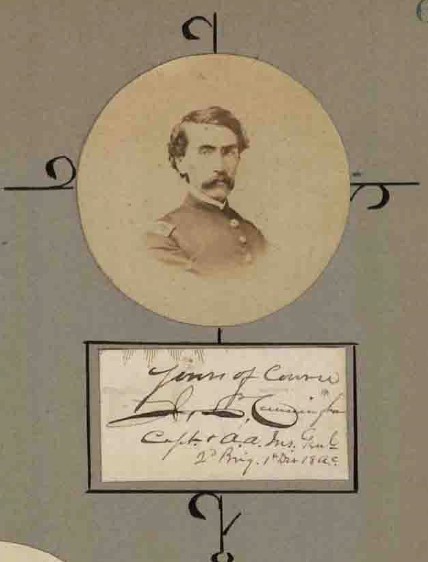
John L. Cunningham image. Courtesy of MOLLUS-Mass Civil War Photograph Collection, Vol. 130, Page 6677.  United States Army Heritage and Education Center, Carlisle, PA

The streets were lined with men, women, and children shouting their goodbyes with occasional audible sobs as near and dear ones passed by… it was more solemn than hilarious to marchers and lookers-on.” [8]

Once in Whitehall, they were crammed into the boxcars of a freight train bound for Albany. The regiment would reach Albany around noon on the second[9]. Here they had lunch and were loaded onto cattle cars with “evidence of their late occupancy”[10]. This putrid and soiled train was bound for New York City.
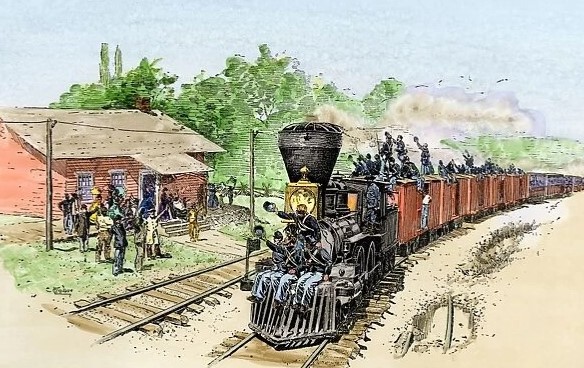
Union troops transported to the front by rail, US Civil War. Hand-colored woodcut of a 19th-century illustration
Courtesy of http://hardtackregiment.com/links.html.

Once, In New York City, Pvt. Hews and the 118th marched to City Hall Park. Here they were billeted on the grounds. A tall iron fence encircled the park, which had a flatiron-shaped design. Makeshift barracks were erected in the upper area of the park containing bunk beds. This is where they would bed down for the night.  The noise of the city would awaken Pvt. Hews and the regiment. They crowded against the fence and interacted with merchants and the people of the city. Major Cunningham establishes the setting with his statement.

Tom Thumb, full-length portrait, facing left, standing by chair , ca. 1863. Photograph. Courtesy of https://www.loc.gov/item/2004672771/.

About half past one of that afternoon, the band of Barnum’s Museum appeared on the balcony of that notable showplace, just across the street from us.  We country-fellows knew much of Barnum’s Museum by reputation and yearned to see its inside for ourselves. Tom Thumb was one of the then leading features of that show and his diminutive coach and ponies, out for advertising, came down the sidewalk on the east side of our enclosure and our men massed themselves against the iron fence to get a glimpse of the coach and followed it in pell-mell fashion as it proceeded towards the narrow point of the park.  The men reached the gates in a mass and overran the guard, those in front being forced through the gate by the pressing crowd behind. Before our reserve guard could be used, a blue streak of men headed for the museum, to the holding up of the large traffic of that vicinity.”[11]

                At around five o’clock that evening, assembly was called. By then, most of the men had returned from their adventure.  Pvt. Hews and the 118th assembled, and marched down Broadway to a steamer, “’mid a shouting side-walk multitude.” [12] They took the ship to Philadelphia and made it just in time for breakfast at the “Cooper Shop.” After a hardy breakfast, they marched a large distance to the train station. Here, Pvt. Hews and the 118th would catch a train to Baltimore. They would reach Baltimore later that evening. At that time, Baltimore was a tinder box, as both Unionists and Southern sympathizers occupied the city. Pvt. Hews and the 118th, having not yet been issued arms, were in quite a predicament.
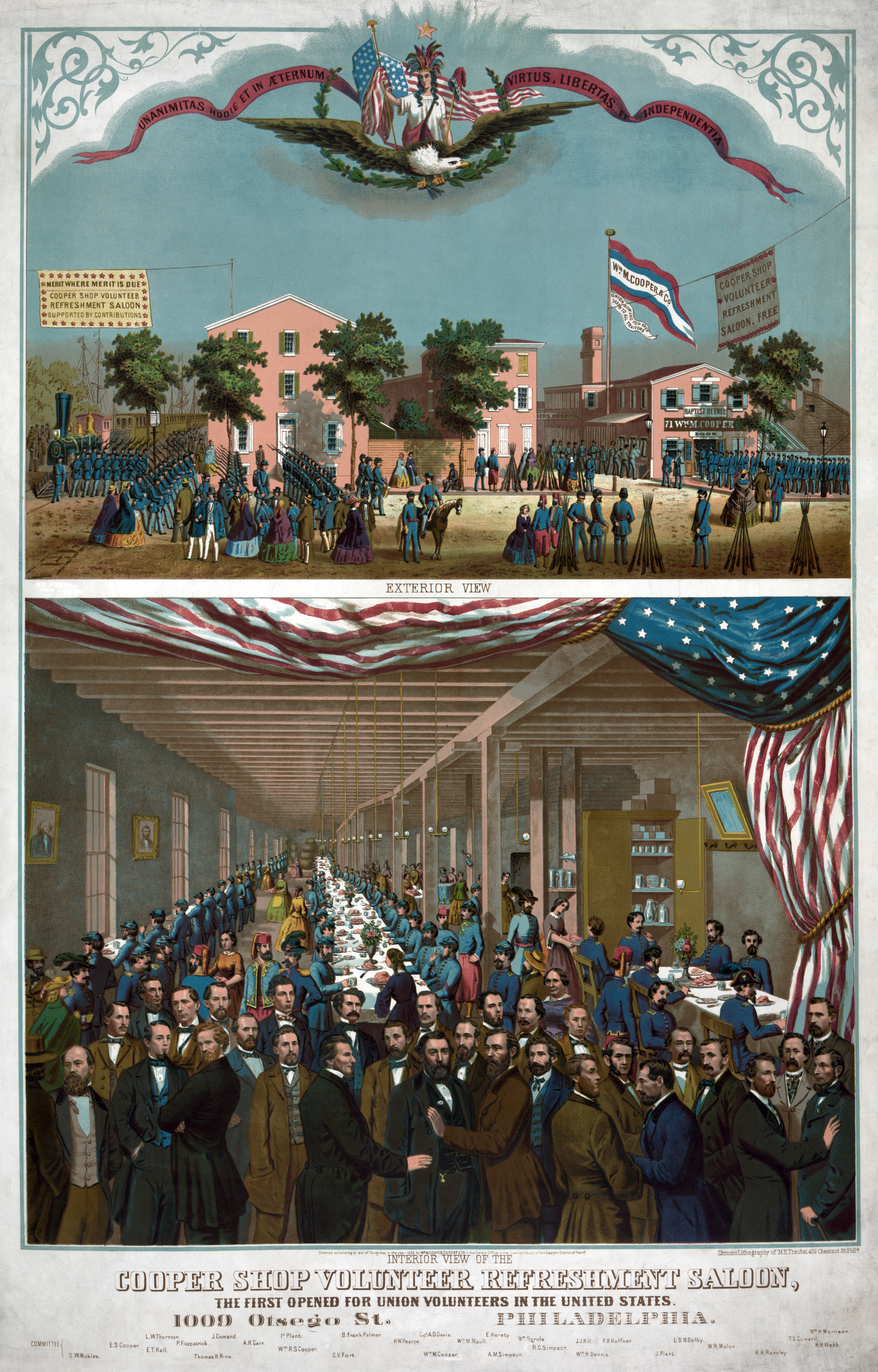
Cooper, William M., Copyright Holder, and M. H Traubel. Cooper Shop Volunteer Refreshment Saloon, the First Opened for Union Volunteers in the United States Otsego Street, Philadelphia =. Pennsylvania United States of America Philadelphia, 1862. Philadelphia: Chromolithography of M. H. Traubel.
Photograph Courtesy of https://www.loc.gov/item/2021670373/.

They had to march a long route through downtown to reach the Ohio Station. This scene is expertly described by Major Cunningham…

We were ordered to make no utterances and pay no attention to the utterances of others.  We heard distinct hisses from behind many a window shutter and reaching the business section found crowds of excited people indulging in all sorts of shouts of derision and threats, mingled with occasional friendly salutations.”  [13]

Major Cunningham continues to say they heard “all sorts of angry, vituperative shouts. “The more Northern scum the more fertilizer for Southern cotton fields “: “Better stop here and surrender to Lee, he’ll be here in a few days,” etc., etc.  The excitement was threatening, and it seemed as if we might be attacked, but we reached the station unmolested.”[14]

The next morning, they would receive their arms and orders to guard the junction of the Washington and Harper’s Ferry trains. Given its status as the sole railway connecting Washington from the north, it was crucial to protect and secure it from potential acts of sabotage.

                The 118th spent most of its time here engaged in daily exercises. The deployment was punctuated by a few false alarms of southern incursions, including one that resulted in the accidental shooting death of a train engineer. Major Cunningham describes the tragic accident by writing…

Our men were scattered along the road in “bunches” of four or more, the groups being within sight of each other, one man to be on watch all the while, and when a train approached, he called out all the group, they to stand at present arms till the train passed. On the coming of this train the guard was called out and in hurrying into position the gun of one man, Eugene Dupuis of our company, was accidentally discharged. The bullet struck the smokestack of the engine, glanced, and hit the engineer in his forehead, killing him instantly.”[15]

In response to the prevailing anger generated by this incident, Pvt. Hews and the regiment were moved to Fort Ethan Allen. The fort was situated on the opposite side of the Potomac River, to the north of Washington. The soldiers of the 118th regiment devoted their time at Fort Ethan Allen to tirelessly participating in drill activities, unwaveringly grappling with the elements, and steadily combating a sudden surge of illnesses.
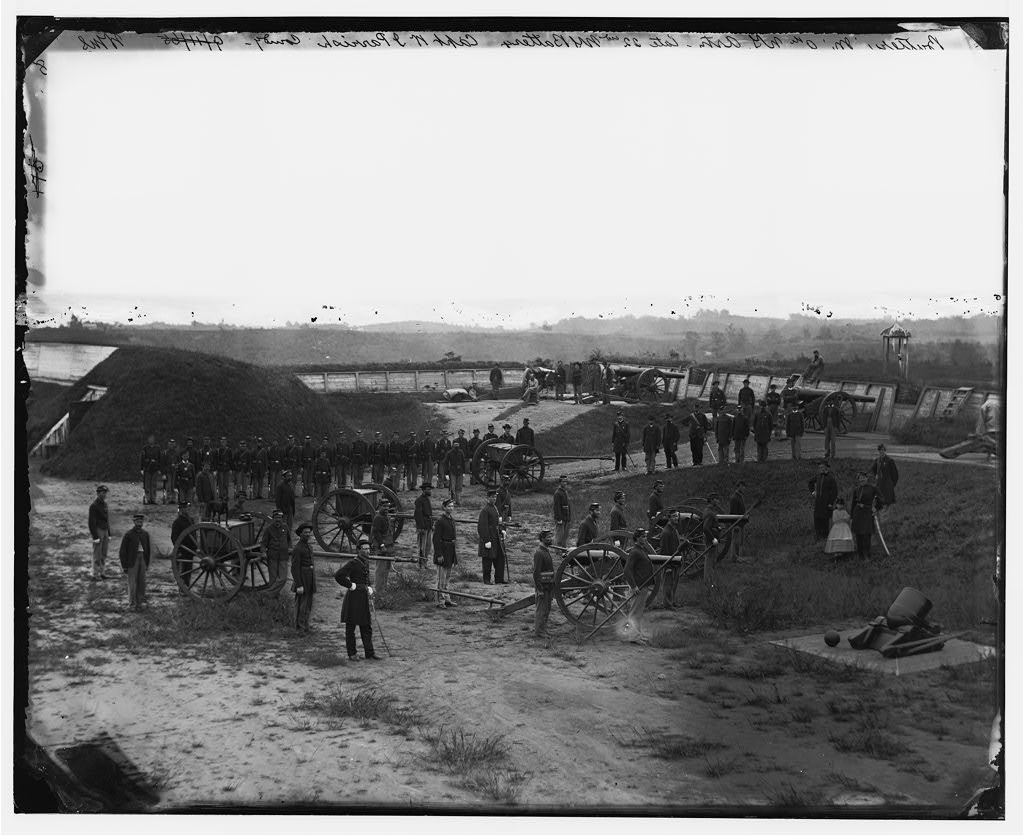
Company M, 9th New York Heavy Artillery, At Fort Ethan Allen Smith,
William Morris; Civil War Glass Negatives – Library of Congress Catalog: https://www.loc.gov/pictures/item/cwp2003000965/PP Original url: http://hdl.loc.gov/loc.pnp/cwpb.04244

                It was here at Fort Ethan Allen where Pvt. James Hews met his fate. Around midnight on December 29th, 1862[16] an alarm was sounded to prepare for an attack. The men were ordered to their rifle pits when, “while there a gun in the hands of William H. Stover was discharged Its ball striking J. Hews about the middle of his back by the side of his spine, going upwards through the lung, lodging just under the skin.” [17] Investigation revealed that the men along the picket line had noticed a small incursion of Confederate troops, which was what had set off the alarm.

                Pvt. Hews would linger through the night, surrounded by his friends and comrades. His demise would occur later in the day, on the 30th. [18] The company fashioned him a headstone from wood and buried him with full military honors, on the 1st of January 1863. [19]  Lieutenant . John H. Smith described the internment as such…

“We have had the painful duty of consigning the remains of poor James to the silent tomb. There were but few dry eyes on the occasion as they all seem to know and feel our loss. We have lost a friend and comrade and some of us a kind neighbor and his kind words and deeds shall ever be fresh in our memories.”[20]

                The 118th New York would continue to serve. They would participate in the Siege of Suffolk, as well as the battles of Drury’s Bluff, Cold Harbor, The Creator, Chaffin’s Farm, New Market, Fair Oaks, and Appomattox Court House. Major Cunningham would survive the war with two wounds. Pvt. William H. Stover remained with the regiment until June of 1863, at which point he was recorded as absent due to illness. Subsequently, he was admitted to various hospitals for the remainder of the war and. ultimately discharged from the U.S. General Hospital in April of 1865[21].

                Sarah, the wife of Pvt. Hews applied for a widow’s pension in October of 1863. [22] Consequently, she was approved for a monthly allowance of eight dollars. Which, in the year 2024, would be equivalent to approximately one hundred and ninety-five dollars[23]. However, her pension ceased on October 10th, 1866[24], when she remarried James Palmer. Unfortunately, Sarah outlived her second husband as well. Mr. Palmer passed away in 1901[25]. This unfortunate circumstance forced her to reapply for a pension. She was granted one at a rate of twelve dollars per month. As of 2024, this amount would be approximately four hundred and thirty dollars[26]. Sarah’s life came to an end on April 17th, 1915. [27]

                Sarah is at rest along with her second husband at Landon Hill Cemetery in Chestertown, Warren County, New York. On the back of her headstone is a cenotaph for Pvt. James Hews. Pvt. Hews is interred at the US Soldiers’ and Airmen’s Home National Cemetery in Washington, District of Columbia.

The demise of James Hews, a brave soldier who actively participated in the American Civil War, was a tragic event. Due to a terrible accident that one of his fellow soldiers caused, his life ended abruptly. This unfortunate incident serves as a poignant reminder of the immense grief and sorrow that engulfed the entire war.


[1] Ancestry.com. “James Franklin Hewes in the New York, U.S., Town Clerks’ Registers of Men Who Served in the Civil War, ca 1861-1865,” n.d. https://www.ancestry.com/discoveryui-content/view/186054:1964?tid=&pid=&queryId=590cc1eb-0549-4287-a482-6f70397d72d4&_phsrc=JHJ53&_phstart=successSource.

[2] New York, U.S., State Census, 1855 for James F Hews. (n.d.). Ancestry.Com. https://www.ancestry.com/discoveryui-content/view/1653073418:7181?tid=&pid=&queryId=8a42329a-f003-4781-b696-2d5b0e3193b4&_phsrc=JHJ170&_phstart=successSource

[3] Hews, James F – Fold3 – US, Civil War “Widows’ Pensions”, 1861-1910. (n.d.). Fold3. https://www.fold3.com/file/185244902 P. 57

[4] Three Years With the Adirondack Regiment: 118th New York Volunteers Infantry: Cunningham, John Lovell, 1840- : Free Download, Borrow, and Streaming: Internet Archive, 1920) P. 13

[5] Hews, James: New York Civil War Muster Roll Abstracts, 1861-1900. (n.d.). Fold3. https://www.fold3.com/image/315830718

[6] Ibid

[7] Three Years With the Adirondack Regiment: 118th New York Volunteers Infantry: Cunningham, John Lovell, 1840- : Free Download, Borrow, and Streaming: Internet Archive, 1920) P. 17

[8] Ibid

[9] Ibid P. 21

[10] Ibid P. 22

[11] Ibid P. 22-23

[12] Ibid P. 23

[13] Ibid P. 24

[14] Ibid

[15] Ibid P. 29

[16] Ibid P. 38

[17] James Hews US, Civil War “Widows’ Pensions”, 1861-1910. (n.d.). Fold3.  https://www.fold3.com/image/185244929/hews-james-f-page-14-us-civil-war-widows-pensions-1861-1910

[18] Hews, James: New York Civil War Muster Roll Abstracts, 1861-1900. (n.d.). Fold3. https://www.fold3.com/image/315830718

[19] Hews, James Page 16 – US, Civil War “Widows’ Pensions”, 1861-1910. (n.d.). Fold3. https://www.fold3.com/image/185244932/hews-james-f-page-16-us-civil-war-widows-pensions-1861-1910

[20] “Hews, James Page 16 – US, Civil War Pensions 1861-1910.” n.d. Fold3. https://www.fold3.com/image/185244932/hews-james-f-page-16-us-civil-war-widows-pensions-1861-1910.

[21] “William Stover US, New York Civil War Muster Roll Abstracts, 1861-1900.” n.d. Fold3. https://www.fold3.com/image/315783439/stover-william-hiram-page-1-us-new-york-civil-war-muster-roll-abstracts-1861-1900.

[22] “Hews, James – US, Civil War Widows’ Pensions, 1861-1910.” n.d. Fold3. https://www.fold3.com/image/185244907/hews-james-f-page-3-us-civil-war-widows-pensions-1861-1910.

[23] “Inflation Rate Between 1863-2024 | Inflation Calculator.” n.d. https://www.officialdata.org/us/inflation/1863?amount=8.

[24] “Hews, James Page 33 – US, Civil War Pensions 1861-1910.” n.d. Fold3. https://www.fold3.com/image/185244965/hews-james-f-page-33-us-civil-war-widows-pensions-1861-1910.

[25] Ibid

[26] “Inflation Rate Between 1902-2024 | Inflation Calculator.” n.d. https://www.officialdata.org/us/inflation/1902?amount=12.

[27] “Hews, James Page 58 – US, Civil War Pensions 1861-1910.” n.d. Fold3. https://www.fold3.com/image/185245039/hews-james-f-page-58-us-civil-war-widows-pensions-1861-1910.

An Englishman in the 112th New York “Chautauqua Regiment”.

Every soldier has a story, and Private Robert Jones Jr. is no exception.

Tintype of Private Robert Jones Jr. of the 112th New York Infantry “Chautauqua Regiment”. Provided by The American Military Heritage Museum Of North Carolina

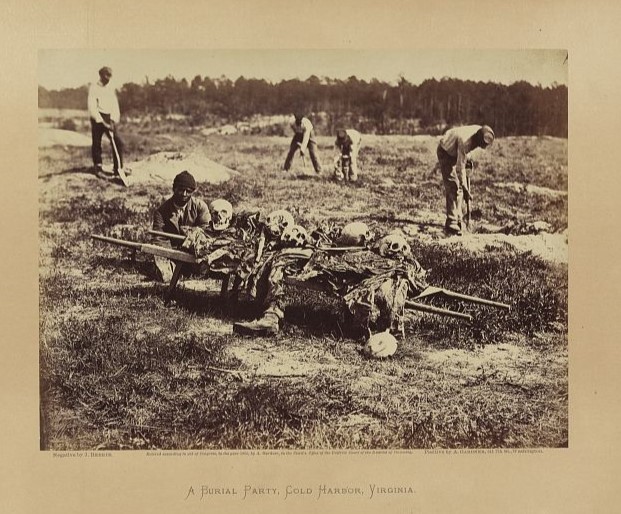
Jones was born to Robert and Mary Jones in Kent England[1] around 1832[2]  The family immigrated to America prior to 1840[3], and settled in Westfield, Chautauqua, New York. Jones would work as a laborer, and would marry Betsy Ann Honeysett in 1860.[4] They would have their first child Rhoda in 1861.[5]At the outbreak of the American Civil War Robert’s brothers, Jacob[6]and Thomas[7] joined the Union as part of the 49th New York Infantry. Later when Chautauqua County was called on for a thousand men the state offered a $50 dollar bounty to any volunteer that enlisted. This $50 was in addition to a $100 dollar bounty offered by the Federal Government. The duty of recruiting a Regiment from Chautauqua County was met with enthusiasm[8]. On August 31st, 1862, Robert Jones filled with patriotism and some extra cash, joined the 112th New York. This regiment would be forever known as the “Chautauqua Regiment. [9] At that time he was listed as being 5 Feet 7 and ¾ inches, with dark hair, chestnut eyes, and a fair complexion.[10] Jones would be mustered into “H” Co as a Private on September 11th, 1862.[11] Private Jones was in the following engagements; The Siege of Suffolk, Battle of Drewry’s Bluff, and the Battle of Cold Harbor. At Cold Harbor the 112th NY had to cross an open field of 600 yards to reach the Confederate advance skirmishers. This action is described by William Lyman Hyde, in his book History Of The One Hundred And Twelfth Regiment N.Y. Volunteers as follows.

Reekie, John, and Alexander Gardner, photographer. A burial party on the battle-field of Cold Harbor / negative by J. Reekie ; positive by A. Gardner. United States Cold Harbor Virginia, ca. 1866. [1865 April printed later] Photograph. https://www.loc.gov/item/2002713100/.

“This had been successfully accomplished and the enemy driven back to their rifle pits and the capture of 600 Confederate soldiers. Facing the Union Army were veteran soldiers….the right was occupied by General A.P. Hill’s Corp., in the center was General James Longstreet’s Corps., and on the left was General Richard Ewell’s Corps. As the attack progressed, Colonel Drake ordered the men to cease firing and fix bayonets. The attack pressed on, the Confederate works were irregular, and the men were exposed to a galling fire. Though the loss was severe the works were reached and mounting the parapet among the first of the men, Colonel Drake waved his sword, hurrahed and fairly danced with exultation as the rebels ran back to their rifle pits. This line of works had been carried with considerable loss and the ranks now quite broken, but the men were pressing on toward the second line. Unfortunately, a Regiment of the 6th Corps on the flank of the 112th New York was a raw regiment, enlisted only six weeks before and this was their first fight. The distance to the Confederate works in their front was less by a hundred rods than in front of Colonel Drake’s Brigade, but that Regiment quailed before the fire and could not be pushed up. This left the Brigade in a very unfortunate position and the Confederate rifle pits on the flank of the 112th were able to pour in a severe enfilading fire. In addition the men of the 112th were exposed to the frontal fire of the advance line of works….. at this point the carnage was terrible, the 112th New York from its position suffering the most severely, its casualties nearly equal to the sum of those in the rest of the Brigade.[12]

Roberts survived this battle and continued to fight at, The Siege of Petersburg, Second Battle of Petersburg, and The Battle of the Crater. The Chaplin of the 112th New York, William L. Hyde describes the action at the Crater to his wife in a letter as such.

“Saturday morning about five o’clock our brigade with the ninth corps were drawn up in successive lines preparatory to a charge upon a redoubt which had been mined.  The first operation was to blow up the fort.  This was done in fine style, a complete success.  The mine was lighted at precisely 5 o’clock and the huge mass of earth with men & guns were lifted up into the air.  Some men were blown over into our advance pits.  One man who came over unharmed said he thought it was rather unceremonious to send a man kiting through the air in that shape before he had eaten his breakfast.  After the redoubt was blown up, we opened a terrible artillery fire along our whole line. then the troops made a charge the negro regiments first.  We got possession of the redoubt without the loss of a man. With a very slight loss we got possession of the main works of the enemy.  We held two lines and were preparing to make or position secure when the negros and some white troops in front were seized with panic and broke & ran and pressed the troops in the rear by sheer force of numbers.  Some officers stood well & tried to stay the rush but it was in vain and in a few minutes the work of weeks was lost.  Our Brigade was just getting into position when the stampede took place.  They did what they could to arrest it but were too feeble.  One man told me that a huge nigger came tumbling over him and almost broke his back!  In our endeavoring to hold the position till the line could be reformed, our Regt suffered some casualties we had one man killed and eleven wounded. two men mortally wounded.  I do not know of any with whom you are acquainted.  We remained in the front of our works until about five o’clock PM when the regiment was marched back into the trenches where they had been so long.”[13]

Private Roberts would soldier on to, the Battle of Chaffin’s Farm, Battle of Fair Oaks & Darbytown Road, First Battle of Fort Fisher, Second Battle of Fort Fisher, and the Carolinas Campaign.[14] Robert would get through the war relatively unscathed. He would be mustered out with his regiment on June 13, 1865, at Raleigh, North Carolina.[15]

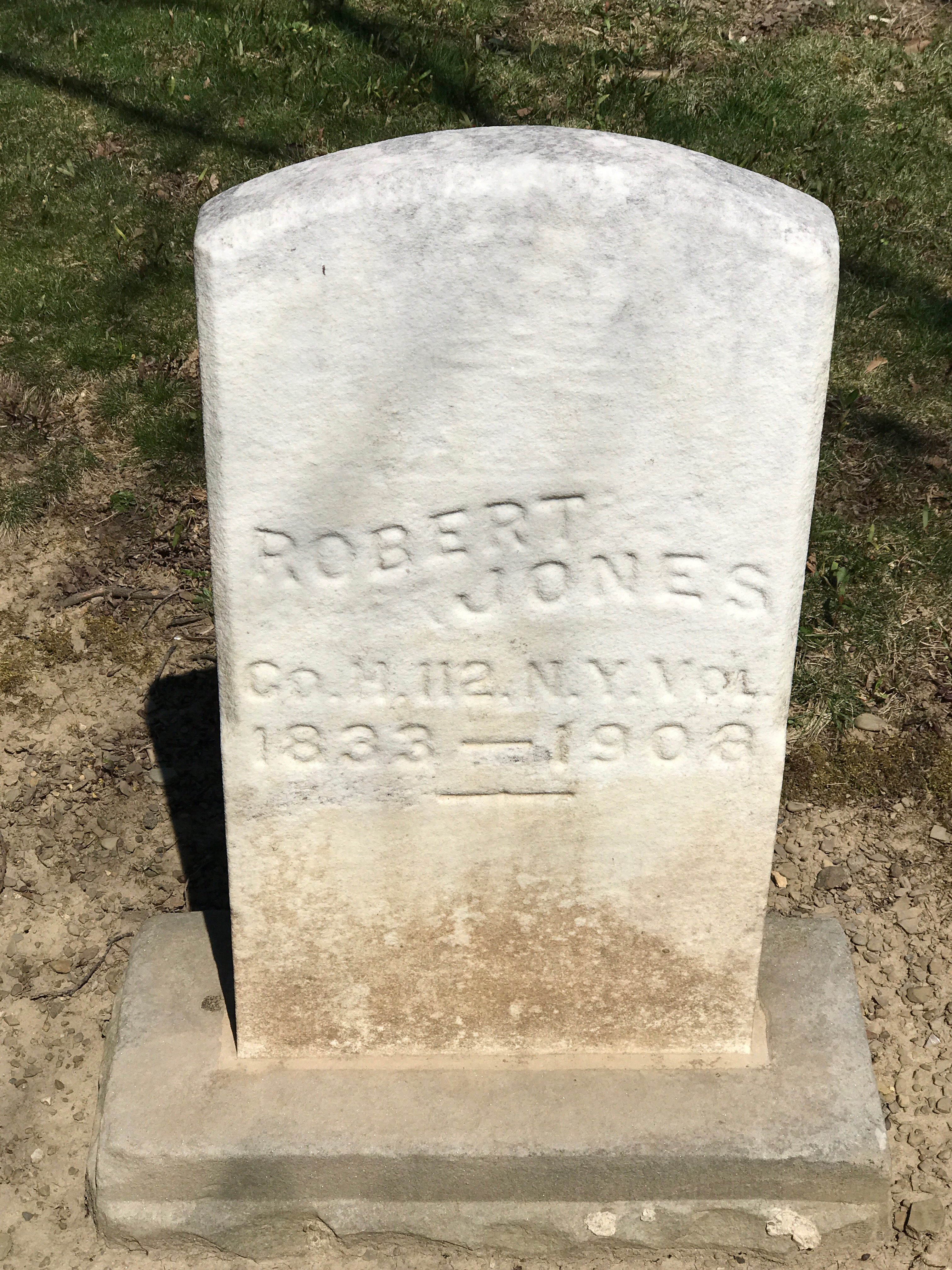
Grave of Private Robert Jones at Quincy Rural Cemetery Ripley, Chautauqua County, New York, USA. Photo By Robin Boyd on 1 May 2018

Sadly his brothers could not say the same. Jacob would be killed at Petersburg, Virginia, on April 2 1865[16], and Thomas would be severely wounded on May 5,1864 during The Battle of the Wilderness.

After the war Robert would become a farm laborer, and have three more children Matilda, Delbert, and Hattie.[17] His wife Betsy would die in 1878. Robert would pass on November 11th, 1908[18] at the approximate age of 76. He is interred at Quincy Rural Cemetery Ripley, Chautauqua County, New York, USA.[19]


[1] eburrelle. “Robert Jones.” Ancestry. Accessed February 1, 2021. https://www.ancestry.com/family-tree/person/tree/20830658/person/994697722/facts.

[2] “New York Civil War Muster Roll Abstracts 112th Infantry, Jones, Robert.” Fold3. Accessed February 1, 2021. https://www.fold3.com/image/315812072.

[3] “1840 United States Federal Census for Robert Jones.” Join Ancestry. Accessed February 1, 2021. https://www.ancestry.com/imageviewer/collections/8057/images/4409458_00336?pId=2348221.

[4] “1860 United States Federal Census for Robert Jones.” Ancestry. Accessed February 1, 2021. https://www.ancestry.com/imageviewer/collections/7667/images/4235216_00189?pId=49149036.

[5]   eburrelle. “Robert Jones.” Ancestry. Accessed February 1, 2021. https://www.ancestry.com/family-tree/person/tree/20830658/person/994697722/facts.

[6] “New York, U.S., Civil War Muster Roll Abstracts, 49th New York Infantry, Jacob Jones.” Ancestry. Accessed February 1, 2021. https://www.ancestry.com/imageviewer/collections/1965/images/31514_219465-00495?pId=594673.

[7] “New York, U.S., Civil War Muster Roll Abstracts, 49th New York Infantry, Jones Thomas 1861-1900.” Ancestry. Accessed February 1, 2021. https://www.ancestry.com/imageviewer/collections/1965/images/31514_219465-00499?pId=594673

[8] Joel Babcock, The beginning – volunteers for the Army, accessed November 17, 2023, https://www.112thnyvi.com/index.html.

[9] “New York Civil War Muster Roll Abstracts 112th Infantry, Ones, Robert.” Fold3. Accessed February 1, 2021. https://www.fold3.com/image/315812072

[10] Ibid

[11] Ibid

[12] Joel Babcock, Cold Harbor, VA June 1, 1864, accessed November 17, 2023, https://www.112thnyvi.com/page29.html.

[13] William L. Hyde, The mine & ft. Gilmer, accessed November 17, 2023, https://www.112thnyvi.com/page4.html.

[14] “112th Infantry Regiment Civil War Chautauqua Regiment.” 112th NY Infantry Regiment during the Civil War – NY Military Museum and Veterans Research Center. Accessed February 1, 2021. https://dmna.ny.gov/historic/reghist/civil/infantry/112thInf/112thInfMain.htm.

[15] Ibid

[16]  “New York, U.S., Civil War Muster Roll Abstracts, 49th New York Infantry, Jacob Jones.” Ancestry. Accessed February 1, 2021. https://www.ancestry.com/imageviewer/collections/1965/images/31514_219465-00495?pId=594673.

[17] “1880 United States Federal Census.” Ancestry. Accessed February 1, 2021. https://www.ancestry.com/imageviewer/collections/6742/images/4242062-00414?pId=1427991.

[18] “New York, U.S., Death Index, 1852-1956 for Robert Jones.” Ancestry. Accessed February 1, 2021. https://www.ancestry.com/imageviewer/collections/61535/images/47952_554183-00456?pId=1785815.

[19] “Robert Jones (1833-1908) – Find A Grave Memorial.” Find a Grave. Accessed February 1, 2021. https://www.findagrave.com/memorial/38795266/robert-jones.

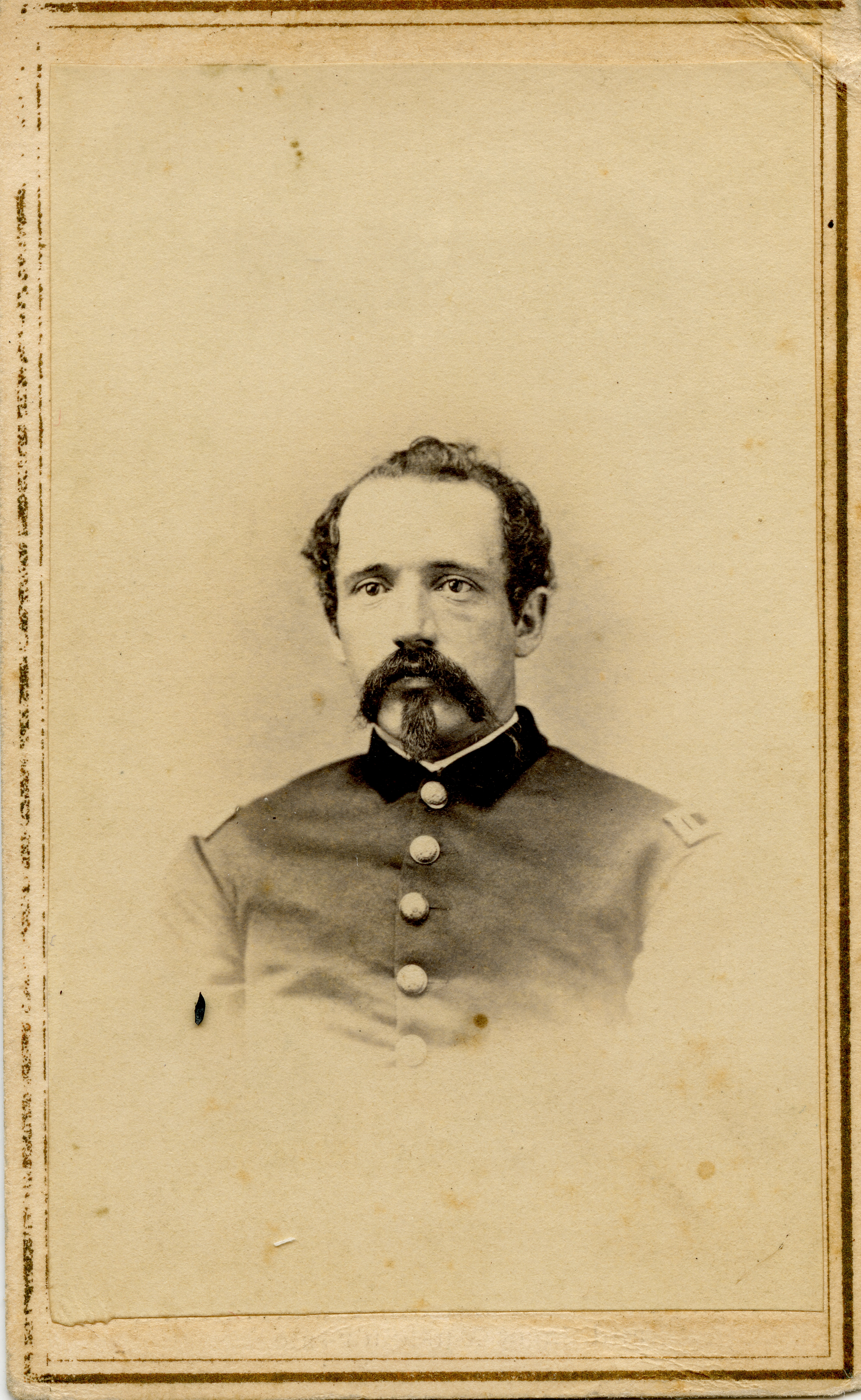
One of Wilson’s Zouaves: The Story of 1st Lieutenant Thomas J. Roberts.

The American Civil War is full of interesting stories. This image of 1st Lieutenant Thomas J. Roberts contains one such tail. He was born in England around 1834[1], and immigrated to The United States in 1848[2].  Roberts Would settle in Brooklyn New York. He would meet Mary E. Spencer there.

Carte De Visite of 1st Lieutenant Thomas J. Roberts. Provided by,The American Military Heritage Museum Of North Carolina

They would marry on January 20th, 1859 at Seventh Presbyterian Church, in New York.[3] Mary and Roberts would have six children. Shortly after the outbreak of the American Civil War Roberts would heed the call. He enlisted on December 21st, 1861. At the time of his enlistment Roberts was listed as being a printer, and was described as five feet six inches, with grey eyes, black hair, and a fair complexion.[4]

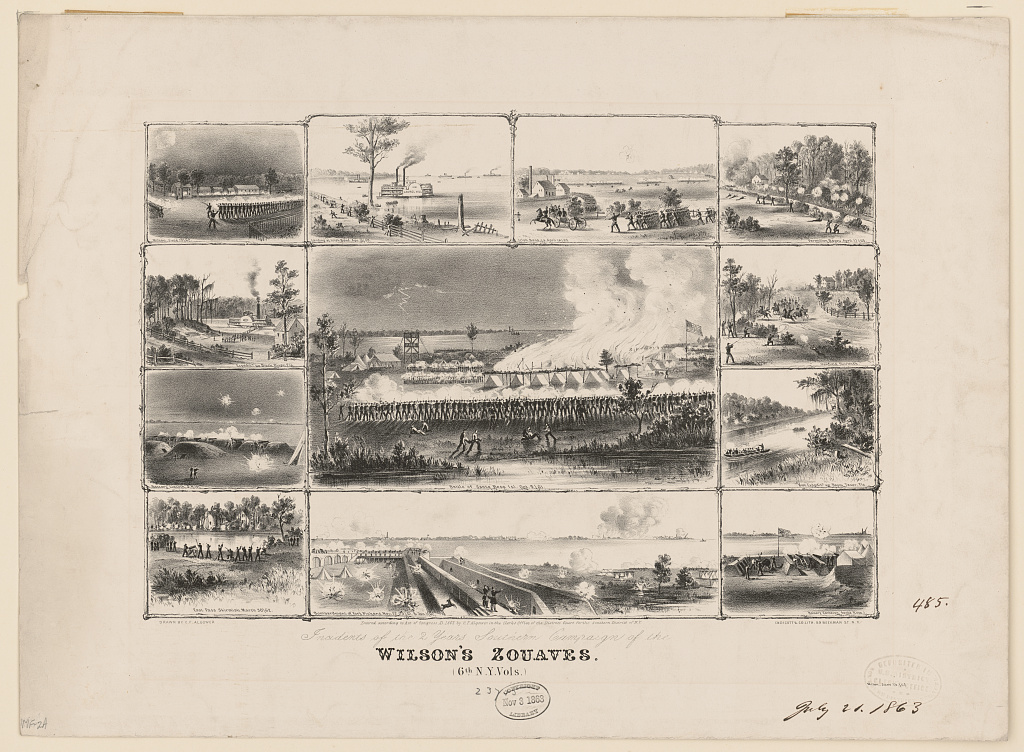
He would be commissioned as a 2nd Lieutenant into “G” Co. 6th New York Infantry that same day. The 6th New York known also as Billy Wilson’s Zouaves had a rough reputation. They were described in a New York paper of the era as..

“the regiment of New York firemen, with a pretty good mixture of the “roughs” of that city, of whom Col. “Billy” Wilson was himself one. They are a hard set to keep in subordination, but have generally proved better soldiers than would be expected. They were a long time stationed at Fort Pickens, and did some pretty good fighting there.”[5]

Incidents of the 2 years southern campaign of the Wilson’s Zouaves. 6th. N.Y. vols. , ca. 1863. July 21. Photograph. https://www.loc.gov/item/2003664954/.

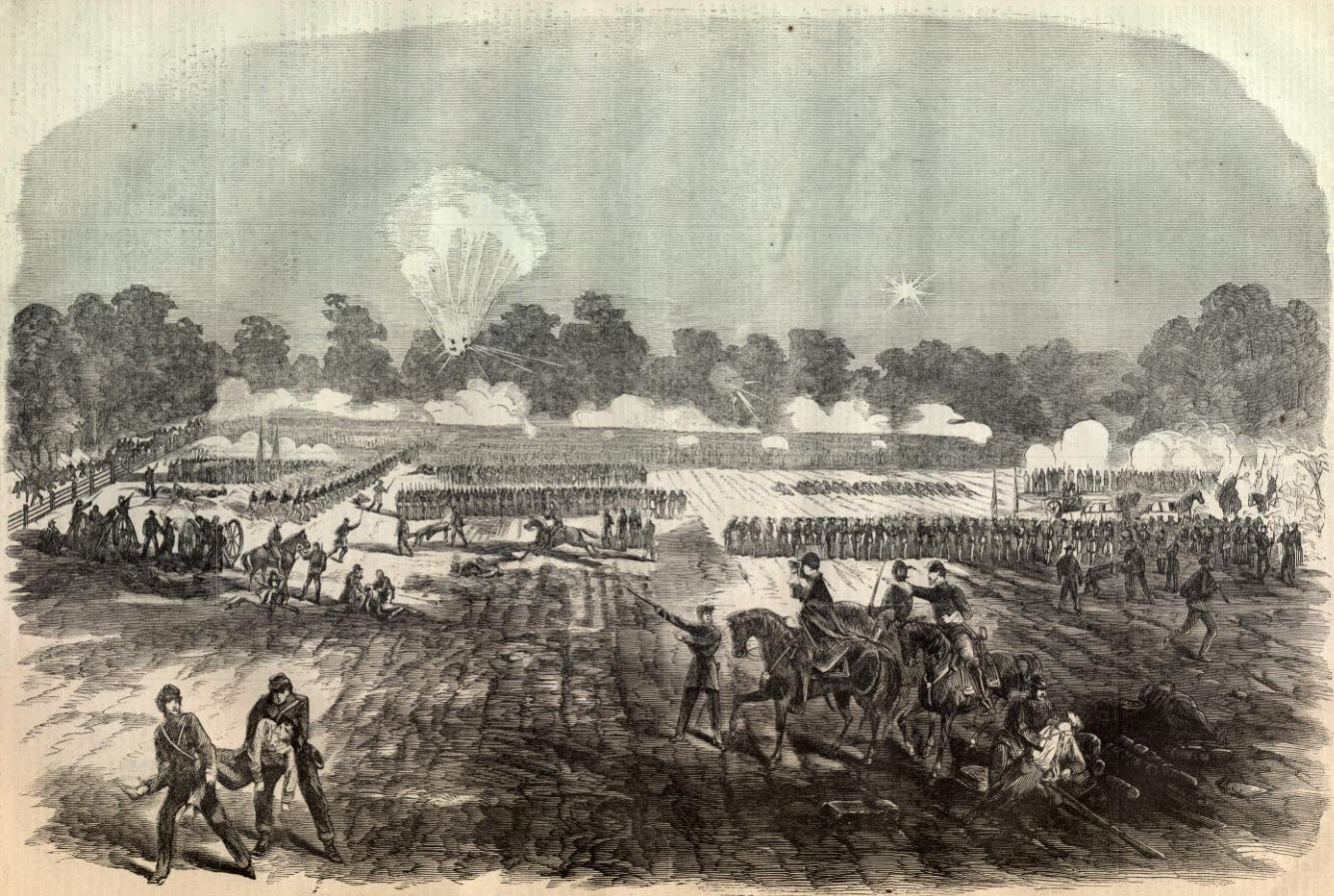
2nd Lieutenant Roberts was with the 6th in all its engagements including the bombardment of Santa Rosa Island, FL, the Battle of Irish Bend, and the Battle of Vermillion Bayou. Roberts would be promoted to 1st Lieutenant. He would made quartermaster of the regiment upon the retirement of Quartermaster Bradley on July 21st, 1862.[6]  Roberts would be mustered out with the regiment on the 25th of June 1863.[7]

The Battle of Irish Bend Louisiana sketched by William Hall of the 22nd Maine. Harper’s Weekly 16 May 1863

                After the war Roberts would continue to be a printer and live in Brooklyn. He would become a member of G.A.R Post 435. Roberts would die on October 1st 1912[8] at the approximate age of 78. He is interred at Cyprus Hills Cemetery in Brooklyn.


[1] “New York Civil War Muster Roll Abstracts 6th Infantry Roberts, Thomas J ,” Fold3, accessed March 8, 2021, https://www.fold3.com/image/315527651.

[2] Nicolai, Jill. “Thomas J Roberts Family Tree.” Ancestry. Accessed March 8, 2021. https://www.ancestry.com/family-tree/person/tree/106032054/person/380048037984/facts?_phsrc=ZhY276&_phstart=successSource.

[3] Ibid

[4] “New York Civil War Muster Roll Abstracts 6th Infantry Roberts, Thomas J ,” Fold3, accessed March 8, 2021, https://www.fold3.com/image/315527651

[5] 6th NY Infantry Regiments Civil War Newspaper Clippings – NY Military Museum and Veterans Research Center. Accessed March 8, 2021. https://dmna.ny.gov/historic/reghist/civil/infantry/6thInf/6thInfCWN.htm.

[6] “New York Civil War Muster Roll Abstracts 6th Infantry  Roberts, Thomas J.” Fold3. Accessed March 8, 2021. https://www.fold3.com/image/315527663.

[7] Ibid

[8] “New York, U.S., Grand Army of the Republic Records, 1866-1931 Post 435 Descriptive Book.” Ancestry. Accessed March 8, 2021. https://tinyurl.com/hju4aaks.

Sergeant Thomas Wilson: A Tragic Tail of Irish Immigration.

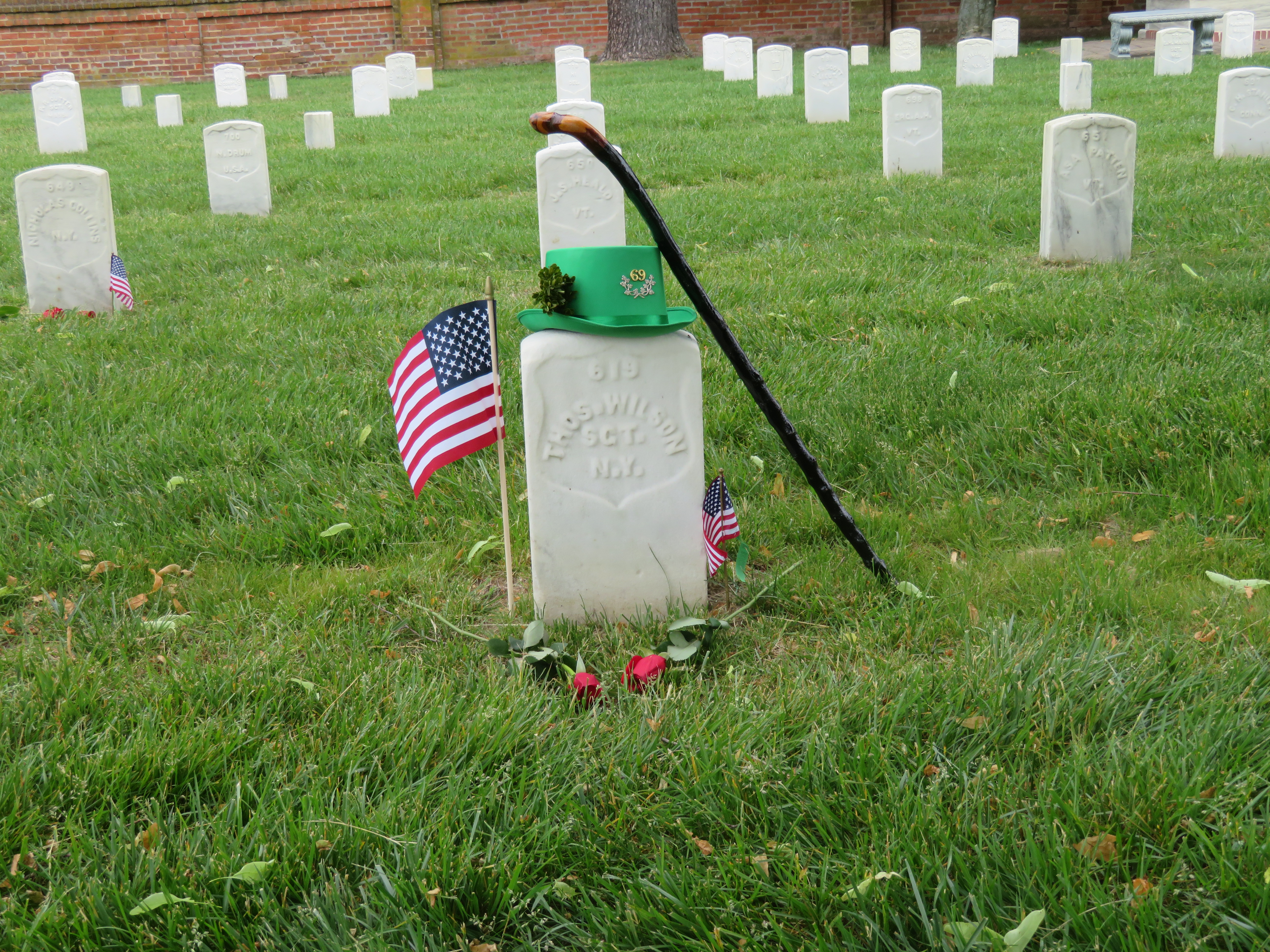
I recently took a trip to Cold Harbor National Cemetery. Here I discovered the final resting place of Sergeant Thomas Wilson. I also unearthed a a tragic tail of Irish immigration. Wilson was born in Ireland around 1834[1], and immigrated to New York to find a better life. Thomas would find a job as an Oyster Shucker at the St. Nicholas Hotel. Here he met Ms. Frances Connor who also worked there as a laundress. They would marry in 1861[2] and shortly after Thomas would enlist.  

Grave of Sgt. Thomas Wilson at Cold Harbor National Cemetery Photo By @firefightinirish

He was mustered into “I” Co. 69th New York as a Corporal on September 17, 1861[3]. Corporal Wilson was in the following engagements: The Siege of Yorktown, Battle of Fair Oaks, The Seven Days Battles, Antietam, and Fredericksburg. It is possible he then deserted, as his name is not on the rolls again until June of 1863[4] with a reduced rank. He was present at The Battle of Gettysburg and promoted to Corporal. Wilson was then assigned to guard a “farmhouse”[5], which was presumably a headquarters, in October of 1863[6]. Wilson reenlisted as a veteran volunteer on December 21, 1863[7] and was assigned to “B” Co. 69th New York Infantry. In 1864 he was promoted to Sergeant. In March of that year, his wife Frances Wilson would have a child named Mary Ellen[8]. Sergeant Wilson would later fight in the battles of The Wilderness, Spotsylvania Court House, Totopotomoy, and Cold Harbor. Sergeant Wilson was killed in action at Cold Harbor and never laid eyes on his daughter.

Wilson’s wife would eventually receive a widow’s pension of two dollars a month, which is about thirty-two dollars in today’s money. Mrs. Wilson was extremely poor. Her pension was not enough to survive on without taking up work, so she returned to her job at the hotel. Before long it was too hard for Mrs. Wilson to care for Mary Ellen, so she would give the child to Mary Score. Mrs. Score lived in a tenement house on “Mulberry Bend”[9], which is an area known for its overwhelming crime and filthy living conditions. Mrs. Wilson would regularly visit her daughter and would “hold and kiss her”[10]. Mrs. Score would also find it a struggle to care for an extra child and would place Mary Ellen with the Department of Public Charities and Corrections. Mrs. Score told Mrs. Wilson that Mary Ellen was dead, driving Mrs. Wilson to alcoholism. Frances Wilson died of a lung hemorrhage in a hospital on Wards Island in 1872[11] and was buried in a Potters field.

The very much alive Mary Ellen was placed in the Alms House at Blackwell Island on July 10, 1865.[12] Orphanages, at the time had an 85% death rate.[13] Mary Ellen would beat the odds and was adopted by Thomas and Mary McCormick on January 2, 1866[14]. The adoption was granted on the grounds that Thomas McCormick claimed to have an affair with a “no good woman”[15], and that she had left the child (Mary Ellen) at the Alms House.  Although there was no actual evidence of this affair the adoption was never contested. More than likely this is because children at this time had no rights and were often adopted for use in household labor. Thomas McCormick died of cholera in August of 1866.[16] Mary McCormick would remarry to Frances Connolly in August 1867.[17]

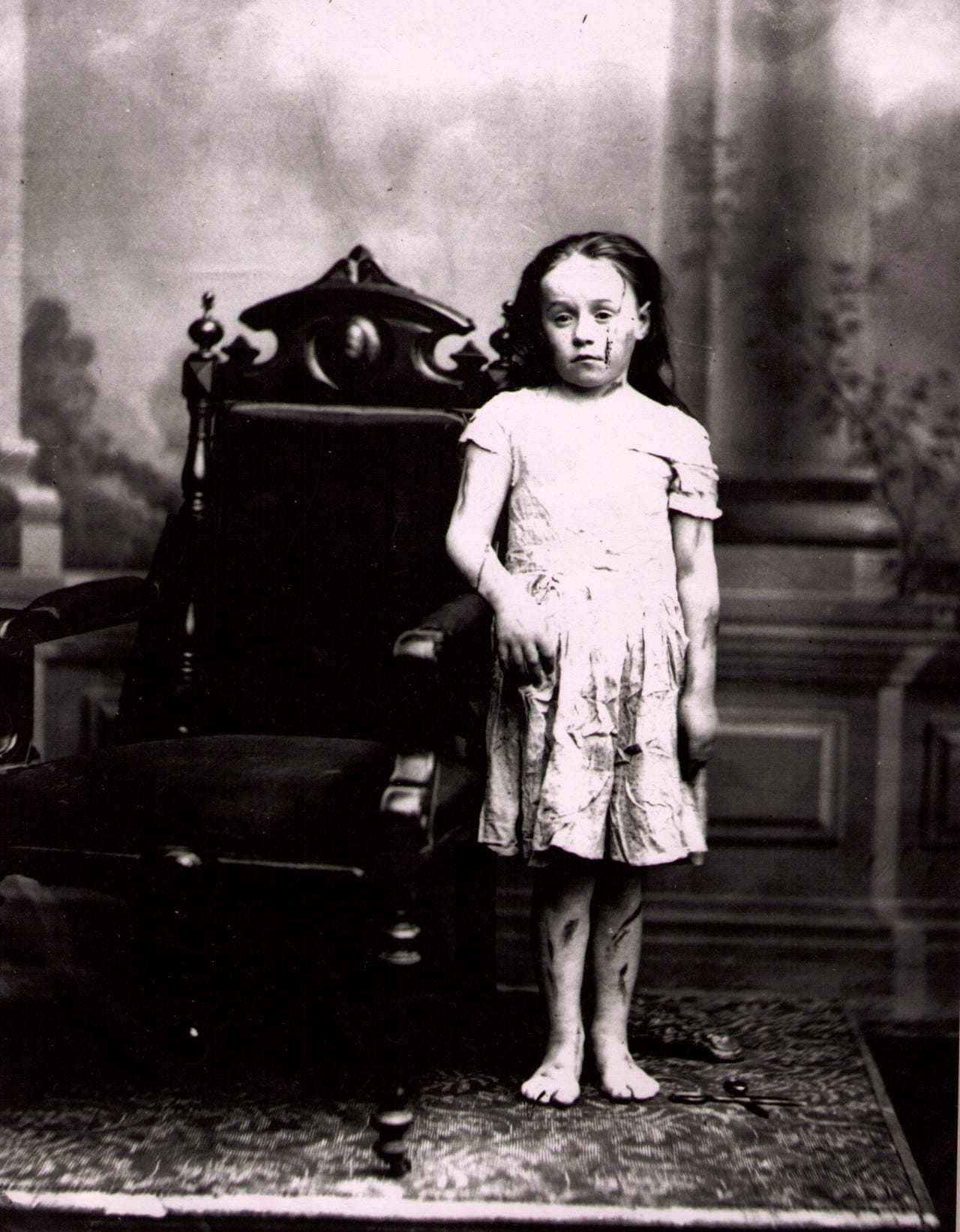
While under the care of Mary (McCormick) Connolly and her new husband, Mary Ellen would suffer severe abuse. She was made to sleep on a small cloth in the corner, had only one set of cloths, made to do strenuous labor, and beaten. In 1874[18] the neighbors suspected abuse and called Etta Angell Wheeler, a Methodist missionary who worked in the area. Ms. Wheeler checked in on the child and what she found was shocking. Ms. Wheeler contacted the police but due to the lack of child abuse laws on the books they were not able to do anything. So, Ms. Wheeler decided to contact Henry Bergh, who was an advocate for the animal humane movement and the founder of the American Society for the Prevention of Cruelty to Animals. Mr. Bergh was instrumental in getting Mary Ellen removed from the home and charges brought against Mrs. Connolly. During the trial shocking eyewitness testimony was given about the abuse,

Mary Ellen Wilson-McCormac in 1874. From: Markel, Howard. “Case Shined First Light on Abuse of Children.” The New York Times, December 14, 2009. https://www.nytimes.com/2009/12/15/health/15abus.html?ref=science.

“During the first week after the Connolly’s came there witness saw the cowhide lying on the table; it is like what a man uses when on horseback; it is about two and a half feet long; it has lashes (she doesn’t know how many) about the size of a finger, something like a cat-o-nine-tails; she used to hear Mrs. Connolly licking the child every morning “up and down, up and down” the room, the child crying “Oh, Mama! Mama!” all the time;”[19]

Mary Connolly was convicted of child abuse and sentenced to one-year imprisonment with hard labor.

Mary Ellen Wilson would live till the age of 91. Her case was the was the first documented case of child abuse in the United States. It also led to the founding of the New York Society for the Prevention of Cruelty to Children. It is amazing to think that out of so much tragedy good could come out of it. The events in this case were and continue to be instrumental in saving many more children.  


[1] “Wilson, Thomas (26) Page 1 New York Civil War Muster Roll Abstracts,” Fold3, accessed July 10, 2020, https://www.fold3.com/image/315769745.

[2] Eric A. Shelman and Stephen Lazoritz, The Mary Ellen Wilson Child Abuse Case and the Beginning of Children’s Rights in 19th Century America (Jefferson, NC: McFarland & Co., 2005). Pg. 20

[3] “Wilson, Thomas (26) Page 1 New York Civil War Muster Roll Abstracts,” Fold3, accessed July 10, 2020, https://www.fold3.com/image/315769745

[4] “Wilson, Thomas (27) Page 1 New York Civil War Muster Roll Abstracts,” Fold3, accessed July 10, 2020, https://www.fold3.com/image/315769764.

[5] Ibid

[6] Ibid

[7] Ibid

[8] Eric A. Shelman and Stephen Lazoritz, The Mary Ellen Wilson Child Abuse Case and the Beginning of Children’s Rights in 19th Century America (Jefferson, NC: McFarland & Co., 2005). Pg. 21

[9] Ibid, Pg. 22

[10] Ibid

[11] Ibid. Pg. 107

[12] Ibid. Pg. 23

[13] Ibid.

[14] Ibid. Pg.24

[15] Ibid. Pg. 23

[16]. Shelman, Eric A.; Lazoritz , Dr. Stephen. Case #1: The Mary Ellen Wilson Files (Kindle Location 575). Dolphin Moon Publishing. Kindle Edition.

[17] Ibid

[18] Shelman, Eric A.; Lazoritz , Dr. Stephen. Case #1: The Mary Ellen Wilson Files (Kindle Location 1896). Dolphin Moon Publishing. Kindle Edition.

[19] “Mary Ellen Wilson Further Testimony As To The Child’s Ill Treatment By Her Guardians,” New York Times, April 12, 1874, p. 12.

A Letter Speaks

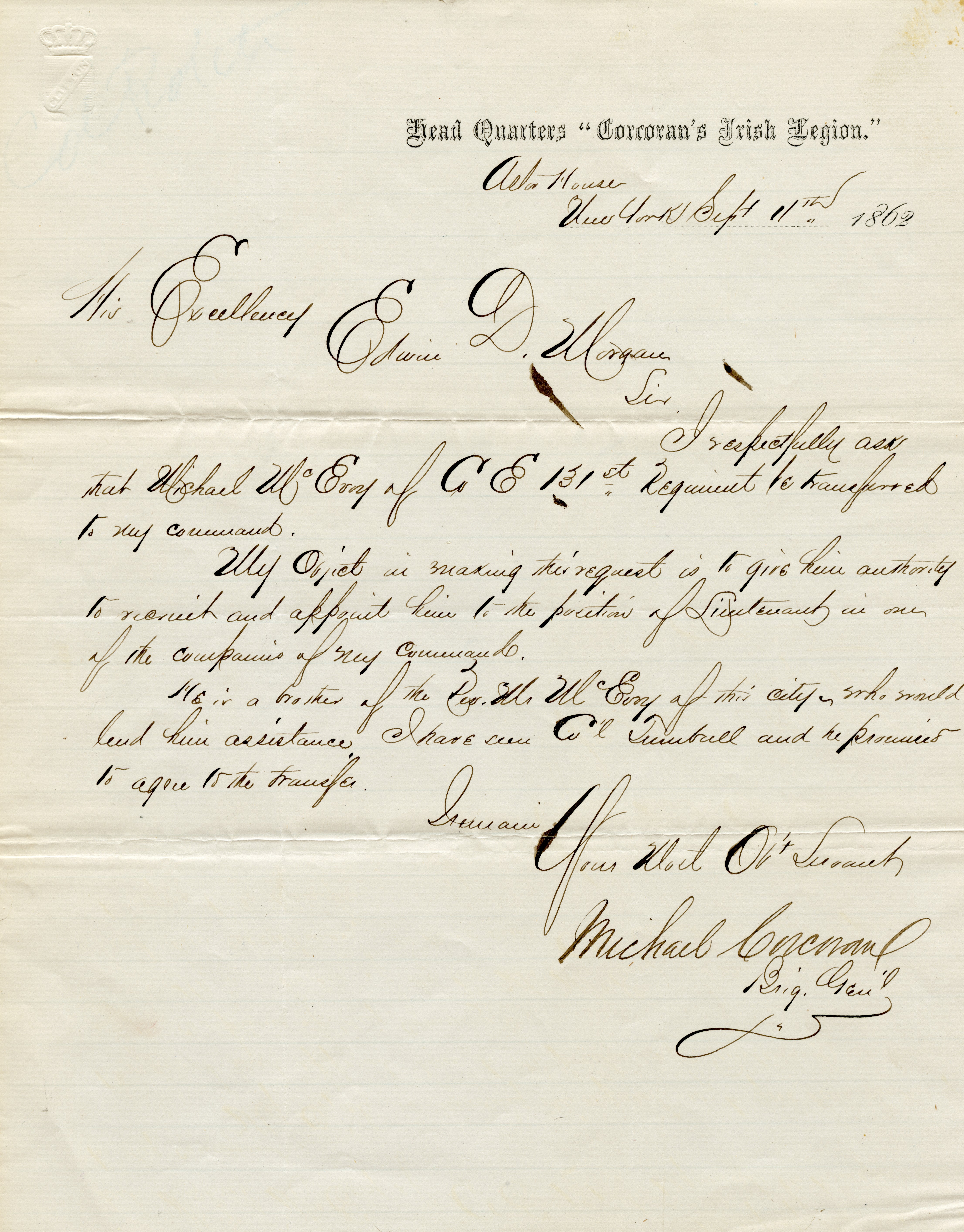
A letter to some is just a piece of paper with words on it. However when one digs deep they can find a hidden story. This letter is written and signed by Brigadier General Michael Corcoran. The letter’s recipient is then Governor of New York Edwin D. Morgan. In this post I am not going to just focus on the “big names” associated with the piece (We can all use Google for that). There is also the interesting tail of Michael McEvoy of Company E, 131st New York. So without further adieu may I present the The letter it reads……

“Sir,

I respectfully ask that Michael McEvoy of Company E, 131st Regiment be transferred to my command.

My object in making this request is to give him authority to recruit and appoint him to the position of Lieutenant in one of the companies of my command.

He is a brother of the Provost Marshal McEvoy of this city, who would lend his assistance. I have seen Colonel Turnbull and he promised to agree to the transfer.

I remain,

Your Most Obedient Servant,

Michael Corcoran

Brigadier General” [1]

Corcoran Letter, provided by The American Military Heritage Museum Of North Carolina
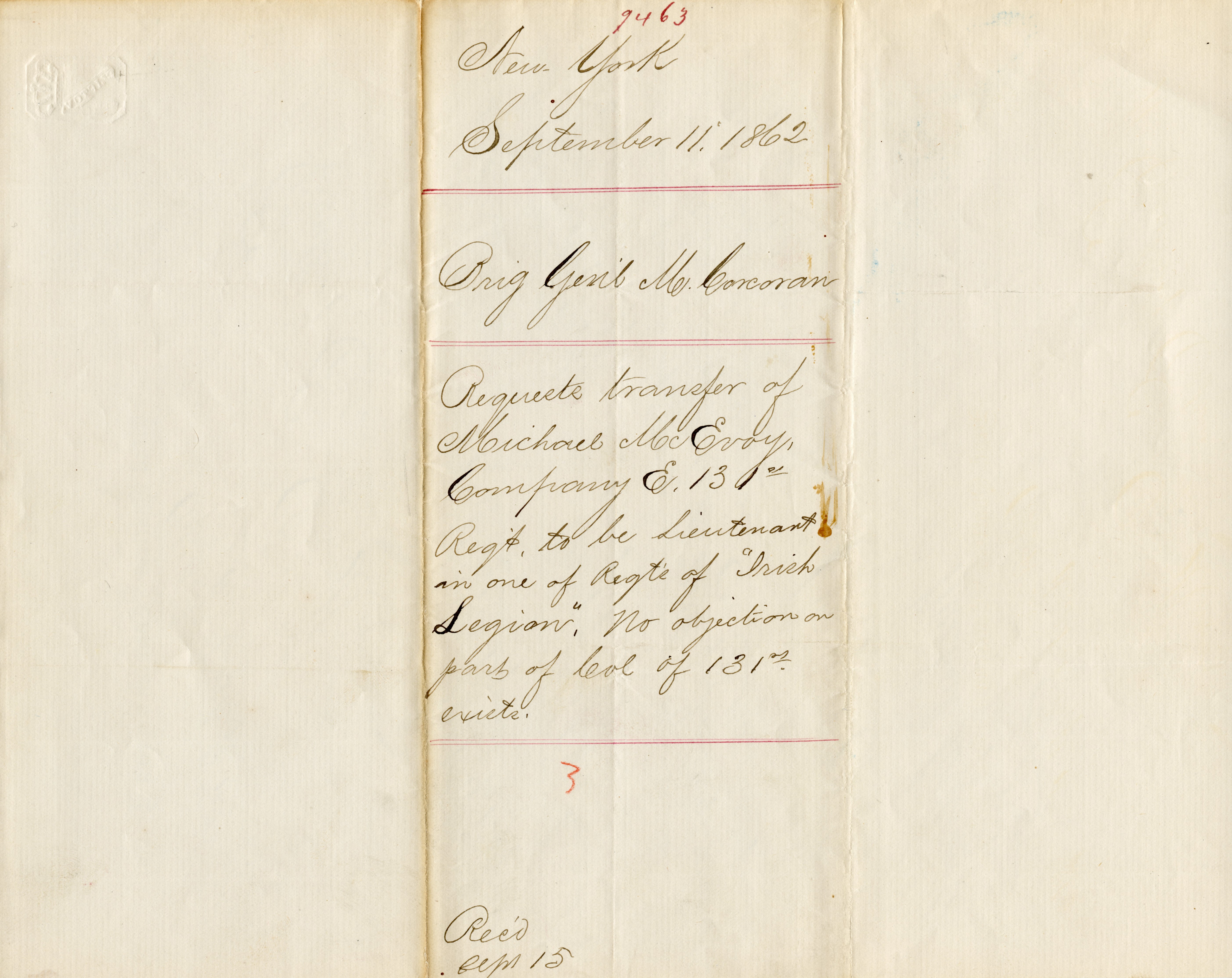
Back of the Corcoran Letter, provided by The American Military Heritage Museum Of North Carolina

Michael McEvoy was born in Ireland around 1828[2]. He was described as five feet nine inches tall, with blue eyes, light hair, and a light complexion.[3] McEvoy would immigrate to America prior to 1850. He was listed on the 1850 United States Federal Census as being a farmer, and married to Cath McEvoy, they had one child James.[4] McEvoy was employed as a Teamster, at the time of his enlistment in the Union army on August 13th, 1862.[5]

. He would be mustered into “E” Co 131st infantry as a private on September 6th.[6] Per General Corcoran’s request McEvoy would be transferred to “D” Co. 170th New York on September 19th, 1862.[7] He would be mustered in as a private on October 7th, 1862. Private McEvoy would participate in the battle of Deserted House. He would later be granted leave on March 21st, 1863, McEvoy would never return to service[8]. Private McEvoy would be listed as a deserter from camp at Suffolk Virginia on April 3rd, 1863.[9] That is where his trail ends for now.

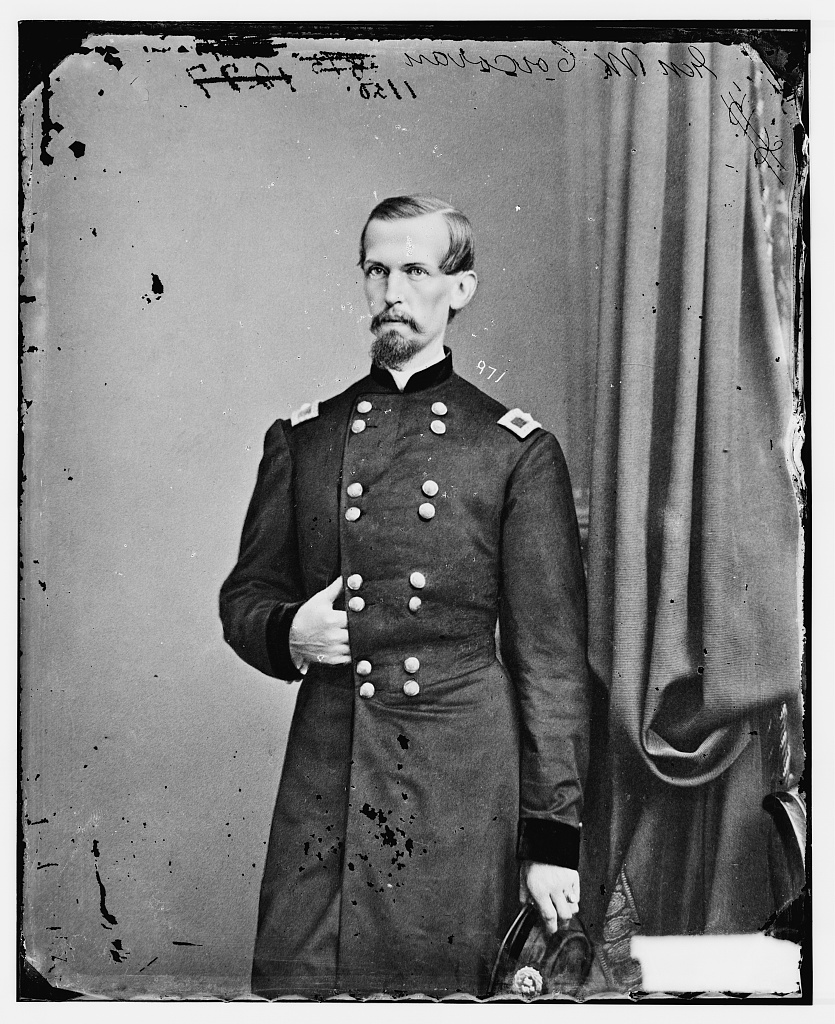
Michael Corcoran was born in Carrowkeel, county Sligo Ireland. He was a member of the Irish Nationalist Guerrilla force known as the Ribbonman. His ties to this group were eventually discovered in 1849, so he immigrated to New York City in order to avoid capture.[10] To gain a position in society Corcoran joined the 69th New York State Militia as a private. He would advance rapidly due to, “his military passion and his previous knowledge of military tactics were a great advantage to him.”[11] Corcoran moved up in rank and became a Colonel.  It was in this capacity that Corcoran became a hero to the Irish Nationalist, as well as the overall Irish immigrant population of New York. When he chose not to parade the 69th  in front of the Prince of Whales upon the Princes visit, saying that “as an Irishman he could not consistently parade Irish-born citizens in honor of the son of a sovereign, under whose rule Ireland was left a desert and her best sons exiled or banished.”[12] His action resulted in a court-martial. However, it was overturned due to the need of good officers to fight in the Civil War.


General Michael Corcoran, U.S.A. United States, None. [Between 1860 and 1865] Photograph. https://www.loc.gov/item/2018667330/.

Corcoran resumed his rank in the 69th New York and was present at that Battle of First Manassas, where he was captured. Corcoran spoke of this later by saying, “I did not surrender until I found myself after having successfully taken my regiment off the field, left with only seven men and surrounded by the enemy.”[13] Corcoran was eventually exchanged over a year later, and was received back with acclaim. He was given the rank of Brigadier General and put in command of his own troops, known as Corcoran’s “Irish Legion.” The first battle of the Legion took place during the Battle of Deserted House Virginia. Although not one of the biggest battles of the war, Corcoran demonstrated calmness under fire and his men showed how they admired Corcoran by following his every commanded under intense battle conditions. Sadly this would be Corcoran’s last major battle as he was killed later that year when he fell from his horse. Even though Corcoran’s life was cut short his legend and the Prince of Wales incident continued to inspire men, especially those of his Legion who were fighting for their adopted homes as well as Irish pride.

The National Governors Association has written this about Gov. Edwin D. Morgan.

“EDWIN D. MORGAN, the twenty-third governor of New York, was born in Washington, Massachusetts on February 8, 1811. His education was attained at the Bacon Academy in Colchester, Connecticut, where his family moved to in 1822. Morgan established a successful business career, with holdings in the banking and brokerage industries. He first entered politics in Connecticut, serving as a member of the Hartford city council, a position he held in 1832. After moving to New York, he served as alderman of New York City in 1849; was a member of the New York State Senate from 1850 to 1851; and served as the state immigration commissioner from 1855 to 1858. He also chaired the Republican National Committee from 1856 to 1864. Morgan next secured the Republican gubernatorial nomination, and was elected governor by a popular vote on November 2, 1858.

Edwin D. Morgan
. United States, None. [Between 1860 and 1870] Photograph. https://www.loc.gov/item/2018669639/.

He was reelected to a second term in 1860. During his tenure, the state’s canal system was advanced; Vassar College was founded; and volunteers were raised and equipped for service in the Civil War. Morgan also served as major general of volunteers during the war, as well as serving as the commander for the Department of New York. After leaving the governorship, Morgan was elected to the U.S. Senate, an office he held from 1863 to 1869. From 1872 to 1876 he chaired the Republican National Committee; and in 1881 he turned down an appointment to serve as U.S. secretary of treasury. Governor Edwin D. Morgan passed away on February 14, 1883, and was buried in the Cedar Hill Cemetery in Hartford, Connecticut.” [14]

Although these three men are from completely different backgrounds, their stories intersect in this one document. Historical stories are everywhere, you just need to dig under the surface to find them.


[1] Corcoran, Michael. Letter to Gov. Edwin D, Morgan. “Brigadier General Michael Corcoran Request For Michael McEvoy.” New York, New York: Astor House, September 11, 1862.

[2] “Page 1 New York Civil War Muster Roll Abstracts McEvoy, Michael.” Fold3. Accessed December 31, 2022. https://www.fold3.com/image/315981459.

[3] Ibid

[4] “Michael McEvoy in the 1850 United States Federal Census.” Ancestry. Accessed December 31, 2022. https://www.ancestry.com/discoveryui-content/view/7008512:8054?tid=&pid=&queryId=6a9bb6ca9453a20b805c27f011dfac83&_phsrc=csG312&_phstart=successSource.

[5] Page 1 New York Civil War Muster Roll Abstracts McEvoy, Michael.” Fold3. Accessed December 31, 2022. https://www.fold3.com/image/315981459

[6] Ibid

[7] “Page 1 New York Civil War Muster Roll Abstracts Michael McEvoy.” Fold3. Accessed December 31, 2022. https://www.fold3.com/image/316135643.

[8] Ibid

[9] Ibid

[10] Pritchard, Russ A. The Irish Brigade : a Pictorial History of the Famed Civil War Fighters. (Philadelphia,

[11] Conyngham, The Irish Brigade and It’s Campaigns , 537

[12] Ibid 

[13] Ibid, 538

[13] Shiels, Damian. Irish in the American Civil War Exploring Irish involvement in the American Civil War . March 18, 2012. http://irishamericancivilwar.com/2012/03/18/baptism-of-fire-the-corcoran-legion-at-deserted-house-virginia-30th-january-1863/ (accessed 11 20, 2013).

[14] Sobel, Robert, and John Raimo. “Edwin Denison Morgan.” National Governors Association. Accessed November 3, 2023. https://www.nga.org/governor/edwin-denison-morgan/.

An Artifact Speaks

I feel every artifact has a story. This identification shield worn by Sergeant Thomas Wood (Woods) is no exception. Sgt. Woods was a member of Company “B”, 69th New York National Guard. This unit would later become the 182nd New York Infantry, part of Corcoran’s Irish Legion.

 Identification shield worn by Sergeant Thomas Wood (Woods). Provided by The American Military Heritage Museum Of North Carolina.
Identification shield worn by Sergeant Thomas Wood (Woods). Provided by The American Military Heritage Museum Of North Carolina.

Woods was born in Ireland around 1827[1] and arrived in the United States prior to 1850.[2] He married Margaret Begnan at St. James Roman Catholic Church in Manhattan on October 13, 1850.[3] By 1860 he was making a living as a butcher. He and his wife, along with their two children Patrick and Elizabeth, resided in the 18th Ward of Lower Manhattan.[4]  In November of 1861 Thomas and Margaret would have another child, Thomas Frances.[5]

As the American Civil War unfolded, Woods made the decision to enlist. On September 18, 1862, Woods enlisted in the 69th New York National Guard.[6]  On November 17, 1862, he was officially mustered in as a Sgt. in “B” Co. 69th N.Y.N.G. This regiment was organized by Col. Mathew Murphy as the first regiment of the Corcoran Brigade, also known as Corcoran’s Irish Legion.  The regiment left New York state on November 10, 1862, to serve at Newport News, VA. The unit first served in Corcoran’s Brigade, part of Peck’s Division, Department of Virginia. Then in December 1862 at Suffolk, as part of Murphy’s Brigade, Corcoran’s Division.[7] Sgt. Woods and the 69th N.Y.N.G spent most of their time guarding Federal naval yards at Portsmouth and Norfolk.

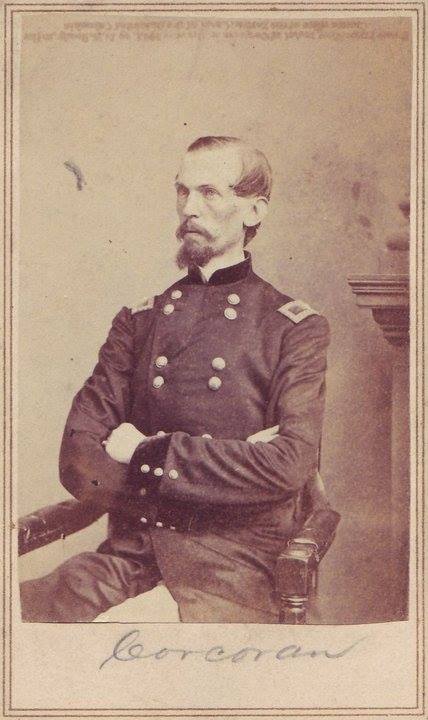
In January of 1863 Confederate Brigadier-General Roger Atkinson Pryor would move 1,800[8] men towards Suffolk, VA. His hope was to disturb Union activity in the region.  Early in the morning of January 30[9] Brigadier-General Corcoran ordered his men to march in the direction of the enemy.

Carte-de-visite of Michael Corcoran Provided by The American Military Heritage Museum Of North Carolina.

The men of the 69th N.Y.N.G were both anxious and eager to see their first combat. Their energy led them to be boisterous and the men had to be ordered to keep quiet, as to not alert the confederate soldiers that were in close proximity. Sgt. Wood and the men of Co. “B” slogged through the mud for nine miles before reaching the enemy.  Brigadier General Corcoran first sent in his cavalry and artillery, who took heavy fire. Corcoran than ordered the 167th Pennsylvania into the fight. However, they were in a shambles due to the wounding of their commander. It was time for Sgt. Woods and the men of the 69th N.Y.N.G to see the elephant. They advanced through the blackness of the early morning….

This magnificent map of The Battle of Deserted House is the property of Baylor University. The image is reprinted with permission from the War of the Rebellion Atlas digital collection. It was produced by the US Government.

“Moving into a gully near the unfortunate 167th Pennsylvania, the Legion came into range of the Confederate artillery, and were ordered to lie down. Trees and houses were ripped apart during the ferocious barrage that followed…. In defense of the Pennsylvanians, the fire under which they had been exposed was extremely heavy, as the Legion were finding out. A piece of spiraling shrapnel struck the canteen of the 69th’s Captain Michael Kelly, carrying away his elbow. 30-year-old Sergeant Thomas Woods took a shell fragment in the stomach, killing him.”[10]

This action would be known as “Deserted House.” It was the first combat for the 69th N.Y.N.G but the last that poor Sgt. Woods would see.

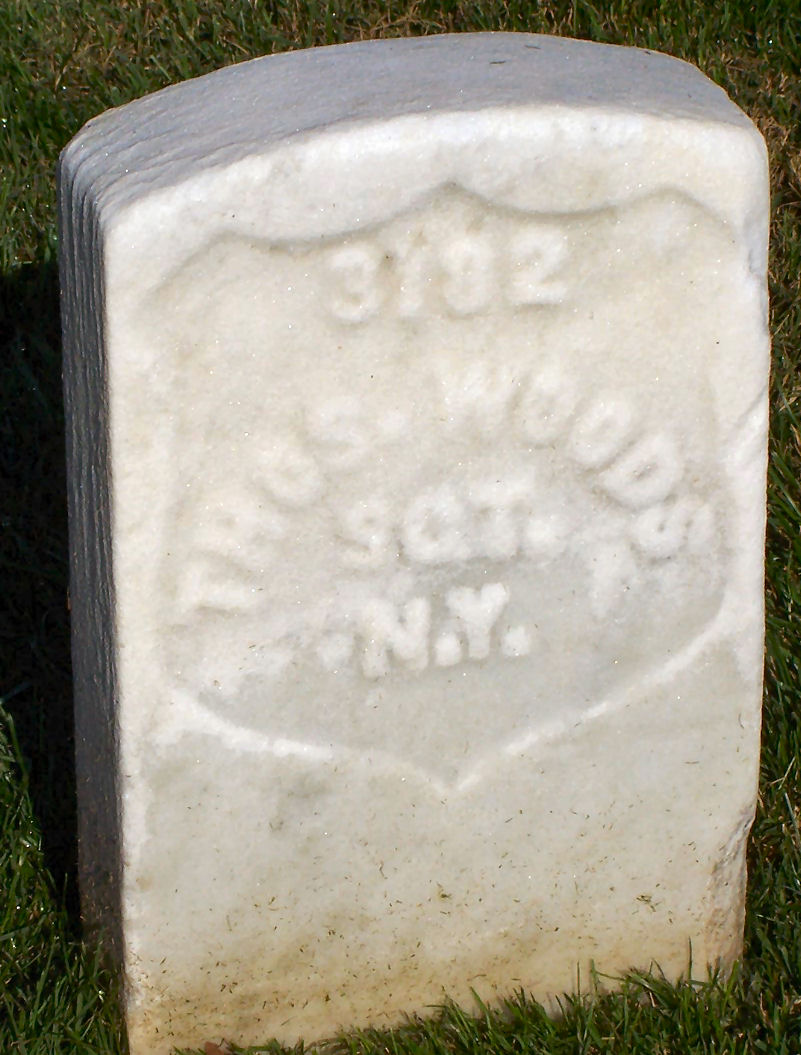
Sgt. Woods now rests in Hampton National Cemetery in section D number 3182.[11]

Photo by Dawn Bilik (prev. Stewart)
Grave of Sgt. Thomas Wood Photo by Dawn Bilik (prev. Stewart)

Margaret would apply for a widow’s pension for her and the three children on March 19, 1863.[12] She would receive a pension of $8.00 a month, which is about $108[13] in today’s money. Sadly, Margaret would die on July 4, 1864.[14] The children and the pension were then transferred to the custody of Mary Ann Grimes.

Let us never forget the sacrifice of Sgt. Woods and his family for their adopted country.


[1] “1860 United States Federal Census for Thomas Woods.” Ancestry. Accessed October 6, 2022. https://tinyurl.com/mr39du7m.

[2] “Thomas Woods Page 5 Civil War ‘Widows’ Pensions.’” Fold3. Accessed October 6, 2022. https://www.fold3.com/image/270483669.

[3] Ibid

[4] “1860 United States Federal Census for Thomas Woods.” Ancestry. Accessed October 6, 2022. https://tinyurl.com/mr39du7m.

[5] “Thomas Woods Page 11 Civil War ‘Widows’ Pensions.’” Fold3. Accessed October 6, 2022. https://www.fold3.com/image/270483681.

[6] “Thomas Woods Page 1 New York Civil War Muster Roll Abstracts.” Fold3. Accessed October 6, 2022. https://www.fold3.com/image/316281613.

[7] “New York State Military Museum and Veterans Research Center.” 182nd Infantry Regiment :: New York State Military Museum and Veterans Research Center. Accessed October 6, 2022. https://museum.dmna.ny.gov/unit-history/infantry-2/182nd-infantry-regiment.

[8] Shiels, Damian. “Baptism of Fire: The Corcoran Legion at Deserted House, Virginia, 30th January 1863.” Irish in the American Civil War, March 25, 2020. https://irishamericancivilwar.com/2012/03/18/baptism-of-fire-the-corcoran-legion-at-deserted-house-virginia-30th-january-1863/.

[9] Ibid

[10] Ibid

[11] “Thomas Woods (Unknown-1863) – Find a Grave…” Find a Grave. Accessed October 6, 2022. https://www.findagrave.com/memorial/3097387/thomas-woods.

[12] “Thomas Wood Page 21 Civil War ‘Widows’ Pensions.’” Fold3. Accessed October 6, 2022. https://www.fold3.com/image/270483701.

[13] “Inflation Rate between 1863-2022: Inflation Calculator.” $8 in 1863 → 2022 | Inflation Calculator. Accessed October 6, 2022. https://www.in2013dollars.com/us/inflation/1863?amount=8.

[14] “Thomas Woods Page 2 Civil War ‘Widows’ Pensions.’” Fold3. Accessed October 6, 2022. https://www.fold3.com/image/270483662.